Rational Numbers — Practice Quiz
Gujarat Board · Class 8 · Mathematics
Try a 4-question quiz on Rational Numbers for Gujarat Board Class 8 Mathematics: tap an answer to check it and see why.
Interactive on Super Tutor
Studying Rational Numbers? Get the full interactive chapter.
Quizzes, flashcards, AI doubt-solver and a step-by-step study plan — built for practice quiz and more.
Free trial, no card needed.
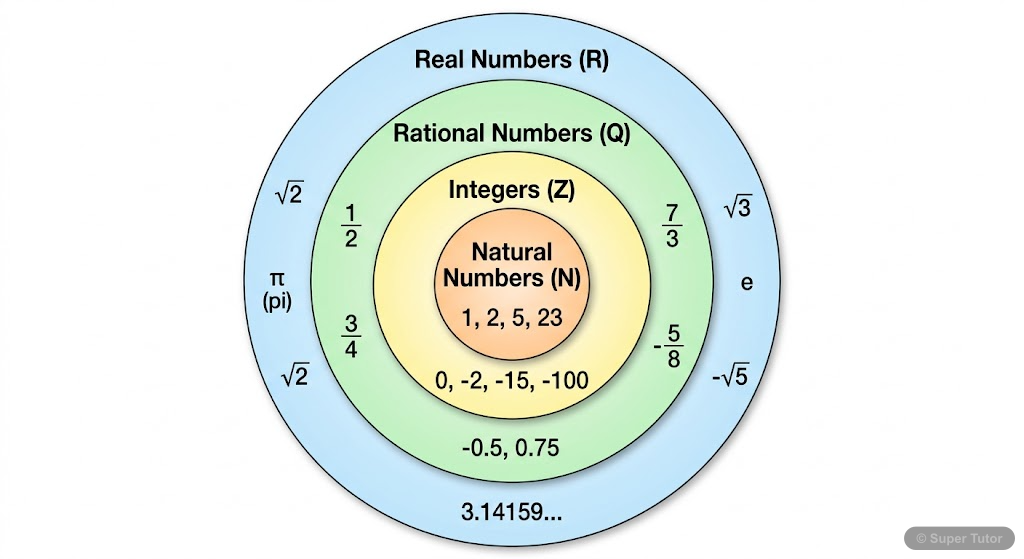
Learn better with visuals Super Tutor pairs illustrations like this with notes and quizzes for Rational Numbers.
Quick Quiz: Rational Numbers
0/4Tap an answer to check it instantly. No sign-up needed for these 4.
Which of the following is the correct result of (-3/4) + (5/8)?
What is the value of (-2/5) × (15/4)?
Which property is used when we write (3/7) × ((-2/5) × (4/3)) = ((3/7) × (-2/5)) × (4/3)?
Find: (4/9) ÷ (-2/3)
Sample Questions
Using distributivity, find: (3/5) × (2/7) + (3/5) × (5/7)
Show answer
3/5
Step 1: Notice that 3/5 is a common factor in both terms. Use the Distributive Property: a×b + a×c = a×(b+c). Step 2: (3/5)×(2/7) + (3/5)×(5/7) = (3/5) × (2/7 + 5/7). Step 3: Add the fractions inside the bracket: 2/7 + 5/7 = 7/7 = 1. Step 4: (3/5) × 1 = 3/5. The answer is 3/5. Using distributivity makes the calculation much simpler!
Which of the following statements is true about rational numbers?
Show answer
Rational numbers are closed under division by non-zero rational numbers
Step 1: Let us check each option. Closure means the result of an operation on two numbers from the set stays within the set. Step 2: For multiplication: (p/q) × (r/s) = pr/qs, which is always a rational number. So rational numbers ARE closed under multiplication. Step 3: For subtraction: (p/q) - (r/s) = (ps-rq)/qs, which is always rational. So they ARE closed under subtraction too. Step 4: For division: dividing by zero is undefined. But if we divide any rational number by a non-zero rational number, the result is always a rational number. So Option A is correct.
What is the additive inverse of -7/11?
Show answer
7/11
Step 1: The additive inverse of a number is the number that when added to it gives 0. Step 2: We need a number x such that (-7/11) + x = 0. Step 3: Solving: x = 0 - (-7/11) = 7/11. Step 4: Check: (-7/11) + (7/11) = 0/11 = 0. Correct! The additive inverse is 7/11. Common mistake: Students confuse additive inverse with multiplicative inverse (reciprocal). Multiplicative inverse of -7/11 would be -11/7.
Simplify: (1/2) × [(-1/4) + (3/8)]
Show answer
1/16
Step 1: First solve the expression inside the brackets. Find LCM of 4 and 8, which is 8. Step 2: Convert -1/4 to -2/8. Now add: -2/8 + 3/8 = 1/8. Step 3: Now multiply: (1/2) × (1/8) = 1/16. Step 4: The answer is 1/16. Always follow BODMAS - solve brackets first, then multiplication. Common mistake: Students sometimes multiply before solving the bracket.
+41 more questions on Rational Numbers (Gujarat Board Class 8 Mathematics)
Practise AllFrequently Asked Questions
What are the important topics in Rational Numbers for Gujarat Board Class 8 Mathematics?
How many practice questions are there for Rational Numbers?
Sources & Official References
Content is aligned to the official syllabus. Refer to the board website for the latest curriculum.
More resources for Rational Numbers
For serious students
Get the full Rational Numbers chapter — start free.
Quizzes, flashcards, an AI doubt solver and a study plan for Gujarat Board Class 8 Mathematics. Free to start, no card needed.