Chapter 15 of 18
NCERT Solutions

The Necklace

Haryana Board · Class 10 · English

NCERT Solutions for The Necklace — Haryana Board Class 10 English.

51 questions20 flashcards5 concepts

Interactive on Super Tutor

Studying The Necklace? Get the full interactive chapter.

Quizzes, flashcards, AI doubt-solver and a step-by-step study plan — built for ncert solutions and more.

1,000+ Class 10 students started this chapter today

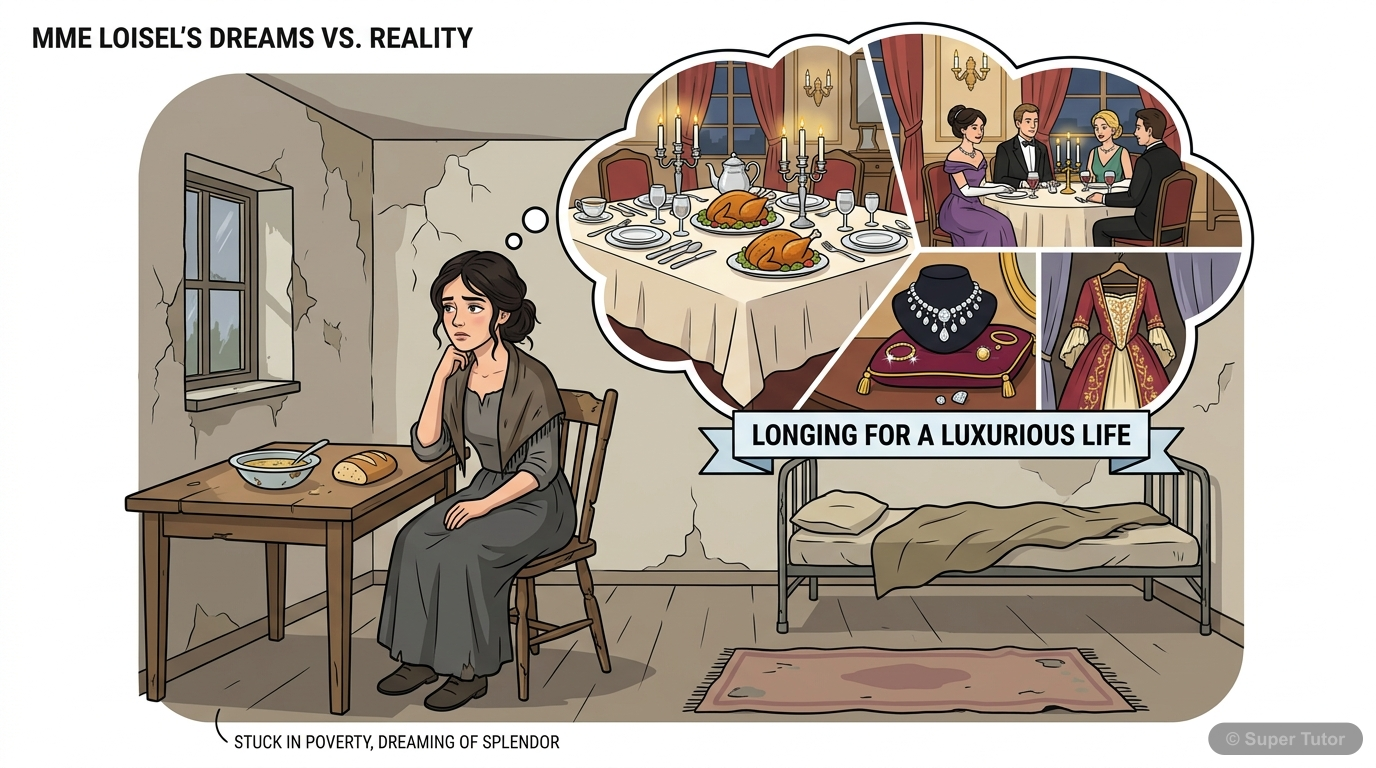
An illustration depicting Mme Loisel's initial character: pretty but perpetually unhappy due to her perceived lack of luxury and social status, contrasting her humble reality with her extravagant desi
Super Tutor

Super Tutor has 7+ illustrations like this for The Necklace alone — flashcards, concept maps, and step-by-step visuals.

See them all
7 Questions Solved · 2 Sections

Think about it

1The course of the Loisels' life changed due to the necklace. Comment.Show solution
Given / Context: Matilda Loisel borrowed a diamond necklace from her friend Mme Forestier to wear at a grand ball. After the party she discovered the necklace was lost.

Answer:

The necklace proved to be the turning point that completely altered the Loisels' life — for the worse.

Before the loss: The Loisels were a lower-middle-class couple. M. Loisel was a petty clerk and, though they were not wealthy, they managed a modest, stable life.

After the loss: In order to replace the lost necklace, the Loisels had to buy a new diamond necklace worth thirty-six thousand francs. To raise this enormous sum they:
- Exhausted M. Loisel's entire inheritance of eighteen thousand francs.
- Borrowed the remaining amount from money-lenders (usurers) at ruinous rates of interest.

Consequences they suffered:
- They dismissed their servant and moved into a cheaper attic.
- Matilda gave up all the comforts of her life and did the heavy household work herself — washing dishes, carrying water, scrubbing floors, and doing the laundry.
- M. Loisel worked evenings doing accounts and odd jobs.
- It took them ten long years of grinding poverty and hard labour to repay the debt.
- By the end, Matilda had become old, rough-handed, and haggard — a shadow of her former self.

Irony: At the end of the story it is revealed that the original necklace was only an imitation worth at most five hundred francs. Thus, the Loisels ruined their lives over a piece of costume jewellery.

Conclusion: A single moment of carelessness and, more importantly, the decision to hide the truth rather than confess it, changed the entire course of the Loisels' life from one of modest comfort to one of extreme hardship and poverty.
2What was the cause of Matilda's ruin? How could she have avoided it?Show solution
Given / Context: Matilda Loisel lost the borrowed necklace and, instead of confessing the truth to Mme Forestier, replaced it with an expensive real diamond necklace, plunging herself and her husband into ten years of debt and poverty.

Causes of Matilda's ruin:

1. Excessive vanity and discontent: Matilda was never satisfied with what she had. She constantly dreamed of wealth, luxury, and social status far beyond her means. This dissatisfaction made her desperate to appear rich at the ball.

2. Dishonesty / lack of courage to confess: The most direct cause of her ruin was her decision NOT to tell Mme Forestier the truth about losing the necklace. Had she confessed immediately, the problem could have been resolved easily (as the ending reveals — the original was a fake worth only ₹500 francs).

3. Hasty decision: Instead of calmly thinking through her options, she and her husband rushed into borrowing a huge sum of money to buy a real diamond necklace as a replacement.

How she could have avoided it:

- By being honest: She should have gone to Mme Forestier immediately and confessed that the necklace was lost. A true friend would have understood, and the truth would have come out that the necklace was only an imitation.
- By being content: If she had not been so obsessed with showing off wealth she did not possess, she would not have borrowed the necklace in the first place.
- By verifying the value: Before spending a fortune on a replacement, she could have asked Mme Forestier about the value of the original necklace.

Conclusion: Matilda's ruin was caused by her pride, vanity, and dishonesty. A simple, honest conversation with her friend would have saved her and her husband from ten years of misery.
3What would have happened to Matilda if she had confessed to her friend that she had lost her necklace?Show solution
Given / Context: Matilda lost the diamond necklace she had borrowed from Mme Forestier and chose to replace it secretly rather than confess the loss.

What would have happened had she confessed:

If Matilda had gone to Mme Forestier and honestly told her that the necklace was lost, the most likely outcome — as the story's ending strongly suggests — would have been:

1. The truth about the necklace would have been revealed: Mme Forestier would have told Matilda (just as she did at the very end of the story) that the necklace was only a piece of imitation jewellery worth at most five hundred francs — not thirty-six thousand francs.

2. No financial ruin: Matilda would have had to pay only five hundred francs or a similarly small amount to replace the fake necklace. This was well within manageable limits and would not have required borrowing from money-lenders.

3. No ten years of hardship: The Loisels would have continued their modest but stable life. Matilda would not have had to do years of back-breaking labour, and she would not have aged prematurely.

4. Possible embarrassment, but nothing more: There might have been a moment of awkwardness or embarrassment between the two friends, but a genuine friendship could have survived that.

Conclusion: Confessing the truth would have saved Matilda from complete ruin. The story thus powerfully conveys the moral that honesty is always the better — and wiser — choice, no matter how difficult it seems in the moment.
4If you were caught in a situation like this, how would you have dealt with it?Show solution
Note: This is a personal/opinion-based question. The following is a model answer suitable for a board examination.

My approach:

If I were caught in a situation like Matilda's — having lost something valuable that I had borrowed — I would deal with it in the following way:

1. Stay calm and search thoroughly: First, I would retrace my steps and search carefully for the lost item before concluding that it was truly gone.

2. Be honest and confess immediately: I would go to my friend as soon as possible and honestly tell her what had happened. I believe that honesty, even when it is difficult and embarrassing, is always the right course of action. Hiding the truth only makes matters worse, as Matilda's story clearly shows.

3. Offer to make amends: I would apologise sincerely and offer to replace the item or compensate my friend for its value — but only after finding out its actual worth, so as not to make the mistake Matilda made.

4. Seek help if needed: If the cost of replacement was beyond my means, I would discuss the situation openly with my parents or trusted elders and find a practical, honest solution together.

Why this is better than Matilda's choice:
Matilda's decision to hide the truth led to ten years of poverty and suffering. A moment of honesty and courage, though uncomfortable, would have resolved the problem quickly and preserved both her friendship and her quality of life.

Conclusion: I strongly believe in the principle that *honesty is the best policy*. Facing a difficult truth bravely is always better than living with the consequences of a lie or a cover-up.

Talk about it

1The characters in this story speak in English. Do you think this is their language? What clues are there in the story about the language its characters must be speaking in?Show solution
Answer:

No, English is clearly not the original language of the characters in this story. The story has been translated into English from its original language, which is French.

Clues in the story that indicate the characters were originally speaking French:

1. Names of the characters: The characters have distinctly French names — *Matilda Loisel*, *Mme (Madame) Forestier*, *M. (Monsieur) Loisel*. These are French forms of address and French surnames.

2. Abbreviations 'M.' and 'Mme': As noted in the glossary, 'M.' stands for 'Monsieur' and 'Mme' stands for 'Madame' — both French titles.

3. Currency — 'francs' and 'sous': The characters deal in *francs* and *sous*, which are French coins/currency, not English ones.

4. Setting — Paris, France: The story is set in Paris. References to French social life, the Ministry, and Parisian culture all point to a French-speaking setting.

5. The author: The story is written by Guy de Maupassant, a celebrated French author. It was originally written in French and has been translated into English for this textbook.

Conclusion: The characters in the story were originally speaking French. The English version we read is a translation, which is why the names, currency, and cultural references all remain distinctly French.
2Honesty is the best policy.Show solution
Note: This is a discussion topic. The following is a model answer/speech suitable for a classroom discussion or written response.

'Honesty is the best policy' — Discussion

The story 'The Necklace' by Guy de Maupassant is a powerful illustration of why honesty is indeed the best policy.

Argument in favour of the statement:

Matilda Loisel's entire tragedy stemmed from a single act of dishonesty — she chose not to tell her friend Mme Forestier that she had lost the borrowed necklace. This one decision to hide the truth cost her and her husband ten years of extreme poverty, hard labour, and suffering. Had she been honest, she would have discovered that the necklace was a mere imitation worth only five hundred francs, and her life would have continued normally.

Honesty, even when it is difficult or embarrassing, saves us from far greater problems in the long run. When we are honest:
- We avoid the stress and burden of maintaining a lie.
- We preserve our relationships and self-respect.
- We find practical solutions to problems more quickly.
- We do not risk the far worse consequences that come when the truth eventually surfaces.

Real-life relevance:
In everyday life too — whether in school, at home, or in society — honesty builds trust, strengthens relationships, and gives us peace of mind. A person known for honesty is respected and trusted by all.

Conclusion:
The story of Matilda is a timeless lesson. The short-term discomfort of admitting a mistake is always far less painful than the long-term consequences of concealing it. Honesty truly is the best policy.
3We should be content with what life gives us.Show solution
Note: This is a discussion topic. The following is a model answer suitable for a classroom discussion or written response.

'We should be content with what life gives us' — Discussion

The story 'The Necklace' strongly supports the idea that contentment is a great virtue and that excessive desire for what we do not have can lead to our downfall.

How the story illustrates this theme:

Matilda Loisel was a pretty young woman married to a decent, hardworking clerk. Though not rich, she had a comfortable home, a caring husband, and a stable life. However, she was never content. She constantly dreamed of grand mansions, expensive jewels, fine food, and high society. This discontentment made her:
- Ungrateful for what she had.
- Desperate to appear wealthy at the ball.
- Willing to borrow a necklace to show off a status she did not possess.

This desire to appear what she was not ultimately led to the loss of the necklace and ten years of ruin.

Balanced view:
While the story clearly advocates contentment, it is also important to distinguish between healthy ambition (working hard to genuinely improve one's life) and vain dissatisfaction (craving luxury and status for the sake of appearances). Matilda's problem was not that she wanted a better life — it was that she was consumed by vanity and was unwilling to be honest about her circumstances.

Conclusion:
Contentment does not mean we should stop striving to improve ourselves. It means we should appreciate what we have, live within our means, and not let envy or vanity drive us to dishonesty or recklessness. As the story shows, the inability to be content with one's life can have devastating consequences.

Stuck on a step?

Ask Super Tutor AI to explain any solution on this page in a simpler way — free, 24x7.

Ask a Doubt Free

Frequently Asked Questions

What are the important topics in The Necklace for Haryana Board Class 10 English?
The Necklace covers several key topics that are frequently asked in Haryana Board Class 10 board exams. Focus on the core concepts listed on this page and practise related questions to build confidence.
How to score full marks in The Necklace — Haryana Board Class 10 English?
Understand the core concepts first, then work through the 51 practice questions available for this chapter. Revise formulas and definitions regularly, and use flashcards for quick recall before the exam.
Where can I get free NCERT Solutions for The Necklace Class 10 English?
This page has free step-by-step NCERT Solutions for every exercise question in The Necklace (Haryana Board Class 10 English) — written the way examiners award marks: given, formula, working, answer.

Sources & Official References

Content is aligned to the official syllabus. Refer to the board website for the latest curriculum.

For serious students

Get the full The Necklace chapter — for free.

Quizzes, flashcards, AI doubt-solver and a step-by-step study plan for Haryana Board Class 10 English.