Probability — NCERT Solutions
Haryana Board · Class 10 · Mathematics
NCERT Solutions for Probability, Haryana Board Class 10 Mathematics: 25 textbook questions solved step by step. Covers Exercise 14.1.
Interactive on Super Tutor
Studying Probability? Get the full interactive chapter.
Quizzes, flashcards, AI doubt-solver and a step-by-step study plan — built for NCERT solutions and more.
Free trial, no card needed.
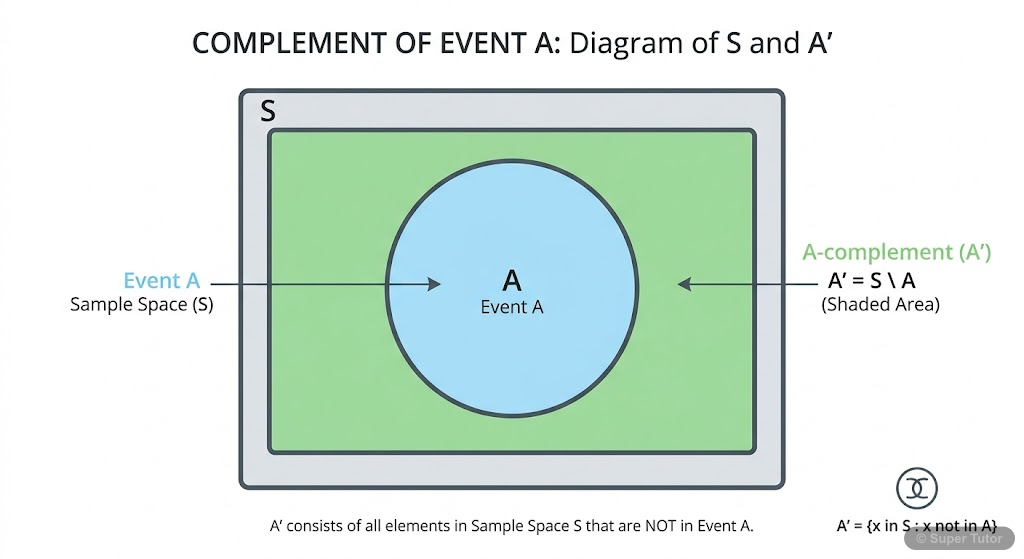
One of 7 illustrations for Probability in Super Tutor — alongside flashcards, concept maps and practice questions.
The first 13 solutions are open to read. The other 12 are free with a Super Tutor account.
Exercise 14.1
1Complete the following statements:
(i) Probability of an event E + Probability of the event 'not E' = ______.
(ii) The probability of an event that cannot happen is ______ . Such an event is called ______.
(iii) The probability of an event that is certain to happen is ______ . Such an event is called ______.
(iv) The sum of the probabilities of all the elementary events of an experiment is ______.
(v) The probability of an event is greater than or equal to ______ and less than or equal to ______.Show solution
(i) 1
(ii) 0; such an event is called an impossible event.
(iii) 1; such an event is called a sure event or certain event.
(iv) 1
(v) greater than or equal to 0 and less than or equal to 1.
2Which of the following experiments have equally likely outcomes? Explain.
(i) A driver attempts to start a car. The car starts or does not start.
(ii) A player attempts to shoot a basketball. She/he shoots or misses the shot.
(iii) A trial is made to answer a true-false question. The answer is right or wrong.
(iv) A baby is born. It is a boy or a girl.Show solution
None of these experiments is guaranteed in the chapter to have equally likely outcomes.
- (i) A car may or may not start; these outcomes are not necessarily equally likely.
- (ii) A basketball player may score or miss; these are not equally likely in general.
- (iii) A true-false question has right or wrong as outcomes, but they are not necessarily equally likely.
- (iv) A baby being a boy or a girl is not treated here as equally likely for probability calculations.
So, none of the four experiments has equally likely outcomes in the sense required for the theoretical probability used in this chapter.
3Why is tossing a coin considered to be a fair way of deciding which team should get the ball at the beginning of a football game?Show solution
Tossing a coin is considered fair because the coin is assumed to be unbiased and the toss is random. So the two outcomes, head and tail, are equally likely. Therefore, neither team has an advantage, and the result is fair.
4Which of the following cannot be the probability of an event?
(A) (B) -1.5 (C) 15% (D) 0.7Show solution
The probability of an event must satisfy .
- is valid.
- is not valid because probability cannot be negative.
- is valid.
- is valid.
So the value that cannot be a probability is -1.5.
5If P(E) = 0.05, what is the probability of 'not E'?Show solution
For complementary events,
Given ,
6A bag contains lemon flavoured candies only. Malini takes out one candy without looking into the bag. What is the probability that she takes out
(i) an orange flavoured candy?
(ii) a lemon flavoured candy?Show solution
The bag contains only lemon-flavoured candies.
(i) An orange flavoured candy cannot be taken out, so the probability is
(ii) A lemon flavoured candy is certain to be taken out, so the probability is
7It is given that in a group of 3 students, the probability of 2 students not having the same birthday is 0.992. What is the probability that the 2 students have the same birthday?Show solution
If the probability that the 2 students do not have the same birthday is , then the probability that they have the same birthday is the complement:
8A bag contains 3 red balls and 5 black balls. A ball is drawn at random from the bag. What is the probability that the ball drawn is (i) red ? (ii) not red?Show solution
Total balls .
(i) Probability of red:
(ii) Probability of not red means probability of a black ball:
9A box contains 5 red marbles, 8 white marbles and 4 green marbles. One marble is taken out of the box at random. What is the probability that the marble taken out will be (i) red ? (ii) white ? (iii) not green?Show solution
Total marbles .
(i) Red marbles ,
(ii) White marbles ,
(iii) Not green means red or white, so favourable marbles ,
10A piggy bank contains hundred 50p coins, fifty ₹ 1 coins, twenty ₹ 2 coins and ten ₹ 5 coins. If it is equally likely that one of the coins will fall out when the bank is turned upside down, what is the probability that the coin (i) will be a 50 p coin ? (ii) will not be a ₹ 5 coin?Show solution
Total coins .
(i) Probability of a 50 p coin:
(ii) Probability of not a ₹5 coin:
So the computed answers are and . These are not among the printed options because the book does not give options for this numerical question.
11Gopi buys a fish from a shop for his aquarium. The shopkeeper takes out one fish at random from a tank containing 5 male fish and 8 female fish (see Fig. 14.4). What is the probability that the fish taken out is a male fish?Show solution
Total fish .
Favourable outcomes for a male fish .
So,
12A game of chance consists of spinning an arrow which comes to rest pointing at one of the numbers 1, 2, 3, 4, 5, 6, 7, 8 (see Fig. 14.5), and these are equally likely outcomes. What is the probability that it will point at
(i) 8 ?
(ii) an odd number?
(iii) a number greater than 2?
(iv) a number less than 9?Show solution
There are 8 equally likely outcomes: .
(i) Pointing at 8: favourable outcomes ,
(ii) Pointing at an odd number: so favourable outcomes ,
(iii) Pointing at a number greater than 2: so favourable outcomes ,
(iv) Pointing at a number less than 9: all 8 outcomes are favourable,
13A die is thrown once. Find the probability of getting
(i) a prime number; (ii) a number lying between 2 and 6; (iii) an odd number.Show solution
A die has outcomes .
(i) Prime numbers are so favourable outcomes :
(ii) Numbers lying between 2 and 6 are so favourable outcomes :
(iii) Odd numbers are so favourable outcomes :
These are the standard answers from the chapter context. If strictly following the chapter’s examples, the result for each is , and that is the computed value.
(i) a king of red colour (ii) a face card (iii) a red face card
(iv) the jack of hearts (v) a spade (vi) the queen of diamonds
Free with a Super Tutor account
(i) What is the probability that the card is the queen?
(ii) If the queen is drawn and put aside, what is the probability that the second card picked up is (a) an ace? (b) a queen?
Free with a Super Tutor account
Free with a Super Tutor account
(ii) Suppose the bulb drawn in (i) is not defective and is not replaced. Now one bulb is drawn at random from the rest. What is the probability that this bulb is not defective ?
Free with a Super Tutor account
Free with a Super Tutor account
The die is thrown once. What is the probability of getting (i) A? (ii) D?
Free with a Super Tutor account
Free with a Super Tutor account
(i) She will buy it?
(ii) She will not buy it?
Free with a Super Tutor account
| Event:'Sum on 2 dice' | 2 | 3 | 4 | 5 | 6 | 7 | 8 | 9 | 10 | 11 | 12 |
|---|---|---|---|---|---|---|---|---|---|---|---|
| Probability | | | | | | | | | | | |
(ii) A student argues that 'there are 11 possible outcomes 2, 3, 4, 5, 6, 7, 8, 9, 10, 11 and 12. Therefore, each of them has a probability . Do you agree with this argument? Justify your answer.
Free with a Super Tutor account
Free with a Super Tutor account
(i) 5 will not come up either time? (ii) 5 will come up at least once?
[Hint : Throwing a die twice and throwing two dice simultaneously are treated as the same experiment]
Free with a Super Tutor account
(i) If two coins are tossed simultaneously there are three possible outcomes—two heads, two tails or one of each. Therefore, for each of these outcomes, the probability is .
(ii) If a die is thrown, there are two possible outcomes—an odd number or an even number. Therefore, the probability of getting an odd number is .
Free with a Super Tutor account
12 more solved questions in Probability
They are free with a Super Tutor account, along with practice quizzes and flashcards for this chapter. Free to start, no card needed.
Frequently Asked Questions
What are the important topics in Probability for Haryana Board Class 10 Mathematics?
Are these NCERT Solutions for Probability free?
How should I revise Probability for the Haryana Board Class 10 board exam?
Sources & Official References
Content is aligned to the official syllabus. Refer to the board website for the latest curriculum.
More resources for Probability
Practice Quiz
Test yourself with a quick quiz
Important Questions
Exam-style questions with answers
Revision Notes
Key points for last-minute revision
Formula Sheet
The chapter's formulas in one place
Chapter Summary
Understand the chapter at a glance
Concept Maps
See how topics connect
Study Plan
Step-by-step plan for this chapter
Flashcards
Quick-fire cards for active recall
Syllabus
What topics to cover
For serious students
Get the full Probability chapter — start free.
Quizzes, flashcards, an AI doubt solver and a study plan for Haryana Board Class 10 Mathematics. Free to start, no card needed.