Chapter 4 of 13
NCERT Solutions

Carbon and its Compounds

Haryana Board · Class 10 · Science

NCERT Solutions for Carbon and its Compounds — Haryana Board Class 10 Science.

61 questions20 flashcards5 concepts

Interactive on Super Tutor

Studying Carbon and its Compounds? Get the full interactive chapter.

Quizzes, flashcards, AI doubt-solver and a step-by-step study plan — built for ncert solutions and more.

1,000+ Class 10 students started this chapter today

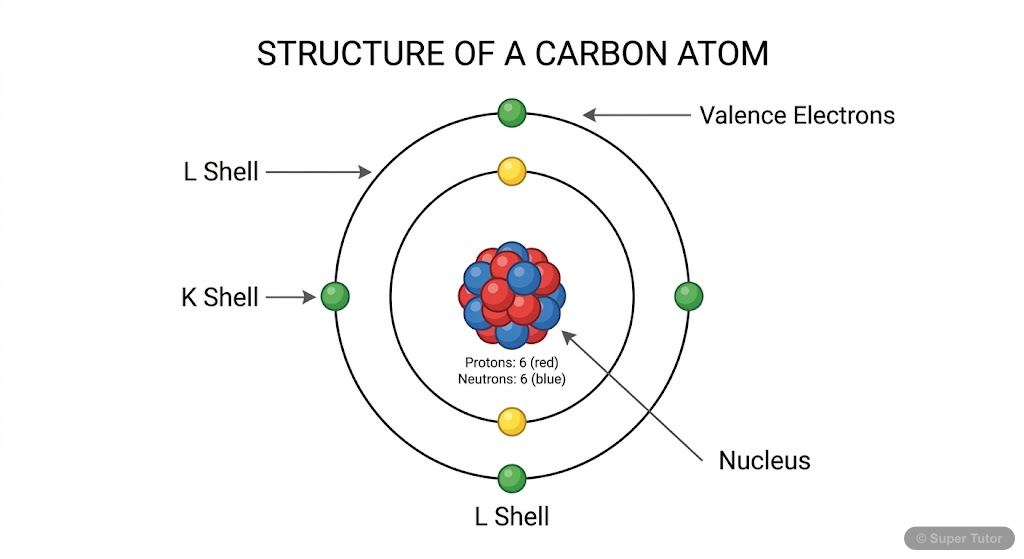
A diagram showing the atomic structure of carbon, specifically its nucleus with protons and neutrons, and the distribution of its 6 electrons in the K and L shells, highlighting the 4 valence electron
Super Tutor

This is just one of 22+ visuals inside Super Tutor's Carbon and its Compounds chapter

Explore the full set
17 Questions Solved · 2 Sections

Intext Questions (Page 76–77)

1Would you be able to check if water is hard by using a detergent?Show solution
Given: Detergents are sodium salts of sulphonic acids or ammonium salts whose charged ends do not form insoluble precipitates with calcium and magnesium ions present in hard water.

Concept: Hard water contains dissolved calcium and magnesium salts. Soap forms a curdy white precipitate (scum) with hard water, but detergents do not.

Answer: No, we cannot check whether water is hard by using a detergent. This is because detergents work equally well in both hard water and soft water — they do not form an insoluble precipitate (scum) with the calcium and magnesium ions present in hard water. Therefore, detergents cannot be used to distinguish hard water from soft water. Soap, on the other hand, forms a white curdy precipitate with hard water and can be used to test for hardness.
2People use a variety of methods to wash clothes. Usually after adding the soap, they 'beat' the clothes on a stone, or beat it with a paddle, scrub with a brush or the mixture is agitated in a washing machine. Why is agitation necessary to get clean clothes?Show solution
Given: Soap molecules have a hydrophilic (water-loving) head and a hydrophobic (water-repelling/oil-loving) tail.

Concept: Cleaning action of soap — micelle formation.

Explanation:
1. When soap is added to dirty clothes, the hydrophobic tails of soap molecules attach themselves to the oily/greasy dirt on the cloth fibres, while the hydrophilic heads remain directed towards the water.
2. This arrangement forms clusters called micelles, with the dirt trapped inside.
3. However, for the micelles to be pulled away from the surface of the cloth and dispersed into the water, mechanical energy (agitation) is required.
4. Beating, scrubbing, or agitation in a washing machine provides this mechanical energy, which helps dislodge the dirt-containing micelles from the cloth surface and keeps them suspended in water.
5. The dirty water is then rinsed away, leaving the clothes clean.

Conclusion: Agitation is necessary because it provides the mechanical energy needed to dislodge the micelles (containing trapped dirt) from the cloth fibres and disperse them into the water, resulting in clean clothes.

EXERCISES

1Ethane, with the molecular formula C2H6\mathrm{C_2H_6} has
(a) 6 covalent bonds.
(b) 7 covalent bonds.
(c) 8 covalent bonds.
(d) 9 covalent bonds.
Show solution
Correct option: (b) 7 covalent bonds.

Note: The question states C6H6\mathrm{C_6H_6} but the answer options and context indicate it refers to Ethane, C2H6\mathrm{C_2H_6}.

Justification: In ethane (C2H6\mathrm{C_2H_6}), the structure is H3CCH3\mathrm{H_3C-CH_3}.
- There is 1 C–C bond.
- Each carbon is bonded to 3 hydrogen atoms, giving 3+3=63 + 3 = 6 C–H bonds.
- Total covalent bonds =1+6=7= 1 + 6 = \mathbf{7}.
2Butanone is a four-carbon compound with the functional group
(a) carboxylic acid.
(b) aldehyde.
(c) ketone.
(d) alcohol.
Show solution
Correct option: (c) ketone.

Justification: Butanone (CH3COCH2CH3\mathrm{CH_3COCH_2CH_3}) contains the carbonyl group (C=O\mathrm{C=O}) flanked by two carbon atoms (not at the terminal position), which is the characteristic functional group of a ketone. Its IUPAC name itself ends in '-one', confirming it is a ketone.
3While cooking, if the bottom of the vessel is getting blackened on the outside, it means that
(a) the food is not cooked completely.
(b) the fuel is not burning completely.
(c) the fuel is wet.
(d) the fuel is burning completely.
Show solution
Correct option: (b) the fuel is not burning completely.

Justification: When a fuel burns completely, it produces carbon dioxide (CO2\mathrm{CO_2}) and water (H2O\mathrm{H_2O}), giving a clean blue flame. When the fuel does not burn completely due to insufficient supply of oxygen, it produces carbon (soot/black carbon particles) along with carbon monoxide. This unburnt carbon deposits as black soot on the bottom of the vessel, blackening it.
4Explain the nature of the covalent bond using the bond formation in CH3Cl\mathrm{CH_3Cl}.Show solution
Given: Molecule — Chloromethane (CH3Cl\mathrm{CH_3Cl}).

Nature of Covalent Bond: A covalent bond is formed by the mutual sharing of one or more pairs of electrons between two atoms so that each atom achieves a stable, completely filled outermost (valence) shell (usually 8 electrons — octet, or 2 electrons for hydrogen — duplet).

Bond formation in CH3Cl\mathrm{CH_3Cl}:
- Carbon (C) has atomic number 6; electronic configuration: 2, 4. It has 4 valence electrons and needs 4 more to complete its octet.
- Hydrogen (H) has 1 valence electron and needs 1 more to complete its duplet.
- Chlorine (Cl) has atomic number 17; electronic configuration: 2, 8, 7. It has 7 valence electrons and needs 1 more to complete its octet.

In CH3Cl\mathrm{CH_3Cl}:
- Carbon shares one electron each with three hydrogen atoms, forming three C–H covalent bonds. Each hydrogen now has 2 electrons (duplet complete).
- Carbon shares one electron with one chlorine atom, forming one C–Cl covalent bond. Chlorine now has 8 electrons (octet complete).
- Carbon has shared 4 electrons (one with each of 3 H and one with Cl), so it now has 4+4=84 + 4 = 8 electrons in its valence shell (octet complete).

Electron dot structure:
HC¨HHCl\mathrm{H}\underset{|}{\overset{|}{\underset{H}{\overset{H}{\ddot{C}}}}}\mathrm{Cl}

More clearly:
HHCClH\begin{array}{c} H \\ | \\ H - C - Cl \\ | \\ H \end{array}

All four bonds in CH3Cl\mathrm{CH_3Cl} are single covalent bonds formed by sharing of one pair of electrons between the bonded atoms. Since the electrons are shared (not transferred), the bond is covalent in nature.
5Draw the electron dot structures for
(a) ethanoic acid.
(b) H2S\mathrm{H_2S}.
(c) propanone.
(d) F2\mathrm{F_2}.
Show solution
Concept: In electron dot (Lewis) structures, valence electrons of each atom are shown as dots. Shared pairs form bonds; unshared pairs are lone pairs.

(a) Ethanoic acid (CH3COOH\mathrm{CH_3COOH}):

Structure: CH3C(=O)OH\mathrm{CH_3 - C(=O) - O - H}

Hamp;amp;O¨:amp;amp;amp;amp;amp;amp;HCCamp;amp;amp;amp;amp;amp;O˙Hamp;amp;Hamp;amp;amp;amp;\begin{array}{ccccc}
H & & \ddot{O}: & & \\
| & & \| & & \\
H-\overset{\displaystyle|}{C}-C & & & & \\
| & & \dot{O}-H & & \\
H & & & &
\end{array}


Written out clearly:
- Carbon 1 (methyl): bonded to 3 H atoms and 1 C atom (4 single bonds, octet complete).
- Carbon 2 (carbonyl): bonded to C1 by single bond, to one O by double bond (C=O\mathrm{C=O}), and to –OH by single bond (octet complete).
- The –OH oxygen has 2 lone pairs.
- The C=O\mathrm{C=O} oxygen has 2 lone pairs.

H ⁣: ⁣CHH ⁣: ⁣C:O: ⁣: ⁣O ⁣: ⁣H\mathrm{H}\!:\!\overset{\displaystyle H}{\underset{\displaystyle H}{C}}\!:\!\overset{\displaystyle :O:}{\underset{}{C}}\!:\!\overset{\displaystyle}{\underset{}{O}}\!:\!H

Full electron dot representation:
[HCHH]O¨CO..H\left[H-\overset{H\atop|}{\underset{|}{C}}-H\right] - \overset{\ddot{O}}{\|} C - \overset{..}{O} - H

(b) H2S\mathrm{H_2S}:
- Sulphur has 6 valence electrons; each H has 1.
- S shares one electron with each H, forming 2 S–H bonds. S has 2 lone pairs remaining.

H:S....:HH : \overset{..}{\underset{..}{S}} : H

This is similar to water. S has 2 bonding pairs and 2 lone pairs; each H has a duplet.

(c) Propanone (CH3COCH3\mathrm{CH_3COCH_3}):
- Structure: CH3C(=O)CH3\mathrm{CH_3 - C(=O) - CH_3}
- Central carbon is double-bonded to oxygen and single-bonded to two methyl carbons.
- Each methyl carbon is bonded to 3 H atoms.

H ⁣ ⁣CH ⁣ ⁣H    O¨C    H ⁣ ⁣CH ⁣ ⁣HH\!-\!\overset{H\atop|}{\underset{|}{C}}\!-\!H \;-\; \overset{\ddot{O}}{\|} C \;-\; H\!-\!\overset{H\atop|}{\underset{|}{C}}\!-\!H

Oxygen has 2 lone pairs; all carbons have complete octets; all hydrogens have duplets.

(d) F2\mathrm{F_2}:
- Each fluorine has 7 valence electrons and needs 1 more.
- The two F atoms share one pair of electrons, forming a single F–F covalent bond. Each F has 3 lone pairs.

: ⁣F.... ⁣: ⁣: ⁣F.... ⁣::\!\overset{..}{\underset{..}{F}}\!:\!:\!\overset{..}{\underset{..}{F}}\!:

or

:FF::F - F:

where each F has 3 lone pairs (6 non-bonding electrons) and shares 1 bonding pair.
6What is a homologous series? Explain with an example.Show solution
Definition: A homologous series is a group (series) of organic compounds that:
1. Have the same general formula.
2. Have the same functional group.
3. Show similar chemical properties.
4. Show a gradual change in physical properties (such as melting point, boiling point, density) with increasing molecular mass.
5. Each successive member differs from the previous one by a CH2-\mathrm{CH_2}- unit (methylene group), i.e., by a molecular mass of 14 u.

Example — Homologous series of alkanes:

| Member | Molecular Formula | Structural Formula |
|--------|------------------|--------------------|
| Methane | CH4\mathrm{CH_4} | CH4\mathrm{CH_4} |
| Ethane | C2H6\mathrm{C_2H_6} | CH3CH3\mathrm{CH_3-CH_3} |
| Propane | C3H8\mathrm{C_3H_8} | CH3CH2CH3\mathrm{CH_3-CH_2-CH_3} |
| Butane | C4H10\mathrm{C_4H_{10}} | CH3CH2CH2CH3\mathrm{CH_3-CH_2-CH_2-CH_3} |

- General formula: CnH2n+2\mathrm{C_nH_{2n+2}}
- Each member differs from the next by CH2\mathrm{CH_2} (14 u).
- All members undergo similar reactions (e.g., combustion, substitution).
- Boiling points increase gradually from methane to butane.

Conclusion: The homologous series concept helps us predict the properties of unknown members from the known properties of other members of the series.
7How can ethanol and ethanoic acid be differentiated on the basis of their physical and chemical properties?Show solution
Given: Two compounds — Ethanol (C2H5OH\mathrm{C_2H_5OH}) and Ethanoic acid (CH3COOH\mathrm{CH_3COOH}).

Differences based on Physical Properties:

| Property | Ethanol | Ethanoic acid |
|----------|---------|---------------|
| Smell | Pleasant smell (wine-like) | Pungent smell (like vinegar) |
| Boiling point | 78.4C78.4^\circ\mathrm{C} | 118C118^\circ\mathrm{C} |
| Taste | Bitter | Sour |
| Freezing point | 114C-114^\circ\mathrm{C} | 16.6C16.6^\circ\mathrm{C} (freezes in winter, called glacial acetic acid) |

Differences based on Chemical Properties:

1. Litmus test:
- Ethanol: Does not change the colour of either red or blue litmus (neutral).
- Ethanoic acid: Turns blue litmus red (acidic in nature).

2. Reaction with sodium carbonate/sodium bicarbonate (Na2CO3\mathrm{Na_2CO_3} / NaHCO3\mathrm{NaHCO_3}):
- Ethanol: Does not react with Na2CO3\mathrm{Na_2CO_3} or NaHCO3\mathrm{NaHCO_3}; no effervescence.
- Ethanoic acid: Reacts vigorously with Na2CO3\mathrm{Na_2CO_3} and NaHCO3\mathrm{NaHCO_3} to produce brisk effervescence of CO2\mathrm{CO_2} gas:
2CH3COOH+Na2CO32CH3COONa+H2O+CO2\mathrm{2CH_3COOH + Na_2CO_3 \rightarrow 2CH_3COONa + H_2O + CO_2\uparrow}
CH3COOH+NaHCO3CH3COONa+H2O+CO2\mathrm{CH_3COOH + NaHCO_3 \rightarrow CH_3COONa + H_2O + CO_2\uparrow}

3. Reaction with sodium metal:
- Both react with sodium to release hydrogen gas, but ethanoic acid reacts more vigorously due to its acidic nature.

4. Esterification:
- Ethanoic acid reacts with ethanol in the presence of a few drops of concentrated H2SO4\mathrm{H_2SO_4} (catalyst) to form a sweet-smelling ester (ethyl ethanoate):
CH3COOH+C2H5OHH+ΔCH3COOC2H5+H2O\mathrm{CH_3COOH + C_2H_5OH \underset{\Delta}{\overset{H^+}{\rightleftharpoons}} CH_3COOC_2H_5 + H_2O}
- Ethanol alone does not undergo this reaction without the acid.

Conclusion: The simplest test to differentiate them is the litmus test and the sodium bicarbonate test — ethanoic acid turns blue litmus red and produces CO2\mathrm{CO_2} with NaHCO3\mathrm{NaHCO_3}, while ethanol does neither.
8Why does micelle formation take place when soap is added to water? Will a micelle be formed in other solvents such as ethanol also?Show solution
Why micelle formation takes place in water:

A soap molecule (e.g., sodium stearate, C17H35COONa\mathrm{C_{17}H_{35}COONa}) has two distinct parts:
1. A long hydrophobic (water-repelling) hydrocarbon tail.
2. A hydrophilic (water-attracting) ionic/polar head (COONa+-\mathrm{COO^-Na^+}).

When soap is dissolved in water:
- The hydrophilic heads are attracted to water molecules and tend to remain in the aqueous phase.
- The hydrophobic tails try to avoid water and tend to cluster together away from water.
- To minimise the contact of hydrophobic tails with water, many soap molecules arrange themselves into a spherical cluster called a micelle, where:
- The hydrophobic tails point inward (towards the centre, away from water).
- The hydrophilic heads point outward (towards the water).

This arrangement is thermodynamically stable in water, which is why micelles form spontaneously.

Will micelles form in ethanol?

No, micelles will NOT be formed in ethanol (or other organic solvents).

Reason: Ethanol is an organic solvent that can dissolve both the hydrophobic tail and the hydrophilic head of the soap molecule. Since both parts of the soap molecule are soluble in ethanol, there is no tendency for the hydrophobic tails to cluster together to avoid the solvent. Hence, the driving force for micelle formation is absent, and micelles do not form in ethanol.
9Why are carbon and its compounds used as fuels for most applications?Show solution
Carbon and its compounds are widely used as fuels because of the following reasons:

1. High calorific value: Carbon and its compounds (such as coal, petroleum, LPG, CNG, wood) release a large amount of heat energy on combustion, making them excellent fuels.

2. Complete combustion: Carbon compounds burn in the presence of oxygen to produce carbon dioxide and water, releasing a large amount of energy:
C+O2CO2+Heat and Light\mathrm{C + O_2 \rightarrow CO_2 + \text{Heat and Light}}
CH4+2O2CO2+2H2O+Heat and Light\mathrm{CH_4 + 2O_2 \rightarrow CO_2 + 2H_2O + \text{Heat and Light}}

3. Easy availability: Carbon-based fuels (coal, petroleum, natural gas) are abundantly available in nature.

4. Easy storage and transport: Carbon compounds are easy to store and transport in solid, liquid, or gaseous form.

5. Ease of ignition: Most carbon compounds ignite easily and burn smoothly.

6. Moderate ignition temperature: They have a moderate ignition temperature — not too low (safe to handle) and not too high (easy to ignite).

Conclusion: The combination of high energy output, easy availability, ease of storage and transport, and moderate ignition temperature makes carbon and its compounds ideal fuels for most applications.
10Explain the formation of scum when hard water is treated with soap.Show solution
Hard water: Water that contains dissolved salts of calcium (Ca2+\mathrm{Ca^{2+}}) and magnesium (Mg2+\mathrm{Mg^{2+}}) — such as their chlorides, sulphates, and hydrogencarbonates — is called hard water.

Soap: Soap is a sodium or potassium salt of a long-chain fatty acid, e.g., sodium stearate (C17H35COONa\mathrm{C_{17}H_{35}COONa}).

Formation of scum:

When soap is added to hard water, the sodium ions of soap are replaced by calcium or magnesium ions. The calcium and magnesium salts of fatty acids are insoluble in water and precipitate out as a white, curdy solid called scum.

The chemical reactions are:
2C17H35COONa+CaCl2(C17H35COO)2Ca+2NaCl\mathrm{2C_{17}H_{35}COONa + CaCl_2 \rightarrow (C_{17}H_{35}COO)_2Ca\downarrow + 2NaCl}
2C17H35COONa+MgCl2(C17H35COO)2Mg+2NaCl\mathrm{2C_{17}H_{35}COONa + MgCl_2 \rightarrow (C_{17}H_{35}COO)_2Mg\downarrow + 2NaCl}

The insoluble calcium stearate or magnesium stearate formed is the scum.

Effect: The formation of scum wastes a large amount of soap (as it is converted to insoluble scum instead of forming lather) and leaves a grey, sticky deposit on clothes, making washing difficult. A large amount of soap must be used before lather is formed and effective cleaning begins.
11What change will you observe if you test soap with litmus paper (red and blue)?Show solution
Given: Soap is a sodium or potassium salt of a long-chain fatty acid. When dissolved in water, it undergoes hydrolysis to give a weakly alkaline solution.

Observation:
- Red litmus paper: When red litmus paper is dipped in soap solution, it turns blue. This indicates that the soap solution is alkaline (basic) in nature.
- Blue litmus paper: When blue litmus paper is dipped in soap solution, it remains blue (no change). This further confirms that the solution is alkaline.

Reason: Soap is a salt of a strong base (NaOH or KOH) and a weak acid (fatty acid). When dissolved in water, it undergoes hydrolysis:
C17H35COONa+H2OC17H35COOH+NaOH\mathrm{C_{17}H_{35}COONa + H_2O \rightleftharpoons C_{17}H_{35}COOH + NaOH}
The NaOH produced makes the solution alkaline (basic), which turns red litmus blue.

Conclusion: Soap solution is alkaline — it turns red litmus blue and has no effect on blue litmus.
12What is hydrogenation? What is its industrial application?Show solution
Hydrogenation:

Hydrogenation is the process of addition of hydrogen to an unsaturated organic compound (containing C=C double bonds or C≡C triple bonds) in the presence of a catalyst (usually finely divided nickel, palladium, or platinum) to convert it into a saturated compound.

General reaction:
RCH=CHR+H2Ni/ΔRCH2CH2R\mathrm{R-CH=CH-R' + H_2 \xrightarrow{Ni/\Delta} R-CH_2-CH_2-R'}

Example:
CH2=CH2+H2Ni,ΔCH3CH3\mathrm{CH_2=CH_2 + H_2 \xrightarrow{Ni,\,\Delta} CH_3-CH_3}
(Ethene)(Ethane)\text{(Ethene)} \quad\quad\quad\quad\quad\quad\quad\quad \text{(Ethane)}

Industrial Application:

The most important industrial application of hydrogenation is the conversion of vegetable oils (unsaturated) into vegetable ghee (vanaspati ghee) (saturated fats).

- Vegetable oils contain long-chain unsaturated fatty acids (with C=C double bonds) and are liquid at room temperature.
- When hydrogen gas is passed through vegetable oil at about 200C200^\circ\mathrm{C} in the presence of finely divided nickel catalyst, the double bonds are broken and hydrogen is added across them.
- The resulting product is a solid or semi-solid fat (vanaspati ghee) which is saturated.

Vegetable  oil  (unsaturated)+H2Ni,200CVegetable  ghee  (saturated)\mathrm{Vegetable\;oil\;(unsaturated) + H_2 \xrightarrow{Ni,\,200^\circ C} Vegetable\;ghee\;(saturated)}

This process is used extensively in the food industry to manufacture vanaspati ghee from cheaper vegetable oils.
13Which of the following hydrocarbons undergo addition reactions: C2H6,  C3H8,  C3H6,  C2H2\mathrm{C_2H_6,\; C_3H_8,\; C_3H_6,\; C_2H_2} and CH4\mathrm{CH_4}.Show solution
Concept: Addition reactions are characteristic of unsaturated hydrocarbons — those containing carbon-carbon double bonds (alkenes) or triple bonds (alkynes). Saturated hydrocarbons (alkanes) do not undergo addition reactions; they undergo substitution reactions instead.

Analysis of each compound:

| Compound | General Formula Check | Type | Addition Reaction? |
|----------|-----------------------|------|--------------------|
| C2H6\mathrm{C_2H_6} (Ethane) | CnH2n+2\mathrm{C_nH_{2n+2}}: 2(2)+2=62(2)+2=6 ✓ | Alkane (saturated) | No |
| C3H8\mathrm{C_3H_8} (Propane) | CnH2n+2\mathrm{C_nH_{2n+2}}: 2(3)+2=82(3)+2=8 ✓ | Alkane (saturated) | No |
| C3H6\mathrm{C_3H_6} (Propene) | CnH2n\mathrm{C_nH_{2n}}: 2(3)=62(3)=6 ✓ | Alkene (unsaturated, C=C) | Yes |
| C2H2\mathrm{C_2H_2} (Ethyne) | CnH2n2\mathrm{C_nH_{2n-2}}: 2(2)2=22(2)-2=2 ✓ | Alkyne (unsaturated, C≡C) | Yes |
| CH4\mathrm{CH_4} (Methane) | CnH2n+2\mathrm{C_nH_{2n+2}}: 2(1)+2=42(1)+2=4 ✓ | Alkane (saturated) | No |

Answer: Only C3H6\mathrm{C_3H_6} (propene) and C2H2\mathrm{C_2H_2} (ethyne) undergo addition reactions, as they are unsaturated hydrocarbons.

Example reactions:
C3H6+H2NiC3H8\mathrm{C_3H_6 + H_2 \xrightarrow{Ni} C_3H_8}
C2H2+2H2NiC2H6\mathrm{C_2H_2 + 2H_2 \xrightarrow{Ni} C_2H_6}

*Note: The question lists C2H8\mathrm{C_2H_8} which is not a valid hydrocarbon formula; it is likely a misprint for C2H2\mathrm{C_2H_2} (ethyne), which has been solved above.*
14Give a test that can be used to differentiate between saturated and unsaturated hydrocarbons.Show solution
Test: Bromine water test (or Bromine in carbon tetrachloride test)

Procedure:
1. Take two test tubes. Add a few drops of bromine water (or bromine dissolved in CCl4\mathrm{CCl_4}, which is orange-brown in colour) to each.
2. Pass the saturated hydrocarbon (e.g., ethane) through one test tube and the unsaturated hydrocarbon (e.g., ethene) through the other.

Observation:
- Saturated hydrocarbon (e.g., C2H6\mathrm{C_2H_6}): The orange-brown colour of bromine water is not decolourised (no change). Saturated hydrocarbons do not react with bromine water under normal conditions.
- Unsaturated hydrocarbon (e.g., C2H4\mathrm{C_2H_4} or C2H2\mathrm{C_2H_2}): The orange-brown colour of bromine water is immediately decolourised (turns colourless). This is because bromine adds across the double or triple bond:
CH2=CH2+Br2CH2BrCH2Br\mathrm{CH_2=CH_2 + Br_2 \rightarrow CH_2Br-CH_2Br}
(Ethene, colourless)(Bromine, orange-brown)(1,2-dibromoethane, colourless)\text{(Ethene, colourless)} \quad \text{(Bromine, orange-brown)} \quad \text{(1,2-dibromoethane, colourless)}

Conclusion:
- Decolourisation of bromine water → Unsaturated hydrocarbon.
- No decolourisation of bromine water → Saturated hydrocarbon.

Alternative test: Alkaline potassium permanganate (KMnO4\mathrm{KMnO_4}) solution (purple) is also decolourised by unsaturated hydrocarbons but not by saturated ones.
15Explain the mechanism of the cleaning action of soaps.Show solution
Structure of soap molecule:
A soap molecule (e.g., sodium stearate, C17H35COONa\mathrm{C_{17}H_{35}COONa}) has two parts:
1. Hydrophobic tail: A long non-polar hydrocarbon chain that is repelled by water but attracted to oil/grease.
2. Hydrophilic head: A polar ionic group (COONa+-\mathrm{COO^-Na^+}) that is attracted to water.

Mechanism of cleaning action (step-by-step):

Step 1 — Adsorption on dirt:
When a soap solution is applied to a dirty (oily/greasy) surface (cloth or skin), the hydrophobic tails of soap molecules dissolve into the oil/grease droplets (like dissolves like), while the hydrophilic heads remain in the water phase, pointing outward.

Step 2 — Micelle formation:
Many soap molecules arrange themselves around each oil/grease droplet in a spherical cluster called a micelle:
- The hydrophobic tails point inward, surrounding the oil/grease droplet at the centre.
- The hydrophilic heads point outward into the water.

The oil/grease is thus trapped inside the micelle.

Step 3 — Emulsification:
The micelles, being negatively charged on the outside (due to COO-\mathrm{COO^-} groups), repel each other and remain dispersed in water without coagulating. This forms a stable emulsion of oil in water.

Step 4 — Rinsing:
When the cloth is rinsed with water (and agitated), the micelles containing the trapped dirt are washed away with the water, leaving the cloth clean.

Diagram (description):
- Centre of micelle: Oil/grease droplet (non-polar dirt)
- Middle layer: Hydrophobic tails of soap molecules pointing inward
- Outer layer: Hydrophilic heads of soap molecules pointing outward into water

Conclusion: The dual nature of the soap molecule (hydrophobic tail + hydrophilic head) enables it to surround oily dirt in micelles and carry it away in water, thus cleaning the surface.

Stuck on a step?

Ask Super Tutor AI to explain any solution on this page in a simpler way — free, 24x7.

Ask a Doubt Free

Frequently Asked Questions

What are the important topics in Carbon and its Compounds for Haryana Board Class 10 Science?
Key topics in Carbon and its Compounds include Carbon and its Compounds - Concept Map, Carbon and its Compounds - Complete Chapter Overview, Carbon and its Compounds - Complete Overview. These are the concepts Haryana Board Class 10 examiners draw on most — study them first, then practise related questions.
How to score full marks in Carbon and its Compounds — Haryana Board Class 10 Science?
Understand the core concepts first, then work through the 61 practice questions available for this chapter. Revise formulas and definitions regularly, and use flashcards for quick recall before the exam.
Where can I get free NCERT Solutions for Carbon and its Compounds Class 10 Science?
This page has free step-by-step NCERT Solutions for every exercise question in Carbon and its Compounds (Haryana Board Class 10 Science) — written the way examiners award marks: given, formula, working, answer.

Sources & Official References

Content is aligned to the official syllabus. Refer to the board website for the latest curriculum.

For serious students

Get the full Carbon and its Compounds chapter — for free.

Quizzes, flashcards, AI doubt-solver and a step-by-step study plan for Haryana Board Class 10 Science.