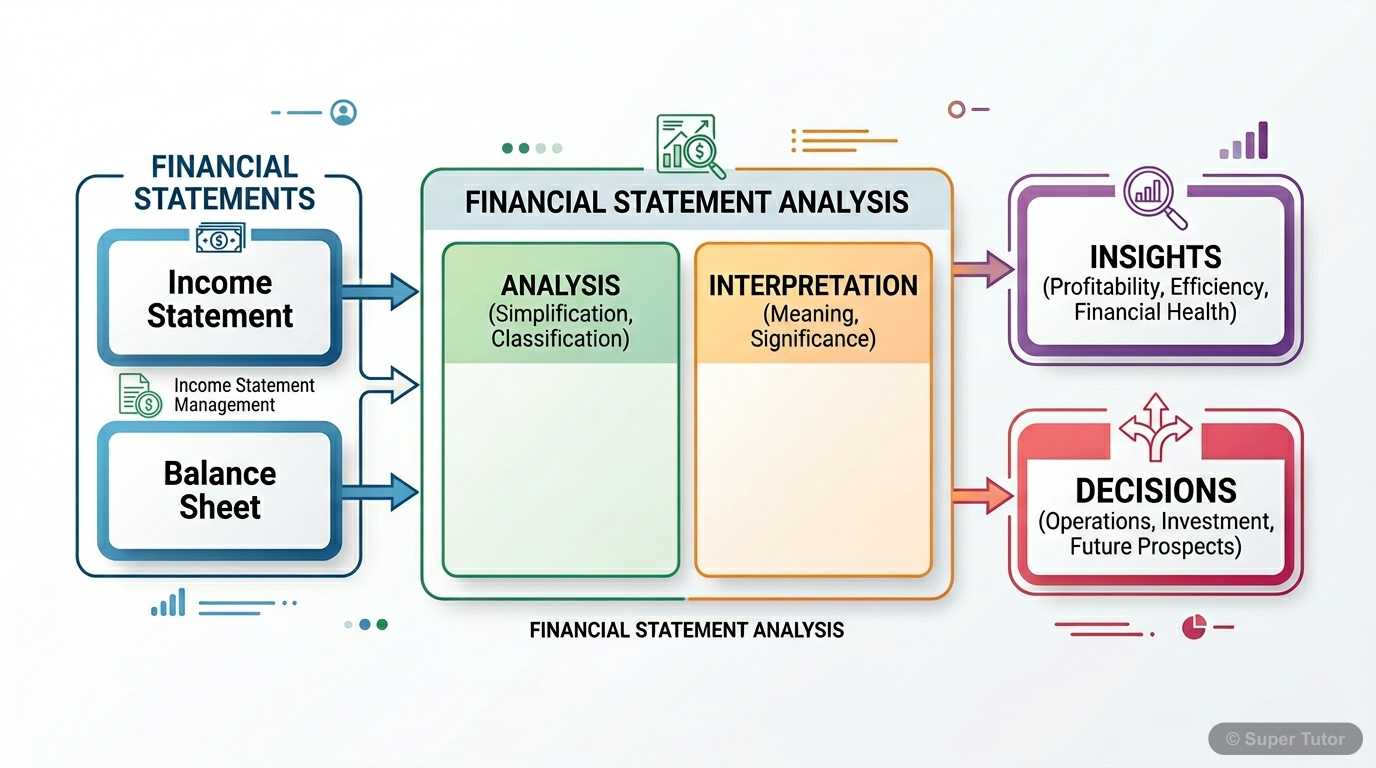
Analysis of Financial Statements
Haryana Board · Class 12 · Accountancy
NCERT Solutions for Analysis of Financial Statements — Haryana Board Class 12 Accountancy.
Interactive on Super Tutor
Studying Analysis of Financial Statements? Get the full interactive chapter.
Quizzes, flashcards, AI doubt-solver and a step-by-step study plan — built for ncert solutions and more.
1,000+ Class 12 students started this chapter today

Learn better with visuals Super Tutor has hundreds of illustrations like this across every chapter — all free to try.
Get startedTest your Understanding - I (Fill in the Blanks)
1Analysis simply means ---data.Show solution
Explanation: Analysis involves breaking down complex financial data into simpler components so that it can be understood and examined more easily.
2Interpretation means ---data.Show solution
Explanation: Interpretation involves explaining the meaning and significance of the analysed data so that conclusions can be drawn and decisions can be made.
3Comparative analysis is also known as --- analysis.Show solution
Explanation: Comparative (horizontal) analysis compares financial data across two or more periods side by side, showing changes over time.
4Common size analysis is also known as --- analysis.Show solution
Explanation: In vertical (common size) analysis, each item in the financial statement is expressed as a percentage of a common base figure (e.g., total assets or revenue from operations).
5The analysis of actual movement of money inflow and outflow in an organisation is called --- analysis.Show solution
Explanation: Cash flow analysis studies the actual movement of cash into (inflow) and out of (outflow) an organisation during an accounting period.
Do it Yourself — Comparative Statement of Profit and Loss (Narang Colours Ltd.)
1From the following particulars, prepare comparative statement of profit and loss of Narang Colours Ltd. for the year ended March 31, 2016 and 2017:
| Particulars | 2016-17 (Rs.) | 2015-16 (Rs.) |
|---|---|---|
| Revenue from operations | 40,00,000 | 35,00,000 |
| Other income | 50,000 | 50,000 |
| Cost of material consumed | 15,00,000 | 18,00,000 |
| Changes in inventories | 10,000 | (15,000) |
| Employee benefit expenses | 2,40,000 | 2,40,000 |
| Depreciation and amortisation | 25,000 | 22,500 |
| Other expenses (incl. tax) | 2,66,000 | 3,02,000 |
| Profit | 20,09,000 | 14,27,300 |Show solution
- Revenue from operations, other income, various expenses for 2015-16 and 2016-17.
- Other expenses include provision for tax (Rs. 50,000 for 2016-17 and Rs. 60,000 for 2015-16).
Step 1: Separate tax from other expenses.
Other expenses (excluding tax):
- 2016-17: Rs. 2,66,000 − Rs. 50,000 = Rs. 2,16,000
- 2015-16: Rs. 3,02,000 − Rs. 60,000 = Rs. 2,42,000
Step 2: Calculate Total Revenue (I)
- 2016-17: Rs. 40,00,000 + Rs. 50,000 = Rs. 40,50,000
- 2015-16: Rs. 35,00,000 + Rs. 50,000 = Rs. 35,50,000
Step 3: Calculate Total Expenses (II) before tax
| Expense | 2016-17 (Rs.) | 2015-16 (Rs.) |
|---|---|---|
| Cost of material consumed | 15,00,000 | 18,00,000 |
| Changes in inventories | 10,000 | (15,000) |
| Employee benefit expenses | 2,40,000 | 2,40,000 |
| Depreciation & amortisation | 25,000 | 22,500 |
| Other expenses (excl. tax) | 2,16,000 | 2,42,000 |
| Total Expenses | 19,91,000 | 22,89,500 |
Step 4: Profit before tax = Total Revenue − Total Expenses
- 2016-17: Rs. 40,50,000 − Rs. 19,91,000 = Rs. 20,59,000
- 2015-16: Rs. 35,50,000 − Rs. 22,89,500 = Rs. 12,60,500
Step 5: Less Tax
- 2016-17: Rs. 50,000
- 2015-16: Rs. 60,000
Step 6: Profit after tax
- 2016-17: Rs. 20,59,000 − Rs. 50,000 = Rs. 20,09,000 ✓
- 2015-16: Rs. 12,60,500 − Rs. 60,000 = Rs. 12,00,500
*(Note: The profit figure given for 2015-16 is Rs. 14,27,300 in the question. The slight discrepancy may be due to rounding or additional items not separately listed. The statement is prepared using the data as given.)*
Step 7: Calculate Absolute Change and Percentage Change
---
Comparative Statement of Profit and Loss of Narang Colours Ltd.
For the years ended March 31, 2016 and March 31, 2017
| Particulars | 2015-16 (Rs.) | 2016-17 (Rs.) | Absolute Change (Rs.) | % Change |
|---|---|---|---|---|
| I. Revenue | | | | |
| Revenue from operations | 35,00,000 | 40,00,000 | +5,00,000 | +14.29% |
| Other income | 50,000 | 50,000 | 0 | 0% |
| Total Revenue (I) | 35,50,000 | 40,50,000 | +5,00,000 | +14.08% |
| II. Expenses | | | | |
| Cost of material consumed | 18,00,000 | 15,00,000 | −3,00,000 | −16.67% |
| Changes in inventories | (15,000) | 10,000 | +25,000 | — |
| Employee benefit expenses | 2,40,000 | 2,40,000 | 0 | 0% |
| Depreciation & amortisation | 22,500 | 25,000 | +2,500 | +11.11% |
| Other expenses (excl. tax) | 2,42,000 | 2,16,000 | −26,000 | −10.74% |
| Total Expenses (II) | 22,89,500 | 19,91,000 | −2,98,500 | −13.04% |
| Profit before tax (I−II) | 12,60,500 | 20,59,000 | +7,98,500 | +63.35% |
| Less: Provision for tax | 60,000 | 50,000 | −10,000 | −16.67% |
| Profit after tax | 12,00,500 | 20,09,000 | +8,08,500 | +67.34% |
Do it Yourself — Comparative Balance Sheet (Omega Chemicals Ltd.)
1From the Balance Sheets for the year ended March 31, 2016 and 2017, prepare the comparative Balance Sheet of Omega Chemicals Ltd. (Rs. in Lakhs):
Equity & Liabilities: Share capital 2017: 5, 2016: 10; Reserve & surplus 2017: 3, 2016: 2; Long-term borrowings 2017: 5, 2016: 8; Trade Payable 2017: 2, 2016: 4; Total 2017: 15, 2016: 24 (Note: Assets side shows Total 24 for 2016 and 15 for 2017)
Assets: Tangible assets 2017: 14, 2016: 8; Intangible assets 2017: 3, 2016: 2; Inventories 2017: 5, 2016: 4; Cash and cash equivalents 2017: 2, 2016: 1; Total 2017: 24, 2016: 15Show solution
Given:
- 2016: Share capital = 10, Reserve & surplus = 2, Long-term borrowings = 8, Trade Payable = 4, Total = 24
- 2017: Share capital = 5, Reserve & surplus = 3, Long-term borrowings = 5, Trade Payable = 2, Total = 15
Assets (as given in the text):
- Tangible assets: 2016 = 8, 2017 = 14
- Intangible assets: 2016 = 2, 2017 = 3
- Inventories: 2016 = 4, 2017 = 5
- Cash and cash equivalents: 2016 = 1, 2017 = 2
- Total Assets: 2016 = 15, 2017 = 24
Formula:
---
Comparative Balance Sheet of Omega Chemicals Ltd.
As at March 31, 2016 and March 31, 2017
*(Rs. in Lakhs)*
| Particulars | 2016 (Rs.) | 2017 (Rs.) | Absolute Change (Rs.) | % Change |
|---|---|---|---|---|
| I. Equity and Liabilities | | | | |
| 1. Shareholders' Funds | | | | |
| Share capital | 10 | 5 | −5 | −50.00% |
| Reserve and surplus | 2 | 3 | +1 | +50.00% |
| 2. Non-current Liabilities | | | | |
| Long-term borrowings | 8 | 5 | −3 | −37.50% |
| 3. Current Liabilities | | | | |
| Trade Payable | 4 | 2 | −2 | −50.00% |
| Total | 24 | 15 | −9 | −37.50% |
| II. Assets | | | | |
| 1. Non-current Assets | | | | |
| Tangible assets | 8 | 14 | +6 | +75.00% |
| Intangible assets | 2 | 3 | +1 | +50.00% |
| 2. Current Assets | | | | |
| Inventories | 4 | 5 | +1 | +25.00% |
| Cash and cash equivalents | 1 | 2 | +1 | +100.00% |
| Total | 15 | 24 | +9 | +60.00% |
Observation: The total of Equity & Liabilities (2016 = 24, 2017 = 15) does not match the total of Assets (2016 = 15, 2017 = 24), indicating a likely printing error in the source where the year columns for Assets were swapped. Students should note this discrepancy.
Do it Yourself — Common Size Balance Sheet (Raj Co. Ltd.)
1Prepare common size balance sheet of Raj Co. Ltd. as at March 31, 2016 and March 31, 2017 from the given information:
Equity & Liabilities: Share capital 2017: 20,00,000; 2016: 15,00,000 | Reserve & surplus 2017: 3,00,000; 2016: 4,00,000 | Long-term borrowings 2017: 9,00,000; 2016: 6,00,000 | Trade payables 2017: 3,00,000; 2016: 2,00,000 | Total 2017: 35,00,000; 2016: 27,00,000
Assets: Tangible assets 2017: 20,00,000; 2016: 15,00,000 | Intangible assets 2017: 9,00,000; 2016: 6,00,000 | Inventories 2017: 3,00,000; 2016: 4,00,000 | Cash and cash equivalents 2017: 3,00,000; 2016: 2,00,000 | Total 2017: 35,00,000; 2016: 27,00,000Show solution
Calculations for 2016-17 (Total = Rs. 35,00,000):
- Share capital:
- Reserve & surplus:
- Long-term borrowings:
- Trade payables:
- Tangible assets:
- Intangible assets:
- Inventories:
- Cash & cash equivalents:
Calculations for 2015-16 (Total = Rs. 27,00,000):
- Share capital:
- Reserve & surplus:
- Long-term borrowings:
- Trade payables:
- Tangible assets:
- Intangible assets:
- Inventories:
- Cash & cash equivalents:
---
Common Size Balance Sheet of Raj Co. Ltd.
As at March 31, 2016 and March 31, 2017
| Particulars | 2016-17 (Rs.) | 2015-16 (Rs.) | % of Total 2016-17 | % of Total 2015-16 |
|---|---|---|---|---|
| I. Equity and Liabilities | | | | |
| 1. Shareholders' Funds | | | | |
| Share capital | 20,00,000 | 15,00,000 | 57.14 | 55.56 |
| Reserve & surplus | 3,00,000 | 4,00,000 | 8.57 | 14.81 |
| 2. Non-current Liabilities | | | | |
| Long-term borrowings | 9,00,000 | 6,00,000 | 25.71 | 22.22 |
| 3. Current Liabilities | | | | |
| Trade payables | 3,00,000 | 2,00,000 | 8.57 | 7.41 |
| Total | 35,00,000 | 27,00,000 | 100 | 100 |
| II. Assets | | | | |
| 1. Non-current Assets | | | | |
| Tangible assets | 20,00,000 | 15,00,000 | 57.14 | 55.56 |
| Intangible assets | 9,00,000 | 6,00,000 | 25.71 | 22.22 |
| 2. Current Assets | | | | |
| Inventories | 3,00,000 | 4,00,000 | 8.57 | 14.81 |
| Cash and cash equivalents | 3,00,000 | 2,00,000 | 8.57 | 7.41 |
| Total | 35,00,000 | 27,00,000 | 100 | 100 |
Test your Understanding - II (MCQs)
1The financial statements of a business enterprise include:
(a) Balance sheet
(b) Statement of Profit and loss account
(c) Cash flow statement
(d) All the aboveShow solution
Financial statements of a business enterprise include the Balance Sheet (showing financial position), Statement of Profit and Loss (showing operational performance), and Cash Flow Statement (showing movement of cash). All three together constitute the complete set of financial statements.
2The most commonly used tools for financial analysis are:
(a) Horizontal analysis
(b) Vertical analysis
(c) Ratio analysis
(d) All the aboveShow solution
Horizontal analysis (comparative statements), vertical analysis (common size statements), and ratio analysis are all commonly used tools for financial analysis. Each serves a different purpose in evaluating the financial health of an enterprise.
3An Annual Report is issued by a company to its:
(a) Directors
(b) Auditors
(c) Shareholders
(d) ManagementShow solution
An Annual Report is issued by a company to its shareholders. It contains financial statements, management discussion, and other relevant information to keep shareholders informed about the company's performance and financial position.
4Balance Sheet provides information about financial position of the enterprise:
(a) At a point in time
(b) Over a period of time
(c) For a period of time
(d) None of the aboveShow solution
A Balance Sheet is a static statement that shows the financial position (assets, liabilities, and equity) of an enterprise at a specific date (e.g., March 31, 2017). It is not prepared for a period but for a particular point in time.
5Comparative statements are also known as:
(a) Dynamic analysis
(b) Horizontal analysis
(c) Vertical analysis
(d) External analysisShow solution
Comparative statements compare financial data across two or more time periods side by side (horizontally), hence they are also known as Horizontal Analysis. This helps in identifying trends and changes over time.
Test your Understanding - III (True or False)
(a)The financial statements of a business enterprise include cash flow statement.Show solution
Financial statements of a business enterprise include the Balance Sheet, Statement of Profit and Loss, and Cash Flow Statement. The Cash Flow Statement is an integral part of the financial statements.
(b)Comparative statements are the form of horizontal analysis.Show solution
Comparative statements compare financial data of two or more periods placed side by side (i.e., horizontally), and are therefore a form of horizontal analysis.
(c)Common size statements and financial ratios are the two tools employed in vertical analysis.Show solution
Vertical analysis involves expressing each item as a percentage of a base figure within the same period. Common size statements and financial ratios both involve this type of within-period comparison, making them tools of vertical analysis.
(d)Ratio analysis establishes relationship between two financial statements.Show solution
Ratio analysis establishes a relationship between two items (or groups of items) within the same financial statement or across financial statements. It does not merely establish a relationship between two complete financial statements.
(e)Ratio analysis is a tool for analysing the financial statements of any enterprise.Show solution
Ratio analysis is a widely used tool for analysing the financial statements of any enterprise. It helps assess profitability, liquidity, solvency, and efficiency of the enterprise.
(f)Financial analysis is used only by the creditors.Show solution
Financial analysis is used by a wide range of users including investors, creditors, management, employees, government, and the general public — not only by creditors.
(g)Statement of profit and loss account shows the operating performance of an enterprise for a period of time.Show solution
The Statement of Profit and Loss is a dynamic statement that shows the revenues earned and expenses incurred during a specific accounting period, thereby reflecting the operating performance of the enterprise over that period.
(h)Financial analysis helps an analyst to arrive at a decision.Show solution
Financial analysis provides meaningful insights into the financial health, profitability, and efficiency of an enterprise, which helps analysts, investors, and management arrive at informed decisions.
(i)Cash Flow Statement is a tool of financial statement analysis.Show solution
Cash Flow Statement is one of the important tools of financial statement analysis. It analyses the actual movement of cash (inflows and outflows) during an accounting period and helps assess the liquidity position of the enterprise.
(j)In a Common size statement each item is expressed as a percentage of some common base.Show solution
In a Common Size Statement, each item is expressed as a percentage of a common base — Revenue from Operations in the case of Statement of Profit and Loss, and Total Assets (or Total Liabilities) in the case of Balance Sheet.
Short Answer Questions
1List the techniques of Financial Statement Analysis.Show solution
The following are the main techniques (tools) used for financial statement analysis:
1. Comparative Statements (Horizontal Analysis): Financial statements of two or more periods are placed side by side to compare absolute and percentage changes.
2. Common Size Statements (Vertical Analysis): Each item in the financial statement is expressed as a percentage of a common base (e.g., revenue from operations or total assets).
3. Trend Analysis: Percentage changes in financial data over a series of years are studied with reference to a base year to identify trends.
4. Ratio Analysis: Significant relationships between various items of the Balance Sheet and Statement of Profit and Loss are established to assess profitability, solvency, and efficiency.
5. Cash Flow Analysis: The actual movement of cash (inflows and outflows) during an accounting period is analysed to assess the liquidity and cash position of the enterprise.
2Distinguish between Vertical and Horizontal Analysis of financial data.Show solution
| Basis | Horizontal Analysis | Vertical Analysis |
|---|---|---|
| Meaning | Comparison of financial data over two or more periods | Comparison of financial data within the same period |
| Also known as | Comparative Analysis / Dynamic Analysis | Common Size Analysis / Static Analysis |
| Direction | Data is compared across periods (left to right) | Data is compared within a single period (top to bottom) |
| Tools used | Comparative Statements, Trend Analysis | Common Size Statements, Ratio Analysis |
| Purpose | To identify changes and trends over time | To understand the structure/composition of financial statements |
| Base | Previous year's figures serve as the base | A common figure (e.g., total assets or revenue) serves as the base |
| Usefulness | Useful for intra-firm comparison over time | Useful for inter-firm comparison at a point in time |
3State the meaning of Analysis and Interpretation.Show solution
Analysis of financial statements means simplifying the financial data contained in the financial statements by methodically classifying the data given in the financial statements. It involves breaking down complex financial information into simpler components to make it more understandable and comparable.
Meaning of Interpretation:
Interpretation means explaining the meaning and significance of the data so simplified. It involves drawing conclusions from the analysed data, identifying the financial strengths and weaknesses of the enterprise, and making the data meaningful for decision-making purposes.
Relationship: Analysis and interpretation are complementary processes. Analysis without interpretation is incomplete, and interpretation without proper analysis may be misleading. Together, they help users understand the financial health and performance of an enterprise.
4State the importance of Financial Analysis.Show solution
Financial analysis is important for the following reasons:
1. Assessment of Profitability: It helps in assessing the earning capacity and profitability of the enterprise over different periods.
2. Assessment of Solvency: It helps in determining the short-term and long-term solvency (ability to meet obligations) of the enterprise.
3. Efficiency Evaluation: It helps in evaluating the operational efficiency of the management in utilising the resources of the enterprise.
4. Comparative Study: It enables comparison of the financial performance of the enterprise with that of other enterprises (inter-firm) or with its own past performance (intra-firm).
5. Decision Making: It provides useful information to various stakeholders — investors, creditors, management, employees, and government — to make informed decisions.
6. Trend Identification: It helps in identifying trends in financial performance, which is useful for forecasting and planning.
7. Detection of Problems: It helps in detecting financial problems and weaknesses at an early stage so that corrective action can be taken.
5What are Comparative Financial Statements?Show solution
Comparative Financial Statements are those statements which show the financial data of two or more years side by side in order to make comparison easy. They are also known as Horizontal Analysis or Dynamic Analysis.
Features:
- They present financial data for two or more periods in adjacent columns.
- They show the absolute change (increase or decrease in rupees) and the percentage change between the two periods.
- They help in identifying trends and changes in the financial position and performance of the enterprise.
Types:
1. Comparative Balance Sheet: Shows changes in assets, liabilities, and equity over two periods.
2. Comparative Statement of Profit and Loss: Shows changes in revenues, expenses, and profit over two periods.
Formula:
6What do you mean by Common Size Statements?Show solution
Common Size Statements, also known as Component Percentage Statements or Vertical Analysis, are financial statements in which each item is expressed as a percentage of a common base figure.
Common Base:
- In the Common Size Statement of Profit and Loss: Revenue from Operations is taken as 100, and all other items are expressed as a percentage of it.
- In the Common Size Balance Sheet: Total Assets (or Total Liabilities) is taken as 100, and each item is expressed as a percentage of it.
Formula:
Usefulness:
1. Facilitates inter-firm comparison even when firms differ substantially in size.
2. Helps in understanding the structure and composition of financial statements.
3. Enables identification of changes in the proportion of various items over time.
4. Useful for comparing a company's position with the industry average.
Long Answer Questions
1Describe the different techniques of financial analysis and explain the limitations of financial analysis.Show solution
1. Comparative Statements (Horizontal Analysis):
Comparative statements show the financial data of two or more periods side by side. They show absolute changes (in rupees) and percentage changes between periods. They help in identifying trends and changes in financial position and performance.
2. Common Size Statements (Vertical Analysis):
In common size statements, each item is expressed as a percentage of a common base (revenue from operations for P&L; total assets for Balance Sheet). They facilitate inter-firm comparison and help understand the composition of financial statements.
3. Trend Analysis:
Trend analysis studies the operational results and financial position over a series of years. A base year is selected and trend percentages are calculated for each subsequent year. It helps in identifying whether a particular item is rising, falling, or remaining constant over time.
4. Ratio Analysis:
Ratio analysis establishes relationships between various items of financial statements to assess profitability, solvency, liquidity, and efficiency of the enterprise. Examples include Current Ratio, Debt-Equity Ratio, Gross Profit Ratio, etc.
5. Cash Flow Analysis:
Cash flow analysis studies the actual movement of cash into and out of the organisation. It helps in assessing the liquidity position and the ability of the enterprise to generate and use cash.
---
Limitations of Financial Analysis:
1. Price Level Changes Ignored: Financial analysis does not consider changes in price levels (inflation/deflation), which may distort comparisons over time.
2. Misleading due to Accounting Policy Changes: If a firm changes its accounting policies (e.g., method of depreciation), the financial analysis may be misleading without knowledge of such changes.
3. Based on Historical Data: Financial statements are based on historical cost and past data. They do not reflect the current market value or future prospects.
4. Non-Monetary Aspects Ignored: Financial analysis considers only monetary information. Non-monetary factors such as employee morale, management quality, and brand value are ignored.
5. Window Dressing: Companies may manipulate financial statements to present a better picture than reality (window dressing), making analysis unreliable.
6. Accounting Concepts and Conventions: Financial statements are prepared on the basis of accounting concepts and conventions (e.g., going concern, conservatism), which may not reflect the true financial position.
7. Qualitative Factors Ignored: Financial analysis is purely quantitative and ignores qualitative factors that may significantly affect the performance of the enterprise.
8. Lack of Standard Definitions: Different firms may define and classify items differently, making inter-firm comparison difficult.
2Explain the usefulness of trend percentages in interpretation of financial performance of a company.Show solution
Trend analysis is a technique of studying the operational results and financial position of a business enterprise over a series of years. A base year is selected and the figures of subsequent years are expressed as percentages of the base year figures. These percentages are called Trend Percentages or Trend Ratios.
Formula:
Usefulness of Trend Percentages:
1. Identification of Trends: Trend percentages help in identifying whether a particular item (e.g., sales, profit, expenses) is showing an upward trend, downward trend, or remaining constant over time.
2. Detection of Problems: By observing a declining trend in profitability or an increasing trend in expenses, management can detect problems at an early stage and take corrective action.
3. Long-Run View: Trend analysis provides a long-run view of the financial performance, which is more meaningful than a single-year analysis.
4. Forecasting and Planning: Trend percentages help in forecasting future performance and in making plans and budgets based on past trends.
5. Comparison: Trend analysis enables comparison of the performance of the enterprise over different periods, helping to assess whether the enterprise is improving or deteriorating.
6. Sign of Good or Poor Management: A consistently rising trend in sales and profits indicates good management, while a declining trend may indicate poor management.
7. Basic Changes in Business: Trend analysis may point to basic changes in the nature of the business, such as a shift in product mix or market conditions.
Example:
If sales in the base year (2013-14) = Rs. 10,00,000 and in 2016-17 = Rs. 15,00,000, then:
This indicates a 50% increase in sales over the base year.
3What is the importance of comparative statements? Illustrate your answer with particular reference to comparative income statement.Show solution
Comparative statements are financial statements that present financial data for two or more periods side by side, showing absolute changes (in rupees) and percentage changes. They are also known as horizontal analysis.
Importance of Comparative Statements:
1. Identification of Trends: They help in identifying trends in revenues, expenses, and profits over time.
2. Comparison Made Easy: By placing data side by side, comparison between periods becomes easy and meaningful.
3. Detection of Strengths and Weaknesses: They help in identifying the financial strengths and weaknesses of the enterprise.
4. Basis for Forecasting: Past trends revealed by comparative statements serve as a basis for future forecasting and planning.
5. Intra-firm Comparison: They enable comparison of the enterprise's performance with its own past performance.
6. Inter-firm Comparison: They can also be used to compare the performance of two different enterprises.
7. Decision Making: They provide useful information to management, investors, and creditors for decision making.
---
Illustration — Comparative Statement of Profit and Loss:
Comparative Statement of Profit and Loss of XYZ Ltd.
For the years ended March 31, 2016 and March 31, 2017
| Particulars | 2015-16 (Rs.) | 2016-17 (Rs.) | Absolute Change (Rs.) | % Change |
|---|---|---|---|---|
| Revenue from operations | 10,00,000 | 12,00,000 | +2,00,000 | +20% |
| Less: Cost of goods sold | 6,00,000 | 7,00,000 | +1,00,000 | +16.67% |
| Gross Profit | 4,00,000 | 5,00,000 | +1,00,000 | +25% |
| Less: Operating expenses | 1,50,000 | 1,80,000 | +30,000 | +20% |
| Profit before tax | 2,50,000 | 3,20,000 | +70,000 | +28% |
| Less: Tax @ 40% | 1,00,000 | 1,28,000 | +28,000 | +28% |
| Profit after tax | 1,50,000 | 1,92,000 | +42,000 | +28% |
Interpretation: Revenue from operations increased by 20%, while gross profit increased by 25%, indicating improved efficiency in managing cost of goods sold. Profit after tax increased by 28%, showing overall improvement in profitability.
4What do you understand by analysis and interpretation of financial statements? Discuss its importance.Show solution
Analysis of financial statements means simplifying the complex financial data contained in the financial statements by methodically classifying the data. It involves breaking down the financial information into simpler, more understandable components. For example, grouping all current assets together or calculating ratios from balance sheet figures.
Meaning of Interpretation of Financial Statements:
Interpretation means explaining the meaning and significance of the data so simplified through analysis. It involves drawing conclusions, identifying financial strengths and weaknesses, and making the data meaningful for decision-making. Interpretation goes beyond mere analysis — it explains what the figures mean and what action should be taken.
Relationship between Analysis and Interpretation:
Analysis and interpretation are complementary and interdependent. Analysis without interpretation is incomplete, and interpretation without proper analysis may be misleading.
---
Importance of Analysis and Interpretation of Financial Statements:
1. Assessment of Profitability: Helps in assessing the earning capacity and profitability of the enterprise over different periods.
2. Assessment of Solvency: Helps in determining the short-term liquidity and long-term solvency of the enterprise.
3. Efficiency Evaluation: Helps in evaluating how efficiently the management is utilising the resources of the enterprise.
4. Comparative Study: Enables comparison of the enterprise's performance with competitors (inter-firm) and with its own past performance (intra-firm).
5. Decision Making: Provides useful information to various stakeholders — investors (for investment decisions), creditors (for lending decisions), management (for operational decisions), and government (for regulatory purposes).
6. Trend Identification: Helps in identifying trends in financial performance, which is useful for forecasting and planning.
7. Detection of Problems: Helps in detecting financial problems and weaknesses at an early stage so that corrective action can be taken.
8. Basis for Forecasting: Past trends and ratios revealed by analysis serve as a basis for future forecasting and budgeting.
9. Investor Confidence: Proper analysis and interpretation of financial statements builds investor confidence and helps in raising capital.
5Explain how common size statements are prepared giving an example.Show solution
Common Size Statements are financial statements in which each item is expressed as a percentage of a common base figure. They are also known as Component Percentage Statements or Vertical Analysis.
Procedure for Preparing Common Size Statements:
1. List absolute figures for two periods (Year 1 and Year 2) in separate columns.
2. Choose a common base:
- For Statement of Profit and Loss: Revenue from Operations = 100
- For Balance Sheet: Total Assets (or Total Liabilities) = 100
3. Calculate percentage of each item with respect to the common base:
4. Record percentages in separate columns alongside the absolute figures.
---
Example — Common Size Statement of Profit and Loss:
| Particulars | 2015-16 (Rs.) | 2016-17 (Rs.) | % of Revenue 2015-16 | % of Revenue 2016-17 |
|---|---|---|---|---|
| Revenue from operations | 10,00,000 | 12,00,000 | 100% | 100% |
| Less: Cost of goods sold | 6,00,000 | 7,20,000 | 60% | 60% |
| Gross Profit | 4,00,000 | 4,80,000 | 40% | 40% |
| Less: Operating expenses | 1,00,000 | 1,80,000 | 10% | 15% |
| Profit before tax | 3,00,000 | 3,00,000 | 30% | 25% |
| Less: Tax @ 40% | 1,20,000 | 1,20,000 | 12% | 10% |
| Profit after tax | 1,80,000 | 1,80,000 | 18% | 15% |
Interpretation: Although absolute profit remained the same, the profit as a percentage of revenue declined from 18% to 15%, indicating that operating expenses increased disproportionately (from 10% to 15% of revenue).
Usefulness:
- Facilitates inter-firm comparison even when firms differ in size.
- Helps understand the composition and structure of financial statements.
- Enables identification of changes in proportions over time.
Numerical Questions
1Following are the balance sheets of Alpha Ltd., as at March 31, 2016 and 2017. You are required to prepare Comparative Balance Sheet.
| Particulars | March 31, 2016 (Rs.) | March 31, 2017 (Rs.) |
|---|---|---|
| Share Capital | 2,00,000 | 4,00,000 |
| Reserve & Surplus | 1,00,000 | 1,50,000 |
| Long Term Borrowings | 2,00,000 | 3,00,000 |
| Short term borrowings | 50,000 | 70,000 |
| Trade Payables | 30,000 | 60,000 |
| Other Current Liabilities | 20,000 | 10,000 |
| Short Terms Provisions | 20,000 | 20,000 |
| Total | 6,20,000 | 10,20,000 |
| Fixed Assets | 2,00,000 | 5,00,000 |
| Non-Current Investments | 1,00,000 | 1,25,000 |
| Current Investments | 60,000 | 80,000 |
| Inventories | 1,35,000 | 1,55,000 |
| Trade Receivables | 60,000 | 90,000 |
| Cash and Cash Equivalents | 25,000 | 10,000 |
| Short term Loans & Advances | 40,000 | 60,000 |
| Total | 6,20,000 | 10,20,000 |Show solution
Formula:
Calculations:
*Equity and Liabilities:*
- Share Capital: Change = 4,00,000 − 2,00,000 = +2,00,000; % =
- Reserve & Surplus: Change = 1,50,000 − 1,00,000 = +50,000; % =
- Long Term Borrowings: Change = 3,00,000 − 2,00,000 = +1,00,000; % =
- Short term borrowings: Change = 70,000 − 50,000 = +20,000; % =
- Trade Payables: Change = 60,000 − 30,000 = +30,000; % =
- Other Current Liabilities: Change = 10,000 − 20,000 = −10,000; % =
- Short Term Provisions: Change = 20,000 − 20,000 = 0; % = 0%
- Total: Change = 10,20,000 − 6,20,000 = +4,00,000; % =
*Assets:*
- Fixed Assets: Change = 5,00,000 − 2,00,000 = +3,00,000; % =
- Non-Current Investments: Change = 1,25,000 − 1,00,000 = +25,000; % =
- Current Investments: Change = 80,000 − 60,000 = +20,000; % =
- Inventories: Change = 1,55,000 − 1,35,000 = +20,000; % =
- Trade Receivables: Change = 90,000 − 60,000 = +30,000; % =
- Cash and Cash Equivalents: Change = 10,000 − 25,000 = −15,000; % =
- Short term Loans & Advances: Change = 60,000 − 40,000 = +20,000; % =
---
Comparative Balance Sheet of Alpha Ltd.
As at March 31, 2016 and March 31, 2017
| Particulars | March 31, 2016 (Rs.) | March 31, 2017 (Rs.) | Absolute Change (Rs.) | % Change |
|---|---|---|---|---|
| I. Equity and Liabilities | | | | |
| 1. Shareholders' Funds | | | | |
| Share Capital | 2,00,000 | 4,00,000 | +2,00,000 | +100.00 |
| Reserve & Surplus | 1,00,000 | 1,50,000 | +50,000 | +50.00 |
| 2. Non-current Liabilities | | | | |
| Long Term Borrowings | 2,00,000 | 3,00,000 | +1,00,000 | +50.00 |
| 3. Current Liabilities | | | | |
| Short term borrowings | 50,000 | 70,000 | +20,000 | +40.00 |
| Trade Payables | 30,000 | 60,000 | +30,000 | +100.00 |
| Other Current Liabilities | 20,000 | 10,000 | −10,000 | −50.00 |
| Short Term Provisions | 20,000 | 20,000 | 0 | 0.00 |
| Total | 6,20,000 | 10,20,000 | +4,00,000 | +64.52 |
| II. Assets | | | | |
| 1. Non-Current Assets | | | | |
| Fixed Assets | 2,00,000 | 5,00,000 | +3,00,000 | +150.00 |
| Non-Current Investments | 1,00,000 | 1,25,000 | +25,000 | +25.00 |
| 2. Current Assets | | | | |
| Current Investments | 60,000 | 80,000 | +20,000 | +33.33 |
| Inventories | 1,35,000 | 1,55,000 | +20,000 | +14.81 |
| Trade Receivables | 60,000 | 90,000 | +30,000 | +50.00 |
| Cash and Cash Equivalents | 25,000 | 10,000 | −15,000 | −60.00 |
| Short term Loans & Advances | 40,000 | 60,000 | +20,000 | +50.00 |
| Total | 6,20,000 | 10,20,000 | +4,00,000 | +64.52 |
2Following are the Balance Sheets of Beta Ltd., as at March 31, 2016 and 2017. Prepare comparative Balance Sheet.
| Particulars | March 31, 2016 (Rs.) | March 31, 2017 (Rs.) |
|---|---|---|
| Share Capital | 4,00,000 | 3,00,000 |
| Reserves and surplus | 1,50,000 | 1,00,000 |
| Long term IDBI | 3,00,000 | 1,00,000 |
| Short term borrowings | 70,000 | 50,000 |
| Trade payables | 60,000 | 30,000 |
| Other current liabilities | 1,10,000 | 1,00,000 |
| Short term provisions | 10,000 | 20,000 |
| Total | 11,00,000 | 7,00,000 |
| Fixed Assets | 4,00,000 | 2,20,000 |
| Non-current Investments | 2,25,000 | 1,00,000 |
| Current Investments | 80,000 | 60,000 |
| Inventories | 1,05,000 | 90,000 |
| Trade Receivables | 90,000 | 60,000 |
| Cash and Cash Equivalents | 1,00,000 | 85,000 |
| Short term loans & Advances | 1,00,000 | 85,000 |
| Total | 11,00,000 | 7,00,000 |Show solution
Formula:
Calculations:
*Equity and Liabilities:*
- Share Capital: Change = 3,00,000 − 4,00,000 = −1,00,000; % =
- Reserves & Surplus: Change = 1,00,000 − 1,50,000 = −50,000; % =
- Long term IDBI: Change = 1,00,000 − 3,00,000 = −2,00,000; % =
- Short term borrowings: Change = 50,000 − 70,000 = −20,000; % =
- Trade payables: Change = 30,000 − 60,000 = −30,000; % =
- Other current liabilities: Change = 1,00,000 − 1,10,000 = −10,000; % =
- Short term provisions: Change = 20,000 − 10,000 = +10,000; % =
- Total: Change = 7,00,000 − 11,00,000 = −4,00,000; % =
*Assets:*
- Fixed Assets: Change = 2,20,000 − 4,00,000 = −1,80,000; % =
- Non-current Investments: Change = 1,00,000 − 2,25,000 = −1,25,000; % =
- Current Investments: Change = 60,000 − 80,000 = −20,000; % =
- Inventories: Change = 90,000 − 1,05,000 = −15,000; % =
- Trade Receivables: Change = 60,000 − 90,000 = −30,000; % =
- Cash and Cash Equivalents: Change = 85,000 − 1,00,000 = −15,000; % =
- Short term Loans & Advances: Change = 85,000 − 1,00,000 = −15,000; % =
---
Comparative Balance Sheet of Beta Ltd.
As at March 31, 2016 and March 31, 2017
| Particulars | March 31, 2016 (Rs.) | March 31, 2017 (Rs.) | Absolute Change (Rs.) | % Change |
|---|---|---|---|---|
| I. Equity and Liabilities | | | | |
| 1. Shareholders' Funds | | | | |
| Share Capital | 4,00,000 | 3,00,000 | −1,00,000 | −25.00 |
| Reserves and Surplus | 1,50,000 | 1,00,000 | −50,000 | −33.33 |
| 2. Non-current Liabilities | | | | |
| Long term IDBI | 3,00,000 | 1,00,000 | −2,00,000 | −66.67 |
| 3. Current Liabilities | | | | |
| Short term borrowings | 70,000 | 50,000 | −20,000 | −28.57 |
| Trade payables | 60,000 | 30,000 | −30,000 | −50.00 |
| Other current liabilities | 1,10,000 | 1,00,000 | −10,000 | −9.09 |
| Short term provisions | 10,000 | 20,000 | +10,000 | +100.00 |
| Total | 11,00,000 | 7,00,000 | −4,00,000 | −36.36 |
| II. Assets | | | | |
| 1. Non-Current Assets | | | | |
| Fixed Assets | 4,00,000 | 2,20,000 | −1,80,000 | −45.00 |
| Non-current Investments | 2,25,000 | 1,00,000 | −1,25,000 | −55.56 |
| 2. Current Assets | | | | |
| Current Investments | 80,000 | 60,000 | −20,000 | −25.00 |
| Inventories | 1,05,000 | 90,000 | −15,000 | −14.29 |
| Trade Receivables | 90,000 | 60,000 | −30,000 | −33.33 |
| Cash and Cash Equivalents | 1,00,000 | 85,000 | −15,000 | −15.00 |
| Short term Loans & Advances | 1,00,000 | 85,000 | −15,000 | −15.00 |
| Total | 11,00,000 | 7,00,000 | −4,00,000 | −36.36 |
3Prepare Comparative Statement of profit and loss from the following information:
| Particulars | 2015-16 (Rs.) | 2016-17 (Rs.) |
|---|---|---|
| Freight Outward | 20,000 | 10,000 |
| Wages (office) | 10,000 | 5,000 |
| Manufacturing Expenses | 50,000 | 20,000 |
| Stock adjustment | (60,000) | 30,000 |
| Cash purchases | 80,000 | 60,000 |
| Credit purchases | 60,000 | 20,000 |
| Return inward | 8,000 | 4,000 |
| Gross profit | (30,000) | 90,000 |
| Carriage outward | 20,000 | 10,000 |
| Machinery | 3,00,000 | 2,00,000 |
| 10% depreciation on machinery | 10,000 | 5,000 |
| Interest on short-term loans | 20,000 | 20,000 |
| 10% debentures | 20,000 | 10,000 |
| Profit on sale of furniture | 20,000 | 10,000 |
| Loss on sale of office car | 90,000 | 60,000 |
| Tax rate | 40% | 50% |Show solution
For a Comparative Statement of Profit and Loss, we need:
- Revenue from Operations (Net Sales)
- Cost of Revenue from Operations (Cost of Goods Sold)
- Gross Profit
- Operating Expenses
- Other Income / Other Expenses
- Profit before tax
- Tax
- Profit after tax
Step 2: Calculate Revenue from Operations (Net Sales)
Gross Sales = Cash purchases + Credit purchases + Stock adjustment + Manufacturing expenses + Gross Profit
Actually, let us work backwards from Gross Profit:
Gross Profit = Net Sales − Cost of Goods Sold
Cost of Goods Sold = Cash Purchases + Credit Purchases + Manufacturing Expenses + Stock Adjustment
- 2015-16: 80,000 + 60,000 + 50,000 + (−60,000) = 1,30,000
- 2016-17: 60,000 + 20,000 + 20,000 + 30,000 = 1,30,000
Gross Profit (given):
- 2015-16: −30,000 (Gross Loss)
- 2016-17: 90,000
Net Sales = Cost of Goods Sold + Gross Profit
- 2015-16: 1,30,000 + (−30,000) = 1,00,000
- 2016-17: 1,30,000 + 90,000 = 2,20,000
Return Inward (deducted from Gross Sales to get Net Sales):
- 2015-16: 8,000
- 2016-17: 4,000
So Gross Sales:
- 2015-16: 1,00,000 + 8,000 = 1,08,000
- 2016-17: 2,20,000 + 4,000 = 2,24,000
Step 3: Operating Expenses (Indirect Expenses)
| Expense | 2015-16 (Rs.) | 2016-17 (Rs.) |
|---|---|---|
| Freight Outward | 20,000 | 10,000 |
| Wages (office) | 10,000 | 5,000 |
| Carriage outward | 20,000 | 10,000 |
| Depreciation on machinery | 10,000 | 5,000 |
| Interest on short-term loans | 20,000 | 20,000 |
| Interest on 10% debentures (10% of 20,000/10,000) | 2,000 | 1,000 |
| Loss on sale of office car | 90,000 | 60,000 |
| Total Operating & Other Expenses | 1,72,000 | 1,11,000 |
Note: Interest on debentures = 10% of debenture value.
- 2015-16: 10% × 20,000 = 2,000
- 2016-17: 10% × 10,000 = 1,000
Other Income:
- Profit on sale of furniture: 2015-16 = 20,000; 2016-17 = 10,000
Step 4: Profit before tax
Profit before tax = Gross Profit − Operating & Other Expenses + Other Income
- 2015-16: −30,000 − 1,72,000 + 20,000 = −1,82,000 (Loss)
- 2016-17: 90,000 − 1,11,000 + 10,000 = −11,000 (Loss)
Step 5: Tax (Tax is levied only on profit; if there is a loss, tax = 0)
- 2015-16: No tax (loss)
- 2016-17: No tax (loss)
Step 6: Profit/Loss after tax
- 2015-16: −1,82,000 (Net Loss)
- 2016-17: −11,000 (Net Loss)
---
Comparative Statement of Profit and Loss of the Company
For the years ended March 31, 2016 and March 31, 2017
| Particulars | 2015-16 (Rs.) | 2016-17 (Rs.) | Absolute Change (Rs.) | % Change |
|---|---|---|---|---|
| I. Revenue from Operations | | | | |
| Gross Sales | 1,08,000 | 2,24,000 | +1,16,000 | +107.41 |
| Less: Return Inward | 8,000 | 4,000 | −4,000 | −50.00 |
| Net Revenue from Operations | 1,00,000 | 2,20,000 | +1,20,000 | +120.00 |
| II. Cost of Revenue from Operations | | | | |
| Cash Purchases | 80,000 | 60,000 | −20,000 | −25.00 |
| Credit Purchases | 60,000 | 20,000 | −40,000 | −66.67 |
| Manufacturing Expenses | 50,000 | 20,000 | −30,000 | −60.00 |
| Stock Adjustment | (60,000) | 30,000 | +90,000 | — |
| Total Cost of Revenue | 1,30,000 | 1,30,000 | 0 | 0.00 |
| Gross Profit / (Loss) | (30,000) | 90,000 | +1,20,000 | — |
| III. Other Income | | | | |
| Profit on sale of furniture | 20,000 | 10,000 | −10,000 | −50.00 |
| IV. Operating & Other Expenses | | | | |
| Freight Outward | 20,000 | 10,000 | −10,000 | −50.00 |
| Wages (office) | 10,000 | 5,000 | −5,000 | −50.00 |
| Carriage outward | 20,000 | 10,000 | −10,000 | −50.00 |
| Depreciation on machinery | 10,000 | 5,000 | −5,000 | −50.00 |
| Interest on short-term loans | 20,000 | 20,000 | 0 | 0.00 |
| Interest on debentures | 2,000 | 1,000 | −1,000 | −50.00 |
| Loss on sale of office car | 90,000 | 60,000 | −30,000 | −33.33 |
| Total Expenses | 1,72,000 | 1,11,000 | −61,000 | −35.47 |
| Profit/(Loss) before tax | (1,82,000) | (11,000) | +1,71,000 | — |
| Less: Tax | 0 | 0 | 0 | — |
| Profit/(Loss) after tax | (1,82,000) | (11,000) | +1,71,000 | — |
4Prepare Comparative Statement of Profit and Loss from the following information:
| Particulars | 2015-16 (Rs.) | 2016-17 (Rs.) |
|---|---|---|
| Manufacturing expenses | 35,000 | 80,000 |
| Opening stock | 30,000 | 60% of closing stock |
| Sales | 9,60,000 | 4,50,000 |
| Returns outward | 4,000 (out of credit purchase) | 6,000 (out of cash purchase) |
| Closing stock | 150% of opening stock | 1,00,000 |
| Credit purchases | 1,50,000 | 150% of cash purchase |
| Cash purchases | 80% of credit purchases | 40,000 |
| Carriage outward | 10,000 | 30,000 |
| Building | 1,00,000 | 2,00,000 |
| Depreciation on building | 20% | 10% |
| Interest on bank overdraft | 5,000 | - |
| 10% debentures | 2,00,000 | 20,00,000 |
| Profit on sale of copyright | 10,000 | 20,000 |
| Loss on sale of personal car | 10,000 | 20,000 |
| Other operating expenses | 20,000 | 10,000 |
| Tax rate | 50% | 40% |Show solution
Opening Stock (2015-16): Given = Rs. 30,000
Closing Stock (2015-16): = 150% of Opening Stock = 150% × 30,000 = Rs. 45,000
Credit Purchases (2015-16): Given = Rs. 1,50,000
Cash Purchases (2015-16): = 80% of Credit Purchases = 80% × 1,50,000 = Rs. 1,20,000
Returns Outward (2015-16): = Rs. 4,000 (out of credit purchases)
Net Purchases (2015-16): = Cash Purchases + Credit Purchases − Returns Outward
= 1,20,000 + 1,50,000 − 4,000 = Rs. 2,66,000
Depreciation on Building (2015-16): = 20% × 1,00,000 = Rs. 20,000
Interest on 10% Debentures (2015-16): = 10% × 2,00,000 = Rs. 20,000
---
Step 2: Calculate missing figures for 2016-17
Closing Stock (2016-17): Given = Rs. 1,00,000
Opening Stock (2016-17): = 60% of Closing Stock = 60% × 1,00,000 = Rs. 60,000
Cash Purchases (2016-17): Given = Rs. 40,000
Credit Purchases (2016-17): = 150% of Cash Purchases = 150% × 40,000 = Rs. 60,000
Returns Outward (2016-17): = Rs. 6,000 (out of cash purchases)
Net Purchases (2016-17): = Cash Purchases + Credit Purchases − Returns Outward
= 40,000 + 60,000 − 6,000 = Rs. 94,000
Depreciation on Building (2016-17): = 10% × 2,00,000 = Rs. 20,000
Interest on 10% Debentures (2016-17): = 10% × 20,00,000 = Rs. 2,00,000
---
Step 3: Calculate Cost of Goods Sold (COGS)
- 2015-16: 30,000 + 2,66,000 + 35,000 − 45,000 = Rs. 2,86,000
- 2016-17: 60,000 + 94,000 + 80,000 − 1,00,000 = Rs. 1,34,000
Step 4: Calculate Gross Profit
*Note: Sales given are net sales (no returns inward mentioned separately).*
- 2015-16: 9,60,000 − 2,86,000 = Rs. 6,74,000
- 2016-17: 4,50,000 − 1,34,000 = Rs. 3,16,000
Step 5: Calculate Operating and Other Expenses
| Expense | 2015-16 (Rs.) | 2016-17 (Rs.) |
|---|---|---|
| Carriage outward | 10,000 | 30,000 |
| Depreciation on building | 20,000 | 20,000 |
| Interest on bank overdraft | 5,000 | 0 |
| Interest on 10% debentures | 20,000 | 2,00,000 |
| Loss on sale of personal car* | 0 | 0 |
| Other operating expenses | 20,000 | 10,000 |
| Total | 75,000 | 2,60,000 |
*Note: Loss on sale of personal car is a personal expense and is NOT included in the company's Statement of Profit and Loss.*
Other Income:
- Profit on sale of copyright: 2015-16 = Rs. 10,000; 2016-17 = Rs. 20,000
Step 6: Profit before tax
- 2015-16: 6,74,000 + 10,000 − 75,000 = Rs. 6,09,000
- 2016-17: 3,16,000 + 20,000 − 2,60,000 = Rs. 76,000
Step 7: Tax
- 2015-16: 50% × 6,09,000 = Rs. 3,04,500
- 2016-17: 40% × 76,000 = Rs. 30,400
Step 8: Profit after tax
- 2015-16: 6,09,000 − 3,04,500 = Rs. 3,04,500
- 2016-17: 76,000 − 30,400 = Rs. 45,600
---
Comparative Statement of Profit and Loss
For the years ended March 31, 2016 and March 31, 2017
| Particulars | 2015-16 (Rs.) | 2016-17 (Rs.) | Absolute Change (Rs.) | % Change |
|---|---|---|---|---|
| I. Revenue from Operations (Net Sales) | 9,60,000 | 4,50,000 | −5,10,000 | −53.13 |
| II. Cost of Revenue from Operations | | | | |
| Opening Stock | 30,000 | 60,000 | +30,000 | +100.00 |
| Net Purchases | 2,66,000 | 94,000 | −1,72,000 | −64.66 |
| Manufacturing Expenses | 35,000 | 80,000 | +45,000 | +128.57 |
| Less: Closing Stock | (45,000) | (1,00,000) | −55,000 | +122.22 |
| Total COGS | 2,86,000 | 1,34,000 | −1,52,000 | −53.15 |
| Gross Profit (I − II) | 6,74,000 | 3,16,000 | −3,58,000 | −53.12 |
| III. Other Income | | | | |
| Profit on sale of copyright | 10,000 | 20,000 | +10,000 | +100.00 |
| IV. Operating & Other Expenses | | | | |
| Carriage outward | 10,000 | 30,000 | +20,000 | +200.00 |
| Depreciation on building | 20,000 | 20,000 | 0 | 0.00 |
| Interest on bank overdraft | 5,000 | 0 | −5,000 | −100.00 |
| Interest on 10% debentures | 20,000 | 2,00,000 | +1,80,000 | +900.00 |
| Other operating expenses | 20,000 | 10,000 | −10,000 | −50.00 |
| Total Expenses | 75,000 | 2,60,000 | +1,85,000 | +246.67 |
| Profit before tax | 6,09,000 | 76,000 | −5,33,000 | −87.52 |
| Less: Tax (50%/40%) | 3,04,500 | 30,400 | −2,74,100 | −89.03 |
| Profit after tax | 3,04,500 | 45,600 | −2,58,900 | −85.02 |
5Prepare a Common size statement of profit and loss of Shefali Ltd. with the help of following information:
| Particulars | 2015-16 (Rs.) | 2016-17 (Rs.) |
|---|---|---|
| Revenue from operations | 6,00,000 | 8,00,000 |
| Indirect expense | 25% of gross profit | 25% of gross profit |
| Cost of revenue from operations | 4,28,000 | 7,28,000 |
| Other incomes | 10,000 | 12,000 |
| Income tax | 30% | 30% |Show solution
- 2015-16: 6,00,000 − 4,28,000 = Rs. 1,72,000
- 2016-17: 8,00,000 − 7,28,000 = Rs. 72,000
Step 2: Calculate Indirect Expenses
- 2015-16: 25% × 1,72,000 = Rs. 43,000
- 2016-17: 25% × 72,000 = Rs. 18,000
Step 3: Calculate Net Profit before tax
- 2015-16: 1,72,000 − 43,000 + 10,000 = Rs. 1,39,000
- 2016-17: 72,000 − 18,000 + 12,000 = Rs. 66,000
Step 4: Calculate Tax
- 2015-16: 30% × 1,39,000 = Rs. 41,700
- 2016-17: 30% × 66,000 = Rs. 19,800
Step 5: Calculate Profit after tax
- 2015-16: 1,39,000 − 41,700 = Rs. 97,300
- 2016-17: 66,000 − 19,800 = Rs. 46,200
Step 6: Calculate Percentages (Base = Revenue from Operations = 100)
*2015-16 (Base = 6,00,000):*
- Cost of revenue:
- Gross Profit:
- Indirect Expenses:
- Other Income:
- Profit before tax:
- Tax:
- Profit after tax:
*2016-17 (Base = 8,00,000):*
- Cost of revenue:
- Gross Profit:
- Indirect Expenses:
- Other Income:
- Profit before tax:
- Tax:
- Profit after tax:
---
Common Size Statement of Profit and Loss of Shefali Ltd.
For the years ended March 31, 2016 and March 31, 2017
| Particulars | 2015-16 (Rs.) | 2016-17 (Rs.) | % of Revenue 2015-16 | % of Revenue 2016-17 |
|---|---|---|---|---|
| Revenue from Operations | 6,00,000 | 8,00,000 | 100.00 | 100.00 |
| Less: Cost of Revenue from Operations | 4,28,000 | 7,28,000 | 71.33 | 91.00 |
| Gross Profit | 1,72,000 | 72,000 | 28.67 | 9.00 |
| Less: Indirect Expenses (25% of GP) | 43,000 | 18,000 | 7.17 | 2.25 |
| Add: Other Income | 10,000 | 12,000 | 1.67 | 1.50 |
| Profit before tax | 1,39,000 | 66,000 | 23.17 | 8.25 |
| Less: Income Tax @ 30% | 41,700 | 19,800 | 6.95 | 2.48 |
| Profit after tax | 97,300 | 46,200 | 16.22 | 5.78 |
Observation: Although revenue from operations increased from Rs. 6,00,000 to Rs. 8,00,000, the cost of revenue increased disproportionately (from 71.33% to 91%), resulting in a significant decline in profit after tax as a percentage of revenue (from 16.22% to 5.78%).
6Prepare a Common Size balance sheet from the following balance sheet of Aditya Ltd., and Anjali Ltd.:
| Particulars | Aditya Ltd. (Rs.) | Anjali Ltd. (Rs.) |
|---|---|---|
| Equity share capital | 6,00,000 | 8,00,000 |
| Reserves and surplus | 3,00,000 | 2,50,000 |
| Current liabilities | 1,00,000 | 1,50,000 |
| Total | 10,00,000 | 12,00,000 |
| Fixed assets | 4,00,000 | 7,00,000 |
| Current assets | 6,00,000 | 5,00,000 |
| Total | 10,00,000 | 12,00,000 |Show solution
Calculations for Aditya Ltd. (Total = Rs. 10,00,000):
- Equity share capital:
- Reserves and surplus:
- Current liabilities:
- Fixed assets:
- Current assets:
Calculations for Anjali Ltd. (Total = Rs. 12,00,000):
- Equity share capital:
- Reserves and surplus:
- Current liabilities:
- Fixed assets:
- Current assets:
---
Common Size Balance Sheet of Aditya Ltd. and Anjali Ltd.
| Particulars | Aditya Ltd. (Rs.) | Anjali Ltd. (Rs.) | Aditya Ltd. (%) | Anjali Ltd. (%) |
|---|---|---|---|---|
| I. Equity and Liabilities | | | | |
| 1. Shareholders' Funds | | | | |
| Equity Share Capital | 6,00,000 | 8,00,000 | 60.00 | 66.67 |
| Reserves and Surplus | 3,00,000 | 2,50,000 | 30.00 | 20.83 |
| 2. Current Liabilities | 1,00,000 | 1,50,000 | 10.00 | 12.50 |
| Total | 10,00,000 | 12,00,000 | 100.00 | 100.00 |
| II. Assets | | | | |
| 1. Non-current Assets | | | | |
| Fixed Assets | 4,00,000 | 7,00,000 | 40.00 | 58.33 |
| 2. Current Assets | 6,00,000 | 5,00,000 | 60.00 | 41.67 |
| Total | 10,00,000 | 12,00,000 | 100.00 | 100.00 |
Observation:
- Anjali Ltd. has a higher proportion of fixed assets (58.33%) compared to Aditya Ltd. (40%), indicating a more capital-intensive structure.
- Aditya Ltd. has a higher proportion of current assets (60%) compared to Anjali Ltd. (41.67%), indicating better short-term liquidity.
- Anjali Ltd. has a higher proportion of equity share capital (66.67%) compared to Aditya Ltd. (60%), indicating lower reliance on external funds.
Stuck on a step?
Ask Super Tutor AI to explain any solution on this page in a simpler way — free, 24x7.
Ask a Doubt FreeFrequently Asked Questions
What are the important topics in Analysis of Financial Statements for Haryana Board Class 12 Accountancy?
How to score full marks in Analysis of Financial Statements — Haryana Board Class 12 Accountancy?
Where can I get free NCERT Solutions for Analysis of Financial Statements Class 12 Accountancy?
Sources & Official References
Content is aligned to the official syllabus. Refer to the board website for the latest curriculum.
More resources for Analysis of Financial Statements
Important Questions
Practice with board exam-style questions
Syllabus
What topics to cover
Revision Notes
Key points for last-minute revision
Study Plan
Step-by-step plan to ace this chapter
Flashcards
Quick-fire cards for active recall
Formula Sheet
All formulas in one place
Chapter Summary
Understand the chapter at a glance
Practice Quiz
Test yourself with a quick quiz
Concept Maps
See how topics connect visually
For serious students
Get the full Analysis of Financial Statements chapter — for free.
Quizzes, flashcards, AI doubt-solver and a step-by-step study plan for Haryana Board Class 12 Accountancy.