Sexual Reproduction in Flowering Plants — Practice Quiz
Haryana Board · Class 12 · Biology
Try a 4-question quiz on Sexual Reproduction in Flowering Plants for Haryana Board Class 12 Biology: tap an answer to check it and see why.
Interactive on Super Tutor
Studying Sexual Reproduction in Flowering Plants? Get the full interactive chapter.
Quizzes, flashcards, AI doubt-solver and a step-by-step study plan — built for practice quiz and more.
Free trial, no card needed.
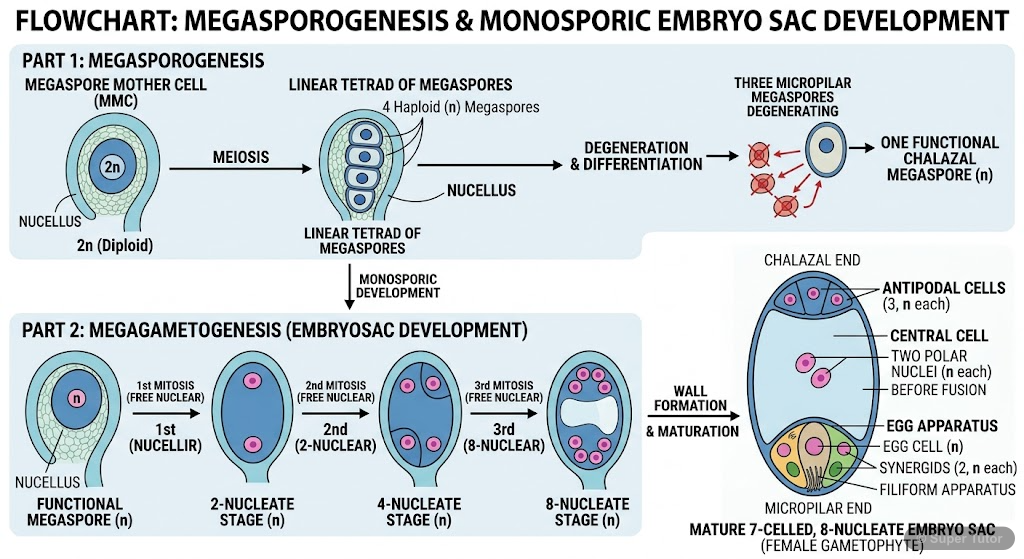
One of 16 illustrations for Sexual Reproduction in Flowering Plants in Super Tutor — alongside flashcards, concept maps and practice questions.
Quick Quiz: Sexual Reproduction in Flowering Plants
0/4Tap an answer to check it instantly. No sign-up needed for these 4.
Which part of the flower represents the male reproductive organ?
A typical anther has how many microsporangia?
The hard outer layer of pollen grain wall is called:
The process of formation of microspores from pollen mother cell is called:
Sample Questions
Which of the following are characteristics of wind-pollinated flowers?
Show answer
Light and non-sticky pollen grains, Well-exposed stamens, Large, feathery stigma
Wind-pollinated flowers have light, non-sticky pollen for easy transport, well-exposed stamens for pollen dispersal, and large feathery stigma to trap airborne pollen. They don't need bright colors or nectar as they don't attract animals.
How many cells are present in a mature embryo sac?
Show answer
Seven
A mature embryo sac is 8-nucleate but 7-celled. It contains 3 cells in egg apparatus (2 synergids + 1 egg), 3 antipodal cells, and 1 large central cell with 2 polar nuclei. The central cell has 2 nuclei but is counted as one cell.
Double fertilization in angiosperms involves:
Show answer
Fusion of one male gamete with egg cell, Fusion of second male gamete with polar nuclei, Formation of diploid zygote, Formation of triploid endosperm nucleus
Double fertilization involves syngamy (male gamete + egg = diploid zygote) and triple fusion (male gamete + 2 polar nuclei = triploid primary endosperm nucleus). This unique process occurs only in angiosperms.
The opening in the ovule through which pollen tube enters is called:
Show answer
Micropyle
The micropyle is a small opening at the tip of the ovule where integuments don't meet, allowing pollen tube entry. Hilum is the junction between ovule and funicle, chalaza is the basal part, and funicle is the stalk of ovule.
+30 more questions on Sexual Reproduction in Flowering Plants (Haryana Board Class 12 Biology)
Practise AllFrequently Asked Questions
What are the important topics in Sexual Reproduction in Flowering Plants for Haryana Board Class 12 Biology?
How many practice questions are there for Sexual Reproduction in Flowering Plants?
Sources & Official References
Content is aligned to the official syllabus. Refer to the board website for the latest curriculum.
More resources for Sexual Reproduction in Flowering Plants
Important Questions
Exam-style questions with answers
Revision Notes
Key points for last-minute revision
Chapter Summary
Understand the chapter at a glance
Concept Maps
See how topics connect
Study Plan
Step-by-step plan for this chapter
Flashcards
Quick-fire cards for active recall
Syllabus
What topics to cover
NCERT Solutions
Every textbook question solved step by step
For serious students
Get the full Sexual Reproduction in Flowering Plants chapter — start free.
Quizzes, flashcards, an AI doubt solver and a study plan for Haryana Board Class 12 Biology. Free to start, no card needed.