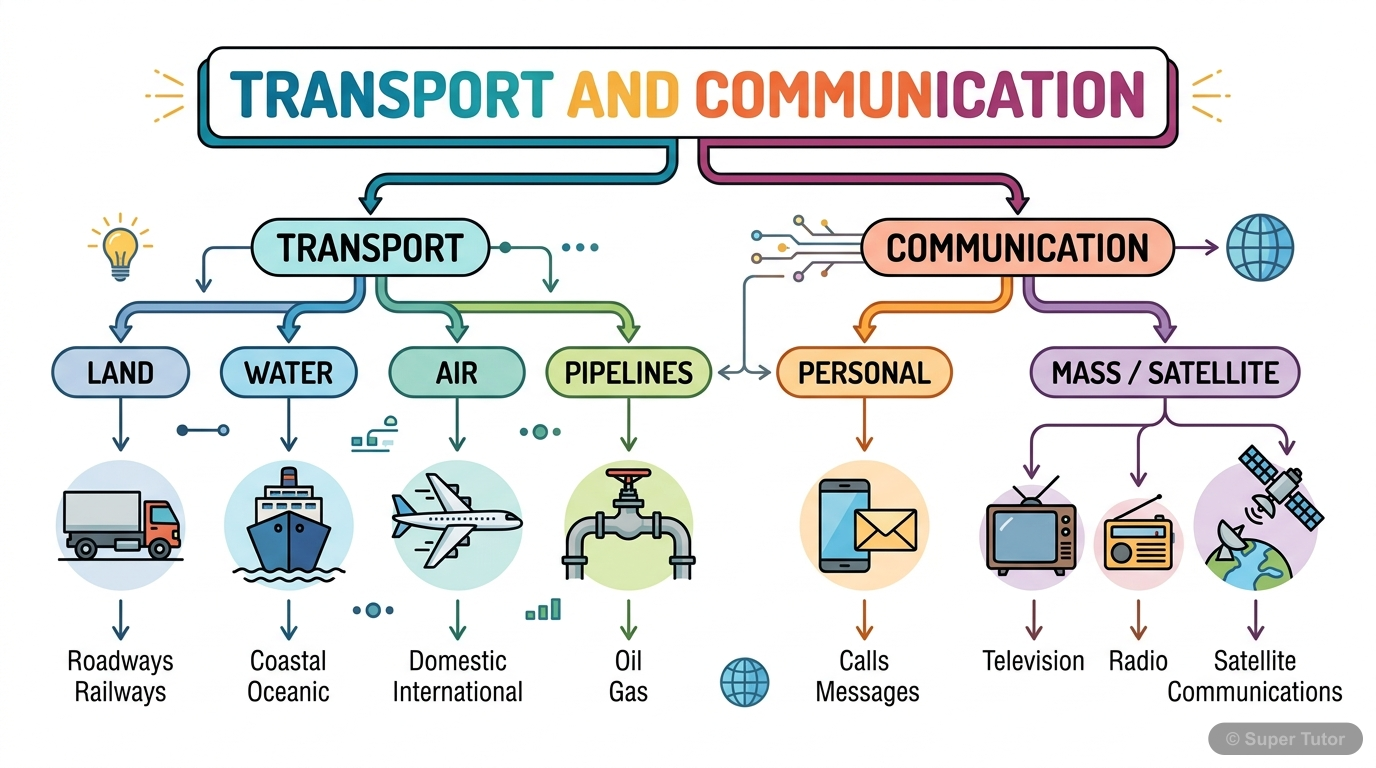
Transport and Communication
Haryana Board · Class 12 · Geography
NCERT Solutions for Transport and Communication — Haryana Board Class 12 Geography.
Interactive on Super Tutor
Studying Transport and Communication? Get the full interactive chapter.
Quizzes, flashcards, AI doubt-solver and a step-by-step study plan — built for ncert solutions and more.
1,000+ Class 12 students started this chapter today

Super Tutor has 9+ illustrations like this for Transport and Communication alone — flashcards, concept maps, and step-by-step visuals.
See them allEXERCISES
1(i)In how many zones has the Indian Railways system been divided?
(a) 9
(b) 12
(c) 17
(d) 14Show solution
The Indian Railways network has been divided into 17 zones for administrative and operational purposes. Each zone is headed by a General Manager and is further divided into divisions. The zones include Northern, Southern, Eastern, Western, Central, North Eastern, Northeast Frontier, South Eastern, South Central, East Central, East Coast, North Central, North Western, South East Central, South Western, West Central, and Metro Railway (Kolkata).
1(ii)On which river and between which two places does the National Water Way No. 1 lie?
(a) The Brahmaputra, Sadiya-Dhubri
(b) The Ganga, Haldia-Prayagraj
(c) West Coast Canal, Kottapuram to Kollam
(d) Godavari-Kakinada PuducherryShow solution
National Waterway No. 1 (NW-1) lies on the river Ganga, stretching between Haldia (in West Bengal) and Prayagraj (in Uttar Pradesh). It has a total length of about 1,620 km and was declared a National Waterway in 1986. It is the longest national waterway in India.
1(iii)In which of the following year was the first radio programme broadcast?
(a) 1911
(b) 1936
(c) 1927
(d) 1923Show solution
The first radio programme in India was broadcast in 1923 by the Radio Club of Bombay. Subsequently, the Indian Broadcasting Service was launched in 1927, and All India Radio (AIR) was established in 1936. Radio remains one of the most widespread means of mass communication in India, especially in rural areas.
2(i)Which activity does transportation convey? Name three major modes of transportation.Show solution
Given/Concept: Transportation is a service or facility by which persons, manufactured goods, and raw materials are carried from one place to another.
Transportation conveys people and goods from one location to another, thereby facilitating trade, commerce, and social interaction. It is the backbone of economic development as it links producers with consumers and integrates markets.
Three major modes of transportation are:
1. Land transport – includes roadways and railways.
2. Water transport – includes inland waterways and oceanic/sea routes.
3. Air transport – includes domestic and international air services.
These modes together form an integrated transport network that supports the economic and social fabric of the country.
2(ii)Discuss advantages and disadvantages of pipeline transportation.Show solution
Concept: Pipelines are used to transport liquids (water, petroleum, natural gas) and even slurry (crushed coal mixed with water) over long distances.
Advantages of Pipeline Transportation:
- It can be laid through difficult terrains (mountains, deserts, under water) where other modes are difficult.
- It involves low running cost and requires minimal maintenance once laid.
- It provides a continuous flow of materials without interruption.
- It is an energy-efficient and environment-friendly mode of transport.
- Reduces road and rail congestion by transporting bulk liquids.
Disadvantages of Pipeline Transportation:
- The initial cost of laying pipelines is very high.
- It is not flexible — once laid, it cannot be easily relocated.
- It is suitable only for liquids, gases, and slurry — not for solid goods.
- Leakages are difficult to detect and can cause environmental damage.
- It is vulnerable to sabotage and accidents.
2(iii)What do you mean by 'communication'?Show solution
Concept: Communication refers to the transmission of information, ideas, and messages from one place or person to another.
Communication is the process by which information, messages, and ideas are transmitted from one individual or place to another. It is a vital service that connects people and enables social, economic, and administrative activities to function smoothly.
Communication can be of two types:
1. Personal communication – such as postal services, telephone, e-mail, etc., which serve individuals.
2. Mass communication – such as radio, television, newspapers, and the internet, which reach large audiences simultaneously.
Modern communication systems, including satellite communication, have revolutionised the way information is shared across the country and the world.
3(i)Which are the chief means of transportation in India? Discuss the factors affecting their development.Show solution
Chief Means of Transportation in India:
India has a vast and diverse transport network. The chief means of transportation are:
1. Roadways – India has one of the largest road networks in the world (about 56 lakh km). Roads include National Highways, State Highways, district roads, and rural roads.
2. Railways – Indian Railways is the largest public sector undertaking and one of the longest rail networks in the world, covering about 67,956 km.
3. Waterways – Both inland waterways (rivers, canals, backwaters) and oceanic routes (major and minor ports) are used.
4. Airways – Air India and private airlines provide domestic and international connectivity.
5. Pipelines – Used for transporting petroleum, natural gas, and water.
Factors Affecting the Development of Transportation:
(a) Physical Factors:
- Relief and Terrain: Plains favour the development of roads and railways, while hilly and mountainous areas make construction difficult and expensive.
- Climate: Heavy rainfall, floods, and extreme temperatures affect the construction and maintenance of transport routes.
- Drainage: Rivers and water bodies can act as barriers or facilitate water transport.
(b) Economic Factors:
- Level of economic development: Industrialised and commercially active regions have better transport networks.
- Availability of capital: Construction and maintenance of transport infrastructure requires huge investment.
- Trade and commerce: Areas with high trade activity develop better transport links.
(c) Administrative and Political Factors:
- Government policies and planning play a crucial role in the development of transport.
- Strategic and defence considerations influence the development of roads and railways in border areas.
(d) Technological Factors:
- Advances in technology have enabled construction of tunnels, bridges, and expressways in difficult terrains.
(e) Population and Demand:
- Densely populated areas generate higher demand for transport, leading to better development of transport networks.
Thus, the development of transportation in India is influenced by a complex interplay of physical, economic, social, and political factors.
3(ii)Give a detailed account of the development of railways in India and highlight their importance.Show solution
Development of Railways in India:
The history of Indian Railways is one of the most remarkable stories of infrastructure development.
- The first railway line in India was laid between Mumbai (Bombay) and Thane in 1853, covering a distance of 34 km. This marked the beginning of the railway era in India.
- Under British rule, railways were expanded primarily to serve colonial interests — to transport raw materials from the interior to ports and to move troops.
- After Independence in 1947, the government took over the management of railways and began systematic expansion and modernisation.
- In 1951, all railway companies were nationalised and integrated into a single unit — Indian Railways.
- The network was reorganised into zones for better administration. Currently, there are 17 zones.
- The total route length of Indian Railways is approximately 67,956 km, making it one of the largest rail networks in the world.
- Indian Railways operates different gauges: Broad Gauge (1.676 m), Metre Gauge (1.0 m), and Narrow Gauge (0.762 m and 0.610 m). The government has been working on gauge conversion to unify the network.
- Modern developments include introduction of Rajdhani, Shatabdi, Duronto, Vande Bharat express trains, electrification of routes, and computerised reservation systems.
- The Konkan Railway is a major achievement, passing through difficult terrain along the western coast.
- The Metro Rail systems in cities like Delhi, Mumbai, Kolkata, and Bengaluru have eased urban congestion.
Importance of Railways:
1. Economic Development: Railways facilitate the movement of raw materials to industries and finished goods to markets, thus boosting trade and commerce.
2. Integration of Markets: They link distant markets and help in price stabilisation of commodities across the country.
3. Employment: Indian Railways is one of the largest employers in the world, providing direct and indirect employment to millions.
4. Social Integration: Railways bring people of different regions, cultures, and languages together, promoting national unity.
5. Agricultural Development: They help in the quick transport of perishable agricultural produce to distant markets.
6. Strategic Importance: Railways are vital for the movement of troops and military equipment during national emergencies.
7. Tourism: Railways promote tourism by connecting important tourist destinations.
8. Passenger Transport: They carry millions of passengers daily at affordable fares, making long-distance travel accessible to the common man.
Thus, Indian Railways is truly the lifeline of the nation, playing a pivotal role in its economic, social, and strategic development.
3(iii)Describe the role of roads in the economic development of India.Show solution
Introduction:
Roads are the most common and widely used mode of transport in India. India has one of the largest road networks in the world, with a total length of about 56 lakh km. Roads play a crucial role in the economic development of the country.
Role of Roads in Economic Development:
(1) Connecting Remote Areas:
Roads are the only means of transport that can reach remote, hilly, and tribal areas where railways and airways cannot penetrate. The Pradhan Mantri Gram Sadak Yojana (PMGSY) has connected thousands of villages with all-weather roads, integrating them into the national economy.
(2) Supporting Agriculture:
- Roads help farmers transport agricultural produce from fields to local markets (mandis) and from mandis to distant urban centres.
- They reduce post-harvest losses by enabling quick movement of perishable goods like fruits, vegetables, and dairy products.
- Fertilisers, seeds, and agricultural machinery can be easily transported to rural areas.
(3) Facilitating Industrial Development:
- Roads connect raw material sources to industries and finished goods to markets.
- They serve as feeder routes to railways, ports, and airports, completing the transport chain.
- Industrial corridors and special economic zones (SEZs) depend heavily on road connectivity.
(4) Promoting Trade and Commerce:
- Roads enable door-to-door delivery of goods, which railways and waterways cannot provide.
- They facilitate both inter-state and intra-state trade.
- National Highways (NHs) and Expressways like the Golden Quadrilateral (connecting Delhi, Mumbai, Chennai, and Kolkata) have greatly boosted trade.
(5) Employment Generation:
- Road construction and maintenance provide employment to millions of unskilled and semi-skilled workers.
- The transport sector (truck drivers, mechanics, loaders) employs a large workforce.
(6) Tourism Development:
- Good road connectivity promotes domestic tourism by making pilgrimage sites, hill stations, and heritage sites accessible.
- Border Roads Organisation (BRO) has constructed roads in strategic border areas, also opening them for tourism.
(7) Emergency and Strategic Use:
- Roads are vital during natural disasters for relief and rescue operations.
- They are strategically important for the movement of defence personnel and equipment.
(8) Urban Development:
- Ring roads, flyovers, and expressways reduce congestion in cities and improve urban mobility, thereby increasing productivity.
Conclusion:
Roads are the arteries of the Indian economy. They not only connect people and places but also drive agricultural growth, industrial expansion, trade, and social development. Investment in road infrastructure has a multiplier effect on the overall economy, making it one of the most important priorities of national planning.
ProjectFind out the facilities that Indian Railways provide to the passengers.Show solution
Indian Railways, being one of the largest railway networks in the world, provides a wide range of facilities to its passengers. Some of the key facilities are:
1. Classes of Travel:
- Indian Railways offers multiple classes to suit different budgets: First Class AC (1A), Second AC (2A), Third AC (3A), AC Chair Car (CC), Sleeper Class (SL), Second Sitting (2S), and General/Unreserved (GEN).
2. Reservation and Ticketing:
- Online booking through the IRCTC website and mobile app.
- Booking through railway reservation counters and authorised agents.
- Tatkal and Premium Tatkal quota for last-minute bookings.
- PRS (Passenger Reservation System) for computerised reservations.
3. Catering Services:
- Pantry cars in long-distance trains provide meals, snacks, and beverages.
- IRCTC e-catering allows passengers to order food from restaurants at select stations.
- Vending machines and food stalls on major platforms.
4. Passenger Amenities at Stations:
- Waiting rooms (general, ladies, and AC waiting rooms).
- Retiring rooms and dormitories for short stays.
- Drinking water facilities and clean toilets.
- Cloak rooms for luggage storage.
- ATMs, medical facilities, and first-aid centres.
- Wi-Fi connectivity at major stations.
5. Concessions:
- Special fare concessions for senior citizens, students, differently-abled persons, journalists, cancer patients, and war widows.
6. Safety and Security:
- Railway Protection Force (RPF) and Government Railway Police (GRP) for passenger safety.
- CCTV surveillance at major stations.
- Emergency helpline numbers (139 for railway enquiry and complaints).
7. Special Trains and Services:
- Vande Bharat Express, Rajdhani, Shatabdi, Duronto for fast and comfortable travel.
- Humsafar Express (fully AC third-tier trains) and Antyodaya Express (fully unreserved trains for common people).
- Tourist trains like the Palace on Wheels and Deccan Odyssey for luxury tourism.
8. Accessibility for Differently-Abled:
- Ramps, lifts, and specially designed coaches for physically challenged passengers.
- Braille signage at select stations.
9. Freight and Parcel Services:
- Facility to book luggage and parcels through the railway parcel service.
10. Digital Services:
- Real-time train tracking through the NTES (National Train Enquiry System).
- SMS alerts for train status and PNR enquiry.
- Rail Madad app for lodging complaints and feedback.
Conclusion:
Indian Railways continuously upgrades its facilities to improve passenger comfort, safety, and convenience. It remains the most affordable and accessible mode of long-distance travel for millions of Indians.
Stuck on a step?
Ask Super Tutor AI to explain any solution on this page in a simpler way — free, 24x7.
Ask a Doubt FreeFrequently Asked Questions
What are the important topics in Transport and Communication for Haryana Board Class 12 Geography?
How to score full marks in Transport and Communication — Haryana Board Class 12 Geography?
Where can I get free NCERT Solutions for Transport and Communication Class 12 Geography?
Sources & Official References
Content is aligned to the official syllabus. Refer to the board website for the latest curriculum.
More resources for Transport and Communication
Important Questions
Practice with board exam-style questions
Syllabus
What topics to cover
Revision Notes
Key points for last-minute revision
Study Plan
Step-by-step plan to ace this chapter
Flashcards
Quick-fire cards for active recall
Formula Sheet
All formulas in one place
Chapter Summary
Understand the chapter at a glance
Practice Quiz
Test yourself with a quick quiz
Concept Maps
See how topics connect visually
For serious students
Get the full Transport and Communication chapter — for free.
Quizzes, flashcards, AI doubt-solver and a step-by-step study plan for Haryana Board Class 12 Geography.