Bhakti - Sufi Traditions: Changes in Religious Beliefs and Devotional Texts — Chapter Summary
Haryana Board · Class 12 · History
Summary of Bhakti - Sufi Traditions: Changes in Religious Beliefs and Devotional Texts for Haryana Board Class 12 History.
Interactive on Super Tutor
Studying Bhakti - Sufi Traditions: Changes in Religious Beliefs and Devotional Texts? Get the full interactive chapter.
Quizzes, flashcards, AI doubt-solver and a step-by-step study plan — built for chapter summary and more.
Free trial, no card needed.
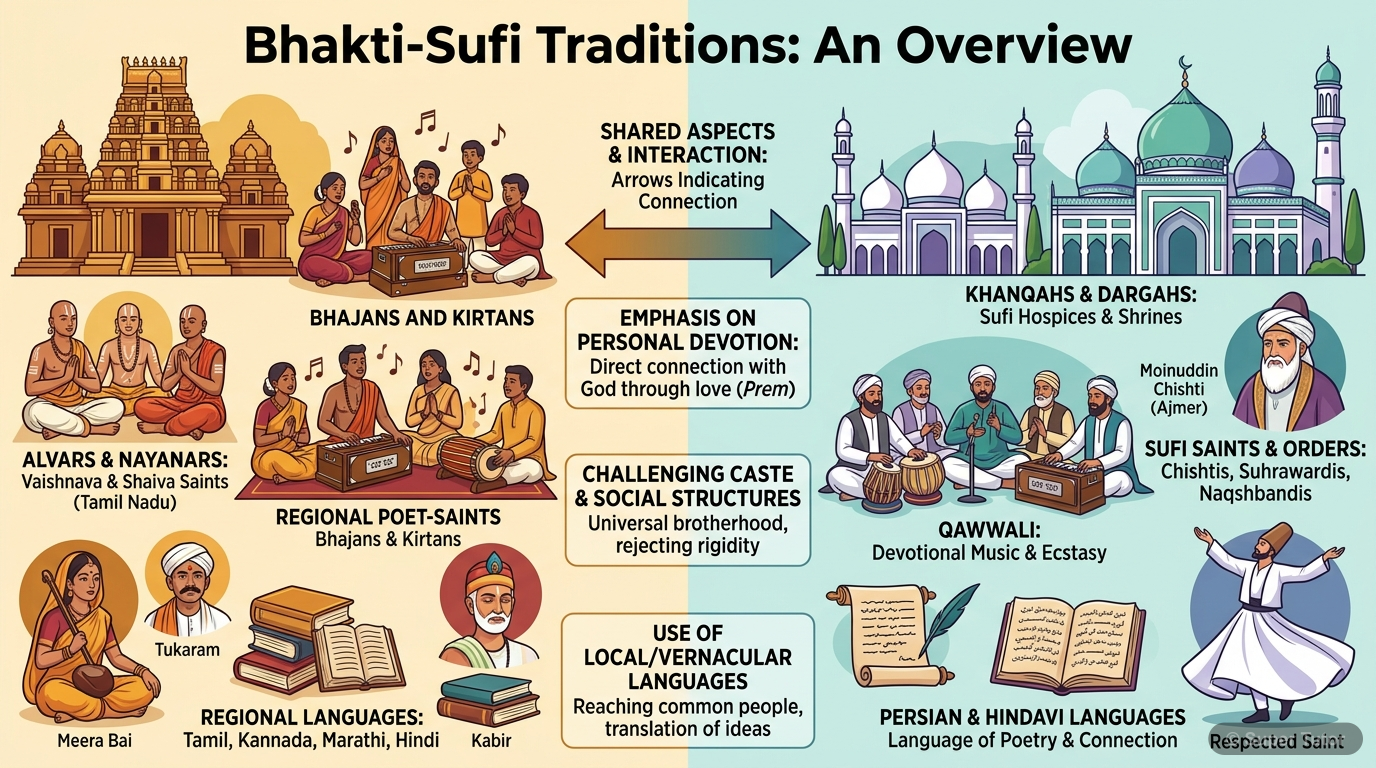
One of 15 illustrations for Bhakti - Sufi Traditions: Changes in Religious Beliefs and Devotional Texts in Super Tutor — alongside flashcards, concept maps and practice questions.
Overview
Bhakti and Sufi traditions transformed religious life in the subcontinent between about the eighth and eighteenth centuries. These traditions gave importance to devotion, personal experience, vernacular languages, poetry, music, and direct relationship with the divine. They also reshaped ideas about
Key Concepts
Bhakti traditions centred on loving devotion
Bhakti traditions centred on loving devotion to a personal or abstract divine being. They included worship of Vishnu, Shiva, goddess forms, and also f
Saguna bhakti worships a deity
Saguna bhakti worships a deity with attributes and form, while nirguna bhakti worships an abstract, formless divine reality.
The Alvars were devotees of Vishnu
The Alvars were devotees of Vishnu and the Nayanars were devotees of Shiva in Tamil Nadu. Their hymns in Tamil expressed intense devotion and challeng
The Nalayira Divyaprabandham became known as
The Nalayira Divyaprabandham became known as the Tamil Veda, and the Tevaram collected the poems of Appar, Sambandar, and Sundarar. These texts were c
Andal
Andal, a woman Alvar, saw herself as the beloved of Vishnu. Karaikkal Ammaiyar, a woman devotee of Shiva, adopted extreme asceticism and described her
Learning Objectives
- Understand the meaning of bhakti and sufi traditions and their major features
- Explain the difference between saguna and nirguna devotion
- Describe the roles of the Alvars, Nayanars, Lingayats, Kabir, Guru Nanak, Mirabai, and Shankaradeva
- Understand the organisation of sufi life through khanqahs, silsilas, dargahs, and devotional practices
- Recognise how devotional traditions interacted with caste, gender, royal power, and local cultures
Frequently Asked Questions
What are the important topics in Bhakti - Sufi Traditions: Changes in Religious Beliefs and Devotional Texts for Haryana Board Class 12 History?
How should I revise Bhakti - Sufi Traditions: Changes in Religious Beliefs and Devotional Texts for the Haryana Board Class 12 board exam?
Sources & Official References
Content is aligned to the official syllabus. Refer to the board website for the latest curriculum.
More resources for Bhakti - Sufi Traditions: Changes in Religious Beliefs and Devotional Texts
Practice Quiz
Test yourself with a quick quiz
Important Questions
Exam-style questions with answers
Revision Notes
Key points for last-minute revision
Concept Maps
See how topics connect
Study Plan
Step-by-step plan for this chapter
Flashcards
Quick-fire cards for active recall
Syllabus
What topics to cover
NCERT Solutions
Every textbook question solved step by step
For serious students
Get the full Bhakti - Sufi Traditions: Changes in Religious Beliefs and Devotional Texts chapter — start free.
Quizzes, flashcards, an AI doubt solver and a study plan for Haryana Board Class 12 History. Free to start, no card needed.