Chapter 7 of 12
NCERT Solutions

Kinship, Caste and Class (Early Societies) (c. 600 BCE-600 CE)

Haryana Board · Class 12 · History

NCERT Solutions for Kinship, Caste and Class (Early Societies) (c. 600 BCE-600 CE) — Haryana Board Class 12 History.

34 questions20 flashcards5 concepts

Interactive on Super Tutor

Studying Kinship, Caste and Class (Early Societies) (c. 600 BCE-600 CE)? Get the full interactive chapter.

Quizzes, flashcards, AI doubt-solver and a step-by-step study plan — built for ncert solutions and more.

1,000+ Class 12 students started this chapter today

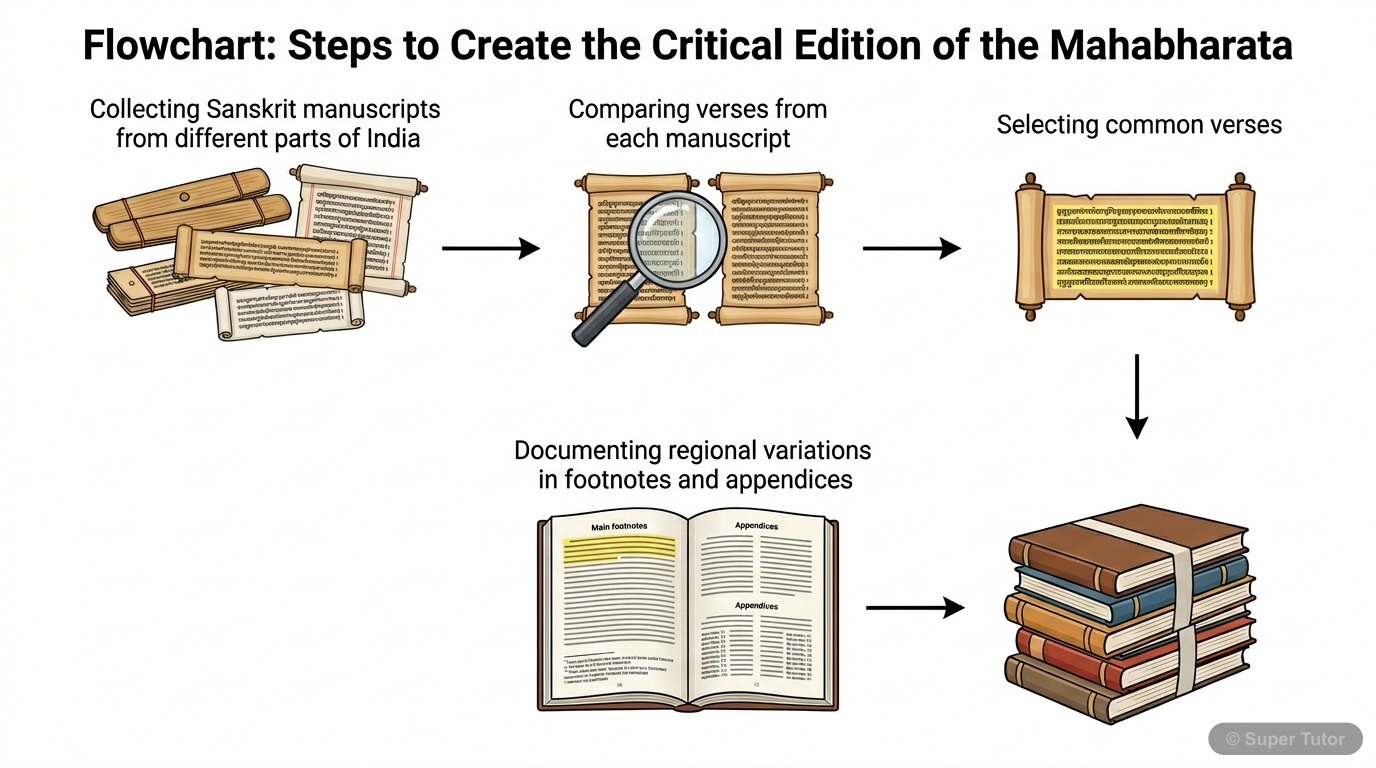
A flowchart illustrating the key steps involved in creating the Critical Edition of the Mahabharata, from collecting manuscripts to publishing the final volumes with variations.
Super Tutor

Learn better with visuals Super Tutor has hundreds of illustrations like this across every chapter — all free to try.

Get started
28 Questions Solved · 5 Sections

Source-Based Intext Questions

Source 1In the context of the mantra from the Rigveda, discuss the implications of marriage from the point of view of the bride and groom. Are the implications identical, or are there differences?Show solution
Given: The mantra reads – 'I free her from here, but not from there. I have bound her firmly there, so that through the grace of Indra she will have fine sons and be fortunate in her husband's love.' 'Here' refers to the father's house and 'there' to the husband's house.

Implications for the Bride:
1. Marriage meant a complete transfer of the woman from her father's household to her husband's household. She was 'freed' from one place only to be 'bound' in another.
2. Her primary purpose, as stated in the mantra, was to produce 'fine sons' – i.e., male heirs – indicating that her reproductive role was central to the institution of marriage.
3. She had no independent identity; her worth was measured by her ability to bear sons and by her husband's love.
4. The mantra suggests she had no agency or choice in the matter – the priest, acting on behalf of the father, 'bound' her to the husband's house.

Implications for the Groom:
1. The mantra does not place any obligations or restrictions on the groom. He is not 'bound' anywhere.
2. He receives a wife whose purpose is to serve him and bear his children.
3. His identity, property, and freedom remain unchanged.

Conclusion: The implications are NOT identical. Marriage was a deeply asymmetrical institution. For the bride, it meant a loss of her natal home, loss of freedom, and a new set of obligations (bearing sons, being devoted to the husband). For the groom, it meant gaining a wife and heirs, with no corresponding loss of freedom or identity. This reflects the patrilineal and patriarchal nature of early Indian society where women were transferred from one male authority (father) to another (husband).
Source 2Read the passage from the Adi Parvan of the Mahabharata and list the different criteria suggested for becoming king. Of these, how important was birth in a particular family? Which of these criteria seem justified? Are there any that strike you as unjust?Show solution
Given: The passage describes the conflict between Kauravas and Pandavas over succession to the throne of Hastinapura.

Criteria suggested for becoming king (as evident from the passage):
1. Birth in the royal family (patrilineal descent) – Pandu's sons (Pandavas) were seen as natural heirs because Pandu had held the throne.
2. Physical and mental capability – The citizens preferred the Pandavas because they were 'more capable and virtuous.'
3. Virtue/moral character – The Pandavas were described as more virtuous.
4. Seniority/age – Dhritarashtra was the elder brother but was passed over due to his blindness.
5. Physical fitness/absence of disability – Dhritarashtra was denied the throne because of his blindness (his 'defect').

Importance of birth:
Birth in a particular family was the most fundamental criterion. The entire conflict arose because both the Kauravas and Pandavas were born into the royal lineage. Duryodhana's argument was entirely based on patrilineal succession – that if the Pandavas inherited, their sons and grandsons would continue to rule, excluding the Kauravas. This shows that birth was the primary determinant of eligibility.

Justified criteria:
- Capability and virtue seem the most justified criteria, as a capable and virtuous ruler would govern better and serve the people's interests.
- The citizens' preference for the Pandavas on grounds of capability reflects a merit-based view.

Unjust criteria:
- Excluding Dhritarashtra solely on the basis of physical disability (blindness) appears unjust, as disability does not necessarily affect one's wisdom or ability to rule.
- The idea that birth alone should determine kingship, regardless of merit, also seems unjust, as it could lead to incompetent rulers.
- Duryodhana's concern was purely self-interest (fear of exclusion), not the welfare of the kingdom or its people.
Source 3 (Eight forms of marriage)For each of the forms of marriage described in the Manusmriti, discuss whether the decision about the marriage was taken by (a) the bride, (b) the bridegroom, (c) the father of the bride, (d) the father of the bridegroom, (e) any other person.Show solution
Given: The Manusmriti describes eight forms of marriage. The first, fourth, fifth and sixth are given.

First Form (Brahma marriage):
- The father selects a learned Vedic scholar and gifts his daughter to him with costly clothes and jewels.
- Decision taken by: (c) the father of the bride. The bride and groom have no say. The father chooses the groom and initiates the marriage.

Fourth Form (Prajapatya marriage):
- The father addresses the couple with the text 'May both of you perform your duties together' and honours the bridegroom.
- Decision taken by: (c) the father of the bride, primarily. He selects the groom and performs the ceremony. The couple is addressed together, suggesting a slight acknowledgement of both parties, but the father retains control.

Fifth Form (Asura marriage):
- The bridegroom gives wealth to the kinsmen and to the bride herself according to his own will, and receives the maiden.
- Decision taken by: (b) the bridegroom. He decides how much wealth to give and takes the bride. The bride's kinsmen also play a role in accepting the wealth. The bride herself receives gifts but does not appear to have a decisive voice.

Sixth Form (Gandharva marriage):
- The voluntary union of a maiden and her lover, which springs from desire.
- Decision taken by: (a) the bride and (b) the bridegroom jointly. This is the only form where both parties exercise free will and mutual consent. It is based on love and desire.

Overall observation: In most forms, the father of the bride or the bridegroom held decision-making power. Only the sixth (Gandharva) form gave agency to both the bride and groom. The Brahmanical texts considered the first four forms 'good' and the remaining (including the Gandharva) as less desirable, which reflects the patriarchal control over women's lives.
Source 4How many Gotami-putas and how many Vasithi (alternative spelling Vasathi)-putas are there in the list of Satavahana kings?Show solution
Given: The list of Satavahana rulers from inscriptions is:
1. raja Gotami-puta Siri-Satakani
2. raja Vasithi-puta (sami-) Siri-Pulumayi
3. raja Gotami-puta sami-Siri-Yana-Satakani
4. raja Madhari-puta svami-Sakasena
5. raja Vasathi-puta Chatarapana-Satakani
6. raja Hariti-puta Vinhukada Chutukulanamda-Satakamni
7. raja Gotami-puta Siri-Vijaya-Satakani

Counting:
- Gotami-putas: Rulers 1, 3, and 7 → Total = 3 Gotami-putas
- Vasithi/Vasathi-putas: Rulers 2 and 5 → Total = 2 Vasithi/Vasathi-putas

Significance: The use of metronymics (names derived from the mother's name) among Satavahana rulers is notable. The gotra names Gotami and Vasithi are feminine forms of the Vedic seers Gotama and Vasistha. This shows that Satavahana women retained their father's gotra names even after marriage, which was contrary to Brahmanical rules that required women to adopt their husband's gotra upon marriage.
Source 5Does the passage about Gandhari's advice to Duryodhana give you an idea about the way in which mothers were viewed in early Indian societies?Show solution
Given: Gandhari appeals to Duryodhana to make peace with the Pandavas, citing dharma, wisdom, self-control, and the futility of war. Duryodhana ignores her advice.

What the passage reveals about the status of mothers:

1. Moral authority: Gandhari's appeal shows that mothers were regarded as moral guides and voices of wisdom. She invokes dharma, artha, and the welfare of the kingdom – suggesting that mothers were expected to uphold ethical values.

2. Emotional bond: Duryodhana is expected to honour his mother's wishes ('By making peace you honour your father and me'). This indicates that a mother's approval was considered important and that sons were expected to respect their mothers.

3. Limited political power: Despite her wisdom and moral authority, Gandhari's advice was ignored by Duryodhana. This suggests that while mothers were respected, they did not hold real political or decision-making power. Their role was advisory, not authoritative.

4. Metronymics and symbolic importance: The use of metronymics among Satavahana rulers (as discussed in the chapter) suggests that mothers were symbolically important, even if succession was patrilineal.

Conclusion: Mothers in early Indian societies were viewed with great respect as moral authorities and emotional anchors of the family. However, their actual power was limited – they could advise but not command. The episode of Gandhari illustrates both the reverence accorded to mothers and the limits of their influence in a patriarchal society.
Source 6Why do you think the Brahmanas quoted the verse from the Purusha sukta (Rigveda) frequently?Show solution
Given: The Purusha sukta verse states that the Brahmana was born from the mouth of Purusha (the primeval man), the Kshatriya from his arms, the Vaishya from his thighs, and the Shudra from his feet.

Reasons why Brahmanas quoted this verse frequently:

1. Divine sanction for social hierarchy: By claiming that the varna system originated from the sacrifice of a cosmic being (Purusha), Brahmanas gave the social order a divine and sacred origin. This made it difficult to question or challenge the hierarchy.

2. Justification of Brahmanical supremacy: The verse placed Brahmanas at the top (born from the mouth – the most sacred part, associated with speech, knowledge, and the Vedas). Frequent citation reinforced their claim to the highest social position.

3. Legitimising the subordination of Shudras: The Shudra's birth from the feet (the lowest part of the body) was used to justify their servile status and restricted occupations.

4. Resistance to challenges: As political power shifted and non-Kshatriya kings emerged, and as Buddhist and other traditions challenged the varna order, Brahmanas needed a powerful counter-argument. A verse from the sacred Rigveda provided unquestionable authority.

5. Universal applicability: By rooting the varna system in a cosmic event, Brahmanas claimed that it was not a human invention but a universal, eternal truth that everyone was obliged to follow.

Conclusion: The frequent citation of the Purusha sukta was a deliberate ideological strategy to naturalise and sacralise social inequality, making the varna hierarchy appear divinely ordained and therefore beyond human questioning.
Source 7(a) What message do you think the story of Ekalavya was meant to convey to the nishadas? (b) What message would it convey to Kshatriyas? (c) Do you think that Drona, as a Brahmana, was acting according to the Dharmasutras when he was teaching archery?Show solution
Given: The story describes how Ekalavya, a nishada (forest-dwelling hunting community), was refused as a pupil by Drona (a Brahmana archery teacher). Ekalavya taught himself using a clay image of Drona, became supremely skilled, but was asked to give his right thumb as guru-dakshina (teacher's fee), which he did, thereby losing his superior skill.

(a) Message to the nishadas:
- The story conveyed that people from 'lower' or 'outside' communities should not aspire to skills and occupations reserved for higher varnas (in this case, archery, which was a Kshatriya skill).
- Even if a nishada acquired such skills through hard work, the social order would find a way to neutralise the threat he posed to the established hierarchy.
- The message was one of resignation and acceptance of one's assigned social role – nishadas were hunters, not warriors or archers.
- It also warned that challenging the social order, even indirectly, would result in loss and punishment.

(b) Message to Kshatriyas:
- The story reassured Kshatriyas that their monopoly over martial skills (like archery) would be protected.
- It showed that Brahmanas (like Drona) would act as guardians of the varna order, ensuring that lower-born individuals did not surpass Kshatriya warriors.
- It also reinforced the bond between Brahmanas and Kshatriyas – Drona protected Arjuna's supremacy, and by extension, Kshatriya dominance in warfare.

(c) Was Drona acting according to the Dharmasutras?
- According to the Dharmasutras, Brahmanas were supposed to study and teach the Vedas, perform sacrifices, and give/receive gifts. Teaching archery was not listed as a Brahmanical occupation.
- Archery and warfare were prescribed for Kshatriyas.
- Therefore, strictly speaking, Drona was NOT acting according to the Dharmasutras when he taught archery. He was performing a Kshatriya function.
- However, the Dharmasutras also allowed Brahmanas to take up other occupations in times of distress (apad-dharma). Drona may have been justified under this provision.
- This also illustrates that in practice, the rigid varna-based occupational rules were not always followed, even by those who upheld the system.
Source 8Do you think the silk weavers were following the occupation laid down for them in the Shastras?Show solution
Given: The inscription from Mandasor describes silk weavers who had migrated from Lata (Gujarat) to Dashapura (Mandasor). The excerpt describes members of the guild as being engaged in music, writing biographies, religious discourses, Vedic astronomy, and even warfare – activities far beyond weaving.

Answer:
No, the silk weavers were clearly NOT following only the occupation laid down for them in the Shastras.

1. According to the Shastras, occupations were determined by varna. Weavers would likely have been classified as Vaishyas or Shudras, whose prescribed occupations were trade, agriculture, pastoralism (Vaishyas) or service (Shudras). Weaving as a craft was a specific occupational identity.

2. However, the inscription reveals that members of the weavers' guild had diversified into:
- Music (a cultural/artistic pursuit)
- Writing biographies (a literary/scholarly activity, closer to Brahmanical learning)
- Religious discourses (again, a Brahmanical domain)
- Vedic astronomy (explicitly a Brahmanical/scholarly field)
- Warfare (a Kshatriya occupation)

3. This shows that in practice, people did not confine themselves to the occupations prescribed by the Shastras. Economic prosperity, urbanisation, and social mobility allowed craft communities to pursue diverse activities.

4. The guild also collectively decided to build a temple – an act of religious patronage that transcended their assigned social role.

Conclusion: The evidence from the Mandasor inscription clearly demonstrates that Brahmanical prescriptions about occupational roles were not universally followed. Real social life was far more complex and fluid than the ideal varna order suggested.
Source 9Identify the practices described in the story of Hidimba which seem non-Brahmanical.Show solution
Given: The story describes how Hidimba, a rakshasa woman, fell in love with Bhima, proposed to him, and eventually married him. Their son Ghatotkacha was born and later rejoined the Pandavas when needed.

Non-Brahmanical practices identified in the story:

1. A woman proposing marriage: Hidimba herself proposed to Bhima. In Brahmanical norms, marriage was arranged by the father (kanyadana), and women had no agency in choosing their husbands. A woman taking the initiative to propose was contrary to Brahmanical ideals.

2. Inter-community/inter-varna marriage: The marriage between a Kshatriya (Bhima, a Pandava prince) and a rakshasa woman was a cross-community union. Brahmanical texts generally discouraged such unions and prescribed marriage within one's own varna.

3. The nature of the union: The marriage was based on love and desire (similar to the Gandharva form), which was considered the sixth and less desirable form of marriage in the Manusmriti. It was not arranged by a father or conducted with Vedic rituals.

4. Living arrangement: The couple spent days together but Bhima returned every night – an unconventional arrangement not prescribed in Brahmanical texts.

5. The rakshasa's way of life: Rakshasas were associated with eating flesh, living in forests, shape-shifting, and other practices considered impure or uncivilised by Brahmanical standards.

6. Abandonment of kin and dharma: Hidimba declared that she had 'forsaken her friends, her dharma and her kin' for Bhima – suggesting that she was consciously stepping outside her community's norms.

Conclusion: The story reflects the integration of non-Brahmanical communities and practices into the Mahabharata narrative, suggesting that the text recorded a diversity of social practices that existed beyond the Brahmanical framework.
Source 10Identify elements in the story of Matanga from the Matanga Jataka that suggest that it was written from the perspective of Matanga.Show solution
Given: The story from the Matanga Jataka describes how Matanga, a chandala (considered 'untouchable'), attained spiritual powers, married a merchant's daughter, and was later rejected by his own son Mandavya (who had become a Brahmanical scholar) when he came begging.

Elements suggesting the story is written from Matanga's perspective:

1. Matanga is the hero and the Bodhisattva: The story identifies Matanga as the Bodhisattva (the Buddha in a previous birth). This immediately elevates him to the highest spiritual status, directly challenging the Brahmanical notion that chandalas were spiritually inferior.

2. Matanga's spiritual superiority: Despite being born a chandala, Matanga attains great spiritual powers through renunciation. This suggests that birth does not determine spiritual worth – a central Buddhist argument against the varna system.

3. Critique of Brahmanical pride: Matanga's statement – 'Those who are proud of their birth and are ignorant do not deserve gifts. On the contrary, those who are free from vices are worthy of offerings' – is a direct critique of Brahmanical claims to superiority based on birth. This is clearly Matanga's (and the Buddhist) viewpoint.

4. Mandavya's rejection is shown as wrong: The story portrays Mandavya's refusal to give food to his own father (because he looked like an outcaste) as morally reprehensible. The narrative condemns the son's behaviour, siding with Matanga.

5. Dittha Mangalika's repentance: The merchant's daughter, who had initially insulted Matanga, later begs his forgiveness. This vindicates Matanga and shows that those who discriminated against him were ultimately in the wrong.

6. The power of Matanga's leftover food: The story ends with Matanga's leftover food being given to Mandavya and the Brahmanas – suggesting that a chandala's spiritual merit was greater than that of the Brahmanas he fed.

Conclusion: The story is clearly written from a Buddhist perspective that champions Matanga's cause, critiques caste-based discrimination, and argues that virtue and spiritual attainment, not birth, determine a person's worth.
Source 11Do you think that the episode of Draupadi being staked in the dice game suggests that wives could be treated as the property of their husbands?Show solution
Given: Yudhisthira staked Draupadi in a game of dice after losing everything else, including himself. Two contrary opinions were expressed: (1) even if Yudhisthira had lost himself, his wife remained under his control; (2) an unfree man could not stake another person. The matter remained unresolved.

Analysis:

Arguments suggesting wives were treated as property:
1. The very act of staking Draupadi in a dice game implies that Yudhisthira considered her his possession, like gold, elephants, or his kingdom.
2. The first opinion expressed in the text explicitly states that 'his wife remained under his control' even after he had lost himself – treating her as an object that could be owned and transferred.
3. The Manusmriti and other Dharmashastra texts gave husbands significant control over their wives' movements and property, reinforcing the idea of wives as dependents under male authority.
4. Women could not claim a share of the paternal estate, and their stridhana (personal wealth) was also subject to the husband's permission – indicating limited economic autonomy.

Arguments against this interpretation:
1. The second opinion in the text challenges Yudhisthira's right to stake Draupadi, suggesting that even in early Indian society, there were voices that questioned the treatment of women as property.
2. Draupadi herself challenged the assembly, asking whether Yudhisthira had the right to stake her. Her protest shows that women were not entirely passive.
3. Dhritarashtra ultimately restored freedom to both the Pandavas and Draupadi, suggesting that her enslavement was not considered fully legitimate.

Conclusion: Yes, the episode does suggest that in the social context of the time, wives could be (and were) treated as property by their husbands. However, the text itself presents this as a contested and morally ambiguous act, indicating that there were dissenting voices even within early Indian society. The episode reflects the patriarchal nature of the society while also hinting at its contradictions.
Source 12Compare and contrast the ways in which men and women could acquire wealth according to the Manusmriti.Show solution
Given: According to the Manusmriti:
- Men's seven means of acquiring wealth: inheritance, finding, purchase, conquest, investment, work, and acceptance of gifts from good people.
- Women's six means: gifts received at marriage (in front of the fire), gifts during the bridal procession, tokens of affection, gifts from brother/mother/father, subsequent gifts, and gifts from an 'affectionate' husband.

Comparison:

Similarities:
1. Both men and women could receive gifts as a means of acquiring wealth.
2. Both could inherit wealth (though the conditions differed significantly).

Differences:

| Aspect | Men | Women |
|---|---|---|
| Number of means | 7 | 6 |
| Nature of means | Active and independent (work, purchase, conquest, investment) | Passive and dependent (gifts from family members, husband) |
| Economic agency | High – men could earn through work, trade, investment | Low – women depended almost entirely on gifts from others |
| Conquest | Men could acquire wealth through conquest (warfare) | No such provision for women |
| Investment | Men could invest and earn returns | No such provision for women |
| Work | Men could earn through their own labour | No independent earning through work mentioned |
| Source of wealth | Self-generated as well as received | Almost entirely received from others (father, brother, husband) |

Conclusion: The contrast is stark. Men had multiple active, independent means of acquiring wealth through their own efforts (work, investment, conquest, purchase). Women's means were almost entirely passive and dependent on the goodwill of male relatives (father, brother, husband). This reflects the deeply patriarchal nature of early Indian society, where women had limited economic autonomy and were financially dependent on men throughout their lives – first on their father, then on their husband.
Source 13What does the dialogue between Avantiputta and Kachchana (from the Majjhima Nikaya) reveal about Buddhist attitudes towards varna?Show solution
Given: Kachchana (a disciple of the Buddha) asks King Avantiputta whether a wealthy Shudra could command the service of Brahmanas, Kshatriyas, and Vaishyas. Avantiputta agrees that wealth, not birth, determines social relations. Kachchana then asks whether the four varnas are not exactly the same, and Avantiputta concedes.

Buddhist attitudes towards varna as revealed by this passage:

1. Rejection of birth-based hierarchy: The dialogue directly challenges the Brahmanical claim that varna is determined by birth and is divinely ordained. By showing that a wealthy Shudra can command the service of Brahmanas, the text argues that birth is irrelevant to actual social power.

2. Wealth as the real determinant of status: The Buddhist text suggests that in practice, economic power (wealth) determines social relationships, not ritual purity or birth. This is a materialist critique of the varna system.

3. Equality of all varnas: Kachchana's conclusion – 'are not these four varnas exactly the same?' – reflects the Buddhist belief in the fundamental equality of all human beings, regardless of their birth.

4. Critique of Brahmanical claims: The passage directly addresses and refutes Brahmanical claims of being 'sons of Brahma,' 'born of his mouth,' and being the 'best caste.' The Buddhist text treats these as unfounded assertions.

5. Social differences are not natural or inflexible: Unlike the Brahmanical view that the varna order was eternal and divinely created, Buddhists recognised social differences but argued they were human constructs that could change with circumstances (like the acquisition of wealth).

Conclusion: The Buddhist tradition offered a powerful critique of the Brahmanical varna system by arguing that social status was determined by wealth and conduct, not by birth. This made Buddhism attractive to many who were marginalised by the Brahmanical order.
Source 14(a) What are the strategies which the bard uses to try and persuade the chief to be generous? (b) What is the chief expected to do to acquire wealth in order to give some to the bards?Show solution
Given: A poem from the Puranaruru (Tamil Sangam literature) in which a bard describes his patron to other poets, inviting them to seek his generosity.

(a) Strategies used by the bard to persuade the chief:

1. Honest acknowledgement of the chief's limited wealth: The bard does not flatter the chief falsely. He admits 'He doesn't have the wealth to lavish on others everyday' – this honesty builds credibility and makes the appeal more genuine.

2. Praising the chief's generous spirit: Despite limited wealth, the bard emphasises that the chief does not refuse with the excuse of having nothing. He highlights the chief's willingness to give, which is his defining virtue.

3. Appealing to the chief's identity as a patron: The bard calls the chief 'an enemy to the hunger of bards' – a vivid metaphor that defines the chief's social role as a protector and provider for poets.

4. Appealing to the self-interest of other bards: The bard invites other bards to come along ('come along with me, bards whose lips are so skilled'), promising that the chief will help cure their poverty.

5. Evoking sympathy through physical imagery: The bard describes the bards' 'ribs thin with hunger' – a powerful visual image designed to evoke the chief's compassion and sense of duty.

6. Implicit social pressure: By publicly praising the chief's generosity, the bard creates a social expectation. The chief's reputation depends on living up to this praise.

(b) What the chief is expected to do to acquire wealth:
- The chief is expected to go to the village blacksmith and commission a 'long spear for war, one that has a straight blade.'
- This means the chief is expected to engage in warfare and raiding to acquire wealth (plunder/booty), which he can then distribute to the bards.
- This reflects the chieftain economy of ancient Tamilakam, where chiefs derived wealth through warfare and were expected to redistribute it generously to their followers, bards, and dependants.
- Generosity was a key marker of status and honour for chiefs in this society.
Source 15Do you think the archaeological finds at Hastinapura (by B.B. Lal) match the description of Hastinapura in the Mahabharata?Show solution
Note: The actual details of B.B. Lal's excavation findings are referenced in the chapter but the specific finds are not fully described in the OCR text provided. The solution is based on what is available in the source and general knowledge of the chapter.

Given: The Mahabharata describes Hastinapura as a city 'bursting like the ocean, packed with hundreds of mansions, displayed with its gateways, arches and turrets like massing clouds the splendour of Great Indra's city.' The chapter also shows a photograph of a wall excavated at Hastinapura.

Analysis:

1. The epic's description is highly poetic and grandiose – it compares the city to the heavenly city of Indra, suggesting magnificent architecture, hundreds of mansions, gateways, arches, and turrets.

2. Archaeological excavations at Hastinapura (modern Meerut district, Uttar Pradesh) by B.B. Lal in the 1950s revealed evidence of habitation from the Painted Grey Ware (PGW) culture (c. 1100–600 BCE), which corresponds roughly to the period associated with the Mahabharata.

3. However, the archaeological evidence shows a relatively modest settlement – not the grand, magnificent city described in the epic. The finds included pottery, burnt brick structures, and evidence of floods, but nothing that matches the epic's description of hundreds of mansions and towering gateways.

4. This suggests two possibilities (as the chapter itself notes):
- The grandiose description may have been added later (after the sixth century BCE) when urban centres actually flourished in the region, and was projected back onto the earlier narrative.
- Or it was 'a flight of poetic fancy' – literary exaggeration that cannot be verified by archaeological evidence.

Conclusion: The archaeological finds do NOT fully match the epic's description. The gap between the literary description and the archaeological reality reminds us that epics are literary texts with their own narrative requirements and should not be read as literal historical records.
Source 16Why do you think the author(s) of the Mahabharata offered three explanations for the single episode of Draupadi's marriage to the five Pandavas?Show solution
Given: Three explanations are offered for Draupadi's polyandrous marriage:
1. Kunti's command that whatever the Pandavas had brought must be shared equally.
2. The seer Vyasa's explanation that the Pandavas were incarnations of Indra, whose wife had been reborn as Draupadi.
3. Vyasa's second explanation that a woman had prayed to Shiva five times for a husband and was reborn as Draupadi to have five husbands.

Reasons for offering multiple explanations:

1. Polyandry was unusual and needed justification: Polyandry (a woman having multiple husbands) was not the norm in Brahmanical society and was likely viewed with suspicion or disapproval. The authors needed to explain why the central female character of the epic was in a polyandrous marriage.

2. Gradual change in social attitudes: Historians suggest that polyandry may have been practised among ruling elites at some point but gradually fell out of favour. As Brahmanical editors reworked the text over centuries, they felt the need to justify the practice through divine sanction and cosmic explanations.

3. Multiple authorship over time: The Mahabharata was composed over a long period (c. 400 BCE – 400 CE) by multiple authors. Different explanations may have been added at different times by different authors, each trying to make sense of the episode within their own cultural context.

4. Divine sanction makes the unusual acceptable: By attributing the marriage to divine will (Indra's incarnations, Shiva's boon), the authors removed human agency and moral responsibility from the equation. What the gods ordained could not be questioned.

5. Narrative requirements: The polyandrous marriage is central to the plot of the Mahabharata. The authors needed to make it credible and acceptable to their audience, hence multiple layers of justification.

Conclusion: The multiple explanations reflect the tension between a social practice (polyandry) that may have existed historically but was increasingly seen as problematic by Brahmanical standards. The authors used divine sanction and cosmic narratives to legitimise what might otherwise have been considered transgressive.

Answer in 100-150 Words (Short Answer Questions)

1Explain why patriliny may have been particularly important among elite families.Show solution
Given: The chapter discusses the importance of patriliny (tracing descent through the male line) in early Indian societies, especially among ruling families.

Patriliny was particularly important among elite families for the following reasons:

1. Transmission of property and power: Elite families – whether kings, wealthy landowners, or Brahmanas – had significant property, titles, and political power to transmit. Patriliny provided a clear, unambiguous line of succession, ensuring that wealth and power passed from father to son, preventing disputes.

2. Continuity of the lineage: For ruling dynasties, the continuity of the royal line was crucial for political stability. A clear patrilineal succession prevented rival claimants from destabilising the kingdom. The Mahabharata itself illustrates how disputes over patrilineal succession led to catastrophic conflict.

3. Ritual and religious significance: Brahmanical texts emphasised that sons were necessary to perform the last rites (shraddha) of their fathers, ensuring the father's passage to the afterlife. This gave patriliny a religious sanction that was particularly important for elite families who could afford elaborate rituals.

4. Control over women: Patriliny required that the identity of the father be certain. This led to strict control over women's sexuality and marriage, ensuring that sons were legitimate heirs. Elite families had more to lose if succession was disputed, making such control more important.

5. Social status and gotra: Among Brahmanas, the gotra system (tracing descent from a Vedic seer) was patrilineal. Maintaining the purity of the gotra was a matter of social prestige and ritual status.

Conclusion: Patriliny was the foundation of elite social organisation because it provided a clear mechanism for transmitting property, power, and status across generations, while also serving important religious and social functions.
2Discuss whether kings in early states were invariably Kshatriyas.Show solution
Given: According to the Shastras, only Kshatriyas could be kings. The chapter examines whether this was actually the case.

According to the Brahmanical ideal:
- The Dharmasutras and Dharmashastras prescribed that kingship was the exclusive domain of Kshatriyas. Warfare, protection of people, and administration of justice were Kshatriya functions.

Historical evidence shows that kings were NOT invariably Kshatriyas:

1. The Mauryas: The social origin of the Mauryas (who built one of the largest empires in Indian history) is debated. Later Buddhist texts called them Kshatriyas, but Brahmanical texts described them as being of 'low' origin. This suggests that their Kshatriya status was contested.

2. The Shungas and Kanvas: These dynasties, who succeeded the Mauryas, were Brahmanas – not Kshatriyas. Yet they exercised royal power.

3. The Shakas: These Central Asian rulers were regarded as mlechchhas (foreigners/barbarians) by Brahmanical texts, yet they ruled over parts of India for centuries.

4. Non-Kshatriya origins: Political power was effectively open to anyone who could muster sufficient support and resources. Birth as a Kshatriya was rarely the determining factor in practice.

5. Strategies for legitimisation: Non-Kshatriya rulers often sought Brahmanical legitimacy by performing Vedic rituals, claiming Kshatriya ancestry, or patronising Brahmanas. This itself shows that they were not originally Kshatriyas.

Conclusion: While the Brahmanical ideal prescribed that only Kshatriyas could be kings, historical reality was far more complex. Many important ruling dynasties had non-Kshatriya origins. Political power depended on military strength, resources, and the ability to build alliances, not merely on birth in the Kshatriya varna.
3Compare and contrast the dharma or norms mentioned in the stories of Drona, Hidimba and Matanga.Show solution
Given: Three stories from the chapter – Drona and Ekalavya (Source 7), Hidimba and Bhima (Source 9), and Matanga (Source 10) – each deal with dharma and social norms in different ways.

Drona's story (Brahmanical dharma):
- Drona refused to teach Ekalavya because he was a nishada (forest-dweller, outside the varna system). This reflects the Brahmanical norm that certain skills (archery) were reserved for Kshatriyas.
- Drona demanded Ekalavya's right thumb as guru-dakshina to ensure that Arjuna (a Kshatriya) remained the supreme archer. This upheld the varna-based social order.
- The dharma here is strictly Brahmanical: occupational roles are determined by birth, and the social hierarchy must be maintained.
- Interestingly, Drona himself (a Brahmana) was teaching archery – a Kshatriya occupation – which was technically against Brahmanical norms.

Hidimba's story (Non-Brahmanical/alternative dharma):
- Hidimba, a rakshasa woman, chose her own husband (Bhima) based on love and desire – contrary to Brahmanical norms of arranged marriage through kanyadana.
- She declared that she had 'forsaken her dharma and her kin' for Bhima, suggesting that her community had its own dharma, different from Brahmanical norms.
- The marriage was eventually accepted by the Pandavas, suggesting a degree of accommodation of non-Brahmanical practices.
- The dharma here is one of personal choice, love, and inter-community union – values not endorsed by Brahmanical texts.

Matanga's story (Buddhist dharma):
- Matanga, a chandala (considered 'untouchable'), attained spiritual powers through renunciation – challenging the Brahmanical notion that chandalas were spiritually inferior.
- His son Mandavya, who had become a Brahmanical scholar, refused to give food to his own father because he 'looked like an outcaste.' Matanga condemned this as pride based on ignorance.
- The dharma here is Buddhist: virtue, spiritual attainment, and freedom from vices determine a person's worth, not birth.
- The story directly critiques the Brahmanical dharma of caste-based discrimination.

Comparison:
- Drona's story upholds Brahmanical dharma and the varna order.
- Hidimba's story represents an alternative, non-Brahmanical dharma based on personal choice and inter-community relations.
- Matanga's story presents a Buddhist critique of Brahmanical dharma, arguing for the equality of all human beings regardless of birth.
- All three stories deal with the tension between prescribed social roles and actual human behaviour, but they resolve this tension in very different ways.
4In what ways was the Buddhist theory of a social contract different from the Brahmanical view of society derived from the Purusha sukta?Show solution
Given: The Brahmanical view is derived from the Purusha sukta (Rigveda), which claims that the four varnas were created from the body of the primeval man (Purusha). The Buddhist theory of a social contract is described in early Buddhist texts.

Brahmanical view (Purusha sukta):
1. Divine origin: The varna system was created by a cosmic sacrifice. It was divinely ordained and therefore eternal and unchangeable.
2. Birth-based hierarchy: A person's varna was determined by birth. Brahmanas (born from the mouth) were at the top; Shudras (born from the feet) were at the bottom.
3. Rigid and inflexible: The social order was fixed and could not be altered by human action or achievement.
4. Brahmanical supremacy: Brahmanas were placed at the highest position, giving them the authority to define and enforce social norms.
5. No consent: The social order was imposed by divine will, not agreed upon by the people.

Buddhist theory of social contract:
1. Human origin: According to Buddhist texts (such as the Digha Nikaya), the social order was not divinely created but arose from human needs and agreements. In the beginning, people lived in a state of equality. Social distinctions arose gradually as people began to cultivate land and accumulate property.
2. Elected leadership: When disputes arose over property, people elected a leader (the Mahasammata or 'the great elect') to maintain order. This leader was chosen by the people and paid for his services – an early form of social contract.
3. Merit-based, not birth-based: The Buddhist view held that a person's status was determined by their conduct and qualities, not by birth. A Shudra who was virtuous was superior to a Brahmana who was not.
4. Flexible and changeable: Social differences were not natural or permanent. They could change with circumstances (as illustrated in Source 13, where a wealthy Shudra could command the service of Brahmanas).
5. Equality of all: Buddhism fundamentally rejected the idea of innate superiority based on birth, arguing that all human beings were equal in their capacity for spiritual liberation.

Conclusion: The key difference is that the Brahmanical view presented the social order as divinely created, eternal, and birth-based, while the Buddhist view presented it as a human creation, based on consent and merit, and therefore changeable. The Buddhist theory was far more egalitarian and democratic in its implications.
5Identify the criteria used to make the list in Yudhisthira's message to Sanjaya – in terms of age, gender, kinship ties. Are there any other criteria? For each category, explain why they are placed in a particular position in the list.Show solution
Given: Yudhisthira's message to Sanjaya lists various people in a specific order: Brahmanas and chief priest → teacher Drona → preceptor Kripa → Bhishma → old king Dhritarashtra → Duryodhana and his brother → young Kuru warriors (brothers, sons, grandsons) → Vidura → elderly ladies (mothers) → wives → daughters-in-law → daughters → courtesans → slave women and their children → the aged, the maimed, and the helpless.

Criteria identified:

1. Religious/ritual status:
- Brahmanas and the chief priest are greeted first. This reflects the Brahmanical social hierarchy where Brahmanas occupied the highest ritual status. Yudhisthira, as a Kshatriya, was expected to show deference to Brahmanas.

2. Age and seniority:
- Bhishma (the eldest, a patriarch) and Dhritarashtra (the old king) are greeted with deep respect. Age commanded reverence in early Indian society.
- Teacher-student relationship: Drona and Kripa are greeted as teachers (gurus), reflecting the high status of the guru in Indian tradition.

3. Gender:
- Men are listed before women throughout. This reflects the patriarchal nature of the society.
- Among women, elderly ladies (mothers) come first, then wives, then daughters-in-law, then daughters – reflecting a hierarchy based on age and marital status.

4. Kinship ties:
- The list moves from non-kin (Brahmanas, teachers) to kin (Dhritarashtra, Duryodhana, young warriors, Vidura) to women of the household.
- Vidura, though born of a slave woman, is described as 'like father and mother' – showing that emotional bonds could transcend birth status.

5. Varna/social status:
- Brahmanas and Kshatriyas come before others.
- Courtesans and slave women are near the bottom, reflecting their lower social status.
- The aged, maimed, and helpless are at the very end – they are included out of compassion but occupy the lowest position.

6. Other criteria – emotional/personal bonds:
- Vidura, despite being born of a slave woman (technically a Shudra), is placed high on the list because of his wisdom and his emotional importance to Yudhisthira ('like father and mother'). This suggests that personal bonds and individual qualities could sometimes override birth-based hierarchy.

Conclusion: The list reflects a complex hierarchy based on multiple overlapping criteria: ritual status (varna), age, gender, kinship, and personal bonds. The ordering reveals the values of early Indian society – reverence for Brahmanas and teachers, respect for elders, patriarchal control over women, and a compassionate inclusion of the marginalised at the end.

Write a Short Essay (About 500 Words)

6Maurice Winternitz wrote about the Mahabharata: 'just because the Mahabharata represents more of an entire literature ... and contains so much and so many kinds of things, ... (it) gives(s) us an insight into the most profound depths of the soul of the Indian folk.' Discuss.Show solution
Introduction:
The Mahabharata is one of the longest epics in the world, containing approximately 100,000 verses. Composed over several centuries (c. 400 BCE – 400 CE), it is attributed to the sage Vyasa. Maurice Winternitz's observation that the Mahabharata is 'more of an entire literature' than a single text is deeply insightful and captures the epic's extraordinary scope and significance.

The Mahabharata as an 'entire literature':
The Mahabharata is not merely a narrative of the conflict between the Kauravas and Pandavas. It contains within it a vast range of material:
1. Philosophical and religious discourses: The Bhagavad Gita, embedded within the Mahabharata, is one of the most important philosophical texts in the world, dealing with duty, righteousness, and the nature of the self.
2. Legal and social codes: The epic contains extensive discussions of dharma, artha, and the proper conduct of kings, warriors, and ordinary people.
3. Myths and legends: Hundreds of sub-stories, myths, and legends are woven into the main narrative, making it a repository of Indian mythology.
4. Historical information: The epic provides valuable information about political structures, social organisation, kinship systems, and economic life in early India.
5. Poetry and aesthetics: The epic contains some of the finest poetry in Sanskrit literature.

Insight into the 'soul of the Indian folk':
Winternitz's claim that the Mahabharata gives insight into the 'most profound depths of the soul of the Indian folk' can be understood in several ways:

1. Universal themes: The epic deals with universal human concerns – love, jealousy, duty, loyalty, betrayal, war, and death. These themes resonate across time and culture.

2. Social realities: The epic reflects the social tensions and contradictions of early Indian society – conflicts over succession, the treatment of women (as seen in Draupadi's story), caste discrimination (Ekalavya's story), and the integration of diverse communities (Hidimba's story).

3. Moral complexity: Unlike simple morality tales, the Mahabharata presents morally ambiguous situations. Yudhisthira, the embodiment of dharma, stakes his wife in a dice game. Drona, a great teacher, demands Ekalavya's thumb. These complexities reflect the real moral dilemmas faced by people.

4. Regional diversity: As the epic was retold in different languages and regions, it absorbed local stories, customs, and values. This makes it a truly pan-Indian text that reflects the diversity of Indian culture.

5. Continuity and change: The epic's long compositional history (spanning nearly a millennium) means that it reflects changing social values and attitudes. The multiple explanations offered for Draupadi's polyandrous marriage, for instance, reflect changing attitudes towards this practice over time.

The dynamic nature of the text:
The Mahabharata did not remain static. It was translated into numerous regional languages, retold in different forms, and depicted in sculpture, painting, and performing arts. This ongoing process of retelling and reinterpretation shows that the epic has remained a living text, continuously engaging with the concerns of successive generations.

Conclusion:
Winternitz's observation is apt. The Mahabharata is indeed 'more of an entire literature' – it encompasses philosophy, law, mythology, history, and poetry. Its enduring relevance across millennia and its ability to speak to diverse communities across the subcontinent make it a unique window into the 'soul of the Indian folk.' It is not merely a historical document but a living cultural tradition that continues to shape Indian thought and identity.
7Discuss whether the Mahabharata could have been the work of a single author.Show solution
Introduction:
The Mahabharata is traditionally attributed to the sage Vyasa. However, modern historians and literary scholars have raised serious questions about whether such a vast and complex text could have been the work of a single author. The evidence strongly suggests that the Mahabharata was composed over a long period by multiple authors.

Arguments against single authorship:

1. Enormous length and diversity: The Mahabharata contains approximately 100,000 verses, making it about eight times the length of the Iliad and Odyssey combined. The sheer volume of material – covering philosophy, law, mythology, genealogy, and narrative – makes it virtually impossible for a single author to have composed it.

2. Internal contradictions: The text contains numerous internal contradictions and inconsistencies. For example, multiple and sometimes contradictory explanations are offered for the same episode (such as Draupadi's polyandrous marriage). A single author would likely have maintained greater consistency.

3. Long compositional history: Historians estimate that the Mahabharata was composed over a period of nearly a millennium, from c. 400 BCE to 400 CE. No single author could have lived long enough to compose the entire text.

4. Layers of composition: Scholars have identified different layers within the text. The core narrative (the conflict between Kauravas and Pandavas) appears to be the oldest part. Later additions include philosophical discourses (like the Bhagavad Gita), legal codes, and mythological stories. These additions reflect different historical periods and social contexts.

5. Regional variations: As the epic spread across the subcontinent, regional stories and traditions were incorporated into it. Different versions of the epic exist in different parts of India, reflecting local adaptations. This process of regional incorporation is inconsistent with single authorship.

6. Changing social values: The text reflects changing attitudes towards social practices (such as polyandry, which is both depicted and explained away in the text). These changes in perspective suggest that the text was reworked by successive generations of authors.

7. Oral tradition: The Mahabharata originated as an oral tradition, recited by bards (sutas) at royal courts and public gatherings. Oral traditions are inherently collaborative and evolve over time through the contributions of multiple performers and composers.

Arguments for single authorship (traditional view):
1. The text itself attributes authorship to Vyasa, who is also a character within the narrative.
2. There is a certain thematic unity to the epic – the central conflict and its moral implications are consistently developed throughout.
3. Some scholars argue that a single genius could have conceived the overall framework, with later additions being interpolations.

Conclusion:
The weight of evidence strongly suggests that the Mahabharata was NOT the work of a single author. It was a collaborative, evolving text composed over many centuries by multiple authors, editors, and performers. The traditional attribution to Vyasa reflects the Indian cultural practice of attributing sacred texts to a single divine or semi-divine authority, rather than a historical reality. The Mahabharata is best understood as a collective cultural creation – a text that grew organically over time, absorbing the contributions of countless individuals and communities.
8How important were gender differences in early societies? Give reasons for your answer.Show solution
Introduction:
Gender differences were extremely important in early Indian societies (c. 600 BCE – 600 CE). The evidence from textual sources (Dharmasutras, Dharmashastras, the Manusmriti, the Mahabharata) and epigraphic records reveals a deeply patriarchal social order in which gender determined a person's access to resources, social roles, and legal rights.

1. Patrilineal succession and the importance of sons:
The dominant social system was patrilineal – property, titles, and social identity were transmitted through the male line. Sons were essential for the continuity of the lineage and for performing the last rites of the father. The Rigveda mantra used in marriage rituals explicitly prayed for 'fine sons,' reflecting the premium placed on male offspring. Daughters, by contrast, were seen as temporary members of their natal family, to be transferred to their husband's family through marriage.

2. Marriage and control over women:
The lives of women, especially those from elite families, were carefully regulated. They were expected to marry at the 'right' time and to the 'right' person. The concept of kanyadana (gift of a daughter) made marriage a religious duty of the father, reducing the woman to an object of exchange. The eight forms of marriage described in the Manusmriti show that in most cases, the decision about marriage was taken by the father or the groom, not the bride. Only the Gandharva form (based on mutual love) gave women any agency.

3. Differential access to property:
According to the Manusmriti, women could not claim a share of the paternal estate. While they could retain stridhana (gifts received at marriage), even this was subject to the husband's control. Men, on the other hand, had seven means of acquiring wealth, including active means like work, investment, and conquest. Women's means were almost entirely passive, dependent on gifts from male relatives. This differential access to property reinforced women's subordination.

4. Gotra rules and women's identity:
Brahmanical rules required women to give up their father's gotra and adopt their husband's gotra upon marriage. This symbolised the complete transfer of a woman's identity from her natal family to her husband's family. However, as the Satavahana evidence shows, this rule was not always followed in practice.

5. Exceptions and complexities:
Despite the general pattern of subordination, there were exceptions. Women like Prabhavati Gupta (a Vakataka queen) exercised significant political power. The Satavahana rulers used metronymics (names derived from their mothers), suggesting that mothers held symbolic importance. Buddhist and Jain traditions offered women greater opportunities for spiritual participation. Tamil Sangam literature depicts women with greater agency and voice.

6. Resistance and alternative voices:
Draupadi's challenge to the assembly after being staked in the dice game shows that women were not entirely passive. The story of Gandhari's advice to Duryodhana shows mothers as moral authorities. Buddhist texts like the Matanga Jataka challenged caste and gender-based discrimination.

Conclusion:
Gender differences were profoundly important in early Indian societies. They determined a woman's access to property, her social identity, her freedom of movement, and her role in the family and society. The dominant Brahmanical framework was deeply patriarchal. However, the evidence also reveals that this framework was contested, that women exercised agency in various ways, and that alternative traditions offered different possibilities. Gender inequality was real and significant, but it was not absolute or unchallenged.
9Discuss the evidence that suggests that Brahmanical prescriptions about kinship and marriage were not universally followed.Show solution
Introduction:
The Brahmanical texts (Dharmasutras, Dharmashastras, and the Manusmriti) laid down detailed prescriptions about kinship, marriage, and social behaviour. However, a careful examination of historical evidence – both textual and epigraphic – reveals that these prescriptions were not universally followed. Real social practices were far more diverse and complex.

1. Satavahana marriage practices:
The Brahmanical rules required women to give up their father's gotra upon marriage and adopt their husband's gotra. They also prohibited marriage within the same gotra (exogamy). However, inscriptions from the Satavahana dynasty (c. second century BCE – second century CE) reveal a different picture:
- Satavahana queens retained their father's gotra names (such as Gotami and Vasithi) even after marriage, contrary to Brahmanical rules.
- Some Satavahana rulers married women from the same gotra, violating the rule of gotra exogamy.
- This practice of endogamy (marriage within the kin group) was prevalent in south India and continues to be so today.

2. Polyandry in the Mahabharata:
The Brahmanical texts generally prescribed monogamy or polygyny (a man having multiple wives) for women. Polyandry (a woman having multiple husbands) was not endorsed. Yet the Mahabharata, the central epic of the Brahmanical tradition, depicts Draupadi as the common wife of the five Pandavas. The fact that the authors felt the need to offer multiple explanations for this practice suggests that polyandry existed but was gradually falling out of favour among Brahmanical authors.

3. Non-Kshatriya kings:
The Shastras prescribed that only Kshatriyas could be kings. Yet the Shungas and Kanvas (successors of the Mauryas) were Brahmanas who exercised royal power. The Shakas were mlechchhas (foreigners) who ruled over parts of India. The Mauryas themselves were of disputed origin. This shows that the Brahmanical prescription about Kshatriya kingship was widely violated in practice.

4. Silk weavers of Mandasor:
The Mandasor inscription (fifth century CE) describes members of a silk weavers' guild who had diversified into music, writing, religious discourses, Vedic astronomy, and even warfare – activities far beyond their prescribed occupational role. This shows that the Brahmanical prescription of fixed, birth-based occupations was not followed in practice.

5. The story of Hidimba:
Hidimba, a rakshasa woman, chose her own husband (Bhima) based on love and desire, contrary to the Brahmanical norm of arranged marriage through kanyadana. The marriage was eventually accepted by the Pandavas, suggesting that inter-community unions and love marriages did occur.

6. Buddhist critique and alternative practices:
Buddhist texts explicitly rejected the varna-based social order and argued that status was determined by conduct, not birth. The story of Matanga (Source 10) shows a chandala attaining spiritual superiority over Brahmanas. This suggests that many people did not accept Brahmanical prescriptions.

7. Regional diversity:
Given the vast size of the subcontinent and the difficulties of communication, Brahmanical influence was by no means all-pervasive. Many communities – forest-dwellers, nomadic pastoralists, speakers of non-Sanskritic languages – lived outside the Brahmanical framework entirely.

Conclusion:
The evidence from inscriptions, literary texts, and archaeological sources clearly demonstrates that Brahmanical prescriptions about kinship and marriage were not universally followed. Real social practices were shaped by regional traditions, economic factors, and the agency of individuals and communities. The Brahmanical texts themselves, by repeatedly prescribing norms and warning against violations, implicitly acknowledge that these norms were frequently transgressed.

Map Work

10Compare the map in this chapter with Map 1 in Chapter 2. List the mahajanapadas and cities located near the Kuru-Panchala lands.Show solution
Note: The actual maps are not fully visible in the OCR text. The solution is based on standard historical knowledge of the mahajanapadas and their locations relative to the Kuru-Panchala region.

Given: The Kuru-Panchala region was located in the upper Gangetic plain, roughly corresponding to modern Haryana, western Uttar Pradesh, and parts of Delhi.

Mahajanapadas and cities located near the Kuru-Panchala lands:

Mahajanapadas:
1. Kuru – with its capital at Hastinapura (and later Indraprastha). Located in the upper Doab region (modern Haryana/western UP).
2. Panchala – located to the east of Kuru, in the central Gangetic plain (modern western UP). Its capitals were Ahichchhatra (northern Panchala) and Kampilya (southern Panchala).
3. Matsya – located to the south of Kuru, in the region of modern Rajasthan (Jaipur area). Capital: Viratanagara.
4. Surasena – located to the south of Kuru, in the Mathura region. Capital: Mathura.
5. Vatsa – located to the southeast, in the Allahabad region. Capital: Kaushambi.
6. Kosala – located to the northeast, in modern eastern UP. Capital: Shravasti.
7. Malla – located in modern eastern UP/Bihar border region.

Cities near Kuru-Panchala:
1. Hastinapura – capital of the Kurus (modern Meerut district, UP)
2. Indraprastha – another Kuru capital (near modern Delhi)
3. Ahichchhatra – capital of northern Panchala (modern Bareilly district, UP)
4. Kampilya – capital of southern Panchala
5. Mathura – capital of Surasena
6. Kaushambi – capital of Vatsa

Note: Students should refer to the actual maps in their textbook to verify and complete this list accurately, as the precise boundaries shown in the maps may include additional details.

Project Questions

11Find out about retellings of the Mahabharata in other languages. Discuss how they handle any two of the episodes of the text described in this chapter, explaining any similarities or differences that you notice.Show solution
Note: This is a project question requiring independent research. The following provides a framework and examples to guide the student.

Retellings of the Mahabharata in other languages:
The Mahabharata has been retold in numerous Indian languages, including Tamil (Perundevanar's Bharatam, c. 9th century CE), Telugu (Nannaya's Andhra Mahabharatamu, c. 11th century CE), Kannada (Pampa's Vikramarjuna Vijaya, c. 10th century CE), Malayalam, Bengali (Kashiram Das's Mahabharata, c. 17th century CE), Odia, and many others. Modern retellings include works in English by authors like Irawati Karve (Yuganta) and Shashi Tharoor (The Great Indian Novel).

Episode 1: The story of Ekalavya

Original Sanskrit version: Ekalavya, a nishada, is refused as a pupil by Drona. He teaches himself, becomes supremely skilled, but is asked to give his right thumb as guru-dakshina, which he does, losing his superior skill. The story upholds the varna order.

Alternative retellings:
- In some regional and folk retellings, Ekalavya is portrayed as a hero who was unjustly treated. His sacrifice of the thumb is seen as a tragedy, not a triumph of the social order.
- Some modern retellings (especially those written from Dalit perspectives) present Ekalavya as a symbol of the oppression of lower-caste communities by the Brahmanical order. His story is retold as one of resistance and injustice.
- In some versions, Ekalavya's skill is celebrated, and the demand for his thumb is portrayed as Drona's moral failure.

Similarities: All versions retain the basic narrative – Ekalavya's self-taught skill, Drona's demand, and the sacrifice of the thumb.
Differences: The moral interpretation varies significantly. The original Sanskrit version justifies the social order; alternative retellings challenge it.

Episode 2: Draupadi's marriage to the five Pandavas

Original Sanskrit version: Three explanations are offered – Kunti's command, the Pandavas as incarnations of Indra, and Draupadi's five prayers to Shiva. The polyandrous marriage is justified through divine sanction.

Alternative retellings:
- In some south Indian retellings, Draupadi is portrayed with greater agency and her polyandrous marriage is treated more matter-of-factly, without the need for elaborate divine justification.
- In Irawati Karve's Yuganta, Draupadi is analysed as a complex, strong-willed woman who navigated a difficult situation with dignity.
- Some feminist retellings focus on Draupadi's perspective, exploring her feelings about being shared among five husbands.
- In some folk traditions, Draupadi is worshipped as a goddess, and her story is retold with emphasis on her divine nature.

Similarities: The basic facts of the marriage are retained across versions.
Differences: The degree of divine justification, the portrayal of Draupadi's agency, and the moral evaluation of polyandry vary significantly across retellings.

Conclusion: The diversity of retellings of the Mahabharata across languages and traditions confirms the epic's status as a living, dynamic text that each generation and community has reinterpreted in light of its own values and concerns.
12Imagine that you are an author and rewrite the story of Ekalavya from a perspective of your choice.Show solution
Note: This is a creative writing project. The following is a sample rewriting from Ekalavya's perspective.

The Archer of the Forest
(Rewritten from Ekalavya's perspective)

My name is Ekalavya. I am a son of the forest, a nishada, born to the earth and the trees and the rivers that run through the deep woods. From the time I could hold a stick, I dreamed of the bow.

I had heard of Drona, the great teacher of the Kuru princes, the man who could make an arrow sing. I walked for many days to reach his ashrama, my heart full of hope. I stood before him, dusty and tired, and I said: 'Acharya, I wish to learn archery from you.'

He looked at me – really looked at me – and I saw in his eyes not cruelty, but something worse: indifference. 'I teach only the Kuru princes,' he said. 'I cannot take you as my pupil.'

I walked back into the forest. But I did not give up. I shaped his image from clay – his face as I had seen it, stern and wise – and I placed it beneath a great tree. And every day, I practised. I practised until my fingers bled. I practised until the arrows flew true in darkness as well as light. I practised until the birds fell silent when I drew the bow, as if they too were watching.

I did not need a teacher's voice. I had his image, and I had my own will.

The day the Kuru princes came hunting, I did not know who they were. Their dog barked at me – I was dark-skinned, dressed in deer hide, caked with the honest dirt of the forest. I silenced the dog with seven arrows, placed so carefully that it was not harmed, only silenced. It was a feat of precision, of love for the animal, not cruelty.

When Arjuna saw what I had done, his face changed. He went to Drona. And Drona came to me.

'Who taught you?' he asked.

'You did, Acharya,' I said, and I showed him his clay image.

I thought I saw something flicker in his eyes – was it pride? Regret? But it passed quickly. 'Then I am your guru,' he said. 'And you must give me my dakshina.'

'Anything, Acharya.'

'Your right thumb.'

I did not hesitate. I cut it off and placed it in his hands. The blood fell on the earth, and the earth received it.

I still shoot. With four fingers, I am still better than most. But I am no longer the best. And that, I think, was the point.

I do not hate Drona. He was a man of his world, doing what his world required of him. But I wonder sometimes: what world requires a man to cut off his own thumb? What dharma demands that a student destroy himself to protect his teacher's promise to another?

I am Ekalavya. I learned alone, I gave alone, and I live alone in my forest. But I shoot every day. And every arrow I release is a question: who decides who is worthy of learning? Who decides who is worthy of greatness?

The forest does not ask these questions. The arrow does not ask. Only I do.

And perhaps that is enough.

Stuck on a step?

Ask Super Tutor AI to explain any solution on this page in a simpler way — free, 24x7.

Ask a Doubt Free

Frequently Asked Questions

What are the important topics in Kinship, Caste and Class (Early Societies) (c. 600 BCE-600 CE) for Haryana Board Class 12 History?
Kinship, Caste and Class (Early Societies) (c. 600 BCE-600 CE) covers several key topics that are frequently asked in Haryana Board Class 12 board exams. Focus on the core concepts listed on this page and practise related questions to build confidence.
How to score full marks in Kinship, Caste and Class (Early Societies) (c. 600 BCE-600 CE) — Haryana Board Class 12 History?
Understand the core concepts first, then work through the 34 practice questions available for this chapter. Revise formulas and definitions regularly, and use flashcards for quick recall before the exam.
Where can I get free NCERT Solutions for Kinship, Caste and Class (Early Societies) (c. 600 BCE-600 CE) Class 12 History?
This page has free step-by-step NCERT Solutions for every exercise question in Kinship, Caste and Class (Early Societies) (c. 600 BCE-600 CE) (Haryana Board Class 12 History) — written the way examiners award marks: given, formula, working, answer.

Sources & Official References

Content is aligned to the official syllabus. Refer to the board website for the latest curriculum.

For serious students

Get the full Kinship, Caste and Class (Early Societies) (c. 600 BCE-600 CE) chapter — for free.

Quizzes, flashcards, AI doubt-solver and a step-by-step study plan for Haryana Board Class 12 History.