Electrostatic Potential and Capacitance — Practice Quiz
Haryana Board · Class 12 · Physics
Try a 4-question quiz on Electrostatic Potential and Capacitance for Haryana Board Class 12 Physics: tap an answer to check it and see why.
Interactive on Super Tutor
Studying Electrostatic Potential and Capacitance? Get the full interactive chapter.
Quizzes, flashcards, AI doubt-solver and a step-by-step study plan — built for practice quiz and more.
Free trial, no card needed.
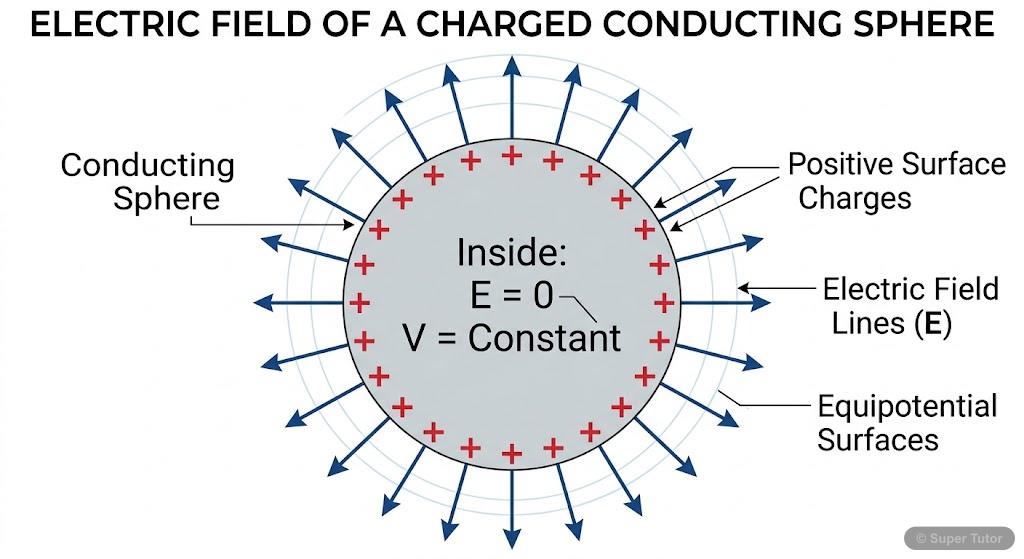
One of 24 illustrations for Electrostatic Potential and Capacitance in Super Tutor — alongside flashcards, concept maps and practice questions.
Quick Quiz: Electrostatic Potential and Capacitance
0/4Tap an answer to check it instantly. No sign-up needed for these 4.
What is the SI unit of electric potential?
The electric potential at a point due to a positive point charge is:
The capacitance of a parallel plate capacitor is given by:
What happens to the capacitance when a dielectric material is inserted between the plates of a capacitor?
Sample Questions
Which of the following statements about equipotential surfaces are correct?
Show answer
Electric field is perpendicular to equipotential surfaces, No work is done in moving a charge along an equipotential surface, All points on an equipotential surface have the same potential
Electric field is always perpendicular to equipotential surfaces. Since all points have the same potential, no work is done in moving charges along the surface. Equipotential surfaces cannot intersect as this would mean a point has two different potentials. Electric field lines are perpendicular, not parallel, to equipotential surfaces.
The potential energy of a system of two point charges q₁ and q₂ separated by distance r is:
Show answer
U = kq₁q₂/r
The potential energy of two point charges is U = kq₁q₂/r, where k = 1/(4πε₀). This represents the work done in bringing the charges from infinite separation to distance r. The energy is positive for like charges and negative for unlike charges.
Which of the following are properties of conductors in electrostatic equilibrium?
Show answer
Electric field inside is zero, Electric potential is constant throughout, Charges reside only on the surface, Electric field at surface is perpendicular to surface
In electrostatic equilibrium, conductors have zero electric field inside, constant potential throughout, charges only on the surface, and electric field perpendicular (not parallel) to the surface at every point.
The work done in moving a charge between two points depends on:
Show answer
Only the initial and final positions
Electrostatic force is conservative, so work done depends only on the initial and final positions, not on the path taken. This is why we can define electric potential as a state function. The speed and time of movement don't affect the work done.
+120 more questions on Electrostatic Potential and Capacitance (Haryana Board Class 12 Physics)
Practise AllFrequently Asked Questions
What are the important topics in Electrostatic Potential and Capacitance for Haryana Board Class 12 Physics?
How many practice questions are there for Electrostatic Potential and Capacitance?
Sources & Official References
Content is aligned to the official syllabus. Refer to the board website for the latest curriculum.
More resources for Electrostatic Potential and Capacitance
Important Questions
Exam-style questions with answers
Revision Notes
Key points for last-minute revision
Formula Sheet
The chapter's formulas in one place
Chapter Summary
Understand the chapter at a glance
Concept Maps
See how topics connect
Study Plan
Step-by-step plan for this chapter
Flashcards
Quick-fire cards for active recall
Syllabus
What topics to cover
NCERT Solutions
Every textbook question solved step by step
For serious students
Get the full Electrostatic Potential and Capacitance chapter — start free.
Quizzes, flashcards, an AI doubt solver and a study plan for Haryana Board Class 12 Physics. Free to start, no card needed.