Contemporary South Asia — Chapter Summary
Haryana Board · Class 12 · Political Science
Summary of Contemporary South Asia for Haryana Board Class 12 Political Science. Part of the Haryana Board Class 12 Political Science syllabus.
Interactive on Super Tutor
Studying Contemporary South Asia? Get the full interactive chapter.
Quizzes, flashcards, AI doubt-solver and a step-by-step study plan — built for chapter summary and more.
Free trial, no card needed.
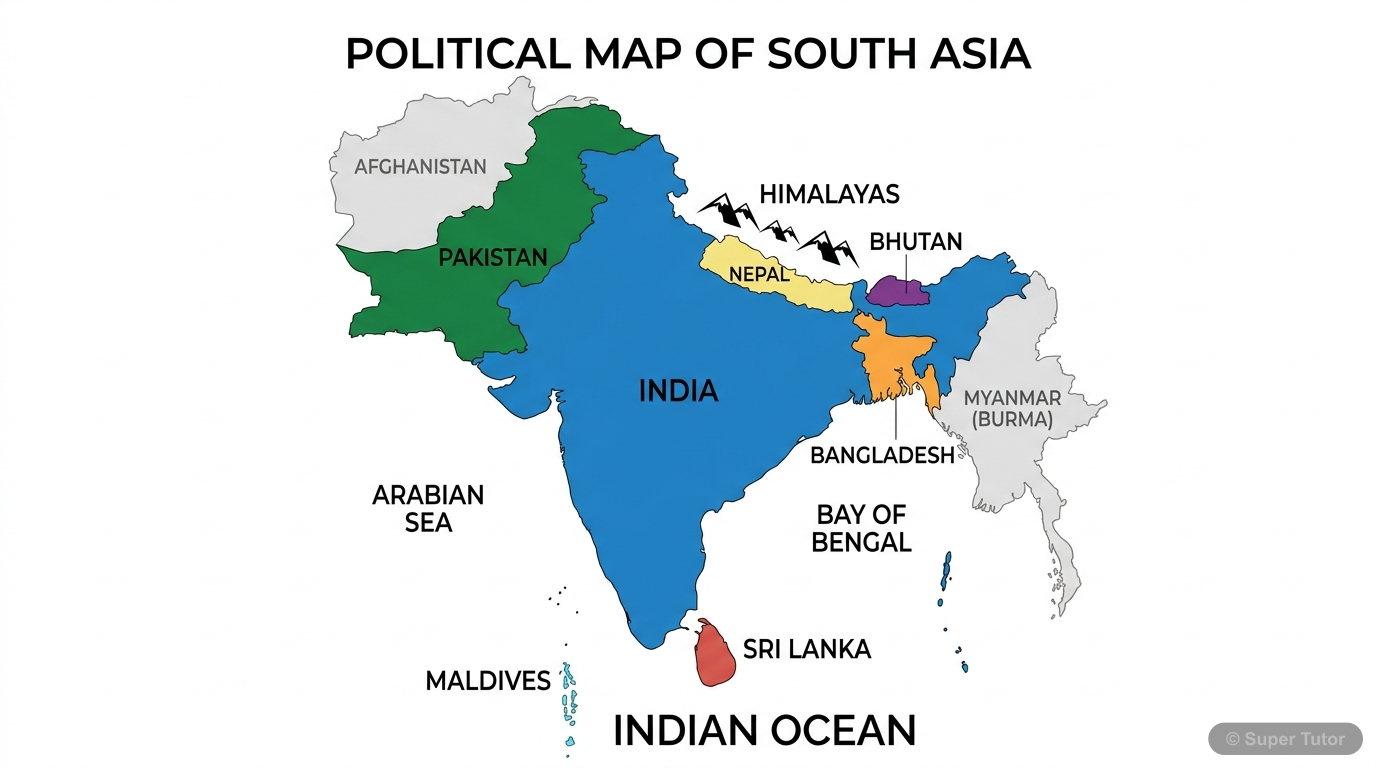
Learn better with visuals Super Tutor pairs illustrations like this with notes and quizzes for Contemporary South Asia.
Overview
South Asia is a region shaped by shared geography, deep political differences, and recurring conflict as well as cooperation. The seven countries covered here are Bangladesh, Bhutan, India, the Maldives, Nepal, Pakistan, and Sri Lanka. China is an important regional player but is not part of South A
Key Concepts
South Asia
South Asia, as defined here, includes Bangladesh, Bhutan, India, the Maldives, Nepal, Pakistan, and Sri Lanka. The region has natural boundaries in th
India and Sri Lanka have successfully
India and Sri Lanka have successfully operated democratic systems since independence. Sri Lanka’s main challenge to democracy came from ethnic conflic
Pakistan experienced repeated military intervention
Pakistan experienced repeated military intervention, including the 1999 coup. General Musharraf removed Nawaz Sharif and later got himself elected Pre
Bangladesh was part of Pakistan from
Bangladesh was part of Pakistan from 1947 to 1971 and became independent after the 1971 war. It later faced military rule, but mass protest and electi
Nepal moved from a Hindu kingdom
Nepal moved from a Hindu kingdom to a constitutional monarchy and then to a democratic republic. The king accepted a new democratic constitution in 19
Learning Objectives
- Understand the meaning and scope of South Asia as a region
- Compare the political experiences of South Asian countries
- Explain the main domestic political changes in Pakistan, Bangladesh, Nepal, Sri Lanka, Bhutan, and the Maldives
- Describe major conflicts in South Asia, especially India-Pakistan and ethnic conflict in Sri Lanka
- Understand the role of cooperation through SAARC and SAFTA
Frequently Asked Questions
What are the important topics in Contemporary South Asia for Haryana Board Class 12 Political Science?
How should I revise Contemporary South Asia for the Haryana Board Class 12 board exam?
Sources & Official References
Content is aligned to the official syllabus. Refer to the board website for the latest curriculum.
More resources for Contemporary South Asia
Practice Quiz
Test yourself with a quick quiz
Important Questions
Exam-style questions with answers
Revision Notes
Key points for last-minute revision
Concept Maps
See how topics connect
Study Plan
Step-by-step plan for this chapter
Flashcards
Quick-fire cards for active recall
Syllabus
What topics to cover
NCERT Solutions
Every textbook question solved step by step
For serious students
Get the full Contemporary South Asia chapter — start free.
Quizzes, flashcards, an AI doubt solver and a study plan for Haryana Board Class 12 Political Science. Free to start, no card needed.