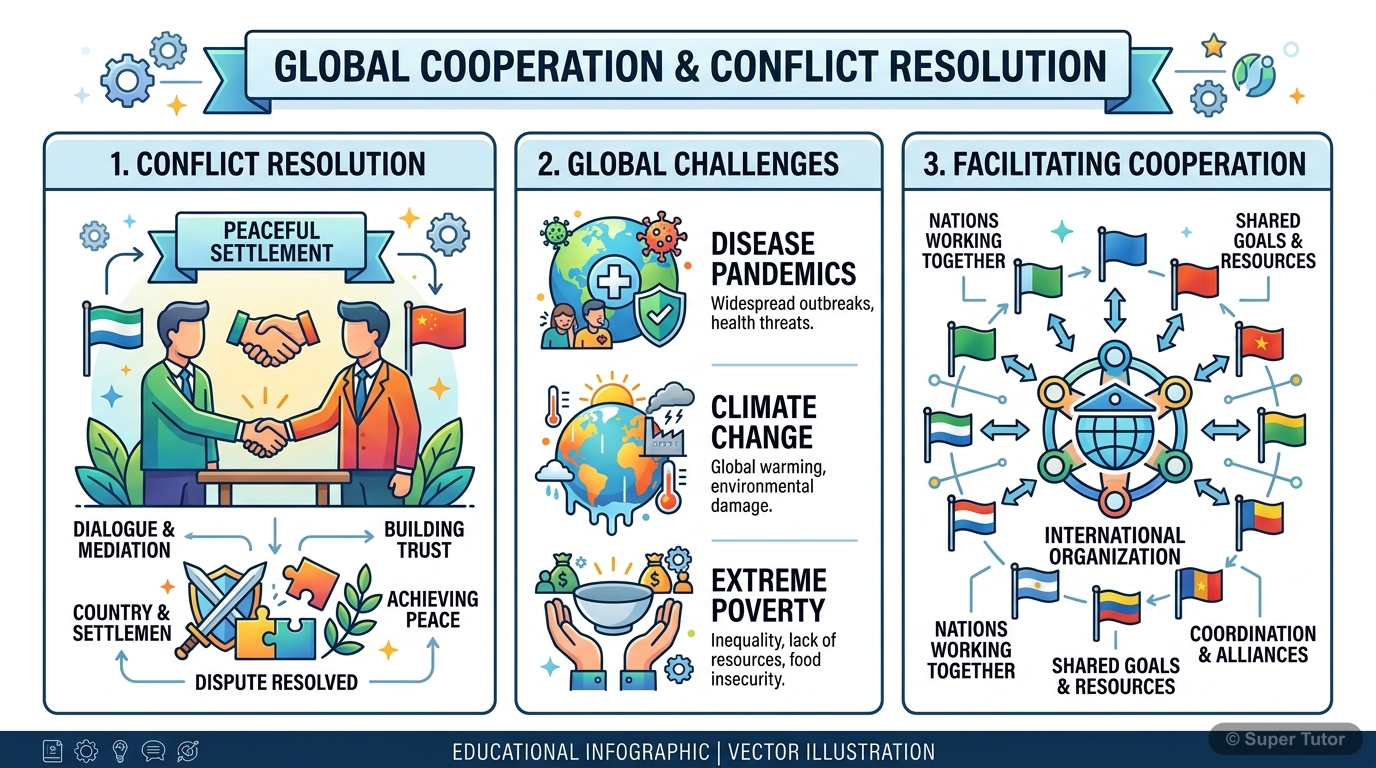
International Organizations
Haryana Board · Class 12 · Political Science
NCERT Solutions for International Organizations — Haryana Board Class 12 Political Science.
Interactive on Super Tutor
Studying International Organizations? Get the full interactive chapter.
Quizzes, flashcards, AI doubt-solver and a step-by-step study plan — built for ncert solutions and more.
1,000+ Class 12 students started this chapter today

Learn better with visuals Super Tutor has hundreds of illustrations like this across every chapter — all free to try.
Get startedExercise Questions — Chapter: International Organizations (Contemporary World Politics, Class 12)
1Mark correct or wrong against each of the following statements about the veto power.
a. Only the permanent members of the Security Council possess the veto power.
b. It's a kind of negative power.
c. The Secretary-General uses this power when not satisfied with any decision.
d. One veto can stall a Security Council resolution.Show solution
Concept: The veto power is the special privilege given to the five permanent members (P5) of the UN Security Council — USA, UK, France, Russia, and China — by which a single 'No' vote from any one of them can block/defeat any substantive resolution.
Answers:
a. Correct — Only the five permanent members (USA, UK, France, Russia, China) possess the veto power. Non-permanent members do not have this power.
b. Correct — It is indeed a kind of negative power because it is used to block or prevent a resolution from being passed, rather than to affirmatively create something.
c. Wrong — The Secretary-General does NOT possess the veto power. The veto is exclusively with the five permanent members of the Security Council. The Secretary-General is the chief administrative officer of the UN.
d. Correct — Even a single veto by one permanent member is sufficient to stall (block) a Security Council resolution, regardless of how many other members vote in favour.
2Mark correct or wrong against each of the following statements about the way the UN functions.
a. All security and peace related issues are dealt with in the Security Council.
b. Humanitarian policies are implemented by the main organs and specialised agencies spread across the globe.
c. Having consensus among the five permanent members on security issues is vital for its implementation.
d. The members of the General Assembly are automatically the members of all other principal organs and specialised agencies of the UN.Show solution
Concept: The UN functions through its six principal organs — the General Assembly, Security Council, Secretariat, International Court of Justice, Economic and Social Council, and the Trusteeship Council — along with numerous specialised agencies.
Answers:
a. Correct — The Security Council is the primary organ responsible for maintaining international peace and security. All major security and peace-related issues are dealt with in the Security Council.
b. Correct — Humanitarian policies are implemented by the main organs as well as specialised agencies such as UNHCR, UNICEF, WHO, WFP, etc., which are spread across the globe.
c. Correct — Since any one of the five permanent members can veto a resolution, having consensus (or at least no veto) among the P5 is vital for any security-related decision to be implemented.
d. Wrong — Membership of the General Assembly does NOT automatically confer membership of all other principal organs and specialised agencies. Membership of the Security Council, for example, is limited to 15 members (5 permanent + 10 elected non-permanent). Specialised agencies have their own separate membership criteria.
3Which among the following would give more weightage to India's proposal for permanent membership in the Security Council?
a. Nuclear capability
b. It has been a member of the UN since its inception
c. It is located in Asia
d. India's growing economic power and stable political systemShow solution
Justification: While all options have some relevance, India's growing economic power (it is one of the fastest-growing major economies and among the largest GDPs in the world) combined with its stable democratic political system provides the strongest and most internationally acceptable argument. These factors demonstrate India's capacity to shoulder global responsibilities. Nuclear capability is not an official criterion (and could be controversial), being a founding member is a historical fact but not a decisive criterion, and geographical location alone is insufficient justification for permanent membership.
4The UN agency concerned with the safety and peaceful use of nuclear technology is:
a. The UN Committee on Disarmament
b. International Atomic Energy Agency
c. UN International Safeguard Committee
d. None of the aboveShow solution
Justification: The International Atomic Energy Agency (IAEA), established in 1957, is the UN-related intergovernmental organisation responsible for promoting the safe, secure, and peaceful use of nuclear technology. It also implements safeguards to verify that nuclear materials are not diverted for military purposes. The other options — UN Committee on Disarmament and UN International Safeguard Committee — are not the correct agencies for this specific mandate.
5WTO is serving as the successor to which of the following organisations?
a. General Agreement on Trade and Tariffs
b. General Arrangement on Trade and Tariffs
c. World Health Organisation
d. UN Development ProgrammeShow solution
Justification: The World Trade Organisation (WTO) was established on 1 January 1995 as the successor to the General Agreement on Tariffs and Trade (GATT), which had been in operation since 1948. GATT was a multilateral agreement regulating international trade; the WTO replaced it with a more comprehensive and institutionalised framework. Note: The full form is 'General Agreement on Tariffs and Trade', not 'Tariffs and Tariffs' as in option (a) — the intent of the question is clearly GATT. Option (b) uses the wrong word 'Arrangement', (c) and (d) are entirely different organisations.
6Fill in the blanks.
a. The prime objective of the UN is ___.
b. The highest functionary of the UN is called ___.
c. The UN Security Council has ___ permanent and ___ non-permanent members.
d. ___ is the present UN Secretary-General.Show solution
Answers:
a. The prime objective of the UN is to maintain international peace and security, develop friendly relations among nations, and promote social progress, better living standards, and human rights. (In brief: *to maintain international peace and security*.)
b. The highest functionary of the UN is called the Secretary-General.
c. The UN Security Council has 5 permanent and 10 non-permanent members. (Total = 15 members)
d. António Guterres is the present UN Secretary-General. *(He has been serving since 1 January 2017 and was re-appointed for a second term beginning 1 January 2022. Students should verify the current incumbent at the time of their examination.)*
7Match the principal organs and agencies of the UN with their functions:
1. Economic and Social Council
2. International Court of Justice
3. International Atomic Energy Agency
4. Security Council
5. UN High Commission for Refugees
6. World Trade Organisation
7. International Monetary Fund
8. General Assembly
9. World Health Organisation
10. Secretariat
a. Oversees the global financial system
b. Preservation of international peace and security
c. Looks into the economic and social welfare of the member countries
d. Safety and peaceful use of nuclear technology
e. Resolves disputes between and among member countries
f. Provides shelter and medical help during emergencies
g. Debates and discusses global issues
h. Administration and coordination of UN affairs
i. Providing good health for all
j. Facilitates free trade among member countriesShow solution
Concept: Each organ/agency of the UN has a specific mandate as defined in the UN Charter or its founding treaty.
Matched Answers:
| Organ / Agency | Function |
|---|---|
| 1. Economic and Social Council | c. Looks into the economic and social welfare of the member countries |
| 2. International Court of Justice | e. Resolves disputes between and among member countries |
| 3. International Atomic Energy Agency | d. Safety and peaceful use of nuclear technology |
| 4. Security Council | b. Preservation of international peace and security |
| 5. UN High Commission for Refugees | f. Provides shelter and medical help during emergencies |
| 6. World Trade Organisation | j. Facilitates free trade among member countries |
| 7. International Monetary Fund | a. Oversees the global financial system |
| 8. General Assembly | g. Debates and discusses global issues |
| 9. World Health Organisation | i. Providing good health for all |
| 10. Secretariat | h. Administration and coordination of UN affairs |
Summary: 1-c, 2-e, 3-d, 4-b, 5-f, 6-j, 7-a, 8-g, 9-i, 10-h.
8What are the functions of the Security Council?Show solution
Introduction: The UN Security Council is the most powerful organ of the United Nations. It has the primary responsibility for the maintenance of international peace and security. Its decisions are binding on all UN member states.
Functions of the Security Council:
1. Maintenance of International Peace and Security:
The Security Council's foremost function is to maintain international peace and security. It investigates any dispute or situation that might lead to international friction.
2. Peaceful Settlement of Disputes:
It recommends methods of adjusting disputes or the terms of settlement. It can call upon parties to settle their disputes by peaceful means such as negotiation, mediation, arbitration, or judicial settlement.
3. Enforcement Action:
If peaceful means fail, the Security Council can take enforcement measures. These may include:
- Non-military measures: Economic sanctions, severance of diplomatic relations, blockades, etc.
- Military measures: Use of armed force by member states to restore international peace and security (e.g., authorising peacekeeping operations).
4. Admission of New Members:
The Security Council recommends the admission of new members to the General Assembly.
5. Appointment of the Secretary-General:
It recommends the appointment of the Secretary-General to the General Assembly.
6. Election of ICJ Judges:
Along with the General Assembly, it participates in the election of judges of the International Court of Justice.
7. Peacekeeping Operations:
It authorises and deploys UN peacekeeping forces to conflict zones to monitor ceasefires and protect civilians.
8. Veto Power:
Each of the five permanent members (USA, UK, France, Russia, China) has the power to veto any substantive resolution, making their consensus essential for any major decision.
Conclusion: The Security Council is thus the executive arm of the UN, with wide-ranging powers to prevent conflict and restore peace globally.
9As a citizen of India, how would you support India's candidature for the permanent membership of the Security Council? Justify your proposal.Show solution
Introduction: India has been actively seeking a permanent seat on the UN Security Council as part of the broader demand for UN reforms. As a citizen of India, I would support this candidature on the following grounds:
Arguments in Support of India's Permanent Membership:
1. World's Largest Democracy:
India is the world's largest democracy with a stable, multi-party political system. A permanent seat for India would ensure that democratic values are better represented in the Security Council.
2. Massive Population:
India represents approximately 1.4 billion people — nearly one-sixth of humanity. It is unjust that such a large portion of the world's population has no permanent voice in the most powerful UN body.
3. Founding Member of the UN:
India has been a member of the UN since its inception in 1945 and has consistently upheld the principles of the UN Charter.
4. Significant Contributor to UN Peacekeeping:
India is one of the largest contributors of troops to UN peacekeeping missions. Indian soldiers have served in conflict zones across Africa, Asia, and the Middle East, demonstrating India's commitment to global peace.
5. Growing Economic Power:
India is one of the world's fastest-growing major economies and is among the top economies by GDP (PPP). Economic strength is essential for shouldering the responsibilities of a permanent member.
6. Nuclear Capability:
India is a responsible nuclear state that has maintained a 'No First Use' policy and has not engaged in nuclear proliferation, demonstrating maturity in handling strategic power.
7. Geographical and Regional Representation:
Asia, the world's most populous continent, is underrepresented in the P5. India's inclusion would correct this imbalance and give voice to the Global South.
8. Track Record in International Relations:
India has consistently advocated for peaceful resolution of conflicts, disarmament, and multilateralism. It has maintained friendly relations with most nations.
9. Support from Major Powers:
Countries like the USA, UK, France, and Russia have at various times expressed support for India's permanent membership, reflecting India's growing global stature.
Conclusion: India's inclusion as a permanent member of the Security Council would make the UN more representative, democratic, and effective. As a citizen, I would advocate for this through public awareness campaigns, supporting diplomatic efforts, and encouraging India's continued active participation in UN activities.
10Critically evaluate the difficulties involved in implementing the suggested reforms to reconstruct the UN.Show solution
Introduction: The United Nations, established in 1945, reflects the power realities of the post-World War II era. Since then, the world has changed dramatically, and there have been persistent calls for reforming the UN, especially the Security Council. However, implementing these reforms faces enormous difficulties.
Suggested Reforms:
- Expansion of the Security Council (both permanent and non-permanent members)
- Making the UN more democratic and representative
- Reducing the veto power or abolishing it
- Improving the efficiency of the General Assembly
- Strengthening the role of the Secretary-General
Difficulties in Implementing Reforms:
1. Veto Power of Permanent Members (P5):
Any amendment to the UN Charter requires the approval of all five permanent members. Since reforms — especially expansion of the Security Council — would dilute the P5's power and influence, they are unlikely to agree. This is the single biggest obstacle.
2. Disagreement Among Member States:
There is no consensus among the 193 member states on who should get new permanent seats. For example:
- Germany, Japan, India, and Brazil (G4) seek permanent seats.
- Their regional rivals (Pakistan opposes India; China opposes Japan; Italy opposes Germany; Argentina opposes Brazil) block these proposals.
- African nations demand representation but cannot agree on which country should represent Africa.
3. Competing National Interests:
Each country prioritises its own national interest. Powerful nations do not want to share power, and smaller nations fear being marginalised further.
4. Complexity of Charter Amendment:
Amending the UN Charter requires a two-thirds majority in the General Assembly AND ratification by two-thirds of all member states, including all five permanent members. This is an extremely high threshold.
5. Lack of Political Will:
Despite decades of discussion, there has been insufficient political will among the major powers to push through meaningful reforms. The P5 benefit from the current structure and have little incentive to change it.
6. Geopolitical Rivalries:
Cold War-era rivalries have been replaced by new geopolitical tensions (e.g., US-China rivalry, Russia-West tensions). These rivalries make cooperation on structural reforms very difficult.
7. Financial and Bureaucratic Challenges:
Expanding the Security Council would increase administrative complexity and costs. Reaching decisions in a larger council would be slower and more difficult.
8. Defining Criteria for New Members:
There is no agreed-upon criteria for selecting new permanent members. Should it be based on population, economic size, military power, regional representation, or democratic governance? Each criterion favours different countries.
Conclusion: While UN reforms are widely acknowledged as necessary to make the organisation more representative and effective, the path to implementation is blocked by structural, political, and geopolitical obstacles. The reform process requires extraordinary diplomatic effort, compromise, and political will — all of which are currently in short supply. Nevertheless, incremental reforms (such as increasing non-permanent members or improving working methods) may be more achievable than comprehensive restructuring.
11Though the UN has failed in preventing wars and related miseries, nations prefer its continuation. What makes the UN an indispensable organisation?Show solution
Introduction: The United Nations has often been criticised for its inability to prevent wars, genocides, and humanitarian crises (e.g., the Rwanda genocide in 1994, the Iraq War in 2003, the Syrian civil war). Yet, no nation has withdrawn from the UN, and all nations continue to value its existence. This is because the UN remains indispensable for the following reasons:
Reasons Why the UN is Indispensable:
1. Only Universal Forum:
The UN is the only truly universal international organisation with near-universal membership (193 member states). It provides a unique platform where all nations — big and small, rich and poor — can voice their concerns and participate in global governance.
2. Preventing Escalation of Conflicts:
Even when the UN cannot prevent wars, it often prevents their escalation. UN peacekeeping forces, ceasefire monitoring, and diplomatic mediation have saved countless lives. For example, UN peacekeeping missions in Liberia, Sierra Leone, and East Timor helped restore stability.
3. Humanitarian Assistance:
Agencies like UNHCR, UNICEF, WFP, and WHO provide critical humanitarian assistance to millions of refugees, disaster victims, and people in conflict zones. This work is irreplaceable.
4. Promoting Development:
The UN Development Programme (UNDP) and other agencies work to reduce poverty, promote education, and achieve sustainable development. The Millennium Development Goals (MDGs) and Sustainable Development Goals (SDGs) are UN initiatives that have improved lives globally.
5. Setting International Norms and Laws:
The UN has been instrumental in creating international law and norms — the Universal Declaration of Human Rights (1948), the Nuclear Non-Proliferation Treaty, the Convention on the Rights of the Child, and many others. These norms shape state behaviour even when enforcement is weak.
6. Forum for Diplomacy:
The UN provides a neutral space for diplomacy and negotiation. Even rival nations maintain diplomatic channels through the UN, reducing the risk of miscalculation and accidental war.
7. Checking Unilateralism:
The UN provides a check on the unilateral actions of powerful states. Even the most powerful nation — the USA — faces criticism and opposition in the UN when it acts unilaterally (e.g., the Iraq War). This constrains hegemonic behaviour.
8. Managing Global Interdependence:
In an increasingly interconnected world, issues like climate change, pandemics, terrorism, and nuclear proliferation cannot be solved by any single nation. The UN provides the institutional framework for collective action on these global challenges.
9. Legitimacy:
UN authorisation lends international legitimacy to actions taken by states or coalitions. Military interventions, sanctions, and diplomatic initiatives are more widely accepted when backed by the UN.
10. Alternative Would Be Worse:
As the textbook notes, "The UN is an imperfect body, but without it the world would be worse off." Without the UN, there would be no institutional mechanism to manage conflicts, coordinate humanitarian aid, or set global norms.
Conclusion: The UN's value lies not just in what it has achieved, but in what it prevents and enables. It is the only institution capable of bringing together all nations to address shared challenges. Despite its imperfections, the UN remains the cornerstone of the international order and is truly indispensable.
12'Reforming the UN means restructuring of the Security Council'. Do you agree with this statement? Give arguments for or against this position.Show solution
Introduction: This is a debatable statement. While restructuring the Security Council is a central and critical part of UN reform, it is not the only dimension of reform needed. Let us examine both sides.
---
Arguments IN FAVOUR of the Statement (Agree):
1. Security Council is the Most Powerful Organ:
The Security Council is the only UN body whose decisions are legally binding on all member states. It controls the most critical function of the UN — maintaining international peace and security. Without reforming this body, other reforms remain superficial.
2. Unrepresentative Composition:
The current composition of the Security Council reflects the power realities of 1945, not the 21st century. Germany, Japan, India, Brazil, and African nations — all major powers today — have no permanent representation. This makes the Council undemocratic and illegitimate in the eyes of many.
3. Veto Power is Outdated:
The veto power of the P5 has repeatedly paralysed the Security Council. During the Cold War, the US and USSR used the veto to protect their allies. Today, Russia and China have used it to block action on Syria. Reforming the veto is essential for the UN to function effectively.
4. Lack of Accountability:
The P5 are not accountable to the General Assembly or any other body. Restructuring the Security Council to include more members and reduce the veto would make it more accountable.
5. Symbol of Inequality:
The Security Council, with its privileged P5, symbolises the inequality in the international system. Reforming it is essential for the UN to be seen as a fair and just institution.
---
Arguments AGAINST the Statement (Disagree — Reform is Broader):
1. General Assembly Needs Reform Too:
The General Assembly, which represents all member states, is often ineffective due to its unwieldy size and inability to enforce its resolutions. Reforming its procedures and giving it more authority is equally important.
2. Secretariat Needs Strengthening:
The UN Secretariat needs to be made more efficient, less bureaucratic, and better funded. The Secretary-General needs more authority and resources to act independently in crisis situations.
3. Financial Reform:
The UN faces chronic financial difficulties because member states (including the USA) often withhold or delay their contributions. Financial reform is essential for the UN to function effectively.
4. Specialised Agencies Need Coordination:
There is often duplication and lack of coordination among the numerous UN specialised agencies. Streamlining these agencies would make the UN more effective.
5. Human Rights Mechanisms:
The UN's human rights bodies (like the Human Rights Council) have been criticised for being politicised and ineffective. Reforming these mechanisms is important for the UN's credibility.
6. Peacekeeping Reform:
UN peacekeeping operations have faced serious problems — lack of resources, unclear mandates, and in some cases, misconduct by peacekeepers. Reforming peacekeeping is a critical aspect of UN reform.
---
Conclusion:
I partially agree with the statement. Restructuring the Security Council is undoubtedly the most important and symbolic aspect of UN reform, as it goes to the heart of power and decision-making in the organisation. However, UN reform is a much broader agenda that includes reforming the General Assembly, the Secretariat, financial mechanisms, human rights bodies, and peacekeeping operations. True reform of the UN requires a comprehensive approach, not just restructuring the Security Council. Nevertheless, without Security Council reform, all other reforms will remain incomplete and the UN will continue to be seen as an instrument of the powerful rather than a truly universal organisation.
Stuck on a step?
Ask Super Tutor AI to explain any solution on this page in a simpler way — free, 24x7.
Ask a Doubt FreeFrequently Asked Questions
What are the important topics in International Organizations for Haryana Board Class 12 Political Science?
How to score full marks in International Organizations — Haryana Board Class 12 Political Science?
Where can I get free NCERT Solutions for International Organizations Class 12 Political Science?
Sources & Official References
Content is aligned to the official syllabus. Refer to the board website for the latest curriculum.
More resources for International Organizations
Important Questions
Practice with board exam-style questions
Syllabus
What topics to cover
Revision Notes
Key points for last-minute revision
Study Plan
Step-by-step plan to ace this chapter
Flashcards
Quick-fire cards for active recall
Formula Sheet
All formulas in one place
Chapter Summary
Understand the chapter at a glance
Practice Quiz
Test yourself with a quick quiz
Concept Maps
See how topics connect visually
For serious students
Get the full International Organizations chapter — for free.
Quizzes, flashcards, AI doubt-solver and a step-by-step study plan for Haryana Board Class 12 Political Science.