Therapeutic Approaches — Important Questions
Haryana Board · Class 12 · Psychology
50 important questions from Therapeutic Approaches for Haryana Board Class 12 Psychology, with answers. Written for the board exams 2027.
Interactive on Super Tutor
Studying Therapeutic Approaches? Get the full interactive chapter.
Quizzes, flashcards, AI doubt-solver and a step-by-step study plan — built for important questions and more.
Free trial, no card needed.
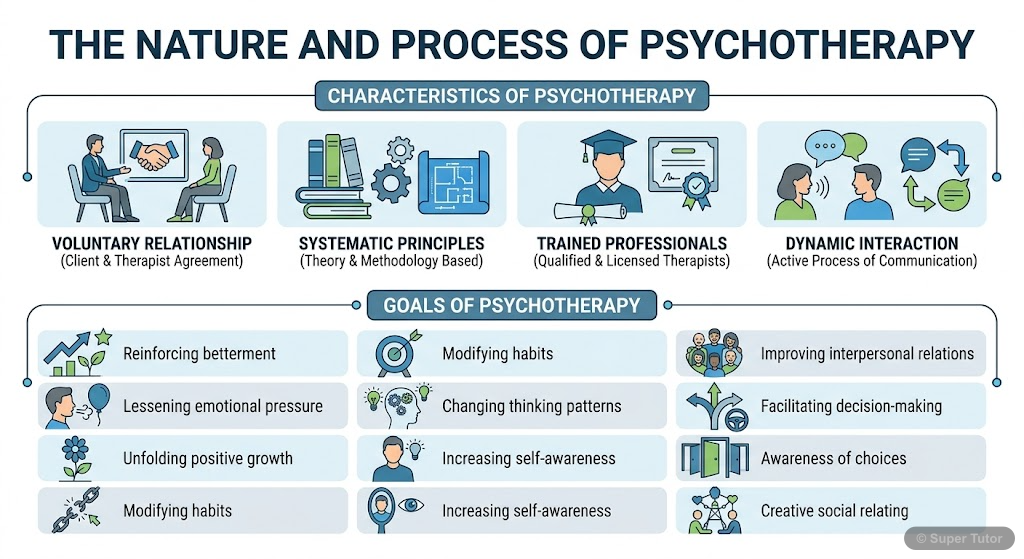
One of 19 illustrations for Therapeutic Approaches in Super Tutor — alongside flashcards, concept maps and practice questions.
Important Questions from Therapeutic Approaches
Which of the following are characteristics of all psychotherapeutic approaches?
Show answer
Systematic application of theoretical principles, Conducted only by trained professionals, Formation of therapeutic relationship
All psychotherapeutic approaches share these common characteristics: systematic application of principles, requirement of professional training, and formation of a therapeutic relationship. They don't always involve medication and duration varies based on individual needs.
In systematic desensitization, the client is gradually exposed to fear-provoking situations while in a relaxed state.
Show answer
True
Systematic desensitization involves creating a hierarchy of anxiety-provoking stimuli and gradually exposing the client to these situations while maintaining relaxation. This technique uses the principle of reciprocal inhibition.
In Rational Emotive Therapy (RET), what does the ABC analysis stand for?
Show answer
Antecedent-Belief-Consequence
In RET by Albert Ellis, ABC analysis identifies Antecedent events that trigger problems, irrational Beliefs that distort reality, and Consequences (negative emotions and behaviors) that result from these beliefs.
Which of the following are examples of irrational beliefs identified in cognitive therapy?
Show answer
One should be loved by everybody all the time, Human misery is caused by external events over which one has no control, Everything must be perfect
Irrational beliefs are characterized by 'musts' and 'shoulds' and are not supported by evidence. They include perfectionist thinking, need for universal approval, and external locus of control. Rational beliefs are more flexible and realistic.
+46 more questions on Therapeutic Approaches (Haryana Board Class 12 Psychology)
Practise AllFrequently Asked Questions
What are the important topics in Therapeutic Approaches for Haryana Board Class 12 Psychology?
How many important questions are there in Therapeutic Approaches?
Sources & Official References
Content is aligned to the official syllabus. Refer to the board website for the latest curriculum.
More resources for Therapeutic Approaches
Practice Quiz
Test yourself with a quick quiz
Revision Notes
Key points for last-minute revision
Chapter Summary
Understand the chapter at a glance
Concept Maps
See how topics connect
Study Plan
Step-by-step plan for this chapter
Flashcards
Quick-fire cards for active recall
Syllabus
What topics to cover
NCERT Solutions
Every textbook question solved step by step
For serious students
Get the full Therapeutic Approaches chapter — start free.
Quizzes, flashcards, an AI doubt solver and a study plan for Haryana Board Class 12 Psychology. Free to start, no card needed.