The Market as a Social Institution — Practice Quiz
Haryana Board · Class 12 · Sociology
Try a 4-question quiz on The Market as a Social Institution for Haryana Board Class 12 Sociology: tap an answer to check it and see why.
Interactive on Super Tutor
Studying The Market as a Social Institution? Get the full interactive chapter.
Quizzes, flashcards, AI doubt-solver and a step-by-step study plan — built for practice quiz and more.
Free trial, no card needed.
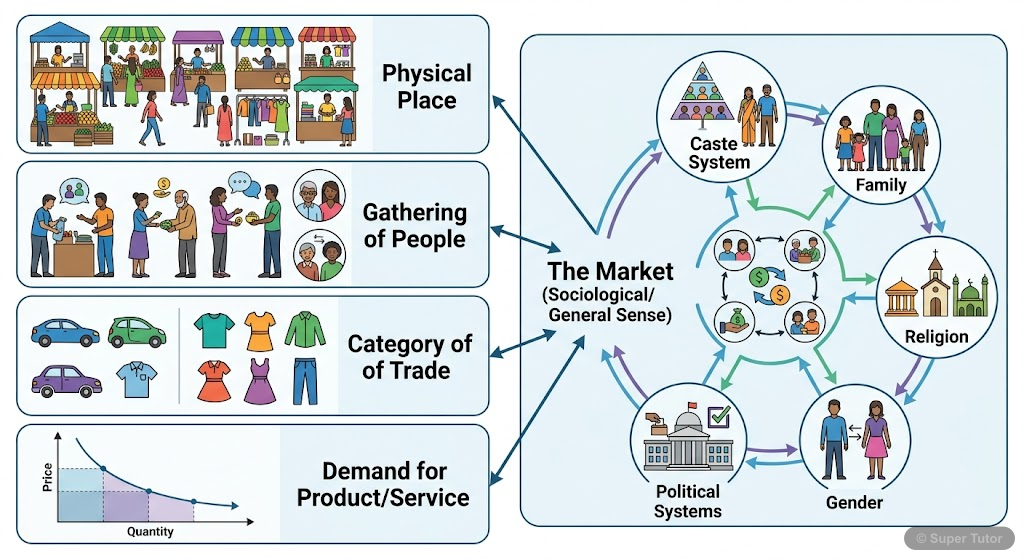
Learn better with visuals Super Tutor pairs illustrations like this with notes and quizzes for The Market as a Social Institution.
Quick Quiz: The Market as a Social Institution
0/4Tap an answer to check it instantly. No sign-up needed for these 4.
What is the most common meaning of 'market' in everyday usage?
According to Adam Smith, how does the market economy function?
What is a 'hundi' in the context of traditional Indian trade?
Which varna is traditionally associated with trade and commerce in Indian society?
Sample Questions
Which of the following are characteristics of weekly tribal haats? (Select all correct answers)
Show answer
They bring together people from surrounding villages, They serve as places for social interaction, They link local economies to wider national economy
Weekly tribal haats bring people from surrounding villages, serve important social functions like meeting relatives and arranging marriages, and connect local economies to wider markets. They are not limited to manufactured goods and primarily operate in rural/tribal areas.
Which of the following are examples of traditional business communities in India? (Select all correct answers)
Show answer
Marwaris, Parsis, Nakarattars, Jains
Marwaris, Parsis, Nakarattars, and Jains are all traditional business communities in India with distinctive religious or community identities that have historically been involved in trade and commerce. Gonds are primarily an adivasi group.
What major change occurred in India's economic role after colonization?
Show answer
India became a source of raw materials and consumer of manufactured goods
After colonization, India's role reversed from being a major supplier of manufactured goods to becoming primarily a source of raw materials and agricultural products while consuming manufactured goods from England.
According to Karl Marx, what are the two basic classes in capitalist society?
Show answer
Capitalists and workers
Marx identified capitalists (who own the means of production like factories) and workers (who sell their labor for wages) as the two basic classes in capitalist society.
+28 more questions on The Market as a Social Institution (Haryana Board Class 12 Sociology)
Practise AllFrequently Asked Questions
What are the important topics in The Market as a Social Institution for Haryana Board Class 12 Sociology?
How many practice questions are there for The Market as a Social Institution?
Sources & Official References
Content is aligned to the official syllabus. Refer to the board website for the latest curriculum.
More resources for The Market as a Social Institution
Important Questions
Exam-style questions with answers
Revision Notes
Key points for last-minute revision
Chapter Summary
Understand the chapter at a glance
Concept Maps
See how topics connect
Study Plan
Step-by-step plan for this chapter
Flashcards
Quick-fire cards for active recall
Syllabus
What topics to cover
NCERT Solutions
Every textbook question solved step by step
For serious students
Get the full The Market as a Social Institution chapter — start free.
Quizzes, flashcards, an AI doubt solver and a study plan for Haryana Board Class 12 Sociology. Free to start, no card needed.