Patterns of Social Inequality and Exclusion — Revision Notes
Haryana Board · Class 12 · Sociology
Patterns of Social Inequality and Exclusion revision notes for Haryana Board Class 12 Sociology: 4 topics in quick points.
Interactive on Super Tutor
Studying Patterns of Social Inequality and Exclusion? Get the full interactive chapter.
Quizzes, flashcards, AI doubt-solver and a step-by-step study plan — built for revision notes and more.
Free trial, no card needed.
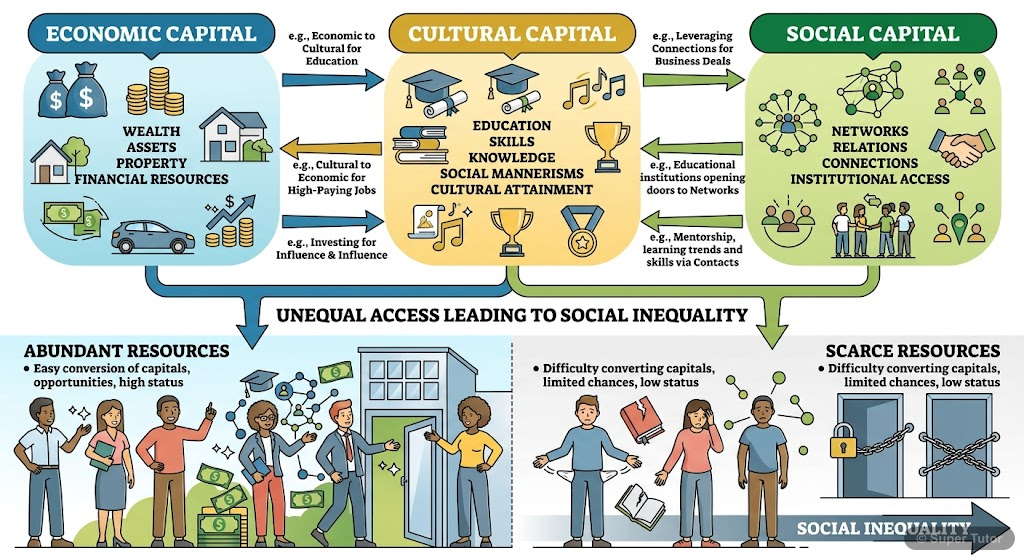
Learn better with visuals Super Tutor pairs illustrations like this with notes and quizzes for Patterns of Social Inequality and Exclusion.
Key Topics to Revise
1. Social inequality: the social basis
- Social inequality is about unequal access to valued resources such as money, property, education, health, and power.
- Social resources can be understood as three forms of capital: economic capital, cultural capital, and social capital.
- Social stratification is a system in which categories of people are ranked in a hierarchy.
2. Caste, untouchability, and state action
- The caste system is a distinct social institution that legitimises and enforces discrimination against people born into particular castes.
- Caste discrimination is humiliating, exclusionary, and exploitative.
- Historically, caste linked occupation with birth and ranked people by social status.
3. Adivasi struggles and identity
- Adivasis are recognised by the Constitution of India.
- The term Adivasi means original inhabitants.
- The term Adivasi was coined in the 1930s as part of the struggle against colonial intrusion and outside settlers.
4. Gender inequality and women’s reform movements
- Gender inequality is social, not natural.
- There are no biological reasons that explain why women hold fewer positions of public power or receive a smaller share of family property.
- Matrilineal societies such as the Nairs of Kerala and the Khasis of Meghalaya show that gender relations can be organised differently.
Get complete notes with diagrams and examples
Full NotesKey Concepts
Frequently Asked Questions
What are the important topics in Patterns of Social Inequality and Exclusion for Haryana Board Class 12 Sociology?
How should I revise Patterns of Social Inequality and Exclusion for the Haryana Board Class 12 board exam?
Sources & Official References
Content is aligned to the official syllabus. Refer to the board website for the latest curriculum.
More resources for Patterns of Social Inequality and Exclusion
Practice Quiz
Test yourself with a quick quiz
Important Questions
Exam-style questions with answers
Chapter Summary
Understand the chapter at a glance
Concept Maps
See how topics connect
Study Plan
Step-by-step plan for this chapter
Flashcards
Quick-fire cards for active recall
Syllabus
What topics to cover
NCERT Solutions
Every textbook question solved step by step
For serious students
Get the full Patterns of Social Inequality and Exclusion chapter — start free.
Quizzes, flashcards, an AI doubt solver and a study plan for Haryana Board Class 12 Sociology. Free to start, no card needed.