Chapter 7 of 12
NCERT Solutions

Triangles

Haryana Board · Class 9 · Mathematics

NCERT Solutions for Triangles — Haryana Board Class 9 Mathematics.

41 questions22 flashcards5 concepts

Interactive on Super Tutor

Studying Triangles? Get the full interactive chapter.

Quizzes, flashcards, AI doubt-solver and a step-by-step study plan — built for ncert solutions and more.

1,000+ Class 9 students started this chapter today

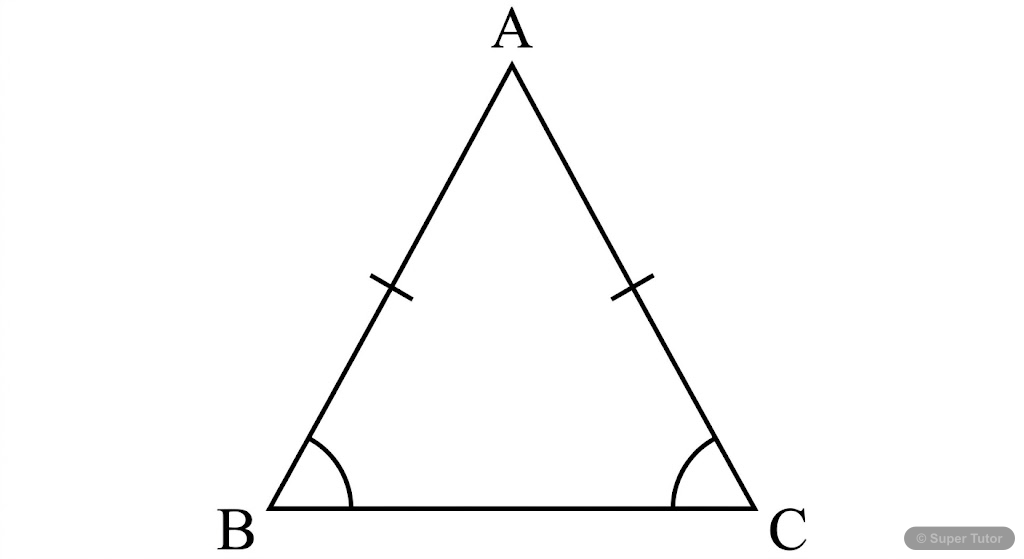
A labeled diagram showing a triangle with its three sides, three angles, and three vertices clearly marked.
Super Tutor

Super Tutor has 16+ illustrations like this for Triangles alone — flashcards, concept maps, and step-by-step visuals.

See them all
21 Questions Solved · 3 Sections

EXERCISE 7.1

1In quadrilateral ACBD, AC = AD and AB bisects ∠A (see Fig. 7.16). Show that △ABC ≅ △ABD. What can you say about BC and BD?Show solution
Given: In quadrilateral ACBD, AC = AD and AB bisects ∠A, i.e., ∠CAB = ∠DAB.

To prove: △ABC ≅ △ABD

Proof:

Consider △ABC and △ABD.

AC=AD(Given)AC = AD \quad \text{(Given)}

CAB=DAB(AB bisects A)\angle CAB = \angle DAB \quad \text{(AB bisects } \angle A\text{)}

AB=AB(Common side)AB = AB \quad \text{(Common side)}

Therefore, by SAS congruence rule:
ΔABCΔABD\Delta ABC \cong \Delta ABD

About BC and BD:
Since △ABC ≅ △ABD, by CPCT:
BC=BDBC = BD
So BC and BD are equal, i.e., B is equidistant from C and D.
2ABCD is a quadrilateral in which AD = BC and ∠DAB = ∠CBA (see Fig. 7.17). Prove that (i) △ABD ≅ △BAC (ii) BD = AC (iii) ∠ABD = ∠BACShow solution
Given: In quadrilateral ABCD, AD = BC and ∠DAB = ∠CBA.

(i) To prove: △ABD ≅ △BAC

Consider △ABD and △BAC.

AD=BC(Given)AD = BC \quad \text{(Given)}

DAB=CBA(Given)\angle DAB = \angle CBA \quad \text{(Given)}

AB=BA(Common side)AB = BA \quad \text{(Common side)}

Therefore, by SAS congruence rule:
ΔABDΔBAC\Delta ABD \cong \Delta BAC

(ii) To prove: BD = AC

Since △ABD ≅ △BAC (proved above), by CPCT:
BD=ACBD = AC

(iii) To prove: ∠ABD = ∠BAC

Since △ABD ≅ △BAC, by CPCT:
ABD=BAC\angle ABD = \angle BAC
3AD and BC are equal perpendiculars to a line segment AB (see Fig. 7.18). Show that CD bisects AB.Show solution
Given: AD ⊥ AB, BC ⊥ AB, and AD = BC.

To prove: CD bisects AB, i.e., the point of intersection O of CD and AB is the mid-point of AB (OA = OB).

Proof:

Consider △AOD and △BOC.

AOD=BOC(Vertically opposite angles)\angle AOD = \angle BOC \quad \text{(Vertically opposite angles)}

DAO=CBO=90(AD  AB and BC  AB)\angle DAO = \angle CBO = 90^\circ \quad \text{(AD } \perp \text{ AB and BC } \perp \text{ AB)}

AD=BC(Given)AD = BC \quad \text{(Given)}

Therefore, by AAS congruence rule:
ΔAODΔBOC\Delta AOD \cong \Delta BOC

By CPCT:
OA=OBOA = OB

Hence, O is the mid-point of AB, i.e., CD bisects AB.
4ll and mm are two parallel lines intersected by another pair of parallel lines pp and qq (see Fig. 7.19). Show that △ABC ≅ △CDA.Show solution
Given: lml \parallel m and pqp \parallel q. ABCD is a parallelogram formed by these lines, with AC as the diagonal.

To prove: △ABC ≅ △CDA

Proof:

Consider △ABC and △CDA.

Since pqp \parallel q and AC is a transversal:
BAC=DCA(Alternate interior angles)\angle BAC = \angle DCA \quad \text{(Alternate interior angles)}

Since lml \parallel m and AC is a transversal:
BCA=DAC(Alternate interior angles)\angle BCA = \angle DAC \quad \text{(Alternate interior angles)}

AC=CA(Common side)AC = CA \quad \text{(Common side)}

Therefore, by ASA congruence rule:
ΔABCΔCDA\Delta ABC \cong \Delta CDA
5Line ll is the bisector of an angle ∠A and B is any point on ll. BP and BQ are perpendiculars from B to the arms of ∠A (see Fig. 7.20). Show that: (i) △APB ≅ △AQB (ii) BP = BQ or B is equidistant from the arms of ∠AShow solution
Given: Line ll bisects ∠A, so ∠PAB = ∠QAB. BP ⊥ AP and BQ ⊥ AQ, so ∠APB = ∠AQB = 90°.

(i) To prove: △APB ≅ △AQB

Consider △APB and △AQB.

APB=AQB=90(BP and BQ are perpendiculars)\angle APB = \angle AQB = 90^\circ \quad \text{(BP and BQ are perpendiculars)}

PAB=QAB(l bisects A)\angle PAB = \angle QAB \quad \text{(}l\text{ bisects }\angle A\text{)}

AB=AB(Common hypotenuse)AB = AB \quad \text{(Common hypotenuse)}

Therefore, by AAS congruence rule:
ΔAPBΔAQB\Delta APB \cong \Delta AQB

(ii) To prove: BP = BQ

Since △APB ≅ △AQB, by CPCT:
BP=BQBP = BQ

Hence, B is equidistant from the arms of ∠A.
6In Fig. 7.21, AC = AE, AB = AD and ∠BAD = ∠EAC. Show that BC = DE.Show solution
Given: AC = AE, AB = AD, and ∠BAD = ∠EAC.

To prove: BC = DE

Proof:

We have:
BAD=EAC(Given)\angle BAD = \angle EAC \quad \text{(Given)}

Adding ∠DAC to both sides:
BAD+DAC=EAC+DAC\angle BAD + \angle DAC = \angle EAC + \angle DAC

BAC=DAE\angle BAC = \angle DAE

Now consider △ABC and △ADE.

AB=AD(Given)AB = AD \quad \text{(Given)}

BAC=DAE(Proved above)\angle BAC = \angle DAE \quad \text{(Proved above)}

AC=AE(Given)AC = AE \quad \text{(Given)}

Therefore, by SAS congruence rule:
ΔABCΔADE\Delta ABC \cong \Delta ADE

By CPCT:
BC=DEBC = DE
7AB is a line segment and P is its mid-point. D and E are points on the same side of AB such that ∠BAD = ∠ABE and ∠EPA = ∠DPB (see Fig. 7.22). Show that (i) △DAP ≅ △EBP (ii) AD = BEShow solution
Given: P is the mid-point of AB, so AP = BP. ∠BAD = ∠ABE and ∠EPA = ∠DPB.

(i) To prove: △DAP ≅ △EBP

We have:
EPA=DPB(Given)\angle EPA = \angle DPB \quad \text{(Given)}

Adding ∠EPD to both sides:
EPA+EPD=DPB+EPD\angle EPA + \angle EPD = \angle DPB + \angle EPD

DPA=EPB\angle DPA = \angle EPB

Now consider △DAP and △EBP.

DAP=EBP(Given: BAD=ABE)\angle DAP = \angle EBP \quad \text{(Given: }\angle BAD = \angle ABE\text{)}

AP=BP(P is mid-point of AB)AP = BP \quad \text{(P is mid-point of AB)}

DPA=EPB(Proved above)\angle DPA = \angle EPB \quad \text{(Proved above)}

Therefore, by ASA congruence rule:
ΔDAPΔEBP\Delta DAP \cong \Delta EBP

(ii) To prove: AD = BE

Since △DAP ≅ △EBP, by CPCT:
AD=BEAD = BE
8In right triangle ABC, right angled at C, M is the mid-point of hypotenuse AB. C is joined to M and produced to a point D such that DM = CM. Point D is joined to point B (see Fig. 7.23). Show that: (i) △AMC ≅ △BMD (ii) ∠DBC is a right angle. (iii) △DBC ≅ △ACB (iv) CM = ½ ABShow solution
Given: △ABC is right-angled at C. M is the mid-point of AB, so AM = BM. CM is produced to D such that DM = CM.

(i) To prove: △AMC ≅ △BMD

Consider △AMC and △BMD.

AM=BM(M is mid-point of AB)AM = BM \quad \text{(M is mid-point of AB)}

AMC=BMD(Vertically opposite angles)\angle AMC = \angle BMD \quad \text{(Vertically opposite angles)}

CM=DM(Given)CM = DM \quad \text{(Given)}

Therefore, by SAS congruence rule:
ΔAMCΔBMD\Delta AMC \cong \Delta BMD

(ii) To prove: ∠DBC is a right angle

From (i), by CPCT:
MAC=MBD\angle MAC = \angle MBD

These are alternate interior angles for lines AC and DB with transversal BC.

Therefore, ACDBAC \parallel DB, which means:
DBC+ACB=180(Co-interior angles)\angle DBC + \angle ACB = 180^\circ \quad \text{(Co-interior angles)}

Since ∠ACB = 90° (given):
DBC=18090=90\angle DBC = 180^\circ - 90^\circ = 90^\circ

Hence, ∠DBC is a right angle.

(iii) To prove: △DBC ≅ △ACB

Consider △DBC and △ACB.

DB=AC(CPCT from part (i))DB = AC \quad \text{(CPCT from part (i))}

DBC=ACB=90(Proved above and given)\angle DBC = \angle ACB = 90^\circ \quad \text{(Proved above and given)}

BC=CB(Common side)BC = CB \quad \text{(Common side)}

Therefore, by SAS congruence rule:
ΔDBCΔACB\Delta DBC \cong \Delta ACB

(iv) To prove: CM = ½ AB

From (iii), by CPCT:
DC=ABDC = AB

But DC=DM+CM=CM+CM=2CMDC = DM + CM = CM + CM = 2\,CM (since DM = CM).

Therefore:
2CM=AB2\,CM = AB

CM=12AB\boxed{CM = \dfrac{1}{2}\,AB}

EXERCISE 7.2

1In an isosceles triangle ABC, with AB = AC, the bisectors of ∠B and ∠C intersect each other at O. Join A to O. Show that: (i) OB = OC (ii) AO bisects ∠AShow solution
Given: △ABC is isosceles with AB = AC. Bisectors of ∠B and ∠C meet at O.

Since AB = AC, the angles opposite to equal sides are equal:
ABC=ACB\angle ABC = \angle ACB

Therefore:
12ABC=12ACB\frac{1}{2}\angle ABC = \frac{1}{2}\angle ACB

OBC=OCB(BO and CO are bisectors)\angle OBC = \angle OCB \quad \text{(BO and CO are bisectors)}

(i) To prove: OB = OC

In △OBC:
OBC=OCB(Proved above)\angle OBC = \angle OCB \quad \text{(Proved above)}

Sides opposite to equal angles are equal:
OB=OCOB = OC

(ii) To prove: AO bisects ∠A

Consider △ABO and △ACO.

AB=AC(Given)AB = AC \quad \text{(Given)}

OB=OC(Proved in part (i))OB = OC \quad \text{(Proved in part (i))}

AO=AO(Common side)AO = AO \quad \text{(Common side)}

Therefore, by SSS congruence rule:
ΔABOΔACO\Delta ABO \cong \Delta ACO

By CPCT:
BAO=CAO\angle BAO = \angle CAO

Hence, AO bisects ∠A.
2In △ABC, AD is the perpendicular bisector of BC (see Fig. 7.30). Show that △ABC is an isosceles triangle in which AB = AC.Show solution
Given: AD is the perpendicular bisector of BC, so BD = DC and ∠ADB = ∠ADC = 90°.

To prove: AB = AC

Proof:

Consider △ADB and △ADC.

BD=DC(AD bisects BC)BD = DC \quad \text{(AD bisects BC)}

ADB=ADC=90(AD  BC)\angle ADB = \angle ADC = 90^\circ \quad \text{(AD } \perp \text{ BC)}

AD=AD(Common side)AD = AD \quad \text{(Common side)}

Therefore, by SAS congruence rule:
ΔADBΔADC\Delta ADB \cong \Delta ADC

By CPCT:
AB=ACAB = AC

Hence, △ABC is an isosceles triangle.
3ABC is an isosceles triangle in which altitudes BE and CF are drawn to equal sides AC and AB respectively (see Fig. 7.31). Show that these altitudes are equal.Show solution
Given: △ABC is isosceles with AB = AC. BE ⊥ AC and CF ⊥ AB.

To prove: BE = CF

Proof:

Consider △ABE and △ACF.

AEB=AFC=90(BE and CF are altitudes)\angle AEB = \angle AFC = 90^\circ \quad \text{(BE and CF are altitudes)}

A=A(Common angle)\angle A = \angle A \quad \text{(Common angle)}

AB=AC(Given)AB = AC \quad \text{(Given)}

Therefore, by AAS congruence rule:
ΔABEΔACF\Delta ABE \cong \Delta ACF

By CPCT:
BE=CFBE = CF

Hence, the altitudes are equal.
4ABC is a triangle in which altitudes BE and CF to sides AC and AB are equal (see Fig. 7.32). Show that (i) △ABE ≅ △ACF (ii) AB = AC, i.e., ABC is an isosceles triangle.Show solution
Given: BE ⊥ AC and CF ⊥ AB, and BE = CF.

(i) To prove: △ABE ≅ △ACF

Consider △ABE and △ACF.

AEB=AFC=90(BE and CF are altitudes)\angle AEB = \angle AFC = 90^\circ \quad \text{(BE and CF are altitudes)}

A=A(Common angle)\angle A = \angle A \quad \text{(Common angle)}

BE=CF(Given)BE = CF \quad \text{(Given)}

Therefore, by AAS congruence rule:
ΔABEΔACF\Delta ABE \cong \Delta ACF

(ii) To prove: AB = AC

Since △ABE ≅ △ACF, by CPCT:
AB=ACAB = AC

Hence, △ABC is an isosceles triangle.
5ABC and DBC are two isosceles triangles on the same base BC (see Fig. 7.33). Show that ∠ABD = ∠ACD.Show solution
Given: △ABC is isosceles with AB = AC. △DBC is isosceles with DB = DC.

To prove: ∠ABD = ∠ACD

Proof:

Consider △ABD and △ACD.

AB=AC(△ABC is isosceles)AB = AC \quad \text{(△ABC is isosceles)}

DB=DC(△DBC is isosceles)DB = DC \quad \text{(△DBC is isosceles)}

AD=AD(Common side)AD = AD \quad \text{(Common side)}

Therefore, by SSS congruence rule:
ΔABDΔACD\Delta ABD \cong \Delta ACD

By CPCT:
ABD=ACD\angle ABD = \angle ACD
6△ABC is an isosceles triangle in which AB = AC. Side BA is produced to D such that AD = AB (see Fig. 7.34). Show that ∠BCD is a right angle.Show solution
Given: △ABC is isosceles with AB = AC. BA is produced to D such that AD = AB.

To prove: ∠BCD = 90°

Proof:

Since AB = AC, angles opposite to equal sides are equal:
ABC=ACB(1)\angle ABC = \angle ACB \quad \ldots (1)

Now, AD = AB = AC, so in △ACD:
AD=ACAD = AC

Angles opposite to equal sides are equal:
ACD=ADC(2)\angle ACD = \angle ADC \quad \ldots (2)

In △BCD, the sum of angles is 180°:
DBC+BDC+BCD=180\angle DBC + \angle BDC + \angle BCD = 180^\circ

Note that ∠DBC = ∠ABC (same angle) and ∠BDC = ∠ADC.

So:
ABC+ADC+BCD=180\angle ABC + \angle ADC + \angle BCD = 180^\circ

Using (1) and (2):
ACB+ACD+BCD=180\angle ACB + \angle ACD + \angle BCD = 180^\circ

BCD+BCD=180\angle BCD + \angle BCD = 180^\circ

2BCD=1802\angle BCD = 180^\circ

BCD=90\angle BCD = 90^\circ

Hence, ∠BCD is a right angle.
7ABC is a right angled triangle in which ∠A = 90° and AB = AC. Find ∠B and ∠C.Show solution
Given: In △ABC, ∠A = 90° and AB = AC.

To find: ∠B and ∠C

Since AB = AC, the angles opposite to equal sides are equal:
ABC=ACB\angle ABC = \angle ACB

Let ∠ABC = ∠ACB = xx.

By the angle sum property of a triangle:
A+B+C=180\angle A + \angle B + \angle C = 180^\circ

90+x+x=18090^\circ + x + x = 180^\circ

2x=902x = 90^\circ

x=45x = 45^\circ

Therefore:
B=C=45\boxed{\angle B = \angle C = 45^\circ}
8Show that the angles of an equilateral triangle are 60° each.Show solution
Given: △ABC is equilateral, so AB = BC = CA.

To prove: ∠A = ∠B = ∠C = 60°

Proof:

Since AB = BC, angles opposite to equal sides are equal:
BAC=BCA(1)\angle BAC = \angle BCA \quad \ldots (1)

Since BC = CA, angles opposite to equal sides are equal:
BAC=ABC(2)\angle BAC = \angle ABC \quad \ldots (2)

From (1) and (2):
BAC=ABC=BCA\angle BAC = \angle ABC = \angle BCA

Let each angle = xx.

By angle sum property:
x+x+x=180x + x + x = 180^\circ

3x=1803x = 180^\circ

x=60x = 60^\circ

Therefore, each angle of an equilateral triangle is 60°.

EXERCISE 7.3

1△ABC and △DBC are two isosceles triangles on the same base BC and vertices A and D are on the same side of BC (see Fig. 7.39). If AD is extended to intersect BC at P, show that (i) △ABD ≅ △ACD (ii) △ABP ≅ △ACP (iii) AP bisects ∠A as well as ∠D. (iv) AP is the perpendicular bisector of BC.Show solution
Given: △ABC is isosceles with AB = AC. △DBC is isosceles with DB = DC. AD extended meets BC at P.

(i) To prove: △ABD ≅ △ACD

Consider △ABD and △ACD.

AB=AC(△ABC is isosceles)AB = AC \quad \text{(△ABC is isosceles)}

DB=DC(△DBC is isosceles)DB = DC \quad \text{(△DBC is isosceles)}

AD=AD(Common side)AD = AD \quad \text{(Common side)}

Therefore, by SSS congruence rule:
ΔABDΔACD\Delta ABD \cong \Delta ACD

By CPCT: BAD=CAD\angle BAD = \angle CAD, i.e., AD bisects ∠A. Also BDA=CDA\angle BDA = \angle CDA, i.e., AD bisects ∠D.

(ii) To prove: △ABP ≅ △ACP

Consider △ABP and △ACP.

AB=AC(Given)AB = AC \quad \text{(Given)}

BAP=CAP(CPCT from part (i), BAD=CAD)\angle BAP = \angle CAP \quad \text{(CPCT from part (i), }\angle BAD = \angle CAD\text{)}

AP=AP(Common side)AP = AP \quad \text{(Common side)}

Therefore, by SAS congruence rule:
ΔABPΔACP\Delta ABP \cong \Delta ACP

(iii) AP bisects ∠A as well as ∠D

- From part (i): BAD=CAD\angle BAD = \angle CAD, so AP (i.e., AD) bisects ∠A.
- From part (i): BDA=CDA\angle BDA = \angle CDA, so AP bisects ∠D.

(iv) AP is the perpendicular bisector of BC

From part (ii), by CPCT:
BP=CP(AP bisects BC)BP = CP \quad \text{(AP bisects BC)}

Also from part (ii), by CPCT:
APB=APC\angle APB = \angle APC

Since ∠APB + ∠APC = 180° (linear pair):
2APB=180    APB=902\angle APB = 180^\circ \implies \angle APB = 90^\circ

Therefore, AP ⊥ BC and AP bisects BC.

Hence, AP is the perpendicular bisector of BC.
2AD is an altitude of an isosceles triangle ABC in which AB = AC. Show that (i) AD bisects BC (ii) AD bisects ∠AShow solution
Given: △ABC is isosceles with AB = AC. AD ⊥ BC (AD is altitude), so ∠ADB = ∠ADC = 90°.

(i) To prove: AD bisects BC, i.e., BD = DC

Consider △ADB and △ADC.

AB=AC(Given)AB = AC \quad \text{(Given)}

ADB=ADC=90(AD is altitude)\angle ADB = \angle ADC = 90^\circ \quad \text{(AD is altitude)}

AD=AD(Common side)AD = AD \quad \text{(Common side)}

Therefore, by RHS congruence rule:
ΔADBΔADC\Delta ADB \cong \Delta ADC

By CPCT:
BD=DCBD = DC

Hence, AD bisects BC.

(ii) To prove: AD bisects ∠A

From △ADB ≅ △ADC (proved above), by CPCT:
BAD=CAD\angle BAD = \angle CAD

Hence, AD bisects ∠A.
3Two sides AB and BC and median AM of one triangle ABC are respectively equal to sides PQ and QR and median PN of △PQR (see Fig. 7.40). Show that: (i) △ABM ≅ △PQN (ii) △ABC ≅ △PQRShow solution
Given: AB = PQ, BC = QR, AM is median of △ABC (so BM = ½BC), PN is median of △PQR (so QN = ½QR), and AM = PN.

(i) To prove: △ABM ≅ △PQN

Since AM is the median of △ABC:
BM=12BCBM = \frac{1}{2}BC

Since PN is the median of △PQR:
QN=12QRQN = \frac{1}{2}QR

Given BC = QR, therefore:
BM=QNBM = QN

Now consider △ABM and △PQN.

AB=PQ(Given)AB = PQ \quad \text{(Given)}

BM=QN(Proved above)BM = QN \quad \text{(Proved above)}

AM=PN(Given)AM = PN \quad \text{(Given)}

Therefore, by SSS congruence rule:
ΔABMΔPQN\Delta ABM \cong \Delta PQN

(ii) To prove: △ABC ≅ △PQR

From part (i), by CPCT:
ABM=PQN\angle ABM = \angle PQN

i.e., ABC=PQR\angle ABC = \angle PQR

Now consider △ABC and △PQR.

AB=PQ(Given)AB = PQ \quad \text{(Given)}

ABC=PQR(Proved above)\angle ABC = \angle PQR \quad \text{(Proved above)}

BC=QR(Given)BC = QR \quad \text{(Given)}

Therefore, by SAS congruence rule:
ΔABCΔPQR\Delta ABC \cong \Delta PQR
4BE and CF are two equal altitudes of a triangle ABC. Using RHS congruence rule, prove that the triangle ABC is isosceles.Show solution
Given: In △ABC, BE ⊥ AC and CF ⊥ AB, and BE = CF.

To prove: △ABC is isosceles, i.e., AB = AC.

Proof:

Consider △BCF and △CBE.

BFC=CEB=90(CF and BE are altitudes)\angle BFC = \angle CEB = 90^\circ \quad \text{(CF and BE are altitudes)}

BC=CB(Common hypotenuse)BC = CB \quad \text{(Common hypotenuse)}

CF=BE(Given)CF = BE \quad \text{(Given)}

Therefore, by RHS congruence rule:
ΔBCFΔCBE\Delta BCF \cong \Delta CBE

By CPCT:
FBC=ECB\angle FBC = \angle ECB

i.e., ABC=ACB\angle ABC = \angle ACB

Sides opposite to equal angles are equal:
AC=ABAC = AB

Hence, △ABC is isosceles.
5ABC is an isosceles triangle with AB = AC. Draw AP ⊥ BC to show that ∠B = ∠C.Show solution
Given: △ABC is isosceles with AB = AC. AP ⊥ BC, so ∠APB = ∠APC = 90°.

To prove: ∠B = ∠C

Proof:

Consider △APB and △APC.

AB=AC(Given)AB = AC \quad \text{(Given)}

APB=APC=90(AP  BC)\angle APB = \angle APC = 90^\circ \quad \text{(AP } \perp \text{ BC)}

AP=AP(Common side)AP = AP \quad \text{(Common side)}

Therefore, by RHS congruence rule:
ΔAPBΔAPC\Delta APB \cong \Delta APC

By CPCT:
ABP=ACP\angle ABP = \angle ACP

i.e., B=C\angle B = \angle C

Hence proved.

Stuck on a step?

Ask Super Tutor AI to explain any solution on this page in a simpler way — free, 24x7.

Ask a Doubt Free

Frequently Asked Questions

What are the important topics in Triangles for Haryana Board Class 9 Mathematics?
Triangles covers several key topics that are frequently asked in Haryana Board Class 9 board exams. Focus on the core concepts listed on this page and practise related questions to build confidence.
How to score full marks in Triangles — Haryana Board Class 9 Mathematics?
Understand the core concepts first, then work through the 41 practice questions available for this chapter. Revise formulas and definitions regularly, and use flashcards for quick recall before the exam.
Where can I get free NCERT Solutions for Triangles Class 9 Mathematics?
This page has free step-by-step NCERT Solutions for every exercise question in Triangles (Haryana Board Class 9 Mathematics) — written the way examiners award marks: given, formula, working, answer.

Sources & Official References

Content is aligned to the official syllabus. Refer to the board website for the latest curriculum.

For serious students

Get the full Triangles chapter — for free.

Quizzes, flashcards, AI doubt-solver and a step-by-step study plan for Haryana Board Class 9 Mathematics.