Matter in Our Surroundings — Practice Quiz
Haryana Board · Class 9 · Science
Try a 4-question quiz on Matter in Our Surroundings for Haryana Board Class 9 Science: tap an answer to check it and see why.
Interactive on Super Tutor
Studying Matter in Our Surroundings? Get the full interactive chapter.
Quizzes, flashcards, AI doubt-solver and a step-by-step study plan — built for practice quiz and more.
Free trial, no card needed.
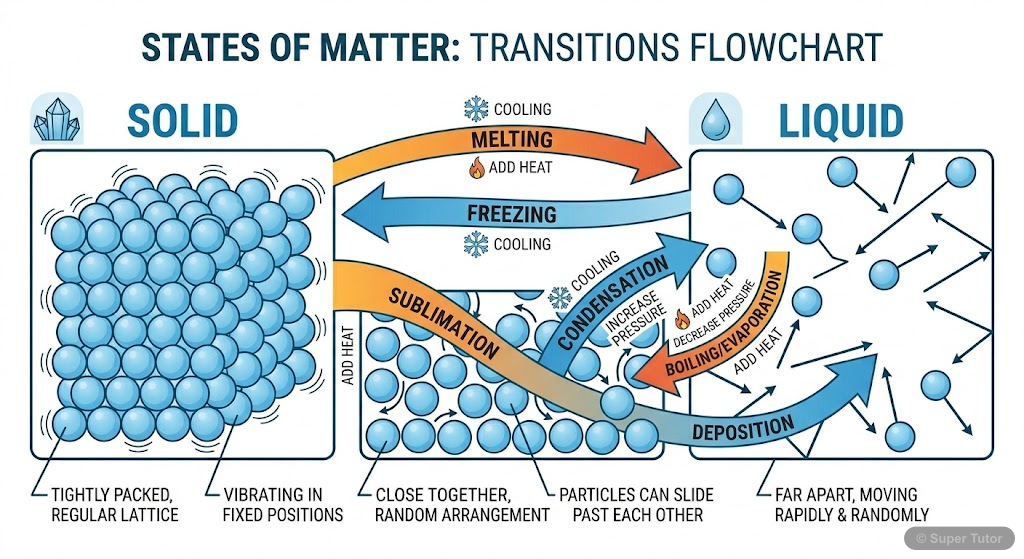
Learn better with visuals Super Tutor pairs illustrations like this with notes and quizzes for Matter in Our Surroundings.
Quick Quiz: Matter in Our Surroundings
0/4Tap an answer to check it instantly. No sign-up needed for these 4.
What are the three states of matter?
What happens when we dissolve salt in water?
The process of change from solid to liquid is called:
Liquids have:
Sample Questions
Which of the following properties belong to solids?
Show answer
Fixed shape, Fixed volume, Particles are closely packed
Solids have a fixed shape and fixed volume because their particles are closely packed and held together by strong forces of attraction. They cannot flow easily like liquids and are not highly compressible like gases.
Which factors affect the rate of evaporation?
Show answer
Surface area, Temperature, Wind speed, Humidity
The rate of evaporation increases with increase in surface area, temperature, and wind speed, but decreases with increase in humidity. The color of the liquid does not significantly affect evaporation rate.
The temperature at which a solid changes to liquid is called:
Show answer
Melting point
The melting point is the temperature at which a solid changes to liquid at atmospheric pressure. For ice, this is 0°C or 273 K. Boiling point is for liquid to gas conversion, and freezing point is for liquid to solid conversion.
Which state of matter has particles that are:
Show answer
Most closely packed in solids, Freely moving in gases, Can slide over each other in liquids, Have maximum kinetic energy in gases
In solids, particles are most closely packed with least kinetic energy. In liquids, particles can slide over each other with intermediate kinetic energy. In gases, particles move freely with maximum kinetic energy and are farthest apart.
+23 more questions on Matter in Our Surroundings (Haryana Board Class 9 Science)
Practise AllFrequently Asked Questions
What are the important topics in Matter in Our Surroundings for Haryana Board Class 9 Science?
How many practice questions are there for Matter in Our Surroundings?
Sources & Official References
Content is aligned to the official syllabus. Refer to the board website for the latest curriculum.
More resources for Matter in Our Surroundings
For serious students
Get the full Matter in Our Surroundings chapter — start free.
Quizzes, flashcards, an AI doubt solver and a study plan for Haryana Board Class 9 Science. Free to start, no card needed.