Chapter 3 of 12
Revision Notes
Atoms and Molecules — Revision Notes
Haryana Board · Class 9 · Science
Atoms and Molecules revision notes for Haryana Board Class 9 Science: 4 topics in quick points. Part of the Haryana Board Class 9 Science syllabus.
29 questions24 flashcards5 concepts
Interactive on Super Tutor
Studying Atoms and Molecules? Get the full interactive chapter.
Quizzes, flashcards, AI doubt-solver and a step-by-step study plan — built for revision notes and more.
Free trial, no card needed.
Super Tutor
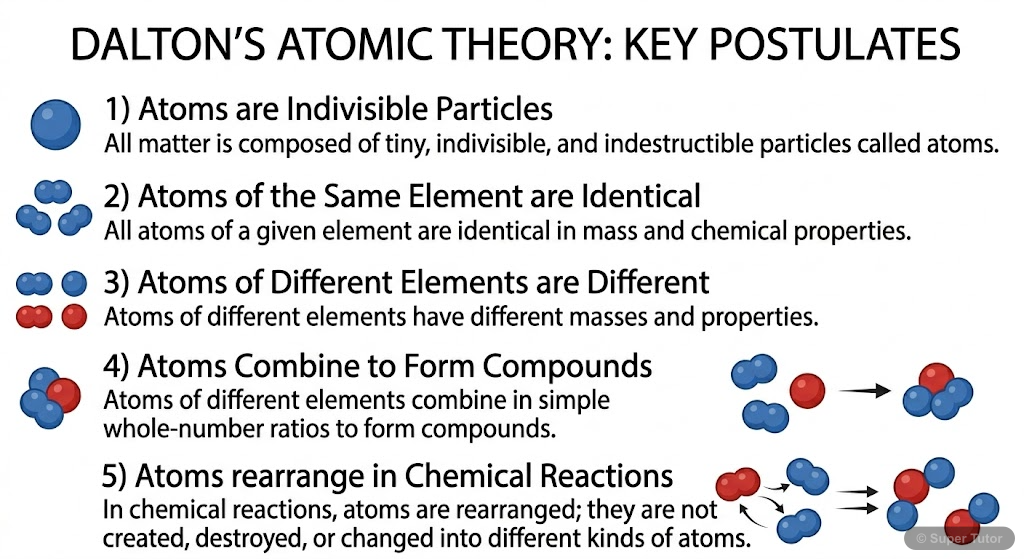
An illustration from Super Tutor's Atoms and Molecules chapter — alongside flashcards, concept maps and practice questions.
Key Topics to Revise
1
Historical Background and Laws of Chemical Combination
- Ancient Indian philosopher Maharishi Kanad (500 BC) proposed the concept of 'Parmanu' - smallest indivisible particles
- Greek philosophers Democritus and Leucippus called indivisible particles 'atoms' (meaning indivisible)
- Antoine Lavoisier established the foundation of chemical sciences through experimental work
2
Dalton's Atomic Theory
- John Dalton (1766-1844) provided the first scientific atomic theory
- Theory explained both laws of chemical combination through atomic concepts
- Six main postulates form the foundation of atomic theory
3
Atoms - Structure and Properties
- Atoms are extremely small - millions stacked would be as thick as paper
- Atomic radius measured in nanometers (1 nm = 10⁻⁹ m)
- Each element has unique symbols following IUPAC conventions
4
Molecules and Their Types
- Molecules are groups of two or more atoms bonded together
- Can be formed from same element atoms or different element atoms
- Atomicity refers to number of atoms in a molecule
Get complete notes with diagrams and examples
Full NotesKey Concepts
Two fundamental laws govern chemical reactionsJohn Dalton proposed that all matterAtoms are extremely small particles (radiusMolecules are groups of atoms heldIons are charged particles formed when
Frequently Asked Questions
What are the important topics in Atoms and Molecules for Haryana Board Class 9 Science?
Key topics in Atoms and Molecules include Historical Background and Laws of Chemical Combination, Dalton's Atomic Theory, Atoms - Structure and Properties, Molecules and Their Types. Study these first, then practise questions on each for Class 9 exams.
How should I revise Atoms and Molecules for Class 9 exams?
Learn the core ideas first, then work through the 29 practice questions on Atoms and Molecules. Revise definitions regularly and use flashcards for quick recall before the exam.
Sources & Official References
Content is aligned to the official syllabus. Refer to the board website for the latest curriculum.
More resources for Atoms and Molecules
For serious students
Get the full Atoms and Molecules chapter — start free.
Quizzes, flashcards, an AI doubt solver and a study plan for Haryana Board Class 9 Science. Free to start, no card needed.