The Human Eye and the Colourful World — Flashcards
Himachal Pradesh Board · Class 10 · Science
72 flashcards for The Human Eye and the Colourful World (Himachal Pradesh Board Class 10 Science) to test yourself on key terms and facts.
Interactive on Super Tutor
Studying The Human Eye and the Colourful World? Get the full interactive chapter.
Quizzes, flashcards, AI doubt-solver and a step-by-step study plan — built for flashcards and more.
Free trial, no card needed.
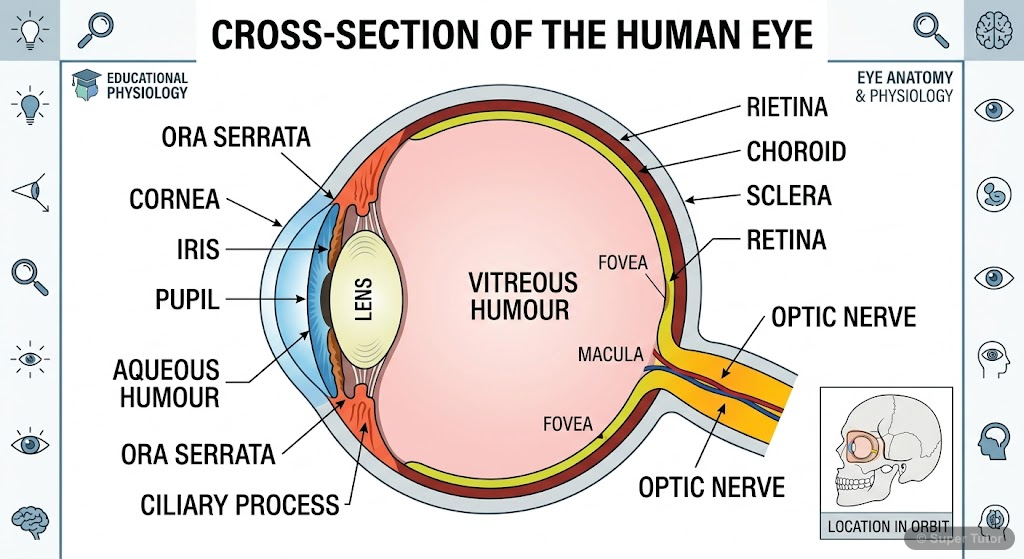
One of 14 illustrations for The Human Eye and the Colourful World in Super Tutor — alongside flashcards, concept maps and practice questions.
What is the human eye like in structure and function?
Answer
The human eye is like a camera. Its lens system forms an image on the retina, which is a light-sensitive screen at the back of the eye.
संरचना और कार्य में मानव आँख कैसी होती है?
Answer
मानव नेत्र एक कैमरे की तरह होता है। इसका लेंस तंत्र नेत्रपटल पर एक छवि बनाता है, जो आँख के पीछे एक प्रकाश-संवेदनशील स्क्रीन है।…
What is the cornea?
Answer
The cornea is a thin transparent membrane forming the front bulge of the eyeball. Light enters the eye through it, and most refraction of light entering the eye occurs at its outer surface.
कॉर्निया क्या है?
Answer
नेत्रपटल (cornea) आँख के गोले के सामने के उभार का निर्माण करने वाली एक पतली पारदर्शी झिल्ली है। प्रकाश इसके माध्यम से आँख में प्रवेश करता है, और आँख में प्रवेश करने वाले प्रकाश का अधिकांश अपवर्तन इसकी…
What is the function of the iris and pupil?
Answer
The iris is a dark muscular diaphragm behind the cornea that controls the size of the pupil. The pupil regulates and controls the amount of light entering the eye.
आँख की पुतली और पुतली का क्या कार्य है?
Answer
आँख की पुतली (आइरिस) कॉर्निया के पीछे एक गहरा पेशीय डायाफ्राम है जो पुतली के आकार को नियंत्रित करता है। पुतली आँख में प्रवेश करने वाले प्रकाश की मात्रा को नियंत्रित और नियंत्रित करती है।…
How does the eye lens help in seeing objects at different distances?
Answer
The crystalline eye lens is a fibrous, jelly-like lens whose curvature is modified by ciliary muscles. This changes its focal length so that nearby and distant objects can be focused clearly on the re…
आँख का लेंस अलग-अलग दूरी पर वस्तुओं को देखने में कैसे मदद करता है?
Answer
नेत्र का स्फटिक लेंस एक रेशेदार, जेली जैसा लेंस है जिसकी वक्रता सिलिअरी मांसपेशियों द्वारा संशोधित होती है। इससे इसकी फ़ोकस दूरी बदल जाती है ताकि निकटवर्ती और दूरवर्ती वस्तुओं को रेटिना पर स्पष्ट रूप …
+64 more flashcards
Practise AllFrequently Asked Questions
What are the important topics in The Human Eye and the Colourful World for Himachal Pradesh Board Class 10 Science?
How many flashcards are available for The Human Eye and the Colourful World?
How should I revise The Human Eye and the Colourful World for the Himachal Pradesh Board Class 10 board exam?
Sources & Official References
Content is aligned to the official syllabus. Refer to the board website for the latest curriculum.
More resources for The Human Eye and the Colourful World
Practice Quiz
Test yourself with a quick quiz
Important Questions
Exam-style questions with answers
Revision Notes
Key points for last-minute revision
Chapter Summary
Understand the chapter at a glance
Concept Maps
See how topics connect
Study Plan
Step-by-step plan for this chapter
Syllabus
What topics to cover
NCERT Solutions
Every textbook question solved step by step
For serious students
Get the full The Human Eye and the Colourful World chapter — start free.
Quizzes, flashcards, an AI doubt solver and a study plan for Himachal Pradesh Board Class 10 Science. Free to start, no card needed.