Magnetic Effects of Electric Current — NCERT Solutions
Himachal Pradesh Board · Class 10 · Science
NCERT Solutions for Magnetic Effects of Electric Current, Himachal Pradesh Board Class 10 Science: 22 textbook questions solved step by step.
Interactive on Super Tutor
Studying Magnetic Effects of Electric Current? Get the full interactive chapter.
Quizzes, flashcards, AI doubt-solver and a step-by-step study plan — built for NCERT solutions and more.
Free trial, no card needed.
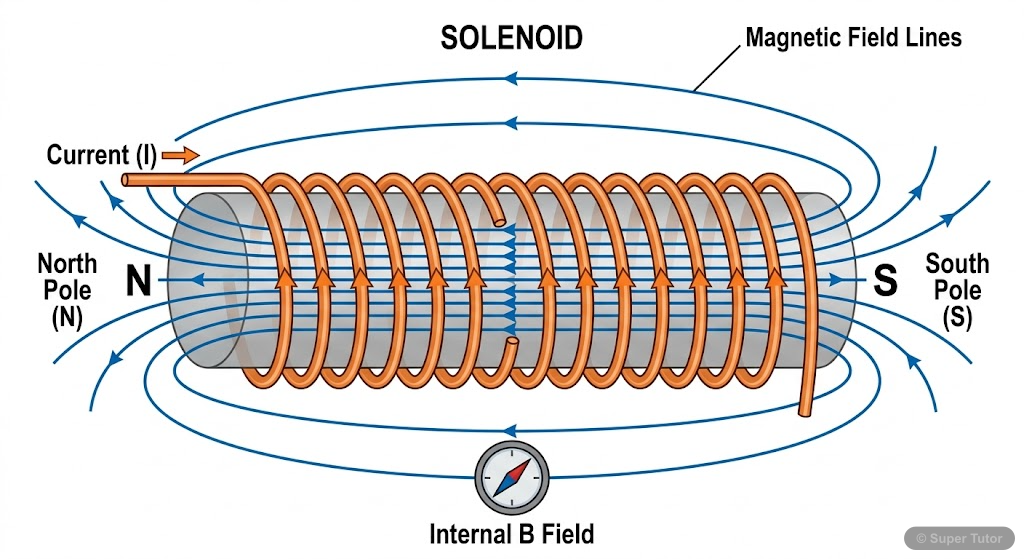
Learn better with visuals Super Tutor pairs illustrations like this with notes and quizzes for Magnetic Effects of Electric Current.
The first 11 solutions are open to read. The other 11 are free with a Super Tutor account.
Questions
1Why does a compass needle get deflected when brought near a bar magnet?Show solution
A compass needle is itself a small magnet. When it is brought near a bar magnet, the magnetic field of the bar magnet exerts a force on the needle. So the needle turns and aligns itself with the magnetic field, causing deflection.
1Draw magnetic field lines around a bar magnet.Show solution
Magnetic field lines around a bar magnet are drawn as closed curves. They emerge from the north pole and enter the south pole outside the magnet, and inside the magnet they go from south to north. The lines are closer near the poles and do not cross each other.
2List the properties of magnetic field lines.Show solution
The properties of magnetic field lines are:
- They form closed, continuous curves.
- The field lines go from the north pole to the south pole outside the magnet.
- Inside the magnet, they go from south pole to north pole.
- The closer the lines, the stronger the magnetic field.
- No two field lines intersect each other.
3Why don't two magnetic field lines intersect each other?Show solution
If two magnetic field lines intersected, then at the point of intersection the compass needle would have to point in two directions at the same time, which is impossible. Hence, magnetic field lines do not intersect.
5Consider a circular loop of wire lying in the plane of the table. Let the current pass through the loop clockwise. Apply the right-hand rule to find out the direction of the magnetic field inside and outside the loop.Show solution
For a circular loop carrying current clockwise, apply the right-hand rule by curling the fingers of the right hand in the direction of current. The thumb then points to the direction of the magnetic field inside the loop.
- Inside the loop: magnetic field is into the plane of the table.
- Outside the loop: magnetic field is in the opposite direction, i.e. out of the plane of the table.
6The magnetic field in a given region is uniform. Draw a diagram to represent it.Show solution
A uniform magnetic field is represented by parallel, equally spaced straight field lines with arrows all pointing in the same direction.
3Choose the correct option.
The magnetic field inside a long straight solenoid-carrying currentShow solution
The magnetic field inside a long straight solenoid carrying current is uniform, so it has the same strength at all points inside it. Therefore the correct option is (d).
1Which of the following property of a proton can change while it moves freely in a magnetic field? (There may be more than one correct answer.)Show solution
For a proton moving freely in a magnetic field, its mass does not change. But the magnetic force can change its direction of velocity, so velocity changes and therefore momentum also changes. Since a magnetic field does no work, the speed remains unchanged in the ideal case. Hence the changing properties are velocity and momentum; among the given options, the best choice is (c) and (d), and speed does not change. If the question expects all properties that can change while direction changes, then velocity and momentum are correct.
2In Activity 12.7, how do we think the displacement of rod AB will be affected if (i) current in rod AB is increased; (ii) a stronger horse-shoe magnet is used; and (iii) length of the rod AB is increased?Show solution
The displacement of rod AB will:
- Increase if the current in the rod is increased.
- Increase if a stronger horse-shoe magnet is used.
- Increase if the length of the rod inside the magnetic field is increased.
This is because the force on a current-carrying conductor in a magnetic field becomes larger when the current, magnetic field strength, or effective length of conductor in the field increases.
3A positively-charged particle (alpha-particle) projected towards west is deflected towards north by a magnetic field. The direction of magnetic field isShow solution
For a positively charged particle, the direction of current is the same as the direction of motion. Using Fleming’s left-hand rule for the given motion and deflection, the magnetic field must be downward. So the correct option is (c).
1Name two safety measures commonly used in electric circuits and appliances.Show solution
Two safety measures commonly used in electric circuits and appliances are:
- Electric fuse
- Earth wire
Free with a Super Tutor account
Free with a Super Tutor account
Free with a Super Tutor account
Free with a Super Tutor account
Free with a Super Tutor account
Free with a Super Tutor account
Free with a Super Tutor account
Free with a Super Tutor account
Free with a Super Tutor account
Free with a Super Tutor account
Free with a Super Tutor account
11 more solved questions in Magnetic Effects of Electric Current
They are free with a Super Tutor account, along with practice quizzes and flashcards for this chapter. Free to start, no card needed.
Frequently Asked Questions
What are the important topics in Magnetic Effects of Electric Current for Himachal Pradesh Board Class 10 Science?
Are these NCERT Solutions for Magnetic Effects of Electric Current free?
How should I revise Magnetic Effects of Electric Current for the Himachal Pradesh Board Class 10 board exam?
Sources & Official References
Content is aligned to the official syllabus. Refer to the board website for the latest curriculum.
More resources for Magnetic Effects of Electric Current
Practice Quiz
Test yourself with a quick quiz
Important Questions
Exam-style questions with answers
Revision Notes
Key points for last-minute revision
Chapter Summary
Understand the chapter at a glance
Concept Maps
See how topics connect
Study Plan
Step-by-step plan for this chapter
Flashcards
Quick-fire cards for active recall
Syllabus
What topics to cover
For serious students
Get the full Magnetic Effects of Electric Current chapter — start free.
Quizzes, flashcards, an AI doubt solver and a study plan for Himachal Pradesh Board Class 10 Science. Free to start, no card needed.