Self and Personality — Important Questions
Himachal Pradesh Board · Class 12 · Psychology
32 important questions from Self and Personality for Himachal Pradesh Board Class 12 Psychology, with answers. Written for the board exams 2027.
Interactive on Super Tutor
Studying Self and Personality? Get the full interactive chapter.
Quizzes, flashcards, AI doubt-solver and a step-by-step study plan — built for important questions and more.
Free trial, no card needed.
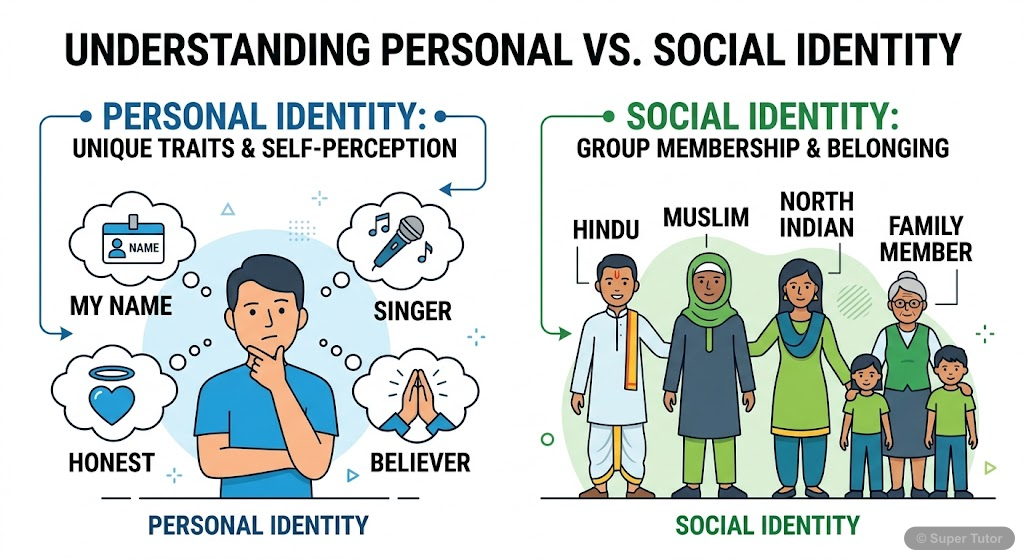
One of 26 illustrations for Self and Personality in Super Tutor — alongside flashcards, concept maps and practice questions.
Important Questions from Self and Personality
According to Freud's psychoanalytic theory, which components make up the structure of personality?
Show answer
Id, Ego, Superego
Freud proposed that personality consists of three components: Id (pleasure principle), Ego (reality principle), and Superego (moral principle). Libido is the energy that drives the id, and conscious is a level of awareness, not a personality structure.
Self-efficacy refers to a person's belief in their ability to perform behaviors required by a particular situation.
Show answer
True
Self-efficacy is indeed a person's belief in their ability to perform behaviors required by a particular situation. This concept was developed by Bandura and is based on social learning theory. People with high self-efficacy feel confident about their capabilities.
Which psychological techniques can be used for self-regulation?
Show answer
Self-observation, Self-instruction, Self-reinforcement
The three main psychological techniques for self-regulation are: self-observation (monitoring one's behavior), self-instruction (giving oneself directions), and self-reinforcement (rewarding oneself for good behavior). Self-denial is not mentioned as a formal technique in this context.
Arrange Freud's psychosexual stages in the correct chronological order:
Show answer
Oral Stage
Freud's psychosexual stages occur in this order: Oral (birth-1 year), Anal (1-3 years), Phallic (3-6 years), Latency (6 years-puberty), and Genital (puberty onwards). Each stage focuses on different erogenous zones and developmental challenges.
+28 more questions on Self and Personality (Himachal Pradesh Board Class 12 Psychology)
Practise AllFrequently Asked Questions
What are the important topics in Self and Personality for Himachal Pradesh Board Class 12 Psychology?
How many important questions are there in Self and Personality?
Sources & Official References
Content is aligned to the official syllabus. Refer to the board website for the latest curriculum.
More resources for Self and Personality
Practice Quiz
Test yourself with a quick quiz
Revision Notes
Key points for last-minute revision
Chapter Summary
Understand the chapter at a glance
Concept Maps
See how topics connect
Study Plan
Step-by-step plan for this chapter
Flashcards
Quick-fire cards for active recall
Syllabus
What topics to cover
NCERT Solutions
Every textbook question solved step by step
For serious students
Get the full Self and Personality chapter — start free.
Quizzes, flashcards, an AI doubt solver and a study plan for Himachal Pradesh Board Class 12 Psychology. Free to start, no card needed.