The Challenges of Cultural Diversity — Practice Quiz
Himachal Pradesh Board · Class 12 · Sociology
Try a 4-question quiz on The Challenges of Cultural Diversity for Himachal Pradesh Board Class 12 Sociology: tap an answer to check it and see why.
Interactive on Super Tutor
Studying The Challenges of Cultural Diversity? Get the full interactive chapter.
Quizzes, flashcards, AI doubt-solver and a step-by-step study plan — built for practice quiz and more.
Free trial, no card needed.
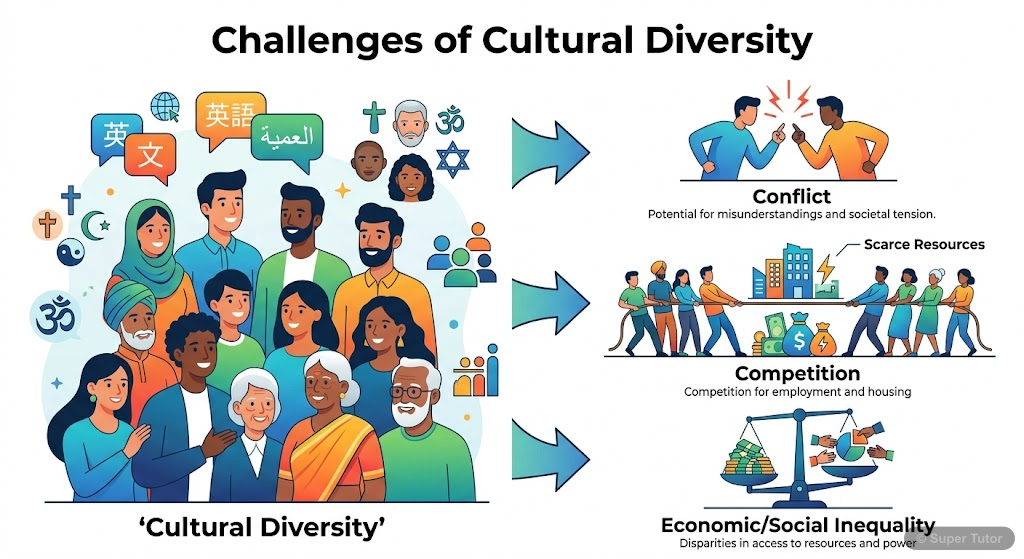
Learn better with visuals Super Tutor pairs illustrations like this with notes and quizzes for The Challenges of Cultural Diversity.
Quick Quiz: The Challenges of Cultural Diversity
0/4Tap an answer to check it instantly. No sign-up needed for these 4.
What does the term 'cultural diversity' primarily emphasize?
According to Max Weber, a state is defined as a body that claims monopoly over what?
The States Reorganisation Commission (SRC) was implemented in which year?
Communalism in the Indian context primarily refers to:
Sample Questions
Which of the following are characteristics of ascriptive identities?
Show answer
Based on birth and belonging, Cannot be chosen by individuals, Include family and religious communities
Ascriptive identities are determined by birth, not choice or achievement. They include family, religion, caste, and regional identities that we are born into.
India follows a secular state model that separates religion completely from public life.
Show answer
False
India's secularism differs from Western models. While India is secular, it doesn't separate religion completely from public life. The state provides equal respect to all religions and even declares public holidays for all religious festivals.
Match the following religious communities with their approximate percentage in India's population (2011 Census):
Show answer
Hindus - 80%
According to the 2011 Census, Hindus form about 80% of India's population, Muslims 14.2%, Christians 2.3%, and Sikhs 1.7%.
Arrange the following events in chronological order:
Show answer
Potti Sriramulu's martyrdom
Potti Sriramulu died in 1953, leading to Andhra Pradesh formation, then SRC was implemented in 1956, and the three new states were created in 2000.
+39 more questions on The Challenges of Cultural Diversity (Himachal Pradesh Board Class 12 Sociology)
Practise AllFrequently Asked Questions
What are the important topics in The Challenges of Cultural Diversity for Himachal Pradesh Board Class 12 Sociology?
How many practice questions are there for The Challenges of Cultural Diversity?
Sources & Official References
Content is aligned to the official syllabus. Refer to the board website for the latest curriculum.
More resources for The Challenges of Cultural Diversity
Important Questions
Exam-style questions with answers
Revision Notes
Key points for last-minute revision
Chapter Summary
Understand the chapter at a glance
Concept Maps
See how topics connect
Study Plan
Step-by-step plan for this chapter
Flashcards
Quick-fire cards for active recall
Syllabus
What topics to cover
NCERT Solutions
Every textbook question solved step by step
For serious students
Get the full The Challenges of Cultural Diversity chapter — start free.
Quizzes, flashcards, an AI doubt solver and a study plan for Himachal Pradesh Board Class 12 Sociology. Free to start, no card needed.