Chapter 6 of 14
NCERT Solutions

Triangles

Jharkhand Board · Class 10 · Mathematics

NCERT Solutions for Triangles — Jharkhand Board Class 10 Mathematics.

47 questions22 flashcards5 concepts

Interactive on Super Tutor

Studying Triangles? Get the full interactive chapter.

Quizzes, flashcards, AI doubt-solver and a step-by-step study plan — built for ncert solutions and more.

1,000+ Class 10 students started this chapter today

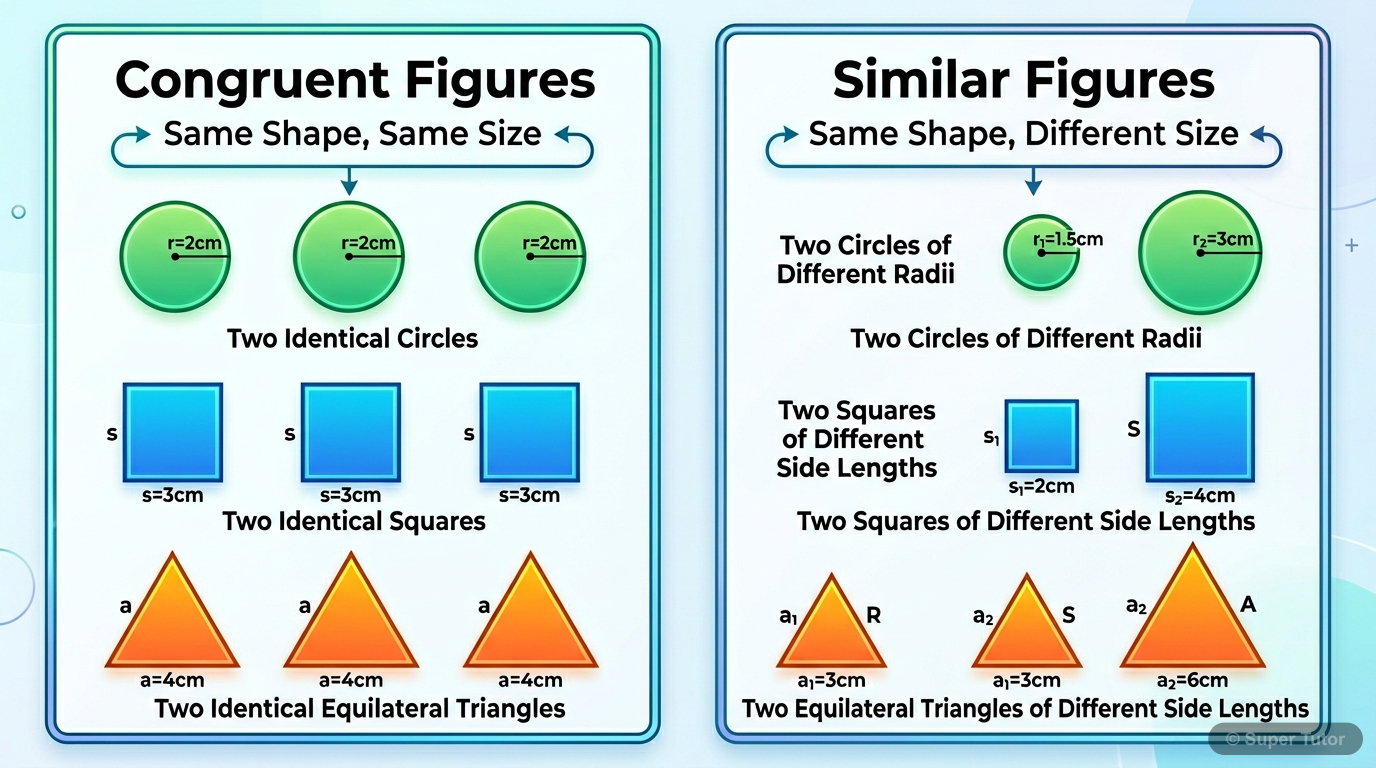
A comparison illustrating the difference between congruent figures (same shape and size) and similar figures (same shape, different size), using examples like circles, squares, and triangles.
Super Tutor

This is just one of 12+ visuals inside Super Tutor's Triangles chapter

Explore the full set
29 Questions Solved · 3 Sections

EXERCISE 6.1

1Fill in the blanks using the correct word given in brackets:
(i) All circles are ______. (congruent, similar)
(ii) All squares are ______. (similar, congruent)
(iii) All ______ triangles are similar. (isosceles, equilateral)
(iv) Two polygons of the same number of sides are similar, if (a) their corresponding angles are ______ and (b) their corresponding sides are ______. (equal, proportional)
Show solution
(i) All circles are similar.
Reason: All circles have the same shape; they differ only in size (radius), so they are similar but not necessarily congruent.

(ii) All squares are similar.
Reason: All squares have all angles equal to 90° and all sides in the same ratio (1:1 for any two squares scaled appropriately), so they are always similar.

(iii) All equilateral triangles are similar.
Reason: In every equilateral triangle each angle is 60°, so all equilateral triangles have equal corresponding angles and are therefore similar by AAA criterion.

(iv) Two polygons of the same number of sides are similar, if
(a) their corresponding angles are equal and
(b) their corresponding sides are proportional.
2Give two different examples of pair of
(i) similar figures.
(ii) non-similar figures.
Show solution
(i) Examples of similar figures:
1. Any two circles (e.g., a circle of radius 3 cm and a circle of radius 5 cm).
2. Any two equilateral triangles (e.g., an equilateral triangle with side 4 cm and another with side 7 cm).

(ii) Examples of non-similar figures:
1. A rectangle of dimensions 2 cm × 4 cm and a rectangle of dimensions 2 cm × 6 cm (corresponding sides are not proportional: 22=146\frac{2}{2} = 1 \neq \frac{4}{6}).
2. A right-angled triangle and an equilateral triangle (corresponding angles are not equal).
3State whether the following quadrilaterals are similar or not (referring to Fig. 6.8 — a square and a rectangle/rhombus shown).Show solution
Given: Two quadrilaterals are shown in Fig. 6.8. From the figure, one appears to be a square and the other a rectangle (or a rhombus), with sides in different proportions.

Condition for similarity of polygons:
Two polygons are similar if and only if
(a) their corresponding angles are equal, AND
(b) their corresponding sides are proportional.

Analysis:
For the quadrilaterals in Fig. 6.8, although both may have all right angles (if one is a square and the other a rectangle), their corresponding sides are not proportional (a square has all sides equal while a rectangle has unequal adjacent sides). Alternatively, if one is a rhombus, the angles are not all equal to 90°.

Conclusion: The two quadrilaterals shown in Fig. 6.8 are not similar, because even though corresponding angles may be equal, their corresponding sides are not proportional (or vice versa). Both conditions must hold simultaneously for similarity.

EXERCISE 6.2

1In Fig. 6.17, (i) and (ii), DE ∥ BC. Find EC in (i) and AD in (ii).Show solution
Case (i): Given DE ∥ BC, AD = 1.5 cm, DB = 3 cm, AE = 1 cm. Find EC.

Concept used: Basic Proportionality Theorem (BPT / Thales' Theorem): If a line is drawn parallel to one side of a triangle, it divides the other two sides in the same ratio.

ADDB=AEEC\frac{AD}{DB} = \frac{AE}{EC}

1.53=1EC\frac{1.5}{3} = \frac{1}{EC}

EC=1×31.5=31.5=2 cmEC = \frac{1 \times 3}{1.5} = \frac{3}{1.5} = 2 \text{ cm}

EC=2 cm\boxed{EC = 2 \text{ cm}}

---

Case (ii): Given DE ∥ BC, DB = 7.2 cm, AE = 1.8 cm, EC = 5.4 cm. Find AD.

Using BPT:
ADDB=AEEC\frac{AD}{DB} = \frac{AE}{EC}

AD7.2=1.85.4\frac{AD}{7.2} = \frac{1.8}{5.4}

AD7.2=13\frac{AD}{7.2} = \frac{1}{3}

AD=7.23=2.4 cmAD = \frac{7.2}{3} = 2.4 \text{ cm}

AD=2.4 cm\boxed{AD = 2.4 \text{ cm}}
2E and F are points on the sides PQ and PR respectively of a ΔPQR. For each of the following cases, state whether EF ∥ QR:
(i) PE = 3.9 cm, EQ = 3 cm, PF = 3.6 cm and FR = 2.4 cm
(ii) PE = 4 cm, QE = 4.5 cm, PF = 8 cm and RF = 9 cm
(iii) PQ = 1.28 cm, PR = 2.56 cm, PE = 0.18 cm and PF = 0.36 cm
Show solution
Concept: By the converse of BPT, EF ∥ QR if and only if PEEQ=PFFR\dfrac{PE}{EQ} = \dfrac{PF}{FR}.

---
(i) PE = 3.9 cm, EQ = 3 cm, PF = 3.6 cm, FR = 2.4 cm

PEEQ=3.93=1.3\frac{PE}{EQ} = \frac{3.9}{3} = 1.3

PFFR=3.62.4=1.5\frac{PF}{FR} = \frac{3.6}{2.4} = 1.5

Since PEEQPFFR\dfrac{PE}{EQ} \neq \dfrac{PF}{FR}, EF is not parallel to QR.

---
(ii) PE = 4 cm, QE = 4.5 cm, PF = 8 cm, RF = 9 cm

PEEQ=44.5=89\frac{PE}{EQ} = \frac{4}{4.5} = \frac{8}{9}

PFFR=89\frac{PF}{FR} = \frac{8}{9}

Since PEEQ=PFFR=89\dfrac{PE}{EQ} = \dfrac{PF}{FR} = \dfrac{8}{9}, EF ∥ QR.

---
(iii) PQ = 1.28 cm, PR = 2.56 cm, PE = 0.18 cm, PF = 0.36 cm

First find EQ and FR:
EQ=PQPE=1.280.18=1.10 cmEQ = PQ - PE = 1.28 - 0.18 = 1.10 \text{ cm}
FR=PRPF=2.560.36=2.20 cmFR = PR - PF = 2.56 - 0.36 = 2.20 \text{ cm}

PEEQ=0.181.10=18110=955\frac{PE}{EQ} = \frac{0.18}{1.10} = \frac{18}{110} = \frac{9}{55}

PFFR=0.362.20=36220=955\frac{PF}{FR} = \frac{0.36}{2.20} = \frac{36}{220} = \frac{9}{55}

Since PEEQ=PFFR\dfrac{PE}{EQ} = \dfrac{PF}{FR}, EF ∥ QR.
3In Fig. 6.18, if LM ∥ CB and LN ∥ CD, prove that AMAB=ANAD\dfrac{AM}{AB} = \dfrac{AN}{AD}.Show solution
Given: In the figure, LM ∥ CB and LN ∥ CD.

To prove: AMAB=ANAD\dfrac{AM}{AB} = \dfrac{AN}{AD}

Proof:

In ΔABC\Delta ABC, LM ∥ CB (given).

By Basic Proportionality Theorem:
AMMB=ALLC(1)\frac{AM}{MB} = \frac{AL}{LC} \quad \cdots (1)

This can be rewritten as:
AMAM+MB=ALAL+LC\frac{AM}{AM + MB} = \frac{AL}{AL + LC}
AMAB=ALAC(2)\Rightarrow \frac{AM}{AB} = \frac{AL}{AC} \quad \cdots (2)

In ΔACD\Delta ACD, LN ∥ CD (given).

By Basic Proportionality Theorem:
ANND=ALLC(3)\frac{AN}{ND} = \frac{AL}{LC} \quad \cdots (3)

This can be rewritten as:
ANAN+ND=ALAL+LC\frac{AN}{AN + ND} = \frac{AL}{AL + LC}
ANAD=ALAC(4)\Rightarrow \frac{AN}{AD} = \frac{AL}{AC} \quad \cdots (4)

From (2) and (4):
AMAB=ANAD\frac{AM}{AB} = \frac{AN}{AD}

Hence proved. \blacksquare
4In Fig. 6.19, DE ∥ AC and DF ∥ AE. Prove that BFFE=BEEC\dfrac{BF}{FE} = \dfrac{BE}{EC}.Show solution
Given: In ΔABC\Delta ABC, DE ∥ AC and DF ∥ AE.

To prove: BFFE=BEEC\dfrac{BF}{FE} = \dfrac{BE}{EC}

Proof:

Step 1: In ΔBCA\Delta BCA, DE ∥ AC (given).

By Basic Proportionality Theorem:
BDDA=BEEC(1)\frac{BD}{DA} = \frac{BE}{EC} \quad \cdots (1)

Step 2: In ΔBEA\Delta BEA, DF ∥ AE (given).

By Basic Proportionality Theorem:
BDDA=BFFE(2)\frac{BD}{DA} = \frac{BF}{FE} \quad \cdots (2)

Step 3: From (1) and (2):
BFFE=BEEC\frac{BF}{FE} = \frac{BE}{EC}

Hence proved. \blacksquare
5In Fig. 6.20, DE ∥ OQ and DF ∥ OR. Show that EF ∥ QR.Show solution
Given: In the figure, DE ∥ OQ and DF ∥ OR (where E is on PQ and F is on PR, D is on PO).

To prove: EF ∥ QR

Proof:

Step 1: In ΔPOQ\Delta POQ, DE ∥ OQ (given).

By Basic Proportionality Theorem:
PEEQ=PDDO(1)\frac{PE}{EQ} = \frac{PD}{DO} \quad \cdots (1)

Step 2: In ΔPOR\Delta POR, DF ∥ OR (given).

By Basic Proportionality Theorem:
PFFR=PDDO(2)\frac{PF}{FR} = \frac{PD}{DO} \quad \cdots (2)

Step 3: From (1) and (2):
PEEQ=PFFR\frac{PE}{EQ} = \frac{PF}{FR}

Step 4: In ΔPQR\Delta PQR, E is on PQ and F is on PR such that PEEQ=PFFR\dfrac{PE}{EQ} = \dfrac{PF}{FR}.

By the Converse of Basic Proportionality Theorem:
EFQREF \parallel QR

Hence proved. \blacksquare
6In Fig. 6.21, A, B and C are points on OP, OQ and OR respectively such that AB ∥ PQ and AC ∥ PR. Show that BC ∥ QR.Show solution
Given: A is on OP, B is on OQ, C is on OR; AB ∥ PQ and AC ∥ PR.

To prove: BC ∥ QR

Proof:

Step 1: In ΔOPQ\Delta OPQ, AB ∥ PQ (given).

By Basic Proportionality Theorem:
OAAP=OBBQ(1)\frac{OA}{AP} = \frac{OB}{BQ} \quad \cdots (1)

Step 2: In ΔOPR\Delta OPR, AC ∥ PR (given).

By Basic Proportionality Theorem:
OAAP=OCCR(2)\frac{OA}{AP} = \frac{OC}{CR} \quad \cdots (2)

Step 3: From (1) and (2):
OBBQ=OCCR\frac{OB}{BQ} = \frac{OC}{CR}

Step 4: In ΔOQR\Delta OQR, B is on OQ and C is on OR such that OBBQ=OCCR\dfrac{OB}{BQ} = \dfrac{OC}{CR}.

By the Converse of Basic Proportionality Theorem:
BCQRBC \parallel QR

Hence proved. \blacksquare
7Using Theorem 6.1, prove that a line drawn through the mid-point of one side of a triangle parallel to another side bisects the third side.Show solution
Given: In ΔABC\Delta ABC, D is the mid-point of AB and DE ∥ BC, where E is a point on AC.

To prove: E is the mid-point of AC, i.e., AE = EC.

Theorem 6.1 (BPT): If a line is drawn parallel to one side of a triangle to intersect the other two sides in distinct points, then the other two sides are divided in the same ratio.

Proof:

In ΔABC\Delta ABC, DE ∥ BC (given).

By Theorem 6.1 (BPT):
ADDB=AEEC(1)\frac{AD}{DB} = \frac{AE}{EC} \quad \cdots (1)

Since D is the mid-point of AB:
AD=DBADDB=1(2)AD = DB \Rightarrow \frac{AD}{DB} = 1 \quad \cdots (2)

From (1) and (2):
AEEC=1AE=EC\frac{AE}{EC} = 1 \Rightarrow AE = EC

Therefore, E is the mid-point of AC.

Hence proved. \blacksquare
8Using Theorem 6.2, prove that the line joining the mid-points of any two sides of a triangle is parallel to the third side.Show solution
Given: In ΔABC\Delta ABC, D and E are mid-points of AB and AC respectively.

To prove: DE ∥ BC.

Theorem 6.2 (Converse of BPT): If a line divides any two sides of a triangle in the same ratio, then the line is parallel to the third side.

Proof:

Since D is the mid-point of AB:
AD=DBADDB=1(1)AD = DB \Rightarrow \frac{AD}{DB} = 1 \quad \cdots (1)

Since E is the mid-point of AC:
AE=ECAEEC=1(2)AE = EC \Rightarrow \frac{AE}{EC} = 1 \quad \cdots (2)

From (1) and (2):
ADDB=AEEC\frac{AD}{DB} = \frac{AE}{EC}

By Theorem 6.2 (Converse of BPT), DE ∥ BC.

Hence proved. \blacksquare
9ABCD is a trapezium in which AB ∥ DC and its diagonals intersect each other at the point O. Show that AOBO=CODO\dfrac{AO}{BO} = \dfrac{CO}{DO}.Show solution
Given: ABCD is a trapezium with AB ∥ DC. Diagonals AC and BD intersect at O.

To prove: AOBO=CODO\dfrac{AO}{BO} = \dfrac{CO}{DO}

Construction: Draw EF through O parallel to AB (and DC), meeting AD at E and BC at F.

Proof:

In ΔDAB\Delta DAB, EO ∥ AB (by construction).

By BPT:
DEEA=DOOB(1)\frac{DE}{EA} = \frac{DO}{OB} \quad \cdots (1)

In ΔABC\Delta ABC, OF ∥ AB (by construction).

By BPT:
AFFC=AOOC()\frac{AF}{FC} = \frac{AO}{OC} \quad \cdots (*)

Alternative direct approach:

In ΔAOB\Delta AOB and ΔCOD\Delta COD:
- AOB=COD\angle AOB = \angle COD (vertically opposite angles)
- OAB=OCD\angle OAB = \angle OCD (alternate interior angles, since AB ∥ DC)
- OBA=ODC\angle OBA = \angle ODC (alternate interior angles, since AB ∥ DC)

Therefore, ΔAOBΔCOD\Delta AOB \sim \Delta COD (by AAA similarity criterion).

Hence:
AOCO=BODO=ABCD\frac{AO}{CO} = \frac{BO}{DO} = \frac{AB}{CD}

This gives:
AOCO=BODO\frac{AO}{CO} = \frac{BO}{DO}

AOBO=CODO\Rightarrow \frac{AO}{BO} = \frac{CO}{DO}

Hence proved. \blacksquare
10The diagonals of a quadrilateral ABCD intersect each other at the point O such that AOBO=CODO\dfrac{AO}{BO} = \dfrac{CO}{DO}. Show that ABCD is a trapezium.Show solution
Given: Diagonals AC and BD of quadrilateral ABCD intersect at O such that AOBO=CODO\dfrac{AO}{BO} = \dfrac{CO}{DO}.

To prove: ABCD is a trapezium, i.e., AB ∥ DC.

Construction: Draw EO ∥ AB through O, meeting AD at E.

Proof:

Step 1: Given:
AOBO=CODO\frac{AO}{BO} = \frac{CO}{DO}
AOCO=BODO(1)\Rightarrow \frac{AO}{CO} = \frac{BO}{DO} \quad \cdots (1)

Step 2: In ΔDAB\Delta DAB, EO ∥ AB (by construction).

By BPT:
DEEA=DOOB(2)\frac{DE}{EA} = \frac{DO}{OB} \quad \cdots (2)

Step 3: In ΔDAC\Delta DAC, consider the line through O.

From (1): AOCO=BODO\dfrac{AO}{CO} = \dfrac{BO}{DO}, i.e., DOOB=COAO\dfrac{DO}{OB} = \dfrac{CO}{AO}.

In ΔABD\Delta ABD, EO ∥ AB gives DEEA=DOOB\dfrac{DE}{EA} = \dfrac{DO}{OB}.

Now in ΔACD\Delta ACD: DOOB=COAO\dfrac{DO}{OB} = \dfrac{CO}{AO} (from given condition rearranged).

So DEEA=COAO\dfrac{DE}{EA} = \dfrac{CO}{AO}.

By converse of BPT in ΔACD\Delta ACD, EO ∥ DC.

But EO ∥ AB (by construction).

Therefore AB ∥ DC.

Since AB ∥ DC, quadrilateral ABCD is a trapezium.

Hence proved. \blacksquare

EXERCISE 6.3

1State which pairs of triangles in Fig. 6.34 are similar. Write the similarity criterion used by you for answering the question and also write the pairs of similar triangles in the symbolic form.Show solution
Note: The figures show several pairs of triangles with given angles and/or sides. Based on the standard NCERT Fig. 6.34, the pairs are analysed as follows:

(i) In the two triangles, the angles given are 40°, 60°, 80° in one and 40°, 60°, 80° in the other.

Since all three corresponding angles are equal:
ΔABCΔPQR(AAA similarity criterion)\Delta ABC \sim \Delta PQR \quad (\text{AAA similarity criterion})

(ii) In the two triangles, sides are given as:
Triangle 1: sides 2, 2, 2 (or proportional sides)
Triangle 2: sides 4, 4, 4

ABPQ=BCQR=CARP=12\frac{AB}{PQ} = \frac{BC}{QR} = \frac{CA}{RP} = \frac{1}{2}

ΔABCΔPQR(SSS similarity criterion)\Delta ABC \sim \Delta PQR \quad (\text{SSS similarity criterion})

(iii) In the two triangles, two sides are proportional and the included angle is equal.

ΔMNLΔPQR(SAS similarity criterion)\Delta MNL \sim \Delta PQR \quad (\text{SAS similarity criterion})

(iv) In the two triangles, angles given are 70°, 80° in one and 70°, 30° in the other. The third angles are: 180°70°80°=30°180° - 70° - 80° = 30° and 180°70°30°=80°180° - 70° - 30° = 80°. So corresponding angles match.

ΔDEFΔPQR(AAA / AA similarity criterion)\Delta DEF \sim \Delta PQR \quad (\text{AAA / AA similarity criterion})

(v) The sides given are not proportional and angles are not equal, so the triangles are not similar.

(vi) In the two triangles, angles given are 70°, 80° in one and 70°, 80° in the other (with the equal angles at corresponding vertices).

ΔDEFΔPQR(AA similarity criterion)\Delta DEF \sim \Delta PQR \quad (\text{AA similarity criterion})

Summary:
- Pairs (i), (ii), (iii), (iv), (vi) are similar by AAA, SSS, SAS, AA, AA criteria respectively.
- Pair (v) is not similar.
2In Fig. 6.35, ΔODC ∼ ΔOBA, ∠BOC = 125° and ∠CDO = 70°. Find ∠DOC, ∠DCO and ∠OAB.Show solution
Given: ΔODCΔOBA\Delta ODC \sim \Delta OBA, BOC=125°\angle BOC = 125°, CDO=70°\angle CDO = 70°.

Step 1: Find ∠DOC

DOC\angle DOC and BOC\angle BOC are supplementary (they form a linear pair on line DB):
DOC=180°BOC=180°125°=55°\angle DOC = 180° - \angle BOC = 180° - 125° = 55°

Step 2: Find ∠DCO

In ΔDOC\Delta DOC:
DCO=180°CDODOC=180°70°55°=55°\angle DCO = 180° - \angle CDO - \angle DOC = 180° - 70° - 55° = 55°

Step 3: Find ∠OAB

Since ΔODCΔOBA\Delta ODC \sim \Delta OBA, corresponding angles are equal:
ODC=OBAandOCD=OAB\angle ODC = \angle OBA \quad \text{and} \quad \angle OCD = \angle OAB

Therefore:
OAB=OCD=55°\angle OAB = \angle OCD = 55°

Answers:
DOC=55°,DCO=55°,OAB=55°\angle DOC = 55°, \quad \angle DCO = 55°, \quad \angle OAB = 55°
3Diagonals AC and BD of a trapezium ABCD with AB ∥ DC intersect each other at the point O. Using a similarity criterion for two triangles, show that OAOC=OBOD\dfrac{OA}{OC} = \dfrac{OB}{OD}.Show solution
Given: ABCD is a trapezium with AB ∥ DC. Diagonals AC and BD intersect at O.

To prove: OAOC=OBOD\dfrac{OA}{OC} = \dfrac{OB}{OD}

Proof:

In ΔAOB\Delta AOB and ΔCOD\Delta COD:

1. AOB=COD\angle AOB = \angle COD (vertically opposite angles)

2. OAB=OCD\angle OAB = \angle OCD (alternate interior angles, since AB ∥ DC and AC is a transversal)

3. OBA=ODC\angle OBA = \angle ODC (alternate interior angles, since AB ∥ DC and BD is a transversal)

By AAA similarity criterion:
ΔAOBΔCOD\Delta AOB \sim \Delta COD

Since corresponding sides of similar triangles are proportional:
OAOC=OBOD=ABCD\frac{OA}{OC} = \frac{OB}{OD} = \frac{AB}{CD}

In particular:
OAOC=OBOD\frac{OA}{OC} = \frac{OB}{OD}

Hence proved. \blacksquare
4In Fig. 6.36, QRQS=QTPR\dfrac{QR}{QS} = \dfrac{QT}{PR} and ∠1 = ∠2. Show that ΔPQS ∼ ΔTQR.Show solution
Given: QRQS=QTPR\dfrac{QR}{QS} = \dfrac{QT}{PR} and 1=2\angle 1 = \angle 2 (where 1=PQT\angle 1 = \angle PQT or TQR\angle TQR and 2=QPR\angle 2 = \angle QPR — as marked in the figure).

To prove: ΔPQSΔTQR\Delta PQS \sim \Delta TQR

Proof:

Step 1: In ΔPQR\Delta PQR, 1=2\angle 1 = \angle 2 means PQR=QPR\angle PQR = \angle QPR (angles at Q and P are equal).

Wait — from the figure, 1=PQS\angle 1 = \angle PQS (or TQR\angle TQR) and 2=QPR\angle 2 = \angle QPR.

Since 1=2\angle 1 = \angle 2, i.e., QPR=PQR\angle QPR = \angle PQR (base angles), triangle PQR is isosceles with PR=QRPR = QR.

Step 2: Given QRQS=QTPR\dfrac{QR}{QS} = \dfrac{QT}{PR}.

Since PR=QRPR = QR (from Step 1):
QRQS=QTQR\frac{QR}{QS} = \frac{QT}{QR}

QR2=QSQT\Rightarrow QR^2 = QS \cdot QT

QTQR=QRQS\Rightarrow \frac{QT}{QR} = \frac{QR}{QS}

Step 3: In ΔPQS\Delta PQS and ΔTQR\Delta TQR:

- Q=Q\angle Q = \angle Q (common angle)
- QTQR=QRQS\dfrac{QT}{QR} = \dfrac{QR}{QS}, i.e., QTQR=QRQS\dfrac{QT}{QR} = \dfrac{QR}{QS}

By SAS similarity criterion:
ΔTQRΔPQS\Delta TQR \sim \Delta PQS

Which is the same as ΔPQSΔTQR\Delta PQS \sim \Delta TQR.

Hence proved. \blacksquare
5S and T are points on sides PR and QR of ΔPQR such that ∠P = ∠RTS. Show that ΔRPQ ∼ ΔRTS.Show solution
Given: In ΔPQR\Delta PQR, S is on PR and T is on QR such that P=RTS\angle P = \angle RTS.

To prove: ΔRPQΔRTS\Delta RPQ \sim \Delta RTS

Proof:

In ΔRPQ\Delta RPQ and ΔRTS\Delta RTS:

1. R=R\angle R = \angle R (common angle)

2. RPQ=RTS\angle RPQ = \angle RTS (given, i.e., P=RTS\angle P = \angle RTS)

By AA similarity criterion:
ΔRPQΔRTS\Delta RPQ \sim \Delta RTS

Hence proved. \blacksquare
6In Fig. 6.37, if ΔABE ≅ ΔACD, show that ΔADE ∼ ΔABC.Show solution
Given: ΔABEΔACD\Delta ABE \cong \Delta ACD.

To prove: ΔADEΔABC\Delta ADE \sim \Delta ABC

Proof:

Since ΔABEΔACD\Delta ABE \cong \Delta ACD (given), their corresponding parts are equal:
AB=AC(1)AB = AC \quad \cdots (1)
AE=AD(2)AE = AD \quad \cdots (2)

Step 2: From (1) and (2):
ADAB=AEAC(3)\frac{AD}{AB} = \frac{AE}{AC} \quad \cdots (3)

(Since AD=AEAD = AE and AB=ACAB = AC means ADAB=AEAC\dfrac{AD}{AB} = \dfrac{AE}{AC}.)

Step 3: In ΔADE\Delta ADE and ΔABC\Delta ABC:

1. A=A\angle A = \angle A (common angle)

2. ADAB=AEAC\dfrac{AD}{AB} = \dfrac{AE}{AC} [from (3)]

By SAS similarity criterion:
ΔADEΔABC\Delta ADE \sim \Delta ABC

Hence proved. \blacksquare
7In Fig. 6.38, altitudes AD and CE of ΔABC intersect each other at the point P. Show that:
(i) ΔAEP ∼ ΔCDP
(ii) ΔABD ∼ ΔCBE
(iii) ΔAEP ∼ ΔADB
(iv) ΔPDC ∼ ΔBEC
Show solution
Given: AD ⊥ BC and CE ⊥ AB are altitudes of ΔABC\Delta ABC intersecting at P.

So ADB=AEP=CDB=CEA=90°\angle ADB = \angle AEP = \angle CDB = \angle CEA = 90°.

---
(i) Prove ΔAEP ∼ ΔCDP:

In ΔAEP\Delta AEP and ΔCDP\Delta CDP:
- AEP=CDP=90°\angle AEP = \angle CDP = 90° (CE ⊥ AB and AD ⊥ BC)
- APE=CPD\angle APE = \angle CPD (vertically opposite angles)

By AA similarity:
ΔAEPΔCDP\Delta AEP \sim \Delta CDP \quad \blacksquare

---
(ii) Prove ΔABD ∼ ΔCBE:

In ΔABD\Delta ABD and ΔCBE\Delta CBE:
- ADB=CEB=90°\angle ADB = \angle CEB = 90° (AD ⊥ BC and CE ⊥ AB)
- ABD=CBE\angle ABD = \angle CBE (common angle B)

By AA similarity:
ΔABDΔCBE\Delta ABD \sim \Delta CBE \quad \blacksquare

---
(iii) Prove ΔAEP ∼ ΔADB:

In ΔAEP\Delta AEP and ΔADB\Delta ADB:
- AEP=ADB=90°\angle AEP = \angle ADB = 90°
- A=A\angle A = \angle A (common angle at A)

By AA similarity:
ΔAEPΔADB\Delta AEP \sim \Delta ADB \quad \blacksquare

---
(iv) Prove ΔPDC ∼ ΔBEC:

In ΔPDC\Delta PDC and ΔBEC\Delta BEC:
- PDC=BEC=90°\angle PDC = \angle BEC = 90° (AD ⊥ BC and CE ⊥ AB)
- PCD=BCE\angle PCD = \angle BCE (common angle C)

By AA similarity:
ΔPDCΔBEC\Delta PDC \sim \Delta BEC \quad \blacksquare
8E is a point on the side AD produced of a parallelogram ABCD and BE intersects CD at F. Show that ΔABE ∼ ΔCFB.Show solution
Given: ABCD is a parallelogram. E is on AD produced. BE intersects CD at F.

To prove: ΔABEΔCFB\Delta ABE \sim \Delta CFB

Proof:

In ΔABE\Delta ABE and ΔCFB\Delta CFB:

1. BAE=BCF\angle BAE = \angle BCF

Since ABCD is a parallelogram, AB ∥ CD. AE is a transversal (AD produced).
DAB+ADC=180°\angle DAB + \angle ADC = 180° (co-interior angles).
Also, BAE=DAB\angle BAE = \angle DAB (same angle, since E is on AD produced, BAE=180°BAD\angle BAE = 180° - \angle BAD... )

Actually: In parallelogram ABCD, AD ∥ BC. So AEB\angle AEB and CBF\angle CBF are alternate interior angles (since AE ∥ BC and BE is transversal).
AEB=CBF(1)\angle AEB = \angle CBF \quad \cdots (1)

2. ABE=CFB\angle ABE = \angle CFB? Let us use:

In parallelogram ABCD: AB ∥ DC.
ABF=CFB\angle ABF = \angle CFB? No.

BAE=BCF\angle BAE = \angle BCF: Since AB ∥ DC (opposite sides of parallelogram), with transversal BC:
ABC+BCD=180°\angle ABC + \angle BCD = 180°.

Better approach: A=C\angle A = \angle C (opposite angles of parallelogram are equal):
DAB=BCD\angle DAB = \angle BCD
BAE=BCF(1)\Rightarrow \angle BAE = \angle BCF \quad \cdots (1) (since BAE\angle BAE is the same as DAB\angle DAB extended — actually BAE=180°BAD\angle BAE = 180° - \angle BAD only if E is beyond D. Let's use: since AD ∥ BC, AEB=FBC\angle AEB = \angle FBC as alternate angles.)

Cleaner proof:

In ΔABE\Delta ABE and ΔCFB\Delta CFB:

1. BAE=BCF\angle BAE = \angle BCF
(In parallelogram, A=C\angle A = \angle C, i.e., DAB=DCB\angle DAB = \angle DCB; since E is on AD produced, BAE=180°BAD\angle BAE = 180° - \angle BAD... )

Since AD ∥ BC (parallelogram), and EB is a transversal:
AEB=CBF(alternate interior angles)(1)\angle AEB = \angle CBF \quad (\text{alternate interior angles}) \cdots (1)

2. ABE=CFB\angle ABE = \angle CFB

In parallelogram AB ∥ FC (since AB ∥ DC and F is on DC):
ABF=BFC(alternate interior angles, ABDC)(2)\angle ABF = \angle BFC \quad (\text{alternate interior angles, AB} \parallel \text{DC}) \cdots (2)

From (1) and (2), by AA similarity:
ΔABEΔCFB\Delta ABE \sim \Delta CFB

Hence proved. \blacksquare
9In Fig. 6.39, ABC and AMP are two right triangles, right angled at B and M respectively. Prove that:
(i) ΔABC ∼ ΔAMP
(ii) CAPA=BCMP\dfrac{CA}{PA} = \dfrac{BC}{MP}
Show solution
Given: ΔABC\Delta ABC is right-angled at B and ΔAMP\Delta AMP is right-angled at M.

---
(i) Prove ΔABC ∼ ΔAMP:

In ΔABC\Delta ABC and ΔAMP\Delta AMP:

1. ABC=AMP=90°\angle ABC = \angle AMP = 90° (right angles given)

2. BAC=MAP\angle BAC = \angle MAP (common angle at A)

By AA similarity criterion:
ΔABCΔAMP\Delta ABC \sim \Delta AMP

Hence proved. \blacksquare

---
(ii) Prove CAPA=BCMP\dfrac{CA}{PA} = \dfrac{BC}{MP}:

Since ΔABCΔAMP\Delta ABC \sim \Delta AMP (proved in part (i)), their corresponding sides are proportional:

ABAM=BCMP=CAPA\frac{AB}{AM} = \frac{BC}{MP} = \frac{CA}{PA}

In particular:
CAPA=BCMP\frac{CA}{PA} = \frac{BC}{MP}

Hence proved. \blacksquare
10CD and GH are respectively the bisectors of ∠ACB and ∠EGF such that D and H lie on sides AB and FE of ΔABC and ΔEFG respectively. If ΔABC ∼ ΔFEG, show that:
(i) CDGH=ACFG\dfrac{CD}{GH} = \dfrac{AC}{FG}
(ii) ΔDCB ∼ ΔHGE
(iii) ΔDCA ∼ ΔHGF
Show solution
Given: ΔABCΔFEG\Delta ABC \sim \Delta FEG. CD bisects ACB\angle ACB (D on AB) and GH bisects EGF\angle EGF (H on FE).

Since ΔABCΔFEG\Delta ABC \sim \Delta FEG:
A=F,B=E,C=G\angle A = \angle F, \quad \angle B = \angle E, \quad \angle C = \angle G
ABFE=BCEG=CAGF()\frac{AB}{FE} = \frac{BC}{EG} = \frac{CA}{GF} \quad \cdots (*)

Also, since ACB=FGE\angle ACB = \angle FGE and CD, GH are their bisectors:
ACD=DCB=ACB2,FGH=HGE=FGE2\angle ACD = \angle DCB = \frac{\angle ACB}{2}, \quad \angle FGH = \angle HGE = \frac{\angle FGE}{2}
ACD=FGHandDCB=HGE(1)\Rightarrow \angle ACD = \angle FGH \quad \text{and} \quad \angle DCB = \angle HGE \quad \cdots (1)

---
(i) Prove CDGH=ACFG\dfrac{CD}{GH} = \dfrac{AC}{FG}:

In ΔACD\Delta ACD and ΔFGH\Delta FGH:
- A=F\angle A = \angle F (from similarity of ΔABC\Delta ABC and ΔFEG\Delta FEG)
- ACD=FGH\angle ACD = \angle FGH [from (1)]

By AA similarity: ΔACDΔFGH\Delta ACD \sim \Delta FGH

Therefore:
CDGH=ACFG\frac{CD}{GH} = \frac{AC}{FG}

Hence proved. \blacksquare

---
(ii) Prove ΔDCB ∼ ΔHGE:

In ΔDCB\Delta DCB and ΔHGE\Delta HGE:
- B=E\angle B = \angle E (from similarity of ΔABC\Delta ABC and ΔFEG\Delta FEG)
- DCB=HGE\angle DCB = \angle HGE [from (1)]

By AA similarity:
ΔDCBΔHGE\Delta DCB \sim \Delta HGE

Hence proved. \blacksquare

---
(iii) Prove ΔDCA ∼ ΔHGF:

In ΔDCA\Delta DCA and ΔHGF\Delta HGF:
- A=F\angle A = \angle F (from similarity of ΔABC\Delta ABC and ΔFEG\Delta FEG)
- DCA=HGF\angle DCA = \angle HGF [from (1), since ACD=FGH\angle ACD = \angle FGH]

By AA similarity:
ΔDCAΔHGF\Delta DCA \sim \Delta HGF

Hence proved. \blacksquare
11In Fig. 6.40, E is a point on side CB produced of an isosceles triangle ABC with AB = AC. If AD ⊥ BC and EF ⊥ AC, prove that ΔABD ∼ ΔECF.Show solution
Given: ΔABC\Delta ABC is isosceles with AB = AC. AD ⊥ BC and EF ⊥ AC. E is on CB produced.

To prove: ΔABDΔECF\Delta ABD \sim \Delta ECF

Proof:

In ΔABD\Delta ABD and ΔECF\Delta ECF:

1. ADB=EFC=90°\angle ADB = \angle EFC = 90° (AD ⊥ BC and EF ⊥ AC)

2. Since AB = AC (isosceles triangle), the base angles are equal:
ABC=ACB\angle ABC = \angle ACB
ABD=ECF\Rightarrow \angle ABD = \angle ECF
(Note: ABD=ABC\angle ABD = \angle ABC and ECF=ACB=ECF\angle ECF = \angle ACB = \angle ECF since E is on BC produced, ECF=ACB\angle ECF = \angle ACB)

By AA similarity criterion:
ΔABDΔECF\Delta ABD \sim \Delta ECF

Hence proved. \blacksquare
12Sides AB and BC and median AD of a triangle ABC are respectively proportional to sides PQ and QR and median PM of ΔPQR (see Fig. 6.41). Show that ΔABC ∼ ΔPQR.Show solution
Given: ABPQ=BCQR=ADPM\dfrac{AB}{PQ} = \dfrac{BC}{QR} = \dfrac{AD}{PM}, where AD and PM are medians of ΔABC\Delta ABC and ΔPQR\Delta PQR respectively.

To prove: ΔABCΔPQR\Delta ABC \sim \Delta PQR

Proof:

Since AD is a median of ΔABC\Delta ABC: BD=BC2BD = \dfrac{BC}{2}

Since PM is a median of ΔPQR\Delta PQR: QM=QR2QM = \dfrac{QR}{2}

Given: ABPQ=BCQR=ADPM\dfrac{AB}{PQ} = \dfrac{BC}{QR} = \dfrac{AD}{PM}

ABPQ=2BD2QM=ADPM\Rightarrow \frac{AB}{PQ} = \frac{2BD}{2QM} = \frac{AD}{PM}

ABPQ=BDQM=ADPM\Rightarrow \frac{AB}{PQ} = \frac{BD}{QM} = \frac{AD}{PM}

In ΔABD\Delta ABD and ΔPQM\Delta PQM, all three sides are proportional:
ABPQ=BDQM=ADPM\frac{AB}{PQ} = \frac{BD}{QM} = \frac{AD}{PM}

By SSS similarity criterion:
ΔABDΔPQM\Delta ABD \sim \Delta PQM

Therefore:
ABD=PQM\angle ABD = \angle PQM
ABC=PQR(1)\Rightarrow \angle ABC = \angle PQR \quad \cdots (1)

Now in ΔABC\Delta ABC and ΔPQR\Delta PQR:
- ABPQ=BCQR\dfrac{AB}{PQ} = \dfrac{BC}{QR} (given)
- ABC=PQR\angle ABC = \angle PQR [from (1)]

By SAS similarity criterion:
ΔABCΔPQR\Delta ABC \sim \Delta PQR

Hence proved. \blacksquare
13D is a point on the side BC of a triangle ABC such that ∠ADC = ∠BAC. Show that CA² = CB·CD.Show solution
Given: In ΔABC\Delta ABC, D is on BC such that ADC=BAC\angle ADC = \angle BAC.

To prove: CA2=CBCDCA^2 = CB \cdot CD

Proof:

In ΔBAC\Delta BAC and ΔACD\Delta ACD:

1. BAC=ADC\angle BAC = \angle ADC (given)

2. ACB=ACD\angle ACB = \angle ACD (common angle C, since D is on BC)

By AA similarity criterion:
ΔBACΔACD\Delta BAC \sim \Delta ACD

Therefore, corresponding sides are proportional:
CACD=CBCA\frac{CA}{CD} = \frac{CB}{CA}

CA×CA=CB×CD\Rightarrow CA \times CA = CB \times CD

CA2=CBCD\Rightarrow CA^2 = CB \cdot CD

Hence proved. \blacksquare
14Sides AB and AC and median AD of a triangle ABC are respectively proportional to sides PQ and PR and median PM of another triangle PQR. Show that ΔABC ∼ ΔPQR.Show solution
Given: ABPQ=ACPR=ADPM\dfrac{AB}{PQ} = \dfrac{AC}{PR} = \dfrac{AD}{PM}, where AD and PM are medians of ΔABC\Delta ABC and ΔPQR\Delta PQR respectively.

To prove: ΔABCΔPQR\Delta ABC \sim \Delta PQR

Construction: Produce AD to E such that AD = DE. Join BE and CE. Similarly, produce PM to N such that PM = MN. Join QN and RN.

Proof:

In ΔABD\Delta ABD and ΔECD\Delta ECD:
- BD=CDBD = CD (D is mid-point of BC, as AD is median)
- AD=EDAD = ED (by construction)
- ADB=EDC\angle ADB = \angle EDC (vertically opposite angles)

By SAS congruence: ΔABDΔECD\Delta ABD \cong \Delta ECD

Therefore: AB=CEAB = CE and ABD=ECD\angle ABD = \angle ECD (i.e., ABD=ECB\angle ABD = \angle ECB, so AB ∥ CE).

Similarly, in ΔPQM\Delta PQM and ΔNRM\Delta NRM:
ΔPQMΔNRM\Delta PQM \cong \Delta NRM, so PQ=NRPQ = NR and PQNRPQ \parallel NR.

Now ABEC is a parallelogram (AB ∥ CE and AB = CE), so BE=ACBE = AC.
Similarly, PQNR is a parallelogram, so QN=PRQN = PR.

In ΔABE\Delta ABE: AE = 2AD (by construction), BE = AC.
In ΔPQN\Delta PQN: PN = 2PM, QN = PR.

Given: ABPQ=ACPR=ADPM\dfrac{AB}{PQ} = \dfrac{AC}{PR} = \dfrac{AD}{PM}

ABPQ=BEQN=AEPN\Rightarrow \frac{AB}{PQ} = \frac{BE}{QN} = \frac{AE}{PN}

(since BE=ACBE = AC, QN=PRQN = PR, AE=2ADAE = 2AD, PN=2PMPN = 2PM)

By SSS similarity: ΔABEΔPQN\Delta ABE \sim \Delta PQN

Therefore: BAE=QPN\angle BAE = \angle QPN, i.e., BAC=QPR\angle BAC = \angle QPR.

Now in ΔABC\Delta ABC and ΔPQR\Delta PQR:
- ABPQ=ACPR\dfrac{AB}{PQ} = \dfrac{AC}{PR} (given)
- BAC=QPR\angle BAC = \angle QPR (proved above)

By SAS similarity criterion:
ΔABCΔPQR\Delta ABC \sim \Delta PQR

Hence proved. \blacksquare
15A vertical pole of length 6 m casts a shadow 4 m long on the ground and at the same time a tower casts a shadow 28 m long. Find the height of the tower.Show solution
Given:
- Height of pole = 6 m
- Shadow of pole = 4 m
- Shadow of tower = 28 m
- Let height of tower = hh m

Concept: At the same time of day, the sun's rays are parallel, so the angle of elevation of the sun is the same. Therefore, the pole and its shadow, and the tower and its shadow form similar triangles.

Setting up proportion:

Since the triangles formed are similar:
Height of poleShadow of pole=Height of towerShadow of tower\frac{\text{Height of pole}}{\text{Shadow of pole}} = \frac{\text{Height of tower}}{\text{Shadow of tower}}

64=h28\frac{6}{4} = \frac{h}{28}

h=6×284=1684=42 mh = \frac{6 \times 28}{4} = \frac{168}{4} = 42 \text{ m}

Height of the tower=42 m\boxed{\text{Height of the tower} = 42 \text{ m}}
16If AD and PM are medians of triangles ABC and PQR, respectively where ΔABC ∼ ΔPQR, prove that ABPQ=ADPM\dfrac{AB}{PQ} = \dfrac{AD}{PM}.Show solution
Given: ΔABCΔPQR\Delta ABC \sim \Delta PQR. AD is a median of ΔABC\Delta ABC (D is mid-point of BC) and PM is a median of ΔPQR\Delta PQR (M is mid-point of QR).

To prove: ABPQ=ADPM\dfrac{AB}{PQ} = \dfrac{AD}{PM}

Proof:

Since ΔABCΔPQR\Delta ABC \sim \Delta PQR:
ABPQ=BCQR(1)\frac{AB}{PQ} = \frac{BC}{QR} \quad \cdots (1)
B=Q(2)\angle B = \angle Q \quad \cdots (2)

Since D is mid-point of BC and M is mid-point of QR:
BD=BC2andQM=QR2BD = \frac{BC}{2} \quad \text{and} \quad QM = \frac{QR}{2}

From (1):
ABPQ=BCQR=BC2QR2=BDQM(3)\frac{AB}{PQ} = \frac{BC}{QR} = \frac{\frac{BC}{2}}{\frac{QR}{2}} = \frac{BD}{QM} \quad \cdots (3)

In ΔABD\Delta ABD and ΔPQM\Delta PQM:
1. ABPQ=BDQM\dfrac{AB}{PQ} = \dfrac{BD}{QM} [from (3)]
2. ABD=PQM\angle ABD = \angle PQM [from (2), i.e., B=Q\angle B = \angle Q]

By SAS similarity criterion:
ΔABDΔPQM\Delta ABD \sim \Delta PQM

Therefore, corresponding sides are proportional:
ABPQ=ADPM\frac{AB}{PQ} = \frac{AD}{PM}

Hence proved. \blacksquare

Stuck on a step?

Ask Super Tutor AI to explain any solution on this page in a simpler way — free, 24x7.

Ask a Doubt Free

Frequently Asked Questions

What are the important topics in Triangles for Jharkhand Board Class 10 Mathematics?
Key topics in Triangles include Decision Tree: Which Similarity Criterion to Use?, Chapter 6 Triangles - Key Concepts Overview, Chapter 6 Triangles — Complete Concept Map. These are the concepts Jharkhand Board Class 10 examiners draw on most — study them first, then practise related questions.
How to score full marks in Triangles — Jharkhand Board Class 10 Mathematics?
Understand the core concepts first, then work through the 47 practice questions available for this chapter. Revise formulas and definitions regularly, and use flashcards for quick recall before the exam.
Where can I get free NCERT Solutions for Triangles Class 10 Mathematics?
This page has free step-by-step NCERT Solutions for every exercise question in Triangles (Jharkhand Board Class 10 Mathematics) — written the way examiners award marks: given, formula, working, answer.

Sources & Official References

Content is aligned to the official syllabus. Refer to the board website for the latest curriculum.

For serious students

Get the full Triangles chapter — for free.

Quizzes, flashcards, AI doubt-solver and a step-by-step study plan for Jharkhand Board Class 10 Mathematics.