The d-and f-Block Elements — Study Plan
Jharkhand Board · Class 12 · Chemistry
A step-by-step study plan for The d-and f-Block Elements, Jharkhand Board Class 12 Chemistry: what to learn first, what to practise and when to revise.
Interactive on Super Tutor
Studying The d-and f-Block Elements? Get the full interactive chapter.
Quizzes, flashcards, AI doubt-solver and a step-by-step study plan — built for study plan and more.
Free trial, no card needed.
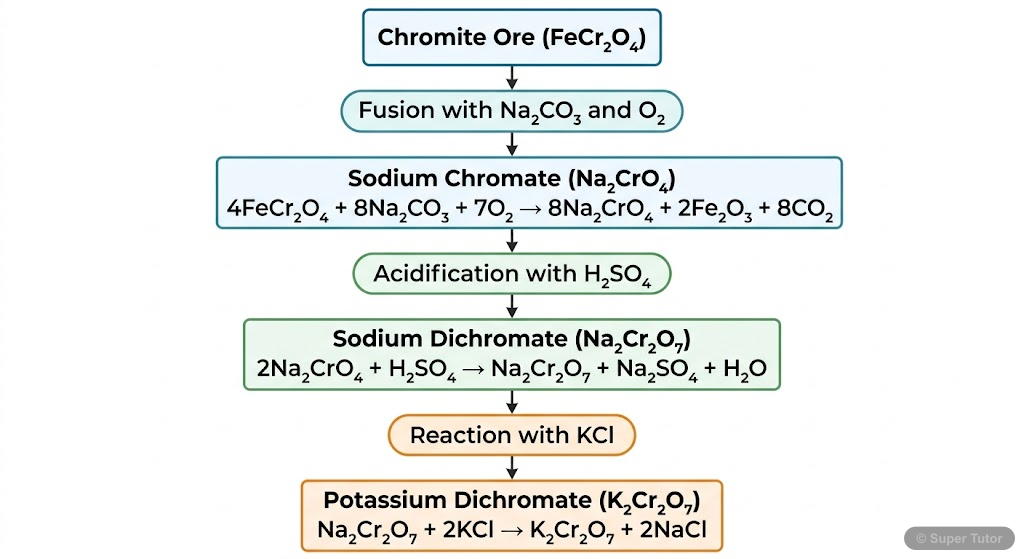
One of 16 illustrations for The d-and f-Block Elements in Super Tutor — alongside flashcards, concept maps and practice questions.
Study Plan
Learn the Theory
Read the textbook chapter carefully. Note down definitions, formulas and key ideas. Focus on: Position, Series and Electronic Configurations, Atomic Size, Density and Lanthanoid Contraction, Ionisation Enthalpy, Exchange Energy and Magnetic Moment.
Practise
Solve the textbook exercises and extra practice questions. There are 93 questions available for this chapter.
Revise & Test
Revise key points without looking at your notes. Take a practice quiz and mark weak areas for another pass.
Spaced Revision
Come back to The d-and f-Block Elements after a week. Use flashcards for quick recall and try past exam questions on this chapter.
What to Focus On
- d-block elements are in groups 3 to 12
- f-block elements are shown separately at the bottom of the periodic table
- There are four transition series: 3d, 4d, 5d, and 6d
- General configuration: (n-1)d1-10 ns1-2
- Pd has 4d10 5s0
- Cr has 3d5 4s1
- Transition metals are typically hard, lustrous, and good conductors
- Zn, Cd, Hg, and Mn are exceptions for typical metallic structures at normal temperatures
- Melting points are high due to strong metallic bonding
Common Mistakes to Avoid
All elements in groups 3 to 12 are transition metals.
Copper should behave like other active metals and liberate hydrogen from dilute acids.
Cr2+ is oxidising because chromium can show high oxidation states, and Mn3+ is reducing because manganese is a stable metal ion.
Memory Tips
Definition of transition metals and the exclusion of Zn, Cd, Hg
Scandium as a transition element and zinc as not a transition element
General electronic configuration of d-block elements and Pd exception
Cr and Cu anomalous configurations
Want a personalised study plan?
Super Tutor builds a day-by-day plan for Jharkhand Board Class 12 Chemistry that fits your exam date and pace.
Create My Study PlanFrequently Asked Questions
What are the important topics in The d-and f-Block Elements for Jharkhand Board Class 12 Chemistry?
How should I revise The d-and f-Block Elements for the Jharkhand Board Class 12 board exam?
Sources & Official References
Content is aligned to the official syllabus. Refer to the board website for the latest curriculum.
More resources for The d-and f-Block Elements
Practice Quiz
Test yourself with a quick quiz
Important Questions
Exam-style questions with answers
Revision Notes
Key points for last-minute revision
Chapter Summary
Understand the chapter at a glance
Concept Maps
See how topics connect
Flashcards
Quick-fire cards for active recall
Syllabus
What topics to cover
NCERT Solutions
Every textbook question solved step by step
For serious students
Get the full The d-and f-Block Elements chapter — start free.
Quizzes, flashcards, an AI doubt solver and a study plan for Jharkhand Board Class 12 Chemistry. Free to start, no card needed.