Chapter 1 of 12
NCERT Solutions

Introduction

Jharkhand Board · Class 12 · Economics

NCERT Solutions for Introduction — Jharkhand Board Class 12 Economics.

18 questions20 flashcards5 concepts

Interactive on Super Tutor

Studying Introduction? Get the full interactive chapter.

Quizzes, flashcards, AI doubt-solver and a step-by-step study plan — built for ncert solutions and more.

1,000+ Class 12 students started this chapter today

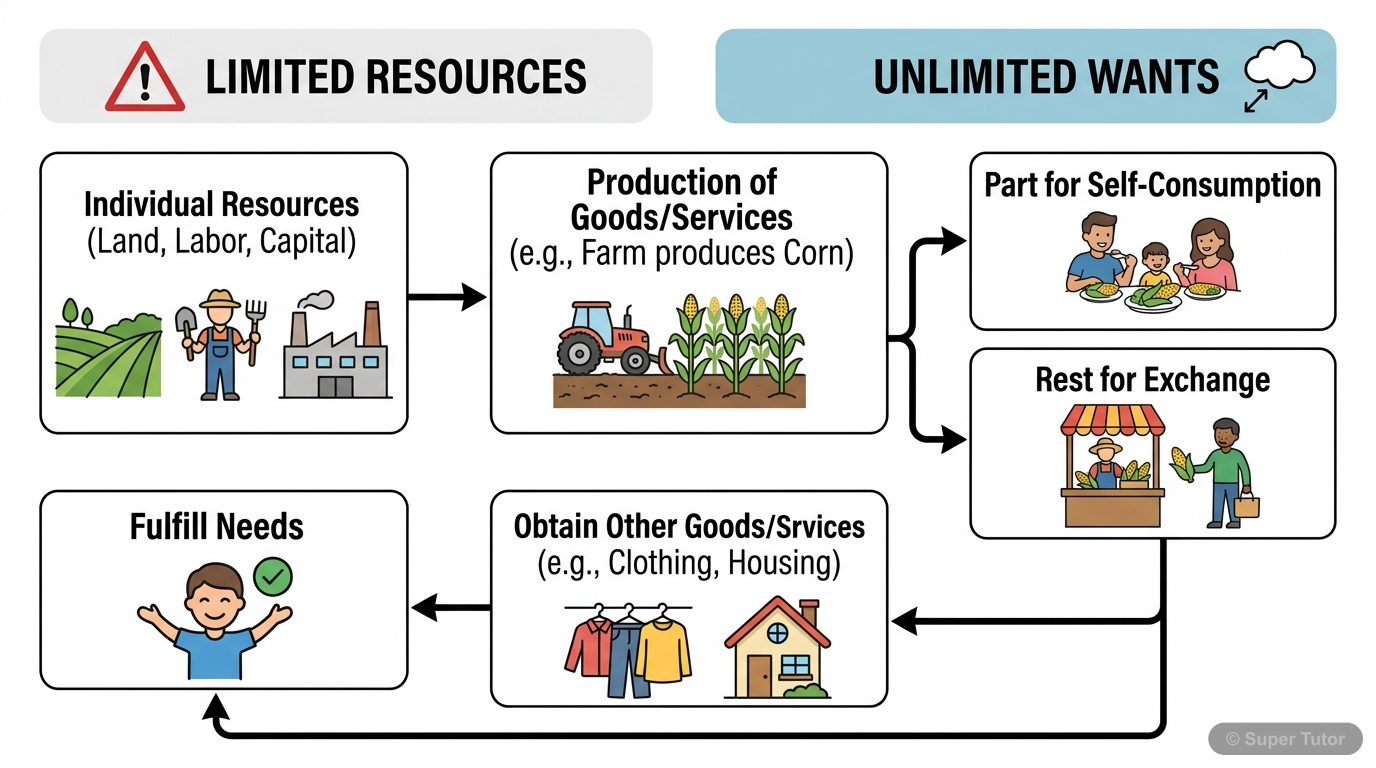
A flowchart illustrating how individuals in a simple economy use their limited resources to produce goods/services, consume some, and exchange the rest to fulfill other needs, highlighting the concept
Super Tutor

Learn better with visuals Super Tutor has hundreds of illustrations like this across every chapter — all free to try.

Get started
8 Questions Solved · 1 Section

Exercises — Chapter 1: Introduction (Introductory Microeconomics, Class 12)

1Discuss the central problems of an economy.Show solution
Given / Context: Every economy, regardless of its type, faces the problem of scarcity — unlimited wants but limited resources. This gives rise to certain fundamental or central problems.

Central Problems of an Economy:

(i) What to produce and in what quantities?
An economy must decide which goods and services are to be produced and in what amounts. For example, should more consumer goods (food, clothing) or capital goods (machinery, factories) be produced? The economy must allocate its scarce resources accordingly.

(ii) How to produce?
Once it is decided what to produce, the economy must choose the technique of production:
- Labour-intensive technique — uses more labour and less capital.
- Capital-intensive technique — uses more capital and less labour.

The choice depends on the availability of factors of production and their relative costs.

(iii) For whom to produce?
This refers to the distribution of the final goods and services among the members of the economy — i.e., who gets how much of the total output. It involves decisions about the distribution of income and wealth among different sections of society.

Underlying Cause: All these problems arise because of scarcity of resources relative to unlimited wants, which forces every economy to make choices.

Conclusion: These three central problems are universal — they exist in every economy, whether centrally planned, market-based, or mixed.
2What do you mean by the production possibilities of an economy?Show solution
Definition: The production possibilities of an economy refer to the various combinations of two goods (or groups of goods) that an economy can produce by fully and efficiently utilising all its available resources and the existing technology at a given point of time.

Key Points:

1. Resources (land, labour, capital, entrepreneurship) are scarce and have alternative uses.
2. If an economy uses all its resources to produce only one good, it must sacrifice the production of the other good.
3. The concept illustrates the trade-off or opportunity cost involved in production decisions.

Example: Suppose an economy produces only two goods — wheat and cloth. If all resources are devoted to wheat, maximum wheat is produced but no cloth, and vice versa. Between these two extremes lie various combinations of wheat and cloth that the economy can produce.

| Combination | Wheat (units) | Cloth (units) |
|---|---|---|
| A | 0 | 10 |
| B | 1 | 8 |
| C | 2 | 5 |
| D | 3 | 0 |

Conclusion: Production possibilities show the maximum attainable output combinations given the economy's resource endowment and technology. They form the basis for drawing the Production Possibility Frontier (PPF).
3What is a production possibility frontier?Show solution
Definition: The Production Possibility Frontier (PPF) (also called the Production Possibility Curve or Transformation Curve) is a curve that shows all possible combinations of two goods that an economy can produce when all its resources are fully and efficiently employed, given the existing technology.

Assumptions:
1. Only two goods are produced in the economy.
2. The total quantity of resources is fixed.
3. Technology remains constant.
4. Resources are fully and efficiently utilised.

Shape of PPF: The PPF is concave to the origin (bowed outward). This is because of the law of increasing opportunity cost — as more of one good is produced, increasingly larger amounts of the other good must be sacrificed, since resources are not perfectly adaptable between uses.

Diagrammatic Representation:

Let the two goods be Good X (x-axis) and Good Y (y-axis).

PPF is the locus of points such as A,B,C,D on the curve.\text{PPF is the locus of points such as } A, B, C, D \text{ on the curve.}

- Points on the PPF (e.g., B, C): Efficient and attainable — all resources are fully used.
- Points inside the PPF (e.g., point P): Attainable but inefficient — resources are underutilised.
- Points outside the PPF (e.g., point Q): Unattainable with current resources and technology.

Opportunity Cost: Moving along the PPF from one combination to another involves an opportunity cost — the amount of one good sacrificed to gain more of the other.

Shift in PPF: The PPF shifts outward (to the right) when:
- Resources increase (e.g., more labour, capital).
- Technology improves.

Conclusion: The PPF is a powerful tool that illustrates scarcity, choice, opportunity cost, and economic growth.
4Discuss the subject matter of economics.Show solution
Introduction: Economics is a social science that studies how individuals, households, firms, and governments make choices to allocate scarce resources to satisfy unlimited wants.

Subject Matter of Economics:

(A) Microeconomics:
Microeconomics studies the economic behaviour of individual economic units such as a consumer, a firm, or an industry. It deals with:
- Consumer behaviour and demand.
- Producer behaviour and supply.
- Price determination of individual goods and services.
- Market structures (perfect competition, monopoly, etc.).

(B) Macroeconomics:
Macroeconomics studies the economy as a whole. It deals with:
- National income and output.
- General price level and inflation.
- Employment and unemployment.
- Money supply and banking.
- Government budget and fiscal policy.
- Balance of payments and exchange rates.

(C) Positive Economics vs. Normative Economics:
- Positive economics deals with facts and describes economic phenomena as they are (e.g., "Unemployment in India is 7%").
- Normative economics involves value judgements and prescribes what ought to be (e.g., "The government should reduce unemployment").

(D) Central Problems: The subject matter of economics revolves around the three central problems — what to produce, how to produce, and for whom to produce — all arising from scarcity.

Conclusion: Economics, broadly, is the study of how societies use scarce resources to produce valuable goods and services and distribute them among different people.
5Distinguish between a centrally planned economy and a market economy.Show solution
Distinction between a Centrally Planned Economy and a Market Economy:

| Basis | Centrally Planned Economy | Market Economy |
|---|---|---|
| Meaning | An economy where all economic decisions are taken by the central government or planning authority. | An economy where economic decisions are determined by the free interaction of demand and supply through the price mechanism. |
| Ownership of resources | Resources are owned by the government/state. | Resources are owned by private individuals and firms. |
| Decision-making | Decisions about what, how, and for whom to produce are made by the central authority. | Decisions are made by individual consumers and producers guided by prices. |
| Role of price mechanism | The price mechanism plays little or no role; prices are fixed by the government. | The price mechanism plays the central role in allocating resources. |
| Objective | To achieve social welfare and equitable distribution. | To achieve profit maximisation and consumer satisfaction. |
| Examples | Former USSR, Cuba, North Korea. | USA, UK (largely). |
| Flexibility | Less flexible — changes require government decisions. | More flexible — adjusts automatically through market forces. |

Conclusion: In a centrally planned economy, the state controls resource allocation, whereas in a market economy, the invisible hand of the market (price mechanism) guides resource allocation. Most modern economies are mixed economies, combining features of both.
6What do you understand by positive economic analysis?Show solution
Definition: Positive economic analysis (also called positive economics) deals with economic phenomena as they actually are. It describes, explains, and predicts economic events based on facts and data, without making any value judgements.

Key Features:
1. It is objective and factual in nature.
2. It describes what is, what was, or what will be in the economy.
3. Positive statements can be tested and verified (proved true or false) using empirical evidence.
4. It does not involve personal opinions or ethical considerations.

Examples of Positive Statements:
- "When the price of a good rises, its demand falls." *(This can be tested empirically.)*
- "The inflation rate in India in 2023 was approximately 5%." *(A factual statement.)*
- "An increase in money supply leads to a rise in the price level."

Significance:
Positive analysis forms the scientific foundation of economics. It helps economists understand cause-and-effect relationships in the economy and provides the factual basis on which economic policies can be designed.

Conclusion: Positive economic analysis is concerned with objective explanation of economic phenomena. It answers the question "What is?" rather than "What ought to be?" It is value-free and empirically verifiable.
7What do you understand by normative economic analysis?Show solution
Definition: Normative economic analysis (also called normative economics) deals with economic phenomena based on value judgements. It prescribes what ought to be or what should be done in the economy, rather than describing what actually is.

Key Features:
1. It is subjective in nature — it involves personal opinions, ethical values, and moral judgements.
2. It prescribes what should be, what ought to be, or what is desirable.
3. Normative statements cannot be tested or verified purely by facts; they depend on values.
4. It is concerned with policy recommendations.

Examples of Normative Statements:
- "The government should reduce income inequality." *(Value judgement — involves what is desirable.)*
- "Prices of essential commodities ought to be controlled by the government."
- "There should be free education for all children up to the age of 14."

Significance:
Normative analysis is important for policy-making. Governments, planners, and economists use normative analysis to recommend policies aimed at improving social welfare, reducing poverty, and achieving equitable distribution of income.

Distinction from Positive Analysis:
- Positive: "Unemployment is 8%." (Fact — verifiable)
- Normative: "Unemployment should be reduced to 4%." (Value judgement — not purely verifiable)

Conclusion: Normative economic analysis is concerned with value-based prescriptions about economic policy. It answers the question "What ought to be?" and forms the basis for economic policy recommendations.
8Distinguish between microeconomics and macroeconomics.Show solution
Distinction between Microeconomics and Macroeconomics:

| Basis | Microeconomics | Macroeconomics |
|---|---|---|
| Meaning | Studies the economic behaviour of individual units such as a consumer, a firm, or an industry. | Studies the economy as a whole — aggregate economic variables. |
| Scope | Narrow — focuses on individual markets and units. | Broad — focuses on the entire economy. |
| Variables studied | Individual demand, individual supply, price of a specific good, output of a firm. | National income, aggregate demand, general price level, total employment. |
| Central problem | Determination of price and output of individual goods and services. | Determination of national income, employment, and general price level. |
| Tools | Demand and supply analysis, indifference curves, production functions. | National income accounting, multiplier, IS-LM model. |
| Objective | To explain how resources are allocated among competing uses at the individual level. | To explain how the overall level of output, employment, and prices is determined. |
| Examples of topics | Consumer equilibrium, producer equilibrium, market equilibrium, elasticity of demand. | GDP, inflation, unemployment, monetary policy, fiscal policy. |
| Founder | Alfred Marshall is associated with the development of microeconomics. | John Maynard Keynes is regarded as the father of macroeconomics. |

Relationship between Micro and Macroeconomics:
Micro and macroeconomics are complementary, not contradictory. Macroeconomic aggregates (e.g., national income) are the sum of individual microeconomic units. Understanding one requires knowledge of the other.

Conclusion: Microeconomics looks at the trees (individual units), while macroeconomics looks at the forest (the economy as a whole). Both are essential branches of economic analysis.

Stuck on a step?

Ask Super Tutor AI to explain any solution on this page in a simpler way — free, 24x7.

Ask a Doubt Free

Frequently Asked Questions

What are the important topics in Introduction for Jharkhand Board Class 12 Economics?
Key topics in Introduction include Central Problems of an Economy — Mind Map, Central Problems of an Economy — Mind Map, Central Problems of an Economy — Complete Overview. These are the concepts Jharkhand Board Class 12 examiners draw on most — study them first, then practise related questions.
How to score full marks in Introduction — Jharkhand Board Class 12 Economics?
Understand the core concepts first, then work through the 18 practice questions available for this chapter. Revise formulas and definitions regularly, and use flashcards for quick recall before the exam.
Where can I get free NCERT Solutions for Introduction Class 12 Economics?
This page has free step-by-step NCERT Solutions for every exercise question in Introduction (Jharkhand Board Class 12 Economics) — written the way examiners award marks: given, formula, working, answer.

Sources & Official References

Content is aligned to the official syllabus. Refer to the board website for the latest curriculum.

For serious students

Get the full Introduction chapter — for free.

Quizzes, flashcards, AI doubt-solver and a step-by-step study plan for Jharkhand Board Class 12 Economics.