Chapter 3 of 17
NCERT Solutions

Human Settlements

Jharkhand Board · Class 12 · Geography

NCERT Solutions for Human Settlements — Jharkhand Board Class 12 Geography.

30 questions22 flashcards5 concepts

Interactive on Super Tutor

Studying Human Settlements? Get the full interactive chapter.

Quizzes, flashcards, AI doubt-solver and a step-by-step study plan — built for ncert solutions and more.

1,000+ Class 12 students started this chapter today

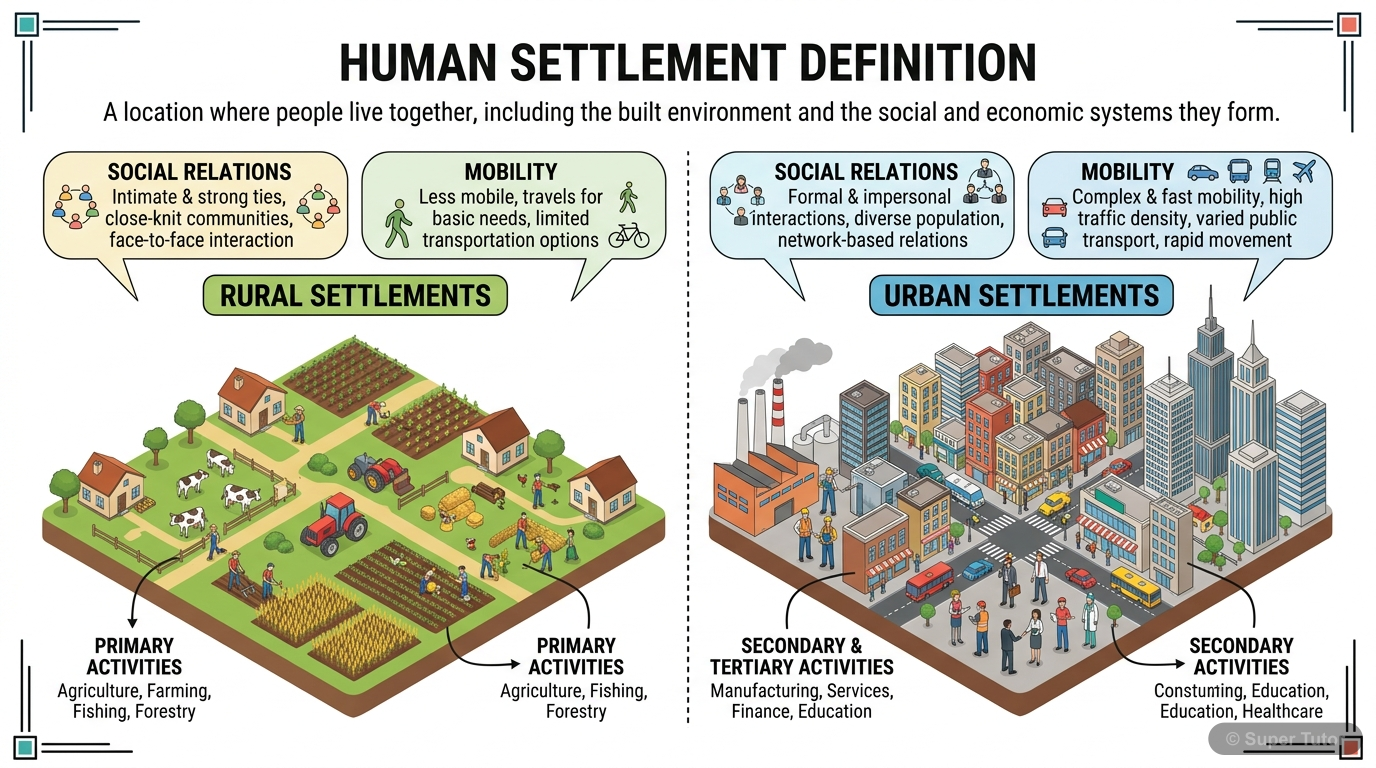
An infographic defining human settlements and illustrating the basic distinction between rural and urban settlements based on size, economic activity, and social structure.
Super Tutor

Super Tutor has 10+ illustrations like this for Human Settlements alone — flashcards, concept maps, and step-by-step visuals.

See them all
7 Questions Solved · 1 Section

EXERCISES — Human Settlements

1(i)Which one of the following towns is NOT located on a river bank?
(a) Agra
(b) Bhopal
(c) Patna
(d) Kolkata
Show solution
Correct Answer: (b) Bhopal

Justification: Agra is located on the river Yamuna, Patna on the river Ganga, and Kolkata on the river Hooghly (a distributary of the Ganga). Bhopal, the capital of Madhya Pradesh, is not situated on a river bank; it is located near artificial lakes (Upper Lake and Lower Lake). Hence, Bhopal is NOT located on a river bank.
1(ii)Which one of the following is NOT the part of the definition of a town as per the census of India?
(a) Population density of 400 persons per sq km.
(b) Presence of municipality, corporation, etc.
(c) More than 75% of the population engaged in primary sector.
(d) Population size of more than 5,000 persons.
Show solution
Correct Answer: (c) More than 75% of the population engaged in primary sector.

Justification: As per the Census of India, a settlement is classified as a town if it satisfies the following criteria: (i) a minimum population of 5,000 persons, (ii) at least 75% of the male working population engaged in non-primary (i.e., secondary and tertiary) activities, and (iii) a population density of at least 400 persons per sq km. Additionally, all statutory towns (having a municipality, corporation, cantonment board, etc.) are also classified as towns. Therefore, option (c) — 'more than 75% engaged in the primary sector' — is NOT part of the definition; in fact, it is the opposite condition.
1(iii)In which one of the following environments does one expect the presence of dispersed rural settlements?
(a) Alluvial plains of Ganga
(b) Arid and semi-arid regions of Rajasthan
(c) Lower valleys of Himalayas
(d) Forests and hills in north-east
Show solution
Correct Answer: (d) Forests and hills in north-east

Justification: Dispersed or isolated settlements are found in areas where the terrain is rugged, resources are scarce, and the land is fragmented — such as forests, hills, and tribal regions of north-east India. In such areas, individual homesteads or hamlets are scattered far apart. In contrast, the alluvial plains of the Ganga and arid regions of Rajasthan tend to have nucleated settlements where people cluster together near water sources or fertile land.
2(i)What are garrison towns? What is their function?Show solution
Answer:

Given/Concept: Garrison towns (also called Cantonment towns) are settlements that developed primarily to serve military purposes.

Definition: Garrison towns are towns that emerged and grew around military establishments such as army camps, cantonments, and defence installations.

Function: Their primary function is to provide accommodation, administrative support, and logistical facilities to the armed forces. They house military personnel, their families, and the supporting civilian population. Examples include Ambala, Jalandhar, Mhow, Babina, and Udhampur.

These towns are generally well-planned with separate residential areas (cantonment areas) and are administered by Cantonment Boards under the Ministry of Defence.
2(ii)What are the main factors for the location of villages in desert regions?Show solution
Answer:

Given/Concept: In desert regions, the physical environment is harsh — water is scarce, temperatures are extreme, and vegetation is sparse. Therefore, the location of villages is determined by specific geographical factors.

Main Factors:

1. Availability of Water: The most critical factor. Villages in desert regions (e.g., Rajasthan) are invariably located near water sources such as wells, oases, ponds (*johads*), or rivers. Without water, human habitation is impossible.

2. Relief and Terrain: Villages tend to be located on slightly elevated ground or near sand dunes that provide some shelter from wind and sand storms.

3. Soil Fertility: Wherever patches of relatively fertile soil exist (near river banks or oases), villages tend to cluster.

4. Defence and Security: Historically, villages were located on elevated terrain or near forts for protection.

Due to scarcity of water and resources, desert settlements are generally nucleated (clustered) so that available resources can be shared collectively.
3(i)Discuss the features of different types of rural settlements. What are the factors responsible for the settlement patterns in different physical environments?Show solution
Answer:

Types of Rural Settlements and Their Features:

Rural settlements in India can be broadly classified into four types based on their spatial pattern:

1. Clustered/Nucleated Settlements:
- Houses are built close together, forming a compact unit.
- Found in fertile plains and river valleys where land is productive and water is easily available.
- Common in the Ganga plains, Rajasthan (near water sources), and parts of Punjab and Haryana.
- People live together for social interaction, security, and sharing of common resources.

2. Semi-Clustered/Fragmented Settlements:
- A large compact village may have a few hamlets scattered nearby.
- Result of the tendency of one or more sections of the village community to live a little away from the main cluster.
- Found in Gujarat plains and some parts of Rajasthan.

3. Hamleted Settlements:
- The settlement is fragmented into several units, yet they are locally known by a common name.
- This fragmentation is often due to social and ethnic factors (caste distinctions).
- Found in the middle and lower Ganga plains, Chhattisgarh, and lower valleys of the Himalayas.

4. Dispersed/Isolated Settlements:
- Settlements are extremely scattered — individual houses or hamlets are far apart.
- Found in hilly, forested, and tribal regions of north-east India, Himachal Pradesh, Uttarakhand, and parts of Kerala.
- Rugged terrain, dense forests, and limited resources prevent clustering.

---

Factors Responsible for Settlement Patterns in Different Physical Environments:

| Factor | Influence on Settlement Pattern |
|---|---|
| Water availability | Settlements cluster near rivers, wells, and ponds |
| Land and soil fertility | Fertile plains attract nucleated settlements |
| Topography/Relief | Hilly and forested areas lead to dispersed settlements |
| Climate | Extreme climates (desert/cold) force clustering for resource sharing |
| Security | Fear of attack historically led to nucleated settlements |
| Social/Ethnic factors | Caste distinctions cause fragmented/hamleted settlements |
| Economic activities | Agricultural communities cluster; forest-based communities disperse |

Conclusion: The physical environment plays the most dominant role in determining settlement patterns. However, social, historical, and economic factors also significantly influence how and where people choose to live in rural areas.
3(ii)Can one imagine the presence of only one-function town? Why do the cities become multi-functional?Show solution
Answer:

Can a Town Have Only One Function?

In the early stages of urban development, it is possible to imagine a town performing a single dominant function. For example:
- A mining town like Jharia or Raniganj initially grew solely due to coal mining.
- A religious town like Varanasi or Tirupati developed primarily as a centre of pilgrimage.
- A garrison town like Ambala emerged purely to serve military needs.

However, even these towns are not purely single-function in the strict sense, because any human settlement requires basic services like trade, administration, and transport to sustain its population. So, while one function may dominate, other functions always exist in a minor capacity.

---

Why Do Cities Become Multi-functional?

As towns grow in size and population, they inevitably become multi-functional due to the following reasons:

1. Growing Population Needs: A larger population demands more services — healthcare, education, retail trade, banking, entertainment — which diversify the town's functions.

2. Economic Diversification: Industries attract workers, workers attract traders and service providers, and this chain reaction leads to the growth of multiple economic activities.

3. Infrastructure Development: Improved transport and communication links a town to wider markets, encouraging commerce, manufacturing, and administration to develop alongside the original function.

4. Administrative Importance: As towns grow, they often become administrative headquarters, adding a governance function.

5. Intertwining of Functions: Industry requires trade; trade requires transport; transport requires administration — all functions become so interdependent that separating them becomes impossible.

Conclusion: Cities are dynamic entities. As they grow into metropolises, their functions multiply and intertwine. Industry, business, administration, transport, education, and culture all become important simultaneously. Therefore, it is practically impossible for a large city to remain confined to a single function — multi-functionality is an inevitable outcome of urban growth.

Stuck on a step?

Ask Super Tutor AI to explain any solution on this page in a simpler way — free, 24x7.

Ask a Doubt Free

Frequently Asked Questions

What are the important topics in Human Settlements for Jharkhand Board Class 12 Geography?
Key topics in Human Settlements include Four Types of Rural Settlements and Their Regional Distribution, Overview of Human Settlements in India, Types of Rural Settlements — Overview. These are the concepts Jharkhand Board Class 12 examiners draw on most — study them first, then practise related questions.
How to score full marks in Human Settlements — Jharkhand Board Class 12 Geography?
Understand the core concepts first, then work through the 30 practice questions available for this chapter. Revise formulas and definitions regularly, and use flashcards for quick recall before the exam.
Where can I get free NCERT Solutions for Human Settlements Class 12 Geography?
This page has free step-by-step NCERT Solutions for every exercise question in Human Settlements (Jharkhand Board Class 12 Geography) — written the way examiners award marks: given, formula, working, answer.

Sources & Official References

Content is aligned to the official syllabus. Refer to the board website for the latest curriculum.

For serious students

Get the full Human Settlements chapter — for free.

Quizzes, flashcards, AI doubt-solver and a step-by-step study plan for Jharkhand Board Class 12 Geography.