Wave Optics — NCERT Solutions
Jharkhand Board · Class 12 · Physics
NCERT Solutions for Wave Optics, Jharkhand Board Class 12 Physics: 6 textbook questions solved step by step. Covers Exercises.
Interactive on Super Tutor
Studying Wave Optics? Get the full interactive chapter.
Quizzes, flashcards, AI doubt-solver and a step-by-step study plan — built for NCERT solutions and more.
Free trial, no card needed.
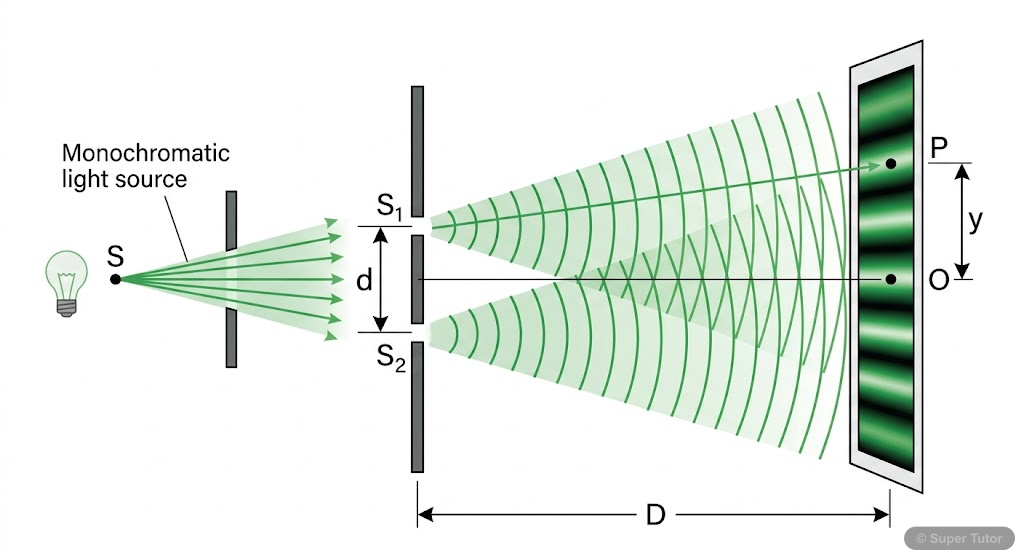
Learn better with visuals Super Tutor pairs illustrations like this with notes and quizzes for Wave Optics.
The first 3 solutions are open to read. The other 3 are free with a Super Tutor account.
Exercises
10.1Monochromatic light of wavelength 589 nm is incident from air on a water surface. What are the wavelength, frequency and speed of (a) reflected, and (b) refracted light? Refractive index of water is 1.33.Show solution
Given:
- Wavelength of incident light:
- Refractive index of water:
- Speed of light in vacuum/air:
Frequency of incident light:
(a) Reflected Light:
Reflection occurs in the same medium (air). The frequency, wavelength, and speed do not change upon reflection.
- Wavelength:
- Frequency:
- Speed:
(b) Refracted Light:
When light enters a denser medium, its frequency remains unchanged but its speed and wavelength change.
- Frequency: Frequency does not change on refraction.
- Speed: Using :
- Wavelength: Using :
Alternatively:
Summary:
| Quantity | Reflected | Refracted |
|---|---|---|
| Wavelength | 589 nm | ~443 nm |
| Frequency | Hz | Hz |
| Speed | m/s | m/s |
10.2What is the shape of the wavefront in each of the following cases: (a) Light diverging from a point source. (b) Light emerging out of a convex lens when a point source is placed at its focus. (c) The portion of the wavefront of light from a distant star intercepted by the Earth.Show solution
(a) Light diverging from a point source:
When light diverges from a point source, it spreads out equally in all directions. All points equidistant from the source are in the same phase. Therefore, the wavefront is spherical (a series of concentric spheres centred at the point source).
(b) Light emerging out of a convex lens when a point source is placed at its focus:
When a point source is placed at the focus of a convex lens, the diverging spherical waves are converted into parallel rays after refraction through the lens. All these parallel rays are in the same phase, so the wavefront is plane (flat).
(c) The portion of the wavefront of light from a distant star intercepted by the Earth:
A distant star is effectively at infinity. The spherical wavefronts originating from it have an extremely large radius by the time they reach the Earth. The small portion intercepted by the Earth is essentially a flat surface. Therefore, the wavefront is plane (flat).
10.3(a) The refractive index of glass is 1.5. What is the speed of light in glass? (Speed of light in vacuum is m s) (b) Is the speed of light in glass independent of the colour of light? If not, which of the two colours red and violet travels slower in a glass prism?Show solution
(a) Speed of light in glass:
Given: ,
Formula:
(b) Dependence of speed on colour:
No, the speed of light in glass is not independent of the colour (wavelength) of light. This is because the refractive index of glass varies with wavelength — a phenomenon called dispersion.
The refractive index of glass is higher for violet light than for red light ().
Since , a higher refractive index means a lower speed.
Therefore, violet light travels slower than red light in a glass prism.
Free with a Super Tutor account
Free with a Super Tutor account
Free with a Super Tutor account
3 more solved questions in Wave Optics
They are free with a Super Tutor account, along with practice quizzes and flashcards for this chapter. Free to start, no card needed.
Frequently Asked Questions
What are the important topics in Wave Optics for Jharkhand Board Class 12 Physics?
Are these NCERT Solutions for Wave Optics free?
How should I revise Wave Optics for the Jharkhand Board Class 12 board exam?
Sources & Official References
Content is aligned to the official syllabus. Refer to the board website for the latest curriculum.
More resources for Wave Optics
Practice Quiz
Test yourself with a quick quiz
Important Questions
Exam-style questions with answers
Revision Notes
Key points for last-minute revision
Formula Sheet
The chapter's formulas in one place
Chapter Summary
Understand the chapter at a glance
Concept Maps
See how topics connect
Study Plan
Step-by-step plan for this chapter
Flashcards
Quick-fire cards for active recall
Syllabus
What topics to cover
For serious students
Get the full Wave Optics chapter — start free.
Quizzes, flashcards, an AI doubt solver and a study plan for Jharkhand Board Class 12 Physics. Free to start, no card needed.