The Challenges of Cultural Diversity — NCERT Solutions
Jharkhand Board · Class 12 · Sociology
NCERT Solutions for The Challenges of Cultural Diversity, Jharkhand Board Class 12 Sociology: 11 textbook questions solved step by step.
Interactive on Super Tutor
Studying The Challenges of Cultural Diversity? Get the full interactive chapter.
Quizzes, flashcards, AI doubt-solver and a step-by-step study plan — built for NCERT solutions and more.
Free trial, no card needed.
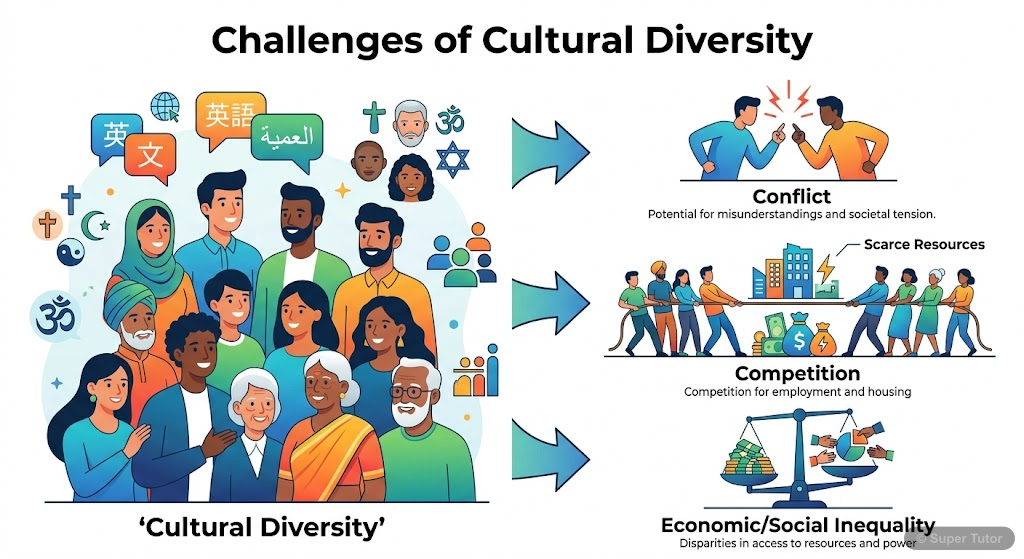
Learn better with visuals Super Tutor pairs illustrations like this with notes and quizzes for The Challenges of Cultural Diversity.
The first 6 solutions are open to read. The other 5 are free with a Super Tutor account.
Exercise Questions — The Challenges of Cultural Diversity
1What is meant by cultural diversity? Why is India considered to be a very diverse country?Show solution
Given / Concept: Cultural diversity refers to the existence of a variety of cultural groups — defined by language, religion, ethnicity, caste, region, etc. — within a single society or nation.
Answer:
Cultural Diversity means the co-existence of many distinct cultural identities, practices, languages, religions, and traditions within a shared social space. It implies that people belonging to different groups live together while retaining their own distinct cultural characteristics.
Why India is considered extremely diverse:
- Linguistic diversity: India has hundreds of languages and dialects. The Constitution recognises 22 scheduled languages, and there are hundreds more spoken across the country.
- Religious diversity: India is home to virtually every major world religion — Hinduism, Islam, Christianity, Sikhism, Buddhism, Jainism, Zoroastrianism, and Judaism — all of which have large and active communities.
- Caste diversity: The caste system has produced thousands of distinct social groups, each with its own customs, occupations, and social practices.
- Regional and ethnic diversity: Different regions have distinct food habits, dress, art forms, festivals, and social customs. Tribal communities add further layers of cultural distinctiveness.
- Historical layering: Centuries of migrations, invasions, and trade have added successive layers of cultural influence, making Indian society uniquely composite.
Thus, India's diversity is not just in one dimension but is multi-layered — cutting across language, religion, region, caste, and ethnicity simultaneously — making it one of the most culturally diverse nations in the world.
2What is community identity and how is it formed?Show solution
Given / Concept: Community identity is a sense of belonging to a particular group. It is a social and psychological phenomenon rooted in shared characteristics.
Answer:
Community Identity refers to the sense of belonging that an individual feels towards a particular social group — such as a religious community, caste group, linguistic group, or ethnic group. It defines who 'we' are as opposed to 'they' (others outside the group).
How community identity is formed:
- Birth and ascription: Most community identities are not chosen but are acquired by birth. A person is born into a religion, caste, or linguistic group and automatically inherits that identity.
- Shared culture and history: Common customs, traditions, festivals, myths, and historical memories bind people together and create a sense of shared identity.
- Socialisation: Through family, education, and community practices, individuals internalise the values, norms, and symbols of their community, reinforcing identity.
- Contrast with 'the other': Community identity is often sharpened by the presence of other communities. The awareness of being different from others strengthens the sense of belonging to one's own group.
- Political and social mobilisation: Leaders and organisations sometimes actively construct or reinforce community identities for political purposes, making people more conscious of their group membership.
Key point: Community identities are not fixed or primordial; they are socially constructed and can change over time depending on historical and political circumstances.
3Why is it difficult to define the nation? How are nation and state related in modern society?Show solution
Given / Concept: A nation is a community of people who share a sense of common identity and belonging, while a state is a political-administrative entity with defined territory, government, and sovereignty.
Answer:
Difficulty in defining the nation:
Defining a nation is difficult because there is no single, universally agreed criterion for what makes a group of people a 'nation'. Various criteria have been proposed but each has limitations:
- Common language: Many nations have multiple languages (e.g., India, Switzerland).
- Common religion: Many nations are multi-religious.
- Common race or ethnicity: Modern nations are rarely ethnically homogeneous.
- Common territory: Territory alone does not create a nation.
- Shared history and culture: These are important but subjective and contested.
Sociologists argue that a nation is ultimately based on a subjective sense of belonging — the belief among a group of people that they constitute a community with a shared past and a common future. This makes it a social and political construction rather than a natural or objective fact.
Relationship between Nation and State in modern society:
| Nation | State |
|---|---|
| A cultural/social community | A political/administrative entity |
| Based on shared identity | Based on territory, law, and sovereignty |
| May or may not have a state | Always has defined territory and government |
- In the modern world, the ideal is the nation-state — where the boundaries of the nation and the state coincide, i.e., the people who share a national identity are governed by a single state.
- In reality, most states are multi-national (containing several nations/communities), and some nations are stateless (spread across multiple states).
- The state uses institutions (law, army, education, media) to build a sense of national identity among its citizens.
- Tension arises when the state tries to impose a single national identity on a diverse population, leading to conflicts over cultural recognition.
4Why are states often suspicious of cultural diversity?Show solution
Given / Concept: States are political entities that seek to maintain unity, sovereignty, and control over their territory. Cultural diversity can sometimes be perceived as a threat to these goals.
Answer:
States are often suspicious of cultural diversity for the following reasons:
- Fear of disintegration: States worry that strong regional, linguistic, or ethnic identities may lead to demands for separation or the creation of new independent states, thereby threatening territorial integrity.
- Challenge to national unity: Cultural diversity can make it difficult to forge a single, unified national identity. The state fears that multiple competing identities may undermine loyalty to the nation.
- Law and order concerns: Cultural conflicts between different communities can lead to violence and social unrest, which the state must manage. This makes diversity appear as a source of instability.
- Administrative difficulties: Governing a highly diverse population requires accommodating multiple languages, customs, and demands, which complicates administration and policy-making.
- External interference: States fear that foreign powers may exploit cultural minorities (e.g., linguistic or religious groups with ties to neighbouring countries) to destabilise the nation.
- Secessionist movements: Historical examples (e.g., demands for separate states based on language or religion) make governments cautious about encouraging strong cultural identities.
However, it is important to note that cultural diversity need not be a threat. A democratic state that accommodates diversity through federal structures, minority rights, and cultural recognition can turn diversity into a strength rather than a weakness.
5What is regionalism? What factors is it usually based on?Show solution
Given / Concept: Regionalism is a political ideology or sentiment that prioritises the interests of a particular region over those of the nation as a whole.
Answer:
Regionalism refers to a strong sense of attachment to one's region, which may express itself as a demand for greater political autonomy, separate statehood, or preferential treatment for the people of that region. It can range from a healthy assertion of regional identity to extreme separatist movements.
Factors on which regionalism is usually based:
- Geographical factors: Natural boundaries like mountains, rivers, and forests create distinct regions with their own ecological and economic characteristics, fostering a separate regional identity.
- Linguistic factors: A shared language is one of the strongest bases of regional identity. The demand for linguistic states in India (e.g., Andhra Pradesh for Telugu speakers) is a classic example.
- Cultural and ethnic factors: Shared customs, traditions, dress, food, and ethnic heritage bind people of a region together and distinguish them from others.
- Economic factors: Feelings of economic neglect or exploitation — when a region believes its resources are being used for the benefit of other regions or the centre — fuel regionalist sentiments (e.g., demands in northeastern states or Jharkhand).
- Historical factors: A region's distinct historical experience, including memories of past kingdoms or colonial administrative units, can strengthen regional consciousness.
- Political factors: Political parties and leaders sometimes mobilise regional sentiments for electoral gains, thereby strengthening regionalism.
Conclusion: Regionalism is not inherently negative. When it takes the form of demands for better governance and equitable development, it can strengthen democracy. It becomes problematic when it turns into violent separatism or promotes hostility towards other regions or communities.
6In your opinion, has the linguistic reorganisation of states helped or harmed India?Show solution
Given / Concept: The linguistic reorganisation of states refers to the redrawing of state boundaries in India (primarily after the States Reorganisation Act, 1956) on the basis of language, so that each major linguistic group would have its own state.
Answer:
This question asks for an opinion supported by reasoning. A balanced answer is presented below:
Arguments that linguistic reorganisation has HELPED India:
- Democratic accommodation: It recognised the legitimate aspirations of linguistic communities and gave them a sense of political belonging, reducing alienation and resentment.
- Administrative efficiency: Governance in the mother tongue is more effective. People can access courts, schools, and government offices in their own language, improving delivery of services.
- Prevented violent conflict: By peacefully accommodating linguistic demands, reorganisation prevented the escalation of language-based conflicts into violent separatist movements.
- Cultural preservation: Linguistic states have helped preserve and promote regional languages, literatures, and cultures.
- Strengthened federalism: It created a more rational federal structure where states have a genuine cultural basis, making federalism more meaningful.
Arguments that linguistic reorganisation has HARMED India:
- Strengthened parochialism: It has sometimes encouraged 'sons of the soil' movements and hostility towards migrants from other states (e.g., anti-migrant sentiments in Maharashtra or Assam).
- Multiplied demands: Once the principle was accepted, it encouraged more and more groups to demand their own states, leading to continuous reorganisation (e.g., creation of Jharkhand, Chhattisgarh, Uttarakhand, Telangana).
- Inter-state disputes: Linguistic states have led to bitter disputes over river waters, borders, and shared resources (e.g., Cauvery water dispute between Karnataka and Tamil Nadu).
Conclusion (Opinion): On balance, linguistic reorganisation has helped India more than it has harmed it. By accommodating diversity within a democratic framework, it has kept India united while respecting its pluralism. The problems it created are real but manageable within a democratic system.
Free with a Super Tutor account
Free with a Super Tutor account
Free with a Super Tutor account
Free with a Super Tutor account
Free with a Super Tutor account
5 more solved questions in The Challenges of Cultural Diversity
They are free with a Super Tutor account, along with practice quizzes and flashcards for this chapter. Free to start, no card needed.
Frequently Asked Questions
What are the important topics in The Challenges of Cultural Diversity for Jharkhand Board Class 12 Sociology?
Are these NCERT Solutions for The Challenges of Cultural Diversity free?
How should I revise The Challenges of Cultural Diversity for the Jharkhand Board Class 12 board exam?
Sources & Official References
Content is aligned to the official syllabus. Refer to the board website for the latest curriculum.
More resources for The Challenges of Cultural Diversity
Practice Quiz
Test yourself with a quick quiz
Important Questions
Exam-style questions with answers
Revision Notes
Key points for last-minute revision
Chapter Summary
Understand the chapter at a glance
Concept Maps
See how topics connect
Study Plan
Step-by-step plan for this chapter
Flashcards
Quick-fire cards for active recall
Syllabus
What topics to cover
For serious students
Get the full The Challenges of Cultural Diversity chapter — start free.
Quizzes, flashcards, an AI doubt solver and a study plan for Jharkhand Board Class 12 Sociology. Free to start, no card needed.