Chapter 2 of 12
NCERT Solutions

Polynomials

Jharkhand Board · Class 9 · Mathematics

NCERT Solutions for Polynomials — Jharkhand Board Class 9 Mathematics.

29 questions24 flashcards5 concepts

Interactive on Super Tutor

Studying Polynomials? Get the full interactive chapter.

Quizzes, flashcards, AI doubt-solver and a step-by-step study plan — built for ncert solutions and more.

1,000+ Class 9 students started this chapter today

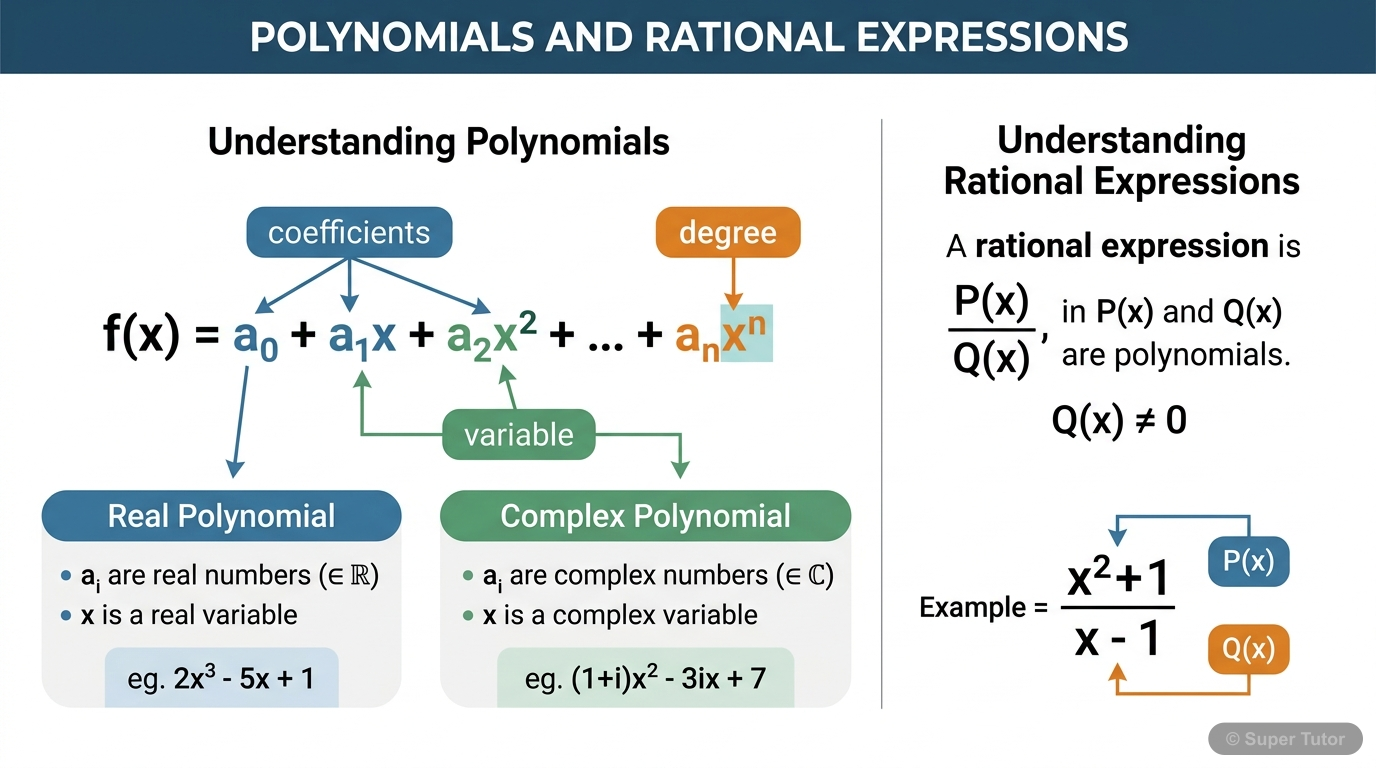
A labeled diagram illustrating the general form of a polynomial, distinguishing between real and complex polynomials by highlighting the nature of coefficients and variables. Also includes the definit
Super Tutor

Learn better with visuals Super Tutor has hundreds of illustrations like this across every chapter — all free to try.

Get started
30 Questions Solved · 4 Sections

Exercise 2.1

1Which of the following expressions are polynomials in one variable and which are not? State reasons for your answer.
(i) 4x23x+74x^{2} - 3x + 7
(ii) y2+2y^{2} + \sqrt{2}
(iii) 3t+t23\sqrt{t} + t\sqrt{2}
(iv) y+2yy + \frac{2}{y}
(v) x10+y3+t50x^{10} + y^3 + t^{50}
Show solution
Concept: A polynomial in one variable is an expression of the form anxn+an1xn1++a0a_n x^n + a_{n-1}x^{n-1} + \cdots + a_0 where all exponents of the variable are whole numbers (non-negative integers).

(i) 4x23x+74x^{2} - 3x + 7
All exponents of xx are whole numbers (2, 1, 0). It is a polynomial in one variable xx.

(ii) y2+2y^{2} + \sqrt{2}
All exponents of yy are whole numbers (2, 0). It is a polynomial in one variable yy.

(iii) 3t+t23\sqrt{t} + t\sqrt{2}
3t=3t1/23\sqrt{t} = 3t^{1/2}. The exponent 12\frac{1}{2} is not a whole number. Hence it is not a polynomial.

(iv) y+2yy + \frac{2}{y}
2y=2y1\frac{2}{y} = 2y^{-1}. The exponent 1-1 is not a whole number. Hence it is not a polynomial.

(v) x10+y3+t50x^{10} + y^3 + t^{50}
This expression contains three variables xx, yy, and tt. Hence it is not a polynomial in one variable (it is a polynomial in three variables).
2Write the coefficients of x2x^2 in each of the following:
(i) 2+x2+x2 + x^{2} + x
(ii) 2x2+x32 - x^{2} + x^{3}
(iii) π2x2+x\frac{\pi}{2} x^2 + x
(iv) 2x1\sqrt{2} x - 1
Show solution
Concept: The coefficient of x2x^2 is the number multiplied with x2x^2 in the expression.

(i) 2+x2+x2 + x^{2} + x
The term containing x2x^2 is 1x21 \cdot x^2.
Coefficient of x2x^2 = 1\mathbf{1}

(ii) 2x2+x32 - x^{2} + x^{3}
The term containing x2x^2 is 1x2-1 \cdot x^2.
Coefficient of x2x^2 = 1\mathbf{-1}

(iii) π2x2+x\frac{\pi}{2} x^2 + x
The term containing x2x^2 is π2x2\frac{\pi}{2} x^2.
Coefficient of x2x^2 = π2\dfrac{\boldsymbol{\pi}}{\mathbf{2}}

(iv) 2x1\sqrt{2} x - 1
There is no x2x^2 term in this expression.
Coefficient of x2x^2 = 0\mathbf{0}
3Give one example each of a binomial of degree 35, and of a monomial of degree 100.Show solution
Concept:
- A binomial has exactly two terms.
- A monomial has exactly one term.
- The degree is the highest power of the variable.

Binomial of degree 35:
x35+1x^{35} + 1
This has two terms and the highest power is 35.

Monomial of degree 100:
x100x^{100}
This has one term and the highest power is 100.
4Write the degree of each of the following polynomials:
(i) 5x3+4x2+7x5x^{3} + 4x^{2} + 7x
(ii) 4y24 - y^{2}
(iii) 5t75t - \sqrt{7}
(iv) 3
Show solution
Concept: The degree of a polynomial is the highest power of the variable in the polynomial.

(i) 5x3+4x2+7x5x^{3} + 4x^{2} + 7x
Highest power of xx is 3.
Degree = 3\mathbf{3}

(ii) 4y24 - y^{2}
Highest power of yy is 2.
Degree = 2\mathbf{2}

(iii) 5t75t - \sqrt{7}
Highest power of tt is 1.
Degree = 1\mathbf{1}

(iv) 33
3=3x03 = 3 \cdot x^0. This is a non-zero constant polynomial.
Degree = 0\mathbf{0}
5Classify the following as linear, quadratic and cubic polynomials:
(i) x2+xx^{2} + x
(ii) xx3x - x^3
(iii) y+y2+4y + y^2 + 4
(iv) 1+x1 + x
(v) 3t3t
(vi) r2r^2
(vii) 7x37x^3
Show solution
Concept:
- Linear polynomial: degree 1
- Quadratic polynomial: degree 2
- Cubic polynomial: degree 3

(i) x2+xx^{2} + x — Highest degree = 2 → Quadratic polynomial

(ii) xx3x - x^3 — Highest degree = 3 → Cubic polynomial

(iii) y+y2+4y + y^2 + 4 — Highest degree = 2 → Quadratic polynomial

(iv) 1+x1 + x — Highest degree = 1 → Linear polynomial

(v) 3t3t — Highest degree = 1 → Linear polynomial

(vi) r2r^2 — Highest degree = 2 → Quadratic polynomial

(vii) 7x37x^3 — Highest degree = 3 → Cubic polynomial

Exercise 2.2

1Find the value of the polynomial 5x4x2+35x - 4x^2 + 3 at
(i) x=0x = 0
(ii) x=1x = -1
(iii) x=2x = 2
Show solution
Let p(x)=5x4x2+3p(x) = 5x - 4x^2 + 3

(i) At x=0x = 0:
p(0)=5(0)4(0)2+3=00+3=3p(0) = 5(0) - 4(0)^2 + 3 = 0 - 0 + 3 = \mathbf{3}

(ii) At x=1x = -1:
p(1)=5(1)4(1)2+3=54(1)+3=54+3=6p(-1) = 5(-1) - 4(-1)^2 + 3 = -5 - 4(1) + 3 = -5 - 4 + 3 = \mathbf{-6}

(iii) At x=2x = 2:
p(2)=5(2)4(2)2+3=104(4)+3=1016+3=3p(2) = 5(2) - 4(2)^2 + 3 = 10 - 4(4) + 3 = 10 - 16 + 3 = \mathbf{-3}
2Find p(0),p(1)p(0), p(1) and p(2)p(2) for each of the following polynomials:
(i) p(y)=y2y+1p(y) = y^2 - y + 1
(ii) p(t)=2+t+2t2t3p(t) = 2 + t + 2t^2 - t^3
(iii) p(x)=x3p(x) = x^3
(iv) p(x)=(x1)(x+1)p(x) = (x - 1)(x + 1)
Show solution
(i) p(y)=y2y+1p(y) = y^2 - y + 1
p(0)=00+1=1p(0) = 0 - 0 + 1 = \mathbf{1}
p(1)=11+1=1p(1) = 1 - 1 + 1 = \mathbf{1}
p(2)=42+1=3p(2) = 4 - 2 + 1 = \mathbf{3}

(ii) p(t)=2+t+2t2t3p(t) = 2 + t + 2t^2 - t^3
p(0)=2+0+00=2p(0) = 2 + 0 + 0 - 0 = \mathbf{2}
p(1)=2+1+2(1)1=2+1+21=4p(1) = 2 + 1 + 2(1) - 1 = 2 + 1 + 2 - 1 = \mathbf{4}
p(2)=2+2+2(4)8=2+2+88=4p(2) = 2 + 2 + 2(4) - 8 = 2 + 2 + 8 - 8 = \mathbf{4}

(iii) p(x)=x3p(x) = x^3
p(0)=03=0p(0) = 0^3 = \mathbf{0}
p(1)=13=1p(1) = 1^3 = \mathbf{1}
p(2)=23=8p(2) = 2^3 = \mathbf{8}

(iv) p(x)=(x1)(x+1)p(x) = (x-1)(x+1)
p(0)=(01)(0+1)=(1)(1)=1p(0) = (0-1)(0+1) = (-1)(1) = \mathbf{-1}
p(1)=(11)(1+1)=(0)(2)=0p(1) = (1-1)(1+1) = (0)(2) = \mathbf{0}
p(2)=(21)(2+1)=(1)(3)=3p(2) = (2-1)(2+1) = (1)(3) = \mathbf{3}
3Verify whether the following are zeroes of the polynomial, indicated against them.
(i) p(x)=3x+1, x=13p(x) = 3x + 1,\ x = -\frac{1}{3}
(ii) p(x)=5xπ, x=45p(x) = 5x - \pi,\ x = \frac{4}{5}
(iii) p(x)=x21, x=1,1p(x) = x^2 - 1,\ x = 1, -1
(iv) p(x)=(x+1)(x2), x=1,2p(x) = (x + 1)(x - 2),\ x = -1, 2
(v) p(x)=x2, x=0p(x) = x^2,\ x = 0
(vi) p(x)=lx+m, x=mlp(x) = lx + m,\ x = -\frac{m}{l}
(vii) p(x)=3x21, x=13,23p(x) = 3x^2 - 1,\ x = -\frac{1}{\sqrt{3}}, \frac{2}{\sqrt{3}}
(viii) p(x)=2x+1, x=12p(x) = 2x + 1,\ x = \frac{1}{2}
Show solution
Concept: x=ax = a is a zero of p(x)p(x) if and only if p(a)=0p(a) = 0.

(i) p(x)=3x+1p(x) = 3x + 1 at x=13x = -\frac{1}{3}:
p ⁣(13)=3(13)+1=1+1=0p\!\left(-\tfrac{1}{3}\right) = 3\left(-\tfrac{1}{3}\right) + 1 = -1 + 1 = 0
Yes, x=13x = -\dfrac{1}{3} is a zero of p(x)p(x).

(ii) p(x)=5xπp(x) = 5x - \pi at x=45x = \frac{4}{5}:
p ⁣(45)=5(45)π=4π0p\!\left(\tfrac{4}{5}\right) = 5\left(\tfrac{4}{5}\right) - \pi = 4 - \pi \neq 0
No, x=45x = \dfrac{4}{5} is not a zero of p(x)p(x).

(iii) p(x)=x21p(x) = x^2 - 1 at x=1x = 1 and x=1x = -1:
p(1)=121=0p(1) = 1^2 - 1 = 0
p(1)=(1)21=11=0p(-1) = (-1)^2 - 1 = 1 - 1 = 0
Yes, both x=1x = 1 and x=1x = -1 are zeroes of p(x)p(x).

(iv) p(x)=(x+1)(x2)p(x) = (x+1)(x-2) at x=1x = -1 and x=2x = 2:
p(1)=(1+1)(12)=(0)(3)=0p(-1) = (-1+1)(-1-2) = (0)(-3) = 0
p(2)=(2+1)(22)=(3)(0)=0p(2) = (2+1)(2-2) = (3)(0) = 0
Yes, both x=1x = -1 and x=2x = 2 are zeroes of p(x)p(x).

(v) p(x)=x2p(x) = x^2 at x=0x = 0:
p(0)=02=0p(0) = 0^2 = 0
Yes, x=0x = 0 is a zero of p(x)p(x).

(vi) p(x)=lx+mp(x) = lx + m at x=mlx = -\frac{m}{l}:
p ⁣(ml)=l(ml)+m=m+m=0p\!\left(-\tfrac{m}{l}\right) = l\left(-\tfrac{m}{l}\right) + m = -m + m = 0
Yes, x=mlx = -\dfrac{m}{l} is a zero of p(x)p(x).

(vii) p(x)=3x21p(x) = 3x^2 - 1 at x=13x = -\frac{1}{\sqrt{3}} and x=23x = \frac{2}{\sqrt{3}}:
p ⁣(13)=3(13)1=11=0p\!\left(-\tfrac{1}{\sqrt{3}}\right) = 3\left(\tfrac{1}{3}\right) - 1 = 1 - 1 = 0
So x=13x = -\dfrac{1}{\sqrt{3}} is a zero.
p ⁣(23)=3(43)1=41=30p\!\left(\tfrac{2}{\sqrt{3}}\right) = 3\left(\tfrac{4}{3}\right) - 1 = 4 - 1 = 3 \neq 0
So x=23x = \dfrac{2}{\sqrt{3}} is not a zero of p(x)p(x).

(viii) p(x)=2x+1p(x) = 2x + 1 at x=12x = \frac{1}{2}:
p ⁣(12)=2(12)+1=1+1=20p\!\left(\tfrac{1}{2}\right) = 2\left(\tfrac{1}{2}\right) + 1 = 1 + 1 = 2 \neq 0
No, x=12x = \dfrac{1}{2} is not a zero of p(x)p(x).
4Find the zero of the polynomial in each of the following cases:
(i) p(x)=x+5p(x) = x + 5
(ii) p(x)=x5p(x) = x - 5
(iii) p(x)=2x+5p(x) = 2x + 5
(iv) p(x)=3x2p(x) = 3x - 2
(v) p(x)=3xp(x) = 3x
(vi) p(x)=ax, a0p(x) = ax,\ a \neq 0
(vii) p(x)=cx+d, c0p(x) = cx + d,\ c \neq 0
Show solution
Concept: To find the zero, set p(x)=0p(x) = 0 and solve for xx.

(i) p(x)=x+5p(x) = x + 5:
x+5=0    x=5x + 5 = 0 \implies x = -5
Zero is 5\mathbf{-5}.

(ii) p(x)=x5p(x) = x - 5:
x5=0    x=5x - 5 = 0 \implies x = 5
Zero is 5\mathbf{5}.

(iii) p(x)=2x+5p(x) = 2x + 5:
2x+5=0    2x=5    x=522x + 5 = 0 \implies 2x = -5 \implies x = -\dfrac{5}{2}
Zero is 52\mathbf{-\dfrac{5}{2}}.

(iv) p(x)=3x2p(x) = 3x - 2:
3x2=0    3x=2    x=233x - 2 = 0 \implies 3x = 2 \implies x = \dfrac{2}{3}
Zero is 23\mathbf{\dfrac{2}{3}}.

(v) p(x)=3xp(x) = 3x:
3x=0    x=03x = 0 \implies x = 0
Zero is 0\mathbf{0}.

(vi) p(x)=ax, a0p(x) = ax,\ a \neq 0:
ax=0    x=0ax = 0 \implies x = 0
Zero is 0\mathbf{0}.

(vii) p(x)=cx+d, c0p(x) = cx + d,\ c \neq 0:
cx+d=0    cx=d    x=dccx + d = 0 \implies cx = -d \implies x = -\dfrac{d}{c}
Zero is dc\mathbf{-\dfrac{d}{c}}.

Exercise 2.3

1Determine which of the following polynomials has (x+1)(x + 1) a factor:
(i) x3+x2+x+1x^3 + x^2 + x + 1
(ii) x4+x3+x2+x+1x^4 + x^3 + x^2 + x + 1
(iii) x4+3x3+3x2+x+1x^4 + 3x^3 + 3x^2 + x + 1
(iv) x3x2(2+2)x+2x^3 - x^2 - (2 + \sqrt{2})x + \sqrt{2}
Show solution
Concept (Factor Theorem): (x+1)(x+1) is a factor of p(x)p(x) if and only if p(1)=0p(-1) = 0.

(i) p(x)=x3+x2+x+1p(x) = x^3 + x^2 + x + 1:
p(1)=(1)3+(1)2+(1)+1=1+11+1=0p(-1) = (-1)^3 + (-1)^2 + (-1) + 1 = -1 + 1 - 1 + 1 = 0
Since p(1)=0p(-1) = 0, (x+1)(x+1) is a factor.

(ii) p(x)=x4+x3+x2+x+1p(x) = x^4 + x^3 + x^2 + x + 1:
p(1)=11+11+1=10p(-1) = 1 - 1 + 1 - 1 + 1 = 1 \neq 0
Since p(1)0p(-1) \neq 0, (x+1)(x+1) is not a factor.

(iii) p(x)=x4+3x3+3x2+x+1p(x) = x^4 + 3x^3 + 3x^2 + x + 1:
p(1)=1+3(1)+3(1)+(1)+1=13+31+1=10p(-1) = 1 + 3(-1) + 3(1) + (-1) + 1 = 1 - 3 + 3 - 1 + 1 = 1 \neq 0
Since p(1)0p(-1) \neq 0, (x+1)(x+1) is not a factor.

(iv) p(x)=x3x2(2+2)x+2p(x) = x^3 - x^2 - (2+\sqrt{2})x + \sqrt{2}:
p(1)=(1)3(1)2(2+2)(1)+2p(-1) = (-1)^3 - (-1)^2 - (2+\sqrt{2})(-1) + \sqrt{2}
=11+2+2+2=0+22=220= -1 - 1 + 2 + \sqrt{2} + \sqrt{2} = 0 + 2\sqrt{2} = 2\sqrt{2} \neq 0
Since p(1)0p(-1) \neq 0, (x+1)(x+1) is not a factor.
2Use the Factor Theorem to determine whether g(x)g(x) is a factor of p(x)p(x) in each of the following cases:
(i) p(x)=2x3+x22x1, g(x)=x+1p(x) = 2x^3 + x^2 - 2x - 1,\ g(x) = x + 1
(ii) p(x)=x3+3x2+3x+1, g(x)=x+2p(x) = x^3 + 3x^2 + 3x + 1,\ g(x) = x + 2
(iii) p(x)=x34x2+x+6, g(x)=x3p(x) = x^3 - 4x^2 + x + 6,\ g(x) = x - 3
Show solution
Concept: g(x)=xag(x) = x - a is a factor of p(x)p(x) iff p(a)=0p(a) = 0.

(i) g(x)=x+1g(x) = x + 1, zero is x=1x = -1:
p(1)=2(1)3+(1)22(1)1=2+1+21=0p(-1) = 2(-1)^3 + (-1)^2 - 2(-1) - 1 = -2 + 1 + 2 - 1 = 0
Since p(1)=0p(-1) = 0, g(x)g(x) is a factor of p(x)p(x).

(ii) g(x)=x+2g(x) = x + 2, zero is x=2x = -2:
p(2)=(2)3+3(2)2+3(2)+1=8+126+1=10p(-2) = (-2)^3 + 3(-2)^2 + 3(-2) + 1 = -8 + 12 - 6 + 1 = -1 \neq 0
Since p(2)0p(-2) \neq 0, g(x)g(x) is not a factor of p(x)p(x).

(iii) g(x)=x3g(x) = x - 3, zero is x=3x = 3:
p(3)=334(3)2+3+6=2736+3+6=0p(3) = 3^3 - 4(3)^2 + 3 + 6 = 27 - 36 + 3 + 6 = 0
Since p(3)=0p(3) = 0, g(x)g(x) is a factor of p(x)p(x).
3Find the value of kk, if x1x - 1 is a factor of p(x)p(x) in each of the following cases:
(i) p(x)=x2+x+kp(x) = x^2 + x + k
(ii) p(x)=2x2+kx+2p(x) = 2x^{2} + kx + \sqrt{2}
(iii) p(x)=kx22x+1p(x) = kx^2 - \sqrt{2}x + 1
(iv) p(x)=kx23x+kp(x) = kx^2 - 3x + k
Show solution
Concept: If (x1)(x-1) is a factor of p(x)p(x), then by Factor Theorem, p(1)=0p(1) = 0.

(i) p(x)=x2+x+kp(x) = x^2 + x + k:
p(1)=1+1+k=0    2+k=0    k=2p(1) = 1 + 1 + k = 0 \implies 2 + k = 0 \implies \mathbf{k = -2}

(ii) p(x)=2x2+kx+2p(x) = 2x^2 + kx + \sqrt{2}:
p(1)=2+k+2=0    k=22    k=(2+2)p(1) = 2 + k + \sqrt{2} = 0 \implies k = -2 - \sqrt{2} \implies \mathbf{k = -(2 + \sqrt{2})}

(iii) p(x)=kx22x+1p(x) = kx^2 - \sqrt{2}x + 1:
p(1)=k2+1=0    k=21    k=21p(1) = k - \sqrt{2} + 1 = 0 \implies k = \sqrt{2} - 1 \implies \mathbf{k = \sqrt{2} - 1}

(iv) p(x)=kx23x+kp(x) = kx^2 - 3x + k:
p(1)=k3+k=0    2k=3    k=32p(1) = k - 3 + k = 0 \implies 2k = 3 \implies \mathbf{k = \dfrac{3}{2}}
4Factorise:
(i) 12x27x+112x^{2} - 7x + 1
(ii) 2x2+7x+32x^{2} + 7x + 3
(iii) 6x2+5x66x^{2} + 5x - 6
(iv) 3x2x43x^{2} - x - 4
Show solution
Method: Splitting the middle term.

(i) 12x27x+112x^2 - 7x + 1:
We need two numbers whose product = 12×1=1212 \times 1 = 12 and sum = 7-7.
Numbers: 3-3 and 4-4.
12x27x+1=12x24x3x+112x^2 - 7x + 1 = 12x^2 - 4x - 3x + 1
=4x(3x1)1(3x1)= 4x(3x - 1) - 1(3x - 1)
=(4x1)(3x1)= \mathbf{(4x - 1)(3x - 1)}

(ii) 2x2+7x+32x^2 + 7x + 3:
Product = 2×3=62 \times 3 = 6, sum = 77. Numbers: 66 and 11.
2x2+7x+3=2x2+6x+x+32x^2 + 7x + 3 = 2x^2 + 6x + x + 3
=2x(x+3)+1(x+3)= 2x(x + 3) + 1(x + 3)
=(2x+1)(x+3)= \mathbf{(2x + 1)(x + 3)}

(iii) 6x2+5x66x^2 + 5x - 6:
Product = 6×(6)=366 \times (-6) = -36, sum = 55. Numbers: 99 and 4-4.
6x2+5x6=6x2+9x4x66x^2 + 5x - 6 = 6x^2 + 9x - 4x - 6
=3x(2x+3)2(2x+3)= 3x(2x + 3) - 2(2x + 3)
=(3x2)(2x+3)= \mathbf{(3x - 2)(2x + 3)}

(iv) 3x2x43x^2 - x - 4:
Product = 3×(4)=123 \times (-4) = -12, sum = 1-1. Numbers: 4-4 and 33.
3x2x4=3x24x+3x43x^2 - x - 4 = 3x^2 - 4x + 3x - 4
=x(3x4)+1(3x4)= x(3x - 4) + 1(3x - 4)
=(x+1)(3x4)= \mathbf{(x + 1)(3x - 4)}
5Factorise:
(i) x32x2x+2x^{3} - 2x^{2} - x + 2
(ii) x33x29x5x^{3} - 3x^{2} - 9x - 5
(iii) x3+13x2+32x+20x^{3} + 13x^{2} + 32x + 20
(iv) 2y3+y22y12y^{3} + y^{2} - 2y - 1
Show solution
Method: Factor Theorem — find a zero by trial, then divide/group.

(i) p(x)=x32x2x+2p(x) = x^3 - 2x^2 - x + 2:
p(1)=121+2=0p(1) = 1 - 2 - 1 + 2 = 0, so (x1)(x-1) is a factor.
x32x2x+2=x2(x1)(x1)(x+2)x^3 - 2x^2 - x + 2 = x^2(x-1) - (x-1)(x+2)
Let us group:
=x2(x1)(x1)x(x1)= x^2(x - 1) - (x - 1) - x(x-1)
Better: divide p(x)p(x) by (x1)(x-1):
x32x2x+2=(x1)(x2x2)x^3 - 2x^2 - x + 2 = (x-1)(x^2 - x - 2)
Now factorise x2x2=(x2)(x+1)x^2 - x - 2 = (x-2)(x+1).
(x1)(x2)(x+1)\boxed{(x-1)(x-2)(x+1)}

(ii) p(x)=x33x29x5p(x) = x^3 - 3x^2 - 9x - 5:
p(5)=12575455=0p(5) = 125 - 75 - 45 - 5 = 0, so (x5)(x-5) is a factor.
Divide: x33x29x5=(x5)(x2+2x+1)=(x5)(x+1)2x^3 - 3x^2 - 9x - 5 = (x-5)(x^2 + 2x + 1) = (x-5)(x+1)^2
(x5)(x+1)2\boxed{(x-5)(x+1)^2}

(iii) p(x)=x3+13x2+32x+20p(x) = x^3 + 13x^2 + 32x + 20:
p(1)=1+1332+20=0p(-1) = -1 + 13 - 32 + 20 = 0, so (x+1)(x+1) is a factor.
Divide: x3+13x2+32x+20=(x+1)(x2+12x+20)x^3 + 13x^2 + 32x + 20 = (x+1)(x^2 + 12x + 20)
Factorise x2+12x+20=(x+2)(x+10)x^2 + 12x + 20 = (x+2)(x+10).
(x+1)(x+2)(x+10)\boxed{(x+1)(x+2)(x+10)}

(iv) p(y)=2y3+y22y1p(y) = 2y^3 + y^2 - 2y - 1:
p(1)=2+121=0p(1) = 2 + 1 - 2 - 1 = 0, so (y1)(y-1) is a factor.
Group: 2y3+y22y1=y2(2y+1)1(2y+1)=(2y+1)(y21)=(2y+1)(y1)(y+1)2y^3 + y^2 - 2y - 1 = y^2(2y+1) - 1(2y+1) = (2y+1)(y^2-1) = (2y+1)(y-1)(y+1)
(2y+1)(y1)(y+1)\boxed{(2y+1)(y-1)(y+1)}

Exercise 2.4

1Use suitable identities to find the following products:
(i) (x+4)(x+10)(x + 4)(x + 10)
(ii) (x+8)(x10)(x + 8)(x - 10)
(iii) (3x+4)(3x5)(3x + 4)(3x - 5)
(iv) (y232)(y232)\left(y^{2} - \frac{3}{2}\right)\left(y^{2} - \frac{3}{2}\right)
(v) (32x)(3+2x)(3 - 2x)(3 + 2x)
Show solution
Identity used: (x+a)(x+b)=x2+(a+b)x+ab(x+a)(x+b) = x^2 + (a+b)x + ab and (x+y)(xy)=x2y2(x+y)(x-y) = x^2 - y^2, (xy)2=x22xy+y2(x-y)^2 = x^2 - 2xy + y^2.

(i) (x+4)(x+10)(x+4)(x+10): Using Identity IV with a=4,b=10a=4, b=10:
=x2+(4+10)x+(4)(10)=x2+14x+40= x^2 + (4+10)x + (4)(10) = \mathbf{x^2 + 14x + 40}

(ii) (x+8)(x10)(x+8)(x-10): Using Identity IV with a=8,b=10a=8, b=-10:
=x2+(810)x+(8)(10)=x22x80= x^2 + (8-10)x + (8)(-10) = \mathbf{x^2 - 2x - 80}

(iii) (3x+4)(3x5)(3x+4)(3x-5): Using Identity IV with x3xx \to 3x, a=4a=4, b=5b=-5:
=(3x)2+(45)(3x)+(4)(5)=9x23x20=9x23x20= (3x)^2 + (4-5)(3x) + (4)(-5) = 9x^2 - 3x - 20 = \mathbf{9x^2 - 3x - 20}

(iv) (y232)2\left(y^2 - \dfrac{3}{2}\right)^2: Using Identity II (xy)2=x22xy+y2(x-y)^2 = x^2 - 2xy + y^2 with x=y2x = y^2, y=32y = \dfrac{3}{2}:
=y42y232+94=y43y2+94= y^4 - 2 \cdot y^2 \cdot \frac{3}{2} + \frac{9}{4} = \mathbf{y^4 - 3y^2 + \dfrac{9}{4}}

(v) (32x)(3+2x)(3-2x)(3+2x): Using Identity III (ab)(a+b)=a2b2(a-b)(a+b) = a^2 - b^2 with a=3a=3, b=2xb=2x:
=94x2=94x2= 9 - 4x^2 = \mathbf{9 - 4x^2}
2Evaluate the following products without multiplying directly:
(i) 103×107103 \times 107
(ii) 95×9695 \times 96
(iii) 104×96104 \times 96
Show solution
(i) 103×107103 \times 107:
103×107=(100+3)(100+7)103 \times 107 = (100 + 3)(100 + 7)
Using (x+a)(x+b)=x2+(a+b)x+ab(x+a)(x+b) = x^2 + (a+b)x + ab with x=100,a=3,b=7x=100, a=3, b=7:
=10000+(3+7)(100)+21=10000+1000+21=11021= 10000 + (3+7)(100) + 21 = 10000 + 1000 + 21 = \mathbf{11021}

(ii) 95×9695 \times 96:
95×96=(1005)(1004)95 \times 96 = (100 - 5)(100 - 4)
Using (x+a)(x+b)(x+a)(x+b) with x=100,a=5,b=4x=100, a=-5, b=-4:
=10000+(54)(100)+(5)(4)=10000900+20=9120= 10000 + (-5-4)(100) + (-5)(-4) = 10000 - 900 + 20 = \mathbf{9120}

(iii) 104×96104 \times 96:
104×96=(100+4)(1004)104 \times 96 = (100 + 4)(100 - 4)
Using (a+b)(ab)=a2b2(a+b)(a-b) = a^2 - b^2 with a=100,b=4a=100, b=4:
=1000016=9984= 10000 - 16 = \mathbf{9984}
3Factorise the following using appropriate identities:
(i) 9x2+6xy+y29x^{2} + 6xy + y^{2}
(ii) 4y24y+14y^{2} - 4y + 1
(iii) x2y2100x^{2} - \dfrac{y^{2}}{100}
Show solution
(i) 9x2+6xy+y29x^2 + 6xy + y^2:
=(3x)2+2(3x)(y)+y2=(3x+y)2= (3x)^2 + 2(3x)(y) + y^2 = (3x + y)^2
Using Identity I: (a+b)2=a2+2ab+b2(a+b)^2 = a^2 + 2ab + b^2.
(3x+y)2\boxed{(3x + y)^2}

(ii) 4y24y+14y^2 - 4y + 1:
=(2y)22(2y)(1)+12=(2y1)2= (2y)^2 - 2(2y)(1) + 1^2 = (2y - 1)^2
Using Identity II: (ab)2=a22ab+b2(a-b)^2 = a^2 - 2ab + b^2.
(2y1)2\boxed{(2y - 1)^2}

(iii) x2y2100x^2 - \dfrac{y^2}{100}:
=x2(y10)2=(x+y10)(xy10)= x^2 - \left(\frac{y}{10}\right)^2 = \left(x + \frac{y}{10}\right)\left(x - \frac{y}{10}\right)
Using Identity III: a2b2=(a+b)(ab)a^2 - b^2 = (a+b)(a-b).
(x+y10)(xy10)\boxed{\left(x + \dfrac{y}{10}\right)\left(x - \dfrac{y}{10}\right)}
4Expand each of the following, using suitable identities:
(i) (x+2y+4z)2(x + 2y + 4z)^{2}
(ii) (2xy+z)2(2x - y + z)^{2}
(iii) (2x+3y+2z)2(-2x + 3y + 2z)^{2}
(iv) (3a7bc)2(3a - 7b - c)^{2}
(v) (2x+5y3z)2(-2x + 5y - 3z)^{2}
(vi) [14a12b+1]2\left[\frac{1}{4}a - \frac{1}{2}b + 1\right]^{2}
Show solution
Identity used: (x+y+z)2=x2+y2+z2+2xy+2yz+2zx(x+y+z)^2 = x^2 + y^2 + z^2 + 2xy + 2yz + 2zx

(i) (x+2y+4z)2(x + 2y + 4z)^2:
=x2+(2y)2+(4z)2+2(x)(2y)+2(2y)(4z)+2(4z)(x)= x^2 + (2y)^2 + (4z)^2 + 2(x)(2y) + 2(2y)(4z) + 2(4z)(x)
=x2+4y2+16z2+4xy+16yz+8xz= \mathbf{x^2 + 4y^2 + 16z^2 + 4xy + 16yz + 8xz}

(ii) (2xy+z)2(2x - y + z)^2:
Take a=2x,b=y,c=za=2x, b=-y, c=z:
=4x2+y2+z2+2(2x)(y)+2(y)(z)+2(z)(2x)= 4x^2 + y^2 + z^2 + 2(2x)(-y) + 2(-y)(z) + 2(z)(2x)
=4x2+y2+z24xy2yz+4xz= \mathbf{4x^2 + y^2 + z^2 - 4xy - 2yz + 4xz}

(iii) (2x+3y+2z)2(-2x + 3y + 2z)^2:
Take a=2x,b=3y,c=2za=-2x, b=3y, c=2z:
=4x2+9y2+4z2+2(2x)(3y)+2(3y)(2z)+2(2z)(2x)= 4x^2 + 9y^2 + 4z^2 + 2(-2x)(3y) + 2(3y)(2z) + 2(2z)(-2x)
=4x2+9y2+4z212xy+12yz8xz= \mathbf{4x^2 + 9y^2 + 4z^2 - 12xy + 12yz - 8xz}

(iv) (3a7bc)2(3a - 7b - c)^2:
Take a=3a,b=7b,c=ca=3a, b=-7b, c=-c:
=9a2+49b2+c2+2(3a)(7b)+2(7b)(c)+2(c)(3a)= 9a^2 + 49b^2 + c^2 + 2(3a)(-7b) + 2(-7b)(-c) + 2(-c)(3a)
=9a2+49b2+c242ab+14bc6ac= \mathbf{9a^2 + 49b^2 + c^2 - 42ab + 14bc - 6ac}

(v) (2x+5y3z)2(-2x + 5y - 3z)^2:
Take a=2x,b=5y,c=3za=-2x, b=5y, c=-3z:
=4x2+25y2+9z2+2(2x)(5y)+2(5y)(3z)+2(3z)(2x)= 4x^2 + 25y^2 + 9z^2 + 2(-2x)(5y) + 2(5y)(-3z) + 2(-3z)(-2x)
=4x2+25y2+9z220xy30yz+12xz= \mathbf{4x^2 + 25y^2 + 9z^2 - 20xy - 30yz + 12xz}

(vi) [14a12b+1]2\left[\dfrac{1}{4}a - \dfrac{1}{2}b + 1\right]^2:
Take x=a4,y=b2,z=1x=\frac{a}{4}, y=-\frac{b}{2}, z=1:
=a216+b24+1+2a4(b2)+2(b2)1+21a4= \frac{a^2}{16} + \frac{b^2}{4} + 1 + 2\cdot\frac{a}{4}\cdot\left(-\frac{b}{2}\right) + 2\cdot\left(-\frac{b}{2}\right)\cdot 1 + 2\cdot 1\cdot\frac{a}{4}
=a216+b24+1ab4b+a2= \mathbf{\dfrac{a^2}{16} + \dfrac{b^2}{4} + 1 - \dfrac{ab}{4} - b + \dfrac{a}{2}}
5Factorise:
(i) 4x2+9y2+16z2+12xy24yz16xz4x^{2} + 9y^{2} + 16z^{2} + 12xy - 24yz - 16xz
(ii) 2x2+y2+8z222xy+42yz8xz2x^{2} + y^{2} + 8z^{2} - 2\sqrt{2}xy + 4\sqrt{2}yz - 8xz
Show solution
Identity used: (a+b+c)2=a2+b2+c2+2ab+2bc+2ca(a+b+c)^2 = a^2+b^2+c^2+2ab+2bc+2ca

(i) 4x2+9y2+16z2+12xy24yz16xz4x^2 + 9y^2 + 16z^2 + 12xy - 24yz - 16xz:
Write as (2x)2+(3y)2+(4z)2+2(2x)(3y)+2(3y)(4z)+2(4z)(2x)(2x)^2 + (3y)^2 + (-4z)^2 + 2(2x)(3y) + 2(3y)(-4z) + 2(-4z)(2x)
=(2x+3y4z)2= (2x + 3y - 4z)^2
(2x+3y4z)2\boxed{(2x + 3y - 4z)^2}

(ii) 2x2+y2+8z222xy+42yz8xz2x^2 + y^2 + 8z^2 - 2\sqrt{2}xy + 4\sqrt{2}yz - 8xz:
Write as (2x)2+y2+(22z)2+2(2x)(y)+2(y)(22z)+2(22z)(2x)(-\sqrt{2}x)^2 + y^2 + (2\sqrt{2}z)^2 + 2(-\sqrt{2}x)(y) + 2(y)(2\sqrt{2}z) + 2(2\sqrt{2}z)(-\sqrt{2}x)
=(2x+y+22z)2= (-\sqrt{2}x + y + 2\sqrt{2}z)^2
(2x+y+22z)2\boxed{(-\sqrt{2}x + y + 2\sqrt{2}z)^2}
6Write the following cubes in expanded form:
(i) (2x+1)3(2x + 1)^{3}
(ii) (2a3b)3(2a - 3b)^{3}
(iii) [32x+1]3\left[\frac{3}{2}x + 1\right]^{3}
(iv) [x23y]3\left[x - \frac{2}{3}y\right]^{3}
Show solution
Identities used:
(a+b)3=a3+b3+3a2b+3ab2=a3+3a2b+3ab2+b3(a+b)^3 = a^3 + b^3 + 3a^2b + 3ab^2 = a^3 + 3a^2b + 3ab^2 + b^3
(ab)3=a33a2b+3ab2b3(a-b)^3 = a^3 - 3a^2b + 3ab^2 - b^3

(i) (2x+1)3(2x+1)^3: a=2x,b=1a=2x, b=1
=(2x)3+3(2x)2(1)+3(2x)(1)2+13= (2x)^3 + 3(2x)^2(1) + 3(2x)(1)^2 + 1^3
=8x3+12x2+6x+1= \mathbf{8x^3 + 12x^2 + 6x + 1}

(ii) (2a3b)3(2a-3b)^3: a=2a,b=3ba=2a, b=3b
=(2a)33(2a)2(3b)+3(2a)(3b)2(3b)3= (2a)^3 - 3(2a)^2(3b) + 3(2a)(3b)^2 - (3b)^3
=8a33(4a2)(3b)+3(2a)(9b2)27b3= 8a^3 - 3(4a^2)(3b) + 3(2a)(9b^2) - 27b^3
=8a336a2b+54ab227b3= \mathbf{8a^3 - 36a^2b + 54ab^2 - 27b^3}

(iii) (32x+1)3\left(\dfrac{3}{2}x + 1\right)^3: a=3x2,b=1a=\dfrac{3x}{2}, b=1
=(3x2)3+3(3x2)2(1)+3(3x2)(1)2+1= \left(\frac{3x}{2}\right)^3 + 3\left(\frac{3x}{2}\right)^2(1) + 3\left(\frac{3x}{2}\right)(1)^2 + 1
=27x38+39x24+9x2+1= \frac{27x^3}{8} + 3 \cdot \frac{9x^2}{4} + \frac{9x}{2} + 1
=27x38+27x24+9x2+1= \mathbf{\dfrac{27x^3}{8} + \dfrac{27x^2}{4} + \dfrac{9x}{2} + 1}

(iv) (x23y)3\left(x - \dfrac{2}{3}y\right)^3: a=x,b=2y3a=x, b=\dfrac{2y}{3}
=x33x22y3+3x4y298y327= x^3 - 3x^2\cdot\frac{2y}{3} + 3x\cdot\frac{4y^2}{9} - \frac{8y^3}{27}
=x32x2y+4xy238y327= \mathbf{x^3 - 2x^2y + \dfrac{4xy^2}{3} - \dfrac{8y^3}{27}}
7Evaluate the following using suitable identities:
(i) (99)3(99)^{3}
(ii) (102)3(102)^{3}
(iii) (998)3(998)^{3}
Show solution
Identity used: (a±b)3=a3±3a2b+3ab2±b3(a \pm b)^3 = a^3 \pm 3a^2b + 3ab^2 \pm b^3

(i) (99)3=(1001)3(99)^3 = (100 - 1)^3:
=10033(100)2(1)+3(100)(1)213= 100^3 - 3(100)^2(1) + 3(100)(1)^2 - 1^3
=100000030000+3001= 1000000 - 30000 + 300 - 1
=970299= \mathbf{970299}

(ii) (102)3=(100+2)3(102)^3 = (100 + 2)^3:
=1003+3(100)2(2)+3(100)(4)+8= 100^3 + 3(100)^2(2) + 3(100)(4) + 8
=1000000+60000+1200+8= 1000000 + 60000 + 1200 + 8
=1061208= \mathbf{1061208}

(iii) (998)3=(10002)3(998)^3 = (1000 - 2)^3:
=100033(1000)2(2)+3(1000)(4)8= 1000^3 - 3(1000)^2(2) + 3(1000)(4) - 8
=10000000006000000+120008= 1000000000 - 6000000 + 12000 - 8
=994011992= \mathbf{994011992}
8Factorise each of the following:
(i) 8a3+b3+12a2b+6ab28a^{3} + b^{3} + 12a^{2}b + 6ab^{2}
(ii) 8a3b312a2b+6ab28a^{3} - b^{3} - 12a^{2}b + 6ab^{2}
(iii) 27125a3135a+225a227 - 125a^{3} - 135a + 225a^{2}
(iv) 64a327b3144a2b+108ab264a^{3} - 27b^{3} - 144a^{2}b + 108ab^{2}
(v) 27p3121692p2+14p27p^{3} - \dfrac{1}{216} - \dfrac{9}{2}p^{2} + \dfrac{1}{4}p
Show solution
Identities used:
(a+b)3=a3+b3+3a2b+3ab2(a+b)^3 = a^3 + b^3 + 3a^2b + 3ab^2
(ab)3=a3b33a2b+3ab2(a-b)^3 = a^3 - b^3 - 3a^2b + 3ab^2

(i) 8a3+b3+12a2b+6ab28a^3 + b^3 + 12a^2b + 6ab^2:
=(2a)3+b3+3(2a)2(b)+3(2a)(b)2=(2a+b)3= (2a)^3 + b^3 + 3(2a)^2(b) + 3(2a)(b)^2 = (2a + b)^3
(2a+b)3\boxed{(2a + b)^3}

(ii) 8a3b312a2b+6ab28a^3 - b^3 - 12a^2b + 6ab^2:
=(2a)3b33(2a)2(b)+3(2a)(b)2=(2ab)3= (2a)^3 - b^3 - 3(2a)^2(b) + 3(2a)(b)^2 = (2a - b)^3
(2ab)3\boxed{(2a - b)^3}

(iii) 27125a3135a+225a227 - 125a^3 - 135a + 225a^2:
=33(5a)33(3)2(5a)+3(3)(5a)2=(35a)3= 3^3 - (5a)^3 - 3(3)^2(5a) + 3(3)(5a)^2 = (3 - 5a)^3
(35a)3\boxed{(3 - 5a)^3}

(iv) 64a327b3144a2b+108ab264a^3 - 27b^3 - 144a^2b + 108ab^2:
=(4a)3(3b)33(4a)2(3b)+3(4a)(3b)2=(4a3b)3= (4a)^3 - (3b)^3 - 3(4a)^2(3b) + 3(4a)(3b)^2 = (4a - 3b)^3
(4a3b)3\boxed{(4a - 3b)^3}

(v) 27p3121692p2+14p27p^3 - \dfrac{1}{216} - \dfrac{9}{2}p^2 + \dfrac{1}{4}p:
=(3p)3(16)33(3p)2(16)+3(3p)(16)2= (3p)^3 - \left(\frac{1}{6}\right)^3 - 3(3p)^2\left(\frac{1}{6}\right) + 3(3p)\left(\frac{1}{6}\right)^2
=(3p16)3= \left(3p - \frac{1}{6}\right)^3
(3p16)3\boxed{\left(3p - \dfrac{1}{6}\right)^3}
9Verify:
(i) x3+y3=(x+y)(x2xy+y2)x^{3} + y^{3} = (x + y)(x^{2} - xy + y^{2})
(ii) x3y3=(xy)(x2+xy+y2)x^{3} - y^{3} = (x - y)(x^{2} + xy + y^{2})
Show solution
(i) Verify x3+y3=(x+y)(x2xy+y2)x^3 + y^3 = (x+y)(x^2 - xy + y^2):

Expand the RHS:
(x+y)(x2xy+y2)(x+y)(x^2 - xy + y^2)
=x(x2xy+y2)+y(x2xy+y2)= x(x^2 - xy + y^2) + y(x^2 - xy + y^2)
=x3x2y+xy2+x2yxy2+y3= x^3 - x^2y + xy^2 + x^2y - xy^2 + y^3
=x3+y3= x^3 + y^3 \quad \checkmark
Hence verified.

(ii) Verify x3y3=(xy)(x2+xy+y2)x^3 - y^3 = (x-y)(x^2 + xy + y^2):

Expand the RHS:
(xy)(x2+xy+y2)(x-y)(x^2 + xy + y^2)
=x(x2+xy+y2)y(x2+xy+y2)= x(x^2 + xy + y^2) - y(x^2 + xy + y^2)
=x3+x2y+xy2x2yxy2y3= x^3 + x^2y + xy^2 - x^2y - xy^2 - y^3
=x3y3= x^3 - y^3 \quad \checkmark
Hence verified.
10Factorise each of the following:
(i) 27y3+125z327y^{3} + 125z^{3}
(ii) 64m3343n364m^{3} - 343n^{3}
Show solution
Identity used: x3+y3=(x+y)(x2xy+y2)x^3 + y^3 = (x+y)(x^2 - xy + y^2) and x3y3=(xy)(x2+xy+y2)x^3 - y^3 = (x-y)(x^2+xy+y^2)

(i) 27y3+125z3=(3y)3+(5z)327y^3 + 125z^3 = (3y)^3 + (5z)^3:
=(3y+5z)[(3y)2(3y)(5z)+(5z)2]= (3y + 5z)\left[(3y)^2 - (3y)(5z) + (5z)^2\right]
=(3y+5z)(9y215yz+25z2)= \mathbf{(3y + 5z)(9y^2 - 15yz + 25z^2)}

(ii) 64m3343n3=(4m)3(7n)364m^3 - 343n^3 = (4m)^3 - (7n)^3:
=(4m7n)[(4m)2+(4m)(7n)+(7n)2]= (4m - 7n)\left[(4m)^2 + (4m)(7n) + (7n)^2\right]
=(4m7n)(16m2+28mn+49n2)= \mathbf{(4m - 7n)(16m^2 + 28mn + 49n^2)}
11Factorise: 27x3+y3+z39xyz27x^{3} + y^{3} + z^{3} - 9xyzShow solution
Given: 27x3+y3+z39xyz27x^3 + y^3 + z^3 - 9xyz

Write as: (3x)3+y3+z33(3x)(y)(z)(3x)^3 + y^3 + z^3 - 3(3x)(y)(z)

Identity used: a3+b3+c33abc=(a+b+c)(a2+b2+c2abbcca)a^3 + b^3 + c^3 - 3abc = (a+b+c)(a^2+b^2+c^2-ab-bc-ca)

Here a=3x, b=y, c=za = 3x,\ b = y,\ c = z:
=(3x+y+z)[(3x)2+y2+z2(3x)(y)(y)(z)(z)(3x)]= (3x + y + z)\left[(3x)^2 + y^2 + z^2 - (3x)(y) - (y)(z) - (z)(3x)\right]
=(3x+y+z)(9x2+y2+z23xyyz3xz)= \mathbf{(3x + y + z)(9x^2 + y^2 + z^2 - 3xy - yz - 3xz)}
12Verify that x3+y3+z33xyz=12(x+y+z)[(xy)2+(yz)2+(zx)2]x^{3} + y^{3} + z^{3} - 3xyz = \dfrac{1}{2}(x + y + z)\left[(x - y)^{2} + (y - z)^{2} + (z - x)^{2}\right]Show solution
We need to show LHS = RHS.

Expand the RHS:
12(x+y+z)[(xy)2+(yz)2+(zx)2]\frac{1}{2}(x+y+z)\left[(x-y)^2 + (y-z)^2 + (z-x)^2\right]

First expand the bracket:
(xy)2+(yz)2+(zx)2(x-y)^2 + (y-z)^2 + (z-x)^2
=x22xy+y2+y22yz+z2+z22zx+x2= x^2 - 2xy + y^2 + y^2 - 2yz + z^2 + z^2 - 2zx + x^2
=2x2+2y2+2z22xy2yz2zx= 2x^2 + 2y^2 + 2z^2 - 2xy - 2yz - 2zx
=2(x2+y2+z2xyyzzx)= 2(x^2 + y^2 + z^2 - xy - yz - zx)

So RHS becomes:
12(x+y+z)2(x2+y2+z2xyyzzx)\frac{1}{2}(x+y+z) \cdot 2(x^2+y^2+z^2-xy-yz-zx)
=(x+y+z)(x2+y2+z2xyyzzx)= (x+y+z)(x^2+y^2+z^2-xy-yz-zx)

By Identity VIII:
(x+y+z)(x2+y2+z2xyyzzx)=x3+y3+z33xyz(x+y+z)(x^2+y^2+z^2-xy-yz-zx) = x^3+y^3+z^3-3xyz

Hence RHS = LHS. \quad\checkmark
13If x+y+z=0x + y + z = 0, show that x3+y3+z3=3xyzx^{3} + y^{3} + z^{3} = 3xyz.Show solution
Given: x+y+z=0x + y + z = 0

To prove: x3+y3+z3=3xyzx^3 + y^3 + z^3 = 3xyz

Proof:
We know the identity (Identity VIII):
x3+y3+z33xyz=(x+y+z)(x2+y2+z2xyyzzx)x^3 + y^3 + z^3 - 3xyz = (x + y + z)(x^2 + y^2 + z^2 - xy - yz - zx)

Since x+y+z=0x + y + z = 0, substituting:
x3+y3+z33xyz=0×(x2+y2+z2xyyzzx)=0x^3 + y^3 + z^3 - 3xyz = 0 \times (x^2 + y^2 + z^2 - xy - yz - zx) = 0

Therefore:
x3+y3+z3=3xyzx^3 + y^3 + z^3 = 3xyz \qquad \blacksquare
14Without actually calculating the cubes, find the value of each of the following:
(i) (12)3+(7)3+(5)3(-12)^{3} + (7)^{3} + (5)^{3}
(ii) (28)3+(15)3+(13)3(28)^{3} + (-15)^{3} + (-13)^{3}
Show solution
Concept: If x+y+z=0x + y + z = 0, then x3+y3+z3=3xyzx^3 + y^3 + z^3 = 3xyz.

(i) (12)3+73+53(-12)^3 + 7^3 + 5^3:
Let x=12, y=7, z=5x = -12,\ y = 7,\ z = 5.
x+y+z=12+7+5=0x + y + z = -12 + 7 + 5 = 0
Since the sum is 0:
x3+y3+z3=3xyz=3(12)(7)(5)=3×(420)=1260x^3 + y^3 + z^3 = 3xyz = 3(-12)(7)(5) = 3 \times (-420) = \mathbf{-1260}

(ii) (28)3+(15)3+(13)3(28)^3 + (-15)^3 + (-13)^3:
Let x=28, y=15, z=13x = 28,\ y = -15,\ z = -13.
x+y+z=281513=0x + y + z = 28 - 15 - 13 = 0
Since the sum is 0:
x3+y3+z3=3xyz=3(28)(15)(13)=3×5460=16380x^3 + y^3 + z^3 = 3xyz = 3(28)(-15)(-13) = 3 \times 5460 = \mathbf{16380}
15Give possible expressions for the length and breadth of each of the following rectangles, in which their areas are given:
(i) Area: 25a235a+1225a^{2} - 35a + 12
(ii) Area: 35y2+13y1235y^{2} + 13y - 12
Show solution
Concept: Area of rectangle = length × breadth. We factorise the given expression.

(i) Area =25a235a+12= 25a^2 - 35a + 12:
Split middle term: product =25×12=300= 25 \times 12 = 300, sum =35= -35. Numbers: 15-15 and 20-20.
25a235a+12=25a215a20a+1225a^2 - 35a + 12 = 25a^2 - 15a - 20a + 12
=5a(5a3)4(5a3)=(5a3)(5a4)= 5a(5a - 3) - 4(5a - 3) = (5a - 3)(5a - 4)

Possible expressions: Length =(5a3)= (5a - 3), Breadth =(5a4)= (5a - 4)

(ii) Area =35y2+13y12= 35y^2 + 13y - 12:
Split middle term: product =35×(12)=420= 35 \times (-12) = -420, sum =13= 13. Numbers: 2828 and 15-15.
35y2+13y12=35y2+28y15y1235y^2 + 13y - 12 = 35y^2 + 28y - 15y - 12
=7y(5y+4)3(5y+4)=(7y3)(5y+4)= 7y(5y + 4) - 3(5y + 4) = (7y - 3)(5y + 4)

Possible expressions: Length =(7y3)= (7y - 3), Breadth =(5y+4)= (5y + 4)
16What are the possible expressions for the dimensions of the cuboids whose volumes are given below?
(i) Volume: 3x212x3x^{2} - 12x
(ii) Volume: 12ky2+8ky20k12ky^{2} + 8ky - 20k
Show solution
Concept: Volume of cuboid = l × b × h. We factorise the given expression.

(i) Volume =3x212x= 3x^2 - 12x:
=3x(x4)= 3x(x - 4)

Possible dimensions: 3, x, (x4)\mathbf{3,\ x,\ (x-4)}

(ii) Volume =12ky2+8ky20k= 12ky^2 + 8ky - 20k:
First take out common factor kk:
=k(12y2+8y20)=4k(3y2+2y5)= k(12y^2 + 8y - 20) = 4k(3y^2 + 2y - 5)
Factorise 3y2+2y53y^2 + 2y - 5: product =15= -15, sum =2= 2. Numbers: 55 and 3-3.
3y2+2y5=3y2+5y3y5=y(3y+5)1(3y+5)=(y1)(3y+5)3y^2 + 2y - 5 = 3y^2 + 5y - 3y - 5 = y(3y+5) - 1(3y+5) = (y-1)(3y+5)

So: 12ky2+8ky20k=4k(y1)(3y+5)12ky^2 + 8ky - 20k = 4k(y-1)(3y+5)

Possible dimensions: 4k, (y1), (3y+5)\mathbf{4k,\ (y-1),\ (3y+5)}

Stuck on a step?

Ask Super Tutor AI to explain any solution on this page in a simpler way — free, 24x7.

Ask a Doubt Free

Frequently Asked Questions

What are the important topics in Polynomials for Jharkhand Board Class 9 Mathematics?
Key topics in Polynomials include How to Identify if an Expression is a Polynomial, Polynomials Chapter Overview, Polynomials – Complete Chapter Overview. These are the concepts Jharkhand Board Class 9 examiners draw on most — study them first, then practise related questions.
How to score full marks in Polynomials — Jharkhand Board Class 9 Mathematics?
Understand the core concepts first, then work through the 29 practice questions available for this chapter. Revise formulas and definitions regularly, and use flashcards for quick recall before the exam.
Where can I get free NCERT Solutions for Polynomials Class 9 Mathematics?
This page has free step-by-step NCERT Solutions for every exercise question in Polynomials (Jharkhand Board Class 9 Mathematics) — written the way examiners award marks: given, formula, working, answer.

Sources & Official References

Content is aligned to the official syllabus. Refer to the board website for the latest curriculum.

For serious students

Get the full Polynomials chapter — for free.

Quizzes, flashcards, AI doubt-solver and a step-by-step study plan for Jharkhand Board Class 9 Mathematics.