Atoms and Molecules — Chapter Summary
Jharkhand Board · Class 9 · Science
Summary of Atoms and Molecules for Jharkhand Board Class 9 Science. Part of the Jharkhand Board Class 9 Science syllabus.
Interactive on Super Tutor
Studying Atoms and Molecules? Get the full interactive chapter.
Quizzes, flashcards, AI doubt-solver and a step-by-step study plan — built for chapter summary and more.
Free trial, no card needed.
An illustration from Super Tutor's Atoms and Molecules chapter — alongside flashcards, concept maps and practice questions.
Overview
This chapter explores the fundamental building blocks of matter - atoms and molecules. We journey from ancient philosophical ideas about the divisibility of matter to modern scientific understanding of atomic structure and chemical combinations. The chapter establishes the foundation for understandi
Key Concepts
Two fundamental laws govern chemical reactions
Two fundamental laws govern chemical reactions: (1) Law of Conservation of Mass - mass cannot be created or destroyed in chemical reactions, and (2) L
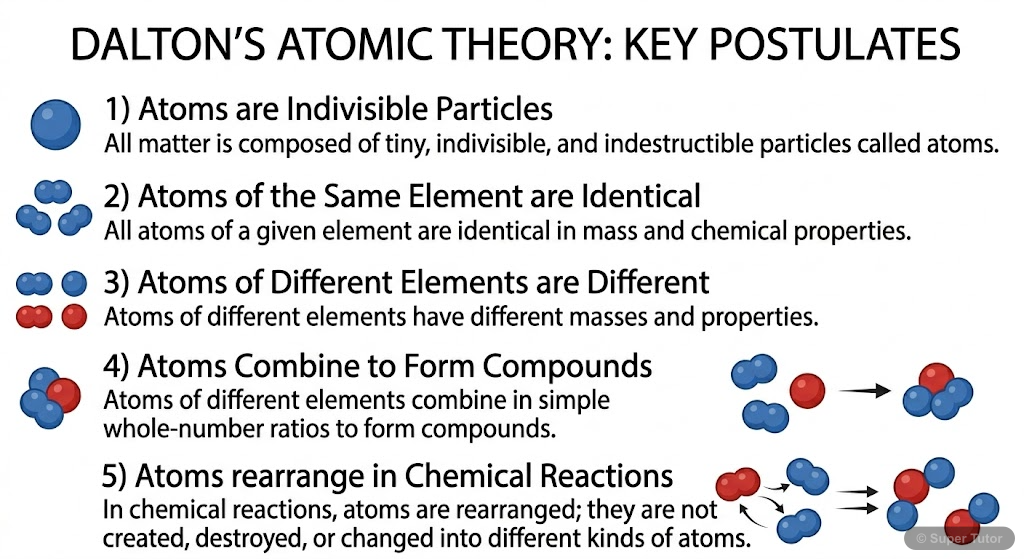
John Dalton proposed that all matter
John Dalton proposed that all matter consists of tiny, indivisible particles called atoms. Key postulates include: atoms are indivisible, atoms of the
Atoms are extremely small particles (radius
Atoms are extremely small particles (radius ~10⁻¹⁰ m) that serve as building blocks of matter. Atomic mass is measured in atomic mass units (u), where
Molecules are groups of atoms held
Molecules are groups of atoms held together by chemical bonds. They can be composed of same elements (like O₂, O₃) or different elements (like H₂O, NH
Ions are charged particles formed when
Ions are charged particles formed when atoms gain or lose electrons. Cations are positively charged (Na⁺), anions are negatively charged (Cl⁻). Polyat
Learning Objectives
- Understand the historical development of atomic theory from ancient Indian and Greek philosophers to Dalton's atomic theory
- Learn the laws of chemical combination - conservation of mass and constant proportions
- Comprehend the concept of atoms as the smallest indivisible particles of elements
- Distinguish between atoms, molecules, and ions
- Master the skill of writing chemical formulas using valency
Frequently Asked Questions
What are the important topics in Atoms and Molecules for Jharkhand Board Class 9 Science?
How should I revise Atoms and Molecules for Class 9 exams?
Sources & Official References
Content is aligned to the official syllabus. Refer to the board website for the latest curriculum.
More resources for Atoms and Molecules
For serious students
Get the full Atoms and Molecules chapter — start free.
Quizzes, flashcards, an AI doubt solver and a study plan for Jharkhand Board Class 9 Science. Free to start, no card needed.