Heredity — NCERT Solutions
Jammu & Kashmir Board · Class 10 · Science
NCERT Solutions for Heredity, Jammu & Kashmir Board Class 10 Science: 10 textbook questions solved step by step. Covers Questions and Exercises.
Interactive on Super Tutor
Studying Heredity? Get the full interactive chapter.
Quizzes, flashcards, AI doubt-solver and a step-by-step study plan — built for NCERT solutions and more.
Free trial, no card needed.
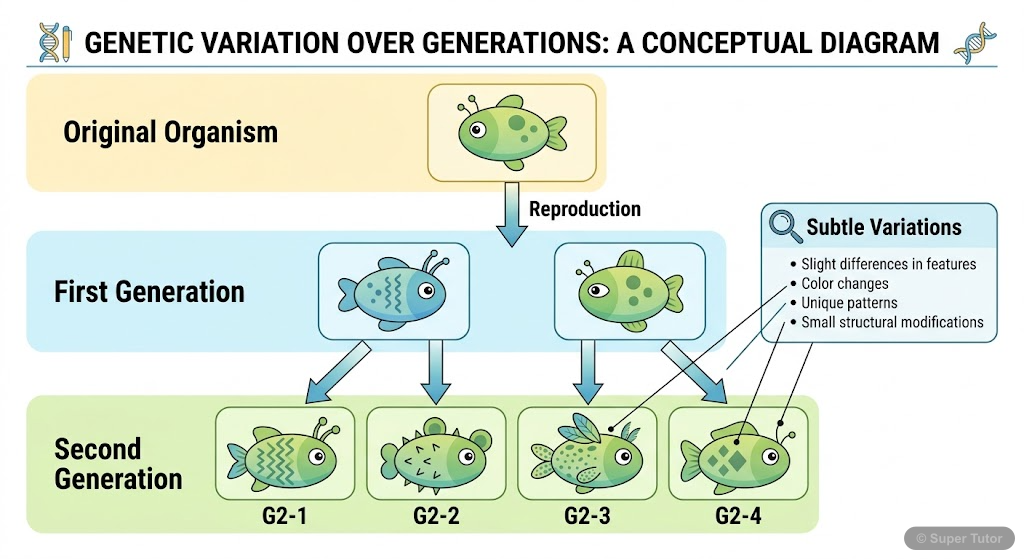
One of 7 illustrations for Heredity in Super Tutor — alongside flashcards, concept maps and practice questions.
The first 5 solutions are open to read. The other 5 are free with a Super Tutor account.
Questions
1If a trait A exists in 10% of a population of an asexually reproducing species and a trait B exists in 60% of the same population, which trait is likely to have arisen earlier?Show solution
In an asexually reproducing species, a trait that is found in a larger part of the population is more likely to have arisen earlier, because it had more time to be passed on to many descendants. Since trait B is present in 60% of the population, while trait A is present in only 10%, B is likely to have arisen earlier.
2How does the creation of variations in a species promote survival?Show solution
Variations promote survival because some variations give an individual advantage in a particular environment. If the environment changes, individuals with favourable variations are more likely to survive and reproduce. For example, bacteria that can withstand heat survive better during a heat wave. So, variations increase the chance that at least some members of a species will survive environmental change.
Questions
1How do Mendel's experiments show that traits may be dominant or recessive?Show solution
Given/Concept: Mendel performed monohybrid crosses using contrasting traits in pea plants (e.g., tall vs. short, round seeds vs. wrinkled seeds).
Explanation:
Step 1: Mendel crossed pure-breeding tall plants (TT) with pure-breeding short plants (tt). All plants in the F₁ generation were tall.
Step 2: When F₁ plants (Tt) were self-pollinated, the F₂ generation showed both tall and short plants in a ratio of approximately 3:1.
Step 3: The trait that appeared in F₁ (tallness) and in 3/4 of F₂ plants is called the dominant trait. The trait that disappeared in F₁ but reappeared in 1/4 of F₂ plants (shortness) is called the recessive trait.
Conclusion: Since the recessive trait (shortness) was hidden in F₁ but reappeared in F₂, Mendel concluded that traits can be dominant (expressed even in a single copy) or recessive (expressed only when both copies are identical). This shows that both copies of a gene are present in an organism, but only the dominant one is expressed when both are present together.
2How do Mendel's experiments show that traits are inherited independently?Show solution
Given/Concept: Mendel performed dihybrid crosses to study the inheritance of two traits simultaneously.
Explanation:
Step 1: Mendel crossed pure-breeding round yellow seed plants (RRYY) with pure-breeding wrinkled green seed plants (rryy).
Step 2: F₁ plants (RrYy) were self-pollinated to get F₂ generation.
Step 3: The F₂ generation showed four phenotypic classes in the ratio:
Step 4: New combinations — Round Green and Wrinkled Yellow — appeared in F₂ that were not present in either parent. This is only possible if the genes for seed shape and seed colour are inherited independently of each other.
Conclusion: If the two traits were linked and always inherited together, only parental combinations (Round Yellow and Wrinkled Green) would appear. The appearance of new combinations in a 9:3:3:1 ratio proves that traits are inherited independently (Law of Independent Assortment).
3A man with blood group A marries a woman with blood group O and their daughter has blood group O. Is this information enough to tell you which of the traits – blood group A or O – is dominant? Why or why not?Show solution
Given:
- Father's blood group = A
- Mother's blood group = O
- Daughter's blood group = O
Analysis:
Step 1: The daughter has blood group O. She received one allele from her father (blood group A) and one from her mother (blood group O).
Step 2: Since the daughter's blood group is O, the allele for blood group O must have been expressed. This means the father must have contributed an allele for O (not A) to the daughter.
Step 3: For the father (blood group A) to pass an O allele to his daughter, his genotype must be heterozygous (), i.e., he carries one A allele and one O allele. The daughter received the (O) allele from the father and (O) allele from the mother, making her genotype (blood group O).
Step 4: Since the father has blood group A with genotype , the A allele is expressed even in the presence of the O allele. This means blood group A is dominant over blood group O.
Conclusion: Yes, this information is enough to conclude that blood group A is dominant over blood group O, because the father expresses blood group A despite carrying an O allele, which means A masks O — confirming A is dominant and O is recessive.
Free with a Super Tutor account
Exercises
(a) TTWW
(b) TTww
(c) TtWW
(d) TtWw
Free with a Super Tutor account
Free with a Super Tutor account
Free with a Super Tutor account
Free with a Super Tutor account
5 more solved questions in Heredity
They are free with a Super Tutor account, along with practice quizzes and flashcards for this chapter. Free to start, no card needed.
Frequently Asked Questions
What are the important topics in Heredity for Jammu & Kashmir Board Class 10 Science?
Are these NCERT Solutions for Heredity free?
How should I revise Heredity for the Jammu & Kashmir Board Class 10 board exam?
Sources & Official References
Content is aligned to the official syllabus. Refer to the board website for the latest curriculum.
More resources for Heredity
Practice Quiz
Test yourself with a quick quiz
Important Questions
Exam-style questions with answers
Revision Notes
Key points for last-minute revision
Chapter Summary
Understand the chapter at a glance
Concept Maps
See how topics connect
Study Plan
Step-by-step plan for this chapter
Flashcards
Quick-fire cards for active recall
Syllabus
What topics to cover
For serious students
Get the full Heredity chapter — start free.
Quizzes, flashcards, an AI doubt solver and a study plan for Jammu & Kashmir Board Class 10 Science. Free to start, no card needed.