Introducing Indian Society — Concept Maps
Jammu & Kashmir Board · Class 12 · Sociology
4 concept maps of Introducing Indian Society for Jammu & Kashmir Board Class 12 Sociology, each also written out as a text outline.
Interactive on Super Tutor
Studying Introducing Indian Society? Get the full interactive chapter.
Quizzes, flashcards, AI doubt-solver and a step-by-step study plan — built for concept maps and more.
Free trial, no card needed.
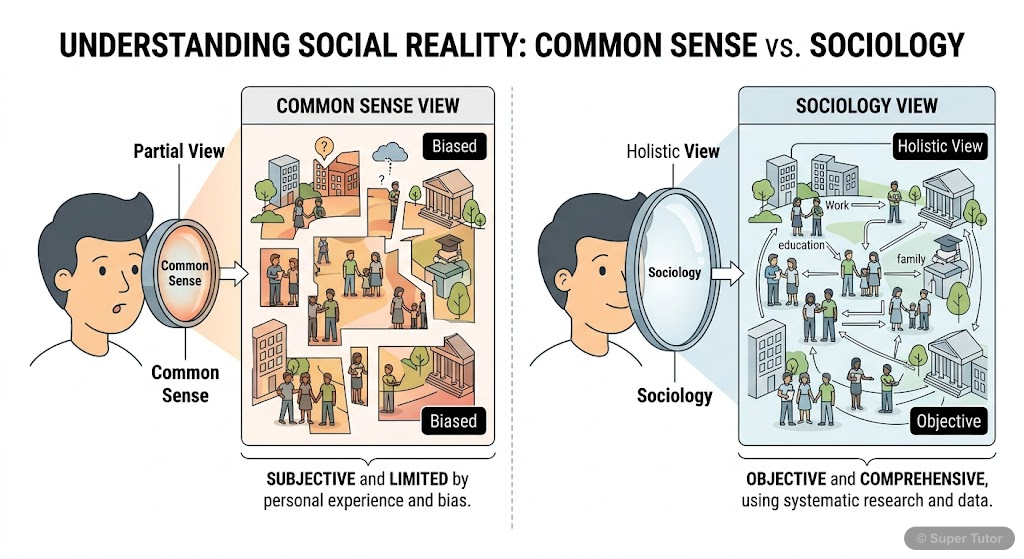
One of 5 illustrations for Introducing Indian Society in Super Tutor — alongside flashcards, concept maps and practice questions.
Common Sense vs Sociological Knowledge — Key Differences
The map in words
- Knowledge About Society
- How Was It Acquired?
- Through growing up and socialisation: Common Sense Knowledge
- Partial Knowledge
- Incomplete — sees only part of social reality
- Problem — Misleads in Exams
- Biased — tilted towards own social group
- Incomplete — sees only part of social reality
- Partial Knowledge
- Through systematic study: Sociological Knowledge
- Critical and Reflexive
- Examines all social groups fairly
- Correct Sociological Thinking
- Goes beyond personal viewpoint
- Examines all social groups fairly
- Critical and Reflexive
- Through growing up and socialisation: Common Sense Knowledge
- How Was It Acquired?
Chapter 1 Concept Map: Introducing Indian Society
The map in words
- Introducing Indian Society
- Sociology as Discipline
- Prior Knowledge
- Unlearning
- Reflexivity
- Common Sense vs Sociology
- Social Map
- Age Group
- Caste or Tribe
- Class
- Religion
- Language Region
- C Wright Mills
- Personal Troubles
- Social Issues
- Sociological Imagination
- Indian Society Textbook
- Demography Chapter 2
- Caste Tribe Family Chapter 3
- Markets Chapter 4
- Inequality Exclusion Chapter 5
- Diversity Chapter 6
- Fieldwork Chapter 7
- Sociology as Discipline
Chapter 1 — Core Concepts Overview
The map in words
- Introducing Indian Society
- Sociology as Discipline
- Unique Subject
- Prior Knowledge Exists
- Advantage and Disadvantage
- Common Sense Knowledge
- Naturally Acquired
- Partial
- Incomplete
- Biased
- Must Unlearn It
- Key Concepts
- Reflexivity
- Critical Self Inspection
- Social Map
- Age Group
- Caste and Religion
- Economic Class
- Region and Language
- Personal Troubles
- Social Issues
- C Wright Mills
- Reflexivity
- Indian Society Structure
- Chapter 2 Population
- Chapter 3 Caste Tribe Family
- Chapter 4 Market
- Chapter 5 Inequality
- Chapter 6 Diversity
- Sociology as Discipline
Indian Society studied through Sociology
The map in words
- Indian Society studied through Sociology
- Sociology
- Common sense knowledge
- Self-reflexivity
- Social mapping
- Personal troubles
- Social issues
- Basic structure of Indian society
- Demographic structure
Explore these maps interactively
Explore DiagramsFrequently Asked Questions
What are the important topics in Introducing Indian Society for Jammu & Kashmir Board Class 12 Sociology?
What do the concept maps for Introducing Indian Society show?
How should I revise Introducing Indian Society for the Jammu & Kashmir Board Class 12 board exam?
Sources & Official References
Content is aligned to the official syllabus. Refer to the board website for the latest curriculum.
More resources for Introducing Indian Society
Practice Quiz
Test yourself with a quick quiz
Important Questions
Exam-style questions with answers
Revision Notes
Key points for last-minute revision
Chapter Summary
Understand the chapter at a glance
Study Plan
Step-by-step plan for this chapter
Flashcards
Quick-fire cards for active recall
Syllabus
What topics to cover
For serious students
Get the full Introducing Indian Society chapter — start free.
Quizzes, flashcards, an AI doubt solver and a study plan for Jammu & Kashmir Board Class 12 Sociology. Free to start, no card needed.