Chapter 3 of 13
NCERT Solutions

Reproductive Health

Karnataka Board · Class 12 · Biology

NCERT Solutions for Reproductive Health — Karnataka Board Class 12 Biology.

32 questions44 flashcards5 concepts

Interactive on Super Tutor

Studying Reproductive Health? Get the full interactive chapter.

Quizzes, flashcards, AI doubt-solver and a step-by-step study plan — built for ncert solutions and more.

1,000+ Class 12 students started this chapter today

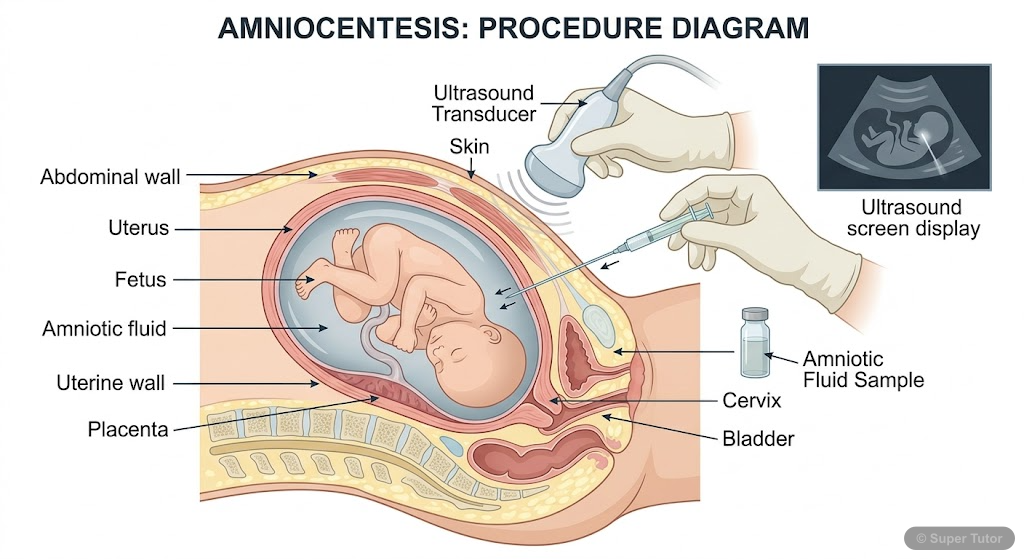
A labeled diagram showing the medical procedure of amniocentesis, including the fetus, amniotic fluid, placenta, and the needle insertion for fluid extraction.
Super Tutor

Super Tutor has 21+ illustrations like this for Reproductive Health alone — flashcards, concept maps, and step-by-step visuals.

See them all
12 Questions Solved · 1 Section

EXERCISES — Reproductive Health (Class 12 Biology)

1What do you think is the significance of reproductive health in a society?Show solution
Given/Concept: Reproductive health refers to total well-being in all aspects of reproduction — physical, emotional, behavioural and social.

Significance of Reproductive Health in Society:

1. Healthy population: Ensures physically and mentally healthy individuals capable of reproduction, leading to a healthy society.
2. Reduced maternal and infant mortality: Proper reproductive health care reduces deaths during pregnancy, childbirth and infancy.
3. Prevention of STIs: Awareness and medical care help in early detection and cure of sexually transmitted infections, preventing their spread.
4. Population control: Knowledge of contraception and family planning helps in controlling population explosion.
5. Elimination of sex-related crimes: Education and awareness reduce sexual abuse, rapes and exploitation.
6. Emotional and social well-being: Counselling and awareness programmes help individuals deal with adolescent changes, relationships and social pressures in a healthy manner.
7. Assistance to infertile couples: Reproductive health programmes provide medical assistance to couples unable to conceive naturally.
8. Legal protection: Legalisation of MTP (Medical Termination of Pregnancy) protects women from unsafe abortions.

Conclusion: A reproductively healthy society is one where people have responsible sexual behaviour, access to safe reproductive health care, and freedom from reproductive diseases and dysfunctions.
2Suggest the aspects of reproductive health which need to be given special attention in the present scenario.Show solution
Aspects of Reproductive Health Needing Special Attention:

1. Sex Education: Proper, scientifically accurate sex education must be imparted in schools to adolescents to make them aware of reproductive organs, puberty changes, safe sexual practices and contraception.

2. Awareness about STIs/STDs: Creating awareness about sexually transmitted infections like HIV/AIDS, gonorrhoea, syphilis, etc., their modes of transmission and prevention.

3. Population Control: Propagation of contraceptive methods and family planning to check the rapidly growing population.

4. Maternal and Child Health Care: Improving ante-natal and post-natal care to reduce maternal and infant mortality rates.

5. Prevention of Female Foeticide: Strict enforcement of the ban on amniocentesis for sex determination to prevent female foeticide and maintain a balanced sex ratio.

6. Assistance to Infertile Couples: Providing access to ART (Assisted Reproductive Technologies) like IVF, GIFT, ZIFT, etc.

7. Safe MTP: Ensuring medically safe and legal termination of unwanted pregnancies.

8. Adolescent Health: Counselling adolescents about physical and emotional changes during puberty, peer pressure, substance abuse and responsible behaviour.

9. Elimination of RTIs (Reproductive Tract Infections): Promoting hygienic practices to prevent reproductive tract infections, especially in women.

10. Awareness about Contraceptives: Educating rural and urban populations about various contraceptive options to enable informed choices.
3Is sex education necessary in schools? Why?Show solution
Yes, sex education is absolutely necessary in schools.

Reasons:

1. Correct information: It provides scientifically accurate information about reproductive organs, puberty, menstruation, fertilisation, etc., dispelling myths and misconceptions.

2. Awareness about STIs: Students learn about sexually transmitted infections (HIV/AIDS, gonorrhoea, syphilis) and how to prevent them.

3. Prevention of sexual abuse: Awareness about 'good touch' and 'bad touch' helps children protect themselves from sexual abuse and exploitation.

4. Responsible sexual behaviour: It encourages adolescents to make informed, responsible decisions regarding sexual activity.

5. Contraception awareness: Knowledge about contraceptive methods helps in preventing unwanted pregnancies among teenagers.

6. Emotional and psychological well-being: Counselling during adolescence helps students cope with physical and emotional changes, reducing anxiety and confusion.

7. Population control: Educated youth are more likely to adopt family planning measures, contributing to population control.

8. Reduction in gender-based violence: Proper education promotes gender equality and reduces sexual harassment and violence.

Conclusion: Sex education, when imparted in a sensitive, age-appropriate and scientific manner, is a powerful tool for building a reproductively healthy society.
4Do you think that reproductive health in our country has improved in the past 50 years? If yes, mention some such areas of improvement.Show solution
Yes, reproductive health in India has significantly improved over the past 50 years.

Areas of Improvement:

1. Reduced Maternal Mortality Rate (MMR): Better ante-natal and post-natal care, institutional deliveries and trained medical personnel have drastically reduced maternal deaths.

2. Reduced Infant Mortality Rate (IMR): Improved nutrition, vaccination programmes and neonatal care have reduced infant deaths.

3. Control of STIs: Early detection, better diagnostic facilities and effective treatment have helped in controlling sexually transmitted infections.

4. Population control: Awareness and availability of contraceptive methods have helped in reducing the birth rate and controlling population growth.

5. Assistance to infertile couples: Advanced ART techniques like IVF (Test Tube Baby), GIFT, ZIFT, IUI, etc. are now available to help infertile couples.

6. Legal MTP: Legalisation of Medical Termination of Pregnancy has reduced unsafe abortions and related deaths.

7. Amniocentesis regulation: Ban on amniocentesis for sex determination has helped in checking female foeticide.

8. Awareness programmes: National programmes like RCH (Reproductive and Child Health Care) have spread awareness about reproductive health.

9. Better sex ratio: Campaigns like 'Beti Bachao, Beti Padhao' have helped improve the sex ratio in many regions.

Conclusion: Though much progress has been made, continuous efforts are still needed to achieve complete reproductive health for all citizens.
5What are the suggested reasons for population explosion?Show solution
Given: India's population has grown enormously, reaching over 1.4 billion.

Suggested Reasons for Population Explosion:

1. Decline in Death Rate (Mortality Rate): Improved medical facilities, better sanitation, availability of medicines and vaccines have drastically reduced the death rate.

2. High Birth Rate: Despite awareness, the birth rate remains high in many parts of the country, especially in rural areas.

3. Decline in Maternal Mortality Rate (MMR): Better obstetric care has reduced deaths during childbirth, allowing more women to survive and have more children.

4. Decline in Infant Mortality Rate (IMR): More infants survive to adulthood, contributing to population growth.

5. Increased Life Expectancy: Better living conditions and healthcare have increased the average lifespan of individuals.

6. Early Marriage: Early marriage, especially in rural areas, leads to a longer reproductive period and more children.

7. Illiteracy and Lack of Awareness: Lack of education and awareness about family planning and contraception leads to larger family sizes.

8. Son Preference: Cultural preference for a male child leads families to keep having children until a son is born.

9. Religious and Social Beliefs: Some communities discourage the use of contraceptives on religious or social grounds.

Conclusion: The combination of reduced death rate without a proportional reduction in birth rate is the primary cause of population explosion.
6Is the use of contraceptives justified? Give reasons.Show solution
Yes, the use of contraceptives is justified.

Reasons:

1. Population Control: Contraceptives help in controlling the rapidly growing population, which is essential for sustainable development and better quality of life.

2. Spacing of Pregnancies: They allow couples to space their children, giving the mother time to recover physically and emotionally between pregnancies.

3. Maternal Health: Frequent pregnancies are harmful to the mother's health. Contraceptives protect maternal health by preventing unwanted pregnancies.

4. Prevention of Unsafe Abortions: By preventing unwanted pregnancies, contraceptives reduce the need for abortions, especially unsafe ones.

5. Prevention of STIs: Barrier methods like condoms protect against sexually transmitted infections including HIV/AIDS.

6. Economic Stability: Smaller families are economically more stable and can provide better education, nutrition and healthcare to children.

7. Women's Empowerment: Contraceptives give women control over their reproductive choices, enabling them to pursue education and careers.

8. Medical Reasons: In cases where pregnancy could be dangerous to the mother's health, contraceptives are medically necessary.

Note: Although contraceptives are not a regular requirement for reproductive health, their use is justified to avoid unwanted pregnancies, delay or space pregnancies, and protect against STIs.

Conclusion: The use of contraceptives is not only justified but also essential for individual well-being and national development.
7Removal of gonads cannot be considered as a contraceptive option. Why?Show solution
Given: Gonads include the testes (in males) and ovaries (in females).

Reason:

Removal of gonads (gonadectomy) cannot be considered a contraceptive option because:

1. Hormonal imbalance: Gonads are endocrine glands that secrete sex hormones — testosterone (testes) and oestrogen/progesterone (ovaries). Their removal causes severe hormonal imbalance leading to serious health consequences.

2. Loss of secondary sexual characters: Without gonadal hormones, secondary sexual characters (beard, breast development, voice changes, etc.) regress or fail to develop.

3. Irreversible procedure: Removal of gonads is a permanent, irreversible surgical procedure, not a reversible contraceptive method.

4. Serious side effects: It leads to conditions like osteoporosis, cardiovascular problems, psychological disturbances and loss of libido.

5. Not the purpose of contraception: Contraceptive methods are meant to prevent fertilisation or implantation temporarily, without causing harm to the individual's overall health. Gonadectomy causes permanent sterility along with severe physiological damage.

Conclusion: A contraceptive method should be safe, effective, reversible and without major side effects. Removal of gonads fulfils none of these criteria and is therefore not a contraceptive option.
8Amniocentesis for sex determination is banned in our country. Is this ban necessary? Comment.Show solution
Yes, the ban on amniocentesis for sex determination is absolutely necessary.

What is Amniocentesis?
Amniocentesis is a prenatal diagnostic technique in which a sample of amniotic fluid is withdrawn from the amniotic sac surrounding the foetus. The foetal cells in this fluid are analysed to detect chromosomal abnormalities, genetic disorders and the sex of the foetus.

Why the Ban is Necessary:

1. Prevention of Female Foeticide: In India, due to deep-rooted patriarchal attitudes and son preference, knowledge of female sex of the foetus often leads to selective abortion (female foeticide), which is morally and ethically wrong.

2. Declining Sex Ratio: Widespread misuse of amniocentesis for sex determination has led to a severely skewed sex ratio in many states (e.g., Haryana, Punjab), with far fewer females than males.

3. Social Imbalance: A declining female population leads to serious social problems like trafficking, polyandry and violence against women.

4. Violation of Rights: Every foetus, irrespective of sex, has the right to life. Sex-selective abortion violates this fundamental right.

5. Legal Framework: The Pre-Conception and Pre-Natal Diagnostic Techniques (PCPNDT) Act, 1994 (amended 2003) bans the use of amniocentesis and other techniques for sex determination.

Legitimate Uses of Amniocentesis:
Amniocentesis is a valuable medical tool for detecting chromosomal abnormalities (e.g., Down's syndrome), metabolic disorders and other genetic diseases. It should be used only for these medical purposes.

Conclusion: The ban on amniocentesis for sex determination is not only necessary but also a moral and social imperative to protect the girl child and maintain a balanced sex ratio in society.
9Suggest some methods to assist infertile couples to have children.Show solution
Given: Infertility is defined as the inability to conceive or produce children even after 2 years of unprotected sexual cohabitation.

Assisted Reproductive Technologies (ART) to Help Infertile Couples:

1. In Vitro Fertilisation (IVF) — 'Test Tube Baby' Programme:
- Ova from the wife/donor and sperm from the husband/donor are collected and fertilised outside the body in a laboratory.
- The resulting embryo is transferred into the uterus (Embryo Transfer — ET).

2. Zygote Intra-Fallopian Transfer (ZIFT):
- The zygote or early embryo (up to 8 blastomeres) formed by IVF is transferred into the fallopian tube instead of the uterus.

3. Intra-Uterine Transfer (IUT):
- Embryos with more than 8 blastomeres are transferred into the uterus.

4. Gamete Intra-Fallopian Transfer (GIFT):
- Ovum collected from a donor is transferred into the fallopian tube of a woman who cannot produce ova but can provide a suitable environment for fertilisation.

5. Intra-Cytoplasmic Sperm Injection (ICSI):
- A single sperm is directly injected into the ovum in the laboratory to form an embryo, useful in cases of very low sperm count.

6. Intra-Uterine Insemination (IUI) / Artificial Insemination (AI):
- Semen collected from the husband or a healthy donor is artificially introduced into the vagina or uterus of the female.
- Used when the male partner has very low sperm count or poor sperm motility.

7. Surrogacy:
- When a woman cannot carry a pregnancy, a surrogate mother carries the embryo (formed from the couple's gametes) to term.

Conclusion: These techniques have given hope to millions of infertile couples worldwide and represent a major advancement in reproductive medicine.
10What are the measures one has to take to prevent from contracting STDs?Show solution
Given: STDs (Sexually Transmitted Diseases) or STIs (Sexually Transmitted Infections) are infections/diseases transmitted through sexual intercourse.

Preventive Measures:

1. Avoid sexual contact with unknown/multiple partners: Having sexual relations with multiple or unknown partners greatly increases the risk of contracting STIs.

2. Use of condoms: Always use condoms (male or female) during sexual intercourse. Condoms act as a barrier and prevent the transmission of pathogens.

3. Avoid sharing needles/syringes: HIV and Hepatitis B can be transmitted through contaminated needles. Always use sterile, disposable needles.

4. Screening of blood: Ensure that blood received during transfusion is screened for STIs like HIV and Hepatitis B.

5. Avoid sharing personal items: Do not share razors, toothbrushes or other personal items that may carry blood or body fluids.

6. Early diagnosis and treatment: Get regular medical check-ups and seek early treatment if symptoms of STIs appear. Early detection facilitates better cure.

7. Vaccination: Vaccines are available for some STIs like Hepatitis B and HPV (Human Papillomavirus). Getting vaccinated provides protection.

8. Sex education and awareness: Proper education about STIs, their transmission and prevention is essential, especially for adolescents.

9. Abstinence or mutual monogamy: Abstaining from sexual activity or maintaining a mutually faithful monogamous relationship significantly reduces the risk.

10. Avoid self-medication: Do not self-medicate for STIs; consult a doctor for proper diagnosis and treatment.

Conclusion: A combination of responsible sexual behaviour, use of barrier contraceptives and regular medical check-ups is the most effective way to prevent STIs.
11State True/False with explanation
(a) Abortions could happen spontaneously too.
(b) Infertility is defined as the inability to produce a viable offspring and is always due to abnormalities/defects in the female partner.
(c) Complete lactation could help as a natural method of contraception.
(d) Creating awareness about sex related aspects is an effective method to improve reproductive health of the people.
Show solution
(a) Abortions could happen spontaneously too.

True.

Explanation: Abortions can occur spontaneously (without any medical intervention) and are called spontaneous abortions or miscarriages. These occur due to chromosomal abnormalities in the foetus, hormonal imbalances, uterine abnormalities, infections or other medical conditions. They are different from induced (medical) abortions (MTP).

---

(b) Infertility is defined as the inability to produce a viable offspring and is always due to abnormalities/defects in the female partner.

False.

Explanation: The first part of the statement is partially correct — infertility is the inability to conceive or produce children even after 2 years of unprotected sexual cohabitation. However, the second part is false. Infertility is not always due to defects in the female partner. It can be due to:
- Male factors: Low sperm count, poor sperm motility, abnormal sperm morphology, blockage of vas deferens, etc.
- Female factors: Blocked fallopian tubes, hormonal imbalances, uterine abnormalities, etc.
- Combined factors: Problems in both partners.
- Unexplained infertility: No identifiable cause in either partner.

Thus, infertility can be due to abnormalities in either or both partners.

---

(c) Complete lactation could help as a natural method of contraception.

True.

Explanation: This is known as the Lactational Amenorrhoea Method (LAM). During complete (full) breastfeeding (lactation), the high levels of prolactin hormone suppress the release of GnRH, which in turn inhibits ovulation and menstruation (amenorrhoea). Since ovulation does not occur, the chances of conception are minimal. However, this method is effective only:
- During complete lactation (no supplementary feeding)
- Up to a maximum of 6 months after delivery
- As long as menstruation has not resumed

Beyond these conditions, its effectiveness decreases significantly.

---

(d) Creating awareness about sex related aspects is an effective method to improve reproductive health of the people.

True.

Explanation: Creating awareness about sex-related aspects — including reproductive organs, puberty, safe sexual practices, contraception, STIs, family planning and MTP — is the primary and most effective step towards improving reproductive health. Awareness:
- Helps people make informed decisions
- Reduces the spread of STIs
- Promotes responsible sexual behaviour
- Reduces unwanted pregnancies and unsafe abortions
- Empowers women and adolescents

This is why sex education and awareness campaigns form the cornerstone of all national reproductive health programmes.
12Correct the following statements:
(a) Surgical methods of contraception prevent gamete formation.
(b) All sexually transmitted diseases are completely curable.
(c) Oral pills are very popular contraceptives among the rural women.
(d) In E.T. techniques, embryos are always transferred into the uterus.
Show solution
(a) Incorrect Statement: Surgical methods of contraception prevent gamete formation.

Corrected Statement: Surgical methods of contraception prevent the transport of gametes (not their formation).

Explanation: Surgical methods include:
- Vasectomy (in males): A small portion of the vas deferens is cut and tied, preventing the transport of sperms from the testes to the urethra. Sperm formation (spermatogenesis) continues normally in the testes.
- Tubectomy (in females): A small portion of the fallopian tube is cut and tied, preventing the transport of the ovum from the ovary to the uterus. Ovum formation (oogenesis) continues normally in the ovaries.

Thus, surgical methods prevent the transport of gametes, not their formation.

---

(b) Incorrect Statement: All sexually transmitted diseases are completely curable.

Corrected Statement: Some sexually transmitted diseases are completely curable, but others, like HIV/AIDS and Hepatitis B, are not completely curable (they can only be managed).

Explanation:
- STIs caused by bacteria (e.g., gonorrhoea, syphilis, chlamydia) are completely curable with antibiotics if detected early.
- STIs caused by viruses (e.g., HIV/AIDS, Hepatitis B, genital herpes, genital warts caused by HPV) are not completely curable. They can only be managed with antiviral drugs to control symptoms and slow progression.

---

(c) Incorrect Statement: Oral pills are very popular contraceptives among the rural women.

Corrected Statement: Oral pills are very popular contraceptives among urban women. Barrier methods (condoms) and IUDs (Intra-Uterine Devices) are more commonly used in rural areas, or alternatively, tubectomy is popular among rural women.

Explanation: Oral contraceptive pills require regular, disciplined daily intake and medical supervision. In rural areas, due to lack of awareness, literacy, access to healthcare and regular medical follow-up, oral pills are less popular. IUDs and sterilisation methods are more commonly adopted in rural settings.

---

(d) Incorrect Statement: In E.T. techniques, embryos are always transferred into the uterus.

Corrected Statement: In E.T. (Embryo Transfer) techniques, embryos are not always transferred into the uterus. Embryos with up to 8 blastomeres are transferred into the fallopian tube (ZIFT — Zygote Intra-Fallopian Transfer), while embryos with more than 8 blastomeres are transferred into the uterus (IUT — Intra-Uterine Transfer).

Explanation:
- ZIFT (Zygote Intra-Fallopian Transfer): The zygote or early embryo (up to 8 blastomeres) is transferred into the fallopian tube.
- IUT (Intra-Uterine Transfer): Embryos with more than 8 blastomeres are transferred into the uterus.

Thus, the site of embryo transfer depends on the stage of embryonic development.

Stuck on a step?

Ask Super Tutor AI to explain any solution on this page in a simpler way — free, 24x7.

Ask a Doubt Free

Frequently Asked Questions

What are the important topics in Reproductive Health for Karnataka Board Class 12 Biology?
Key topics in Reproductive Health include Contraceptive Methods - Complete Overview, Contraceptive Methods: Classification and Mechanisms, Reproductive Health — Complete Chapter Overview. These are the concepts Karnataka Board Class 12 examiners draw on most — study them first, then practise related questions.
How to score full marks in Reproductive Health — Karnataka Board Class 12 Biology?
Understand the core concepts first, then work through the 32 practice questions available for this chapter. Revise formulas and definitions regularly, and use flashcards for quick recall before the exam.
Where can I get free NCERT Solutions for Reproductive Health Class 12 Biology?
This page has free step-by-step NCERT Solutions for every exercise question in Reproductive Health (Karnataka Board Class 12 Biology) — written the way examiners award marks: given, formula, working, answer.

Sources & Official References

Content is aligned to the official syllabus. Refer to the board website for the latest curriculum.

For serious students

Get the full Reproductive Health chapter — for free.

Quizzes, flashcards, AI doubt-solver and a step-by-step study plan for Karnataka Board Class 12 Biology.