Financial Management
Karnataka Board · Class 12 · Business Studies
NCERT Solutions for Financial Management — Karnataka Board Class 12 Business Studies.
Interactive on Super Tutor
Studying Financial Management? Get the full interactive chapter.
Quizzes, flashcards, AI doubt-solver and a step-by-step study plan — built for ncert solutions and more.
1,000+ Class 12 students started this chapter today
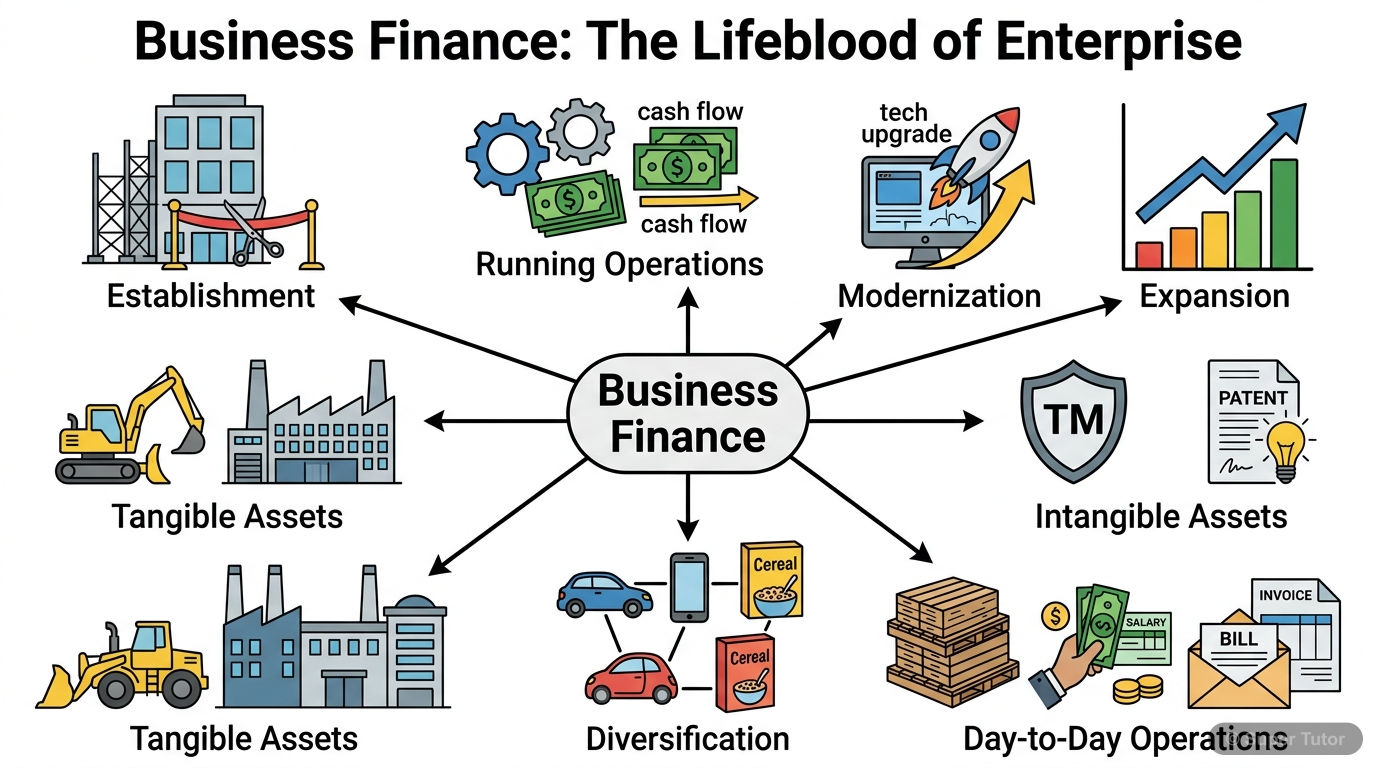
This is just one of 13+ visuals inside Super Tutor's Financial Management chapter
Explore the full setEXERCISES — Very Short Answer Type
1What is meant by capital structure?Show solution
Answer:
Capital structure refers to the mix or proportion of owners' funds (equity) and borrowed funds (debt) used by a firm to finance its assets and operations.
- Owners' funds include equity share capital, preference share capital, and retained earnings.
- Borrowed funds include debentures, long-term loans, bonds, etc.
The capital structure decision involves determining the relative proportion of these two broad categories of funds so as to minimise the cost of capital and maximise the value of the firm.
Example: If a company raises ₹60 lakh through equity and ₹40 lakh through debt, its capital structure is 60:40 (equity : debt).
2State the two objectives of financial planning.Show solution
The two main objectives of financial planning are:
1. To ensure availability of funds whenever required: Financial planning estimates the funds needed at various points of time so that the business does not face a shortage of funds and can carry out its operations smoothly.
2. To ensure that the firm does not raise resources unnecessarily: Excess funding leads to unnecessary costs (e.g., interest on idle borrowed funds). Financial planning ensures that funds are raised only to the extent needed, avoiding wastage and over-capitalisation.
In short, financial planning aims at neither a shortage nor a surplus of funds.
3Name the concept of financial management which increases the return to equity shareholders due to the presence of fixed financial charges.Show solution
Explanation: When a company uses borrowed funds (which carry fixed interest charges) along with equity, and if the rate of return on investment (ROI) is higher than the cost of debt, the surplus return (after paying fixed interest) goes to the equity shareholders. This increases the Earnings Per Share (EPS) and hence the return to equity shareholders.
For example, if ROI = 15% and cost of debt = 10%, the extra 5% benefit accrues to equity shareholders, thereby increasing their returns.
4Amrit is running a 'transport service' and earning good returns by providing this service to industries. Giving reason, state whether the working capital requirement of the firm will be 'less' or 'more'.Show solution
Answer: The working capital requirement of the firm will be LESS.
Reason:
- A transport service is a service sector business. It does not deal in physical goods, so there is no need to maintain inventories (raw materials, work-in-progress, or finished goods).
- Service businesses generally have quick cash realisations as services are rendered and payment is received promptly.
- Since the major investment is in fixed assets (vehicles, equipment) rather than current assets, the working capital requirement is relatively low compared to manufacturing businesses.
5Ramnath is into the business of assembling and selling of televisions. Recently he has adopted a new policy of purchasing the components on three months credit and selling the complete product in cash. Will it affect the requirement of working capital? Give reason in support of your answer.Show solution
- Purchases components on 3 months credit (Credit Availed = 3 months).
- Sells the complete product in cash (Credit Allowed = 0).
Answer: Yes, this new policy will reduce the working capital requirement significantly.
Reason:
1. Credit Availed (Creditors): By purchasing on 3 months credit, Ramnath does not need to pay immediately for raw materials/components. This means his creditors act as a source of short-term finance, reducing the funds he needs to block in current assets.
2. Cash Sales (No Debtors): By selling in cash, there are no debtors or receivables. The firm receives money immediately upon sale, so no funds are tied up in debtors.
Conclusion: The combination of buying on credit and selling for cash reduces the operating cycle and hence lowers the working capital requirement of the business.
EXERCISES — Short Answer Type
1What is financial risk? Why does it arise?Show solution
Financial risk refers to the risk of a company being unable to meet its fixed financial obligations (such as interest payments on debt, preference dividends, or repayment of principal) out of its earnings. It is the risk of insolvency or financial distress arising from the use of debt (borrowed funds) in the capital structure.
Why does it arise?
Financial risk arises due to the following reasons:
1. Use of Debt/Borrowed Funds: When a company uses debt in its capital structure, it is obligated to pay fixed interest charges regardless of whether it earns profits or not. If earnings are insufficient to cover these charges, the firm faces financial risk.
2. Fixed Financial Charges: Preference dividends and loan repayments are fixed obligations. Failure to meet them can lead to legal action by creditors.
3. Variability in EBIT: If the company's Earnings Before Interest and Tax (EBIT) fluctuates, there is a risk that it may fall below the level required to service debt.
In summary: Financial risk arises because of the presence of fixed-cost financing (debt) in the capital structure. Higher the proportion of debt, higher is the financial risk.
2Define current assets? Give four examples of such assets.Show solution
Current assets are those assets which are held for a short period (generally up to one year or one operating cycle, whichever is longer) and can be converted into cash quickly in the normal course of business operations. They are also called short-term assets or liquid assets.
They are used to support the day-to-day operations of the business.
Four Examples of Current Assets:
| S.No. | Current Asset |
|-------|---------------|
| 1. | Cash and Cash Equivalents (cash in hand, cash at bank) |
| 2. | Debtors / Accounts Receivable (amounts owed by customers) |
| 3. | Inventories / Stock (raw materials, work-in-progress, finished goods) |
| 4. | Marketable Securities / Short-term Investments (treasury bills, short-term bonds) |
Other examples include prepaid expenses and bills receivable.
3What are the main objectives of financial management? Briefly explain.Show solution
The primary objective of financial management is:
### Wealth Maximisation (Shareholders' Wealth Maximisation)
The main aim is to maximise the market value of equity shares (i.e., the wealth of shareholders). This is considered superior to profit maximisation because:
- It considers the time value of money.
- It accounts for risk associated with future cash flows.
- It focuses on long-term value creation rather than short-term profits.
The market price of shares reflects the three key financial decisions:
1. Investment Decision (Capital Budgeting): Deciding where to invest funds in long-term assets to generate maximum returns. It involves evaluating projects using techniques like NPV, IRR, etc.
2. Financing Decision (Capital Structure): Deciding the optimal mix of debt and equity to minimise the cost of capital and maximise the value of the firm.
3. Dividend Decision: Deciding how much of the profit should be distributed to shareholders as dividends and how much should be retained for reinvestment (retained earnings).
Conclusion: All three decisions together aim at maximising shareholders' wealth, which is the ultimate objective of financial management.
4Financial management is based on three broad financial decisions. What are these?Show solution
### 1. Investment Decision (Capital Budgeting Decision)
- This decision relates to how the firm's funds are invested in different assets.
- It involves evaluating and selecting long-term investment proposals (fixed assets like plant, machinery, land) as well as short-term investments (working capital management).
- The key criterion is that the investment should generate returns greater than the minimum acceptable return (hurdle rate).
- Tools used: Net Present Value (NPV), Internal Rate of Return (IRR), Payback Period.
### 2. Financing Decision (Capital Structure Decision)
- This decision relates to how the firm raises funds to finance its investments.
- It involves determining the optimal mix of debt (borrowed funds) and equity (owners' funds).
- The goal is to minimise the cost of capital and maximise the value of the firm.
- Key consideration: Use of debt increases financial risk but can enhance returns to equity shareholders (Trading on Equity).
### 3. Dividend Decision
- This decision relates to how much of the net profit is distributed to shareholders as dividends and how much is retained in the business as retained earnings.
- Factors considered: Earnings stability, growth opportunities, shareholders' preferences, legal constraints, and cash flow position.
- A higher dividend may satisfy shareholders but reduces funds available for reinvestment.
All three decisions are interrelated and together determine the market value of the firm's shares and hence the wealth of shareholders.
5Sunrises Ltd. dealing in readymade garments, is planning to expand its business operations in order to cater to international market. For this purpose the company needs additional ₹80,00,000 for replacing machines with modern machinery of higher production capacity. The company wishes to raise the required funds by issuing debentures. The debt can be issued at an estimated cost of 10%. The EBIT for the previous year of the company was ₹8,00,000 and total capital investment was ₹1,00,00,000. Suggest whether issue of debenture would be considered a rational decision by the company. Give reason to justify your answer.Show solution
- Funds required = ₹80,00,000
- Source of funds = Debentures
- Cost of Debt = 10%
- EBIT (previous year) = ₹8,00,000
- Total Capital Investment = ₹1,00,00,000
Step 1: Calculate Return on Investment (ROI)
Step 2: Compare ROI with Cost of Debt
| Particulars | Value |
|-------------|-------|
| Return on Investment (ROI) | 8% |
| Cost of Debt | 10% |
Step 3: Decision
No, issuing debentures would NOT be a rational decision for Sunrises Ltd.
Reason:
- The Cost of Debt (10%) is greater than the ROI (8%).
- This means the company earns only 8% on its investments but has to pay 10% as interest on borrowed funds.
- The shortfall of 2% (10% − 8%) will have to be borne by the equity shareholders, thereby reducing their returns and the EPS.
- Trading on Equity (financial leverage) works in favour of equity shareholders only when ROI > Cost of Debt. Here, since ROI < Cost of Debt, it will have a negative leverage effect.
Conclusion: Sunrises Ltd. should not raise funds through debentures at this stage. It should either look for cheaper sources of finance or improve its ROI before taking on debt.
6How does working capital affect both the liquidity as well as profitability of a business?Show solution
Working capital has a direct impact on both liquidity and profitability of a business. There is a trade-off between the two:
---
### Effect on Liquidity:
- Adequate working capital ensures that the firm can meet its short-term obligations (creditors, wages, taxes) on time, maintaining liquidity.
- If working capital is too low, the firm may face a liquidity crisis — it may not be able to pay its current liabilities, leading to loss of creditworthiness and even insolvency.
- Higher working capital → Higher liquidity (more current assets available to meet current liabilities).
---
### Effect on Profitability:
- Excess working capital means funds are blocked in current assets (idle cash, excess inventory, high debtors) that are not generating adequate returns. This reduces profitability.
- Too little working capital may disrupt production (shortage of raw materials) and sales (inability to offer credit), also reducing profitability.
- Lower working capital → Higher profitability (less funds tied up in low-return current assets, more funds available for productive investment).
---
### The Trade-off:
| Situation | Liquidity | Profitability |
|-----------|-----------|---------------|
| High Working Capital | High | Low |
| Low Working Capital | Low | High |
Conclusion: A firm must maintain an optimal level of working capital — enough to ensure liquidity without sacrificing profitability. This balance is the essence of working capital management.
7Aval Ltd. is engaged in the business of export of canvas goods and bags. In the past, the performance of the company had been up to the expectations. In line with the latest demand in the market, the company decided to venture into leather goods for which it required specialised machinery. For this, the Finance Manager Prabhu prepared a financial blueprint of the organisation's future operations to estimate the amount of funds required and the timings with the objective to ensure that enough funds are available at right time. He also collected the relevant data about the profit estimates in the coming years. By doing this, he wanted to be sure about the availability of funds from the internal sources of the business. For the remaining funds, he is trying to find out alternative sources from outside.
a. Identify the financial concept discussed in the above paragraph. Also, state the objectives to be achieved by the use of financial concept so identified.
b. 'There is no restriction on payment of dividend by a company'. Comment.Show solution
Financial Concept Identified: FINANCIAL PLANNING
The paragraph describes Finance Manager Prabhu preparing a financial blueprint of the organisation's future operations, estimating funds required and their timing, and identifying internal and external sources — all of which are characteristics of Financial Planning.
Objectives of Financial Planning:
1. To ensure availability of funds whenever required:
Financial planning estimates the amount and timing of funds needed so that the business does not face a shortage of funds at any point. This ensures smooth and uninterrupted operations.
2. To ensure that the firm does not raise resources unnecessarily:
Financial planning prevents over-capitalisation by ensuring that funds are raised only to the extent required. Excess funds lead to unnecessary interest costs and reduce profitability.
Additional objectives include:
- Helping the firm tackle uncertainty regarding availability and timing of funds.
- Facilitating coordination between different departments.
- Providing a basis for financial control.
---
### Part (b): 'There is no restriction on payment of dividend by a company' — Comment
This statement is INCORRECT.
There are several legal and contractual constraints on the payment of dividends by a company:
1. Legal Constraints: Under the Companies Act, dividends can only be paid out of current profits or past reserves. A company cannot pay dividends out of capital. Also, before declaring dividends, a company must transfer a certain percentage of profits to reserves as required by law.
2. Contractual Constraints: Loan agreements with banks or financial institutions may contain restrictive covenants that prohibit or limit the payment of dividends until certain conditions (e.g., maintaining a minimum debt service coverage ratio) are met.
3. Availability of Cash: Even if profits exist, dividends require actual cash outflow. If the company has a poor cash position, it may not be able to pay dividends.
4. Growth Needs: If the company has profitable investment opportunities, it may retain profits rather than distribute them as dividends.
5. Preference Shareholders' Rights: Preference dividends must be paid before equity dividends.
Conclusion: Payment of dividend is subject to legal provisions, contractual obligations, cash availability, and management policy. Hence, the statement that there is no restriction on payment of dividend is incorrect.
EXERCISES — Long Answer Type
1What is working capital? Discuss five important determinants of working capital requirement.Show solution
Working Capital refers to the funds invested in current assets that are used in the day-to-day operations of a business.
- Gross Working Capital = Total Current Assets (cash, debtors, inventory, etc.)
- Net Working Capital = Current Assets − Current Liabilities
Working capital ensures the liquidity of the firm and enables it to meet its short-term obligations and run its operations smoothly.
---
### Five Important Determinants of Working Capital Requirement:
#### 1. Nature of Business
- Trading/Service firms (e.g., transport, retail) require less working capital because they have shorter operating cycles, fewer inventories, and quick cash realisations.
- Manufacturing firms require more working capital because they need to maintain raw materials, work-in-progress, and finished goods inventories, and also extend credit to customers.
#### 2. Scale of Operations
- Firms operating at a larger scale need to maintain higher levels of inventory, debtors, and cash, requiring more working capital.
- Smaller firms with lower production volumes require less working capital.
#### 3. Business/Trade Cycle
- During a boom period, sales are high, production is high, and more working capital is needed to maintain higher inventories and debtors.
- During a recession, sales fall, production decreases, and working capital requirement is lower.
#### 4. Credit Allowed (Debtors Policy)
- If a firm extends liberal credit terms to its customers (longer credit period, higher credit limits), more funds are tied up in debtors, increasing the working capital requirement.
- Firms that sell on cash basis require less working capital as there are no debtors.
#### 5. Operating Efficiency
- A firm that manages its operations efficiently (e.g., faster inventory turnover, quicker collection of debtors, better cash management) requires less working capital.
- Efficient firms minimise waste, reduce the operating cycle, and optimise the use of current assets, thereby reducing the working capital needed.
---
Other determinants include: Credit Availed, Seasonal Factors, Production Cycle, Availability of Raw Material, Growth Prospects, Level of Competition, and Rate of Inflation.
Conclusion: The working capital requirement of a firm is not fixed — it varies with the nature, size, and efficiency of the business and the external environment.
2"Capital structure decision is essentially optimisation of risk-return relationship." Comment.Show solution
Capital structure refers to the mix of debt and equity used by a firm to finance its assets. The statement that 'capital structure decision is essentially optimisation of risk-return relationship' is absolutely correct. Here is a detailed explanation:
---
### The Risk-Return Trade-off in Capital Structure:
#### Use of Debt (Borrowed Funds):
- Debt carries a fixed interest obligation regardless of profits.
- Return Perspective: If ROI > Cost of Debt, using debt increases EPS (Trading on Equity) — this is the return benefit.
- Risk Perspective: Fixed interest payments increase the financial risk of the firm. If earnings fall, the firm may not be able to service its debt, leading to financial distress.
#### Use of Equity (Owners' Funds):
- Equity does not carry a fixed obligation — dividends are paid only when profits are available.
- Return Perspective: Using more equity dilutes EPS (earnings spread over more shares) — lower return to existing shareholders.
- Risk Perspective: Equity reduces financial risk as there are no mandatory payments.
---
### Optimisation:
The optimal capital structure is the one that:
1. Maximises the market value of the firm (and hence shareholders' wealth).
2. Minimises the overall cost of capital (Weighted Average Cost of Capital — WACC).
3. Balances the benefits of debt (tax shield, higher EPS through leverage) against the risks of debt (financial risk, bankruptcy risk).
---
### Factors to Consider:
| Factor | Impact on Risk | Impact on Return |
|--------|---------------|------------------|
| Higher Debt | Increases financial risk | Increases EPS (if ROI > cost of debt) |
| Higher Equity | Reduces financial risk | Dilutes EPS |
| Tax Rate | Debt provides tax shield | Increases after-tax return |
| ROI vs Cost of Debt | — | Determines leverage benefit |
---
### Conclusion:
A firm cannot use maximum debt (too risky) nor maximum equity (too costly and dilutive). The capital structure decision is therefore a balancing act — optimising the proportion of debt and equity to achieve the best possible return for a given level of risk. Hence, the statement is fully justified.
3"A capital budgeting decision is capable of changing the financial fortunes of a business." Do you agree? Give reasons for your answer.Show solution
### What is Capital Budgeting?
Capital budgeting (Investment Decision) refers to the process of planning and evaluating long-term investment proposals involving large sums of money in fixed assets (plant, machinery, technology, new projects, etc.).
---
### Reasons Why Capital Budgeting Can Change Financial Fortunes:
#### 1. Long-term Impact
- Capital budgeting decisions involve long-term commitments of funds (5, 10, or even 20 years).
- A good investment (e.g., adopting new technology) can generate high returns for years, transforming the company's profitability.
- A bad investment (e.g., investing in an obsolete technology) can drain resources for years, leading to financial losses.
#### 2. Large Amount of Funds Involved
- Capital budgeting decisions involve huge sums of money. A wrong decision can lead to massive financial losses that may be difficult to recover from.
- Conversely, a correct decision can generate substantial wealth for the firm.
#### 3. Irreversibility
- Most capital budgeting decisions are difficult to reverse once implemented. For example, once a plant is set up, it cannot easily be dismantled without significant loss.
- This makes it critical to make the right decision at the outset.
#### 4. Effect on Competitive Position
- Investing in modern technology or capacity expansion can give the firm a competitive advantage, increasing market share and profitability.
- Failure to invest when competitors do can lead to loss of market position.
#### 5. Impact on Risk Profile
- Capital budgeting decisions affect the business risk of the firm. Diversifying into new products/markets can reduce risk, while concentrating in one area increases it.
- The risk-return profile of the firm changes with each major investment decision.
#### 6. Effect on Future Cash Flows
- Capital investments determine the future cash inflows of the firm. A profitable project generates strong cash flows, enabling the firm to pay dividends, repay debt, and reinvest.
- A loss-making project depletes cash flows, affecting the firm's ability to meet obligations.
---
### Conclusion:
Capital budgeting decisions are the most critical decisions in financial management because they involve large, long-term, and often irreversible commitments. A wise capital budgeting decision can transform a struggling company into a market leader, while a poor decision can push a profitable company into financial distress. Hence, the statement is fully justified.
4Explain the factors affecting dividend decision.Show solution
The dividend decision involves determining how much of the net profit should be distributed to shareholders as dividends and how much should be retained in the business as retained earnings for future growth.
---
### Factors Affecting Dividend Decision:
#### 1. Earnings
- Dividends are paid out of current and past earnings. Higher and stable earnings enable the company to pay higher dividends.
- A company with fluctuating earnings tends to pay lower or irregular dividends.
#### 2. Stability of Earnings
- Companies with stable and predictable earnings (e.g., FMCG companies) can afford to pay regular and higher dividends.
- Companies with volatile earnings (e.g., cyclical industries) prefer to retain more profits as a buffer.
#### 3. Stability of Dividends
- Investors generally prefer stable dividends as it signals financial health and reduces uncertainty.
- Companies try to maintain a consistent dividend policy even if earnings fluctuate, to maintain investor confidence.
#### 4. Growth Opportunities
- If a company has profitable investment opportunities, it will prefer to retain more profits (lower dividend payout) to finance growth internally.
- Companies with limited growth opportunities tend to pay higher dividends as they have fewer uses for retained earnings.
#### 5. Cash Flow Position
- Dividends require actual cash outflow. Even if profits are high, if the company has a poor cash position (funds blocked in debtors, inventory), it may not be able to pay dividends.
- A strong cash position supports higher dividend payments.
#### 6. Shareholders' Preferences
- If shareholders prefer regular income (e.g., retired investors), the company may pay higher dividends.
- If shareholders prefer capital gains (e.g., growth-oriented investors), the company may retain more profits.
#### 7. Taxation Policy
- The tax treatment of dividends vs. capital gains influences the dividend decision.
- If dividends are taxed at a higher rate than capital gains, shareholders may prefer the company to retain profits (leading to capital appreciation) rather than pay dividends.
#### 8. Legal and Contractual Constraints
- Legal constraints: Companies Act requires that dividends be paid only out of profits, and a certain percentage must be transferred to reserves before declaring dividends.
- Contractual constraints: Loan agreements may restrict dividend payments until certain financial ratios are maintained.
#### 9. Access to Capital Markets
- Large, well-established companies with easy access to capital markets can afford to pay higher dividends as they can raise external funds easily when needed.
- Smaller companies with limited access to capital markets prefer to retain more profits.
#### 10. Stock Market Conditions
- In a bullish market, companies may prefer to retain earnings and issue bonus shares or rights issues.
- In a bearish market, paying regular dividends helps maintain investor confidence.
---
Conclusion: The dividend decision is a complex one, influenced by a combination of internal factors (earnings, cash flow, growth needs) and external factors (taxation, legal constraints, market conditions). The goal is to strike a balance between rewarding shareholders and retaining funds for growth.
5Explain the term 'Trading on Equity'? Why, when and how it can be used by company.Show solution
Trading on Equity (also called Financial Leverage) refers to the practice of using borrowed funds (debt) in the capital structure of a company with the expectation that the return earned on the borrowed funds will be greater than the cost (interest) of those funds, thereby increasing the return to equity shareholders.
The term 'equity' is used because it is the equity shareholders who benefit from this practice — the surplus return (after paying fixed interest) accrues to them.
---
### Why is Trading on Equity Used?
Trading on equity is used to increase the Earnings Per Share (EPS) and hence the return to equity shareholders without increasing their investment. It leverages the fixed-cost nature of debt to amplify returns to equity holders.
Example:
| Particulars | Without Debt | With Debt |
|-------------|-------------|----------|
| Total Capital | ₹10,00,000 (Equity) | ₹5,00,000 Equity + ₹5,00,000 Debt @ 10% |
| EBIT (ROI = 15%) | ₹1,50,000 | ₹1,50,000 |
| Less: Interest | — | ₹50,000 |
| EBT | ₹1,50,000 | ₹1,00,000 |
| Return on Equity | 15% | 20% (₹1,00,000 / ₹5,00,000) |
Here, by using debt at 10% when ROI is 15%, the return to equity shareholders increases from 15% to 20%.
---
### When Can Trading on Equity Be Used?
Trading on equity is beneficial and should be used only when:
1. ROI > Cost of Debt: The return earned on investment must be greater than the interest rate on borrowed funds. Only then will the surplus accrue to equity shareholders.
\text{Condition: ROI} > \text{Cost of Debt (Interest Rate)}
2. Stable and Sufficient Earnings: The company must have stable earnings to comfortably service the fixed interest obligations.
3. Favourable Tax Environment: Since interest on debt is tax-deductible, it reduces the effective cost of debt, making trading on equity more attractive.
4. Moderate Debt Levels: The company should not be already over-leveraged (too much existing debt), as additional debt increases financial risk.
---
### How Can Trading on Equity Be Used?
A company can use trading on equity by:
1. Issuing Debentures/Bonds: Raising long-term debt at a fixed rate of interest.
2. Taking Term Loans: Borrowing from banks and financial institutions at fixed interest rates.
3. Issuing Preference Shares: Preference shares carry a fixed dividend, which also creates leverage (though preference dividends are not tax-deductible).
The key is to ensure that the funds raised through these fixed-cost sources are invested in projects that generate returns higher than the cost of these funds.
---
### Limitations:
- If ROI < Cost of Debt, trading on equity has a negative effect — it reduces returns to equity shareholders.
- Excessive use of debt increases financial risk and may lead to insolvency.
Conclusion: Trading on equity is a powerful tool to enhance shareholder returns, but it must be used judiciously — only when ROI exceeds the cost of debt and the firm has stable earnings to service its debt obligations.
6'S' Limited is manufacturing steel at its plant in India. It is enjoying a buoyant demand for its products as economic growth is about 7-8 per cent and the demand for steel is growing. It is planning to set up a new steel plant to cash on the increased demand. It is estimated that it will require about ₹5000 crores to set up and about ₹500 crores of working capital to start the new plant.
a. Describe the role and objectives of financial management for this company.
b. Explain the importance of having a financial plan for this company. Give an imaginary plan to support your answer.
c. What are the factors which will affect the capital structure of this company?
d. Keeping in mind that it is a highly capital-intensive sector, what factors will affect the fixed and working capital. Give reasons in support of your answer.Show solution
Role of Financial Management:
For 'S' Limited, which is planning to invest ₹5000 crores in a new steel plant, financial management plays a critical role in:
1. Procurement of Funds: Identifying and arranging ₹5000 crores (fixed capital) and ₹500 crores (working capital) from appropriate sources at minimum cost — equity, debt, retained earnings, etc.
2. Allocation of Funds (Investment Decision): Ensuring that the ₹5000 crores is invested in the most productive assets (land, plant, machinery, technology) to generate maximum returns.
3. Managing Working Capital: Ensuring that ₹500 crores of working capital is managed efficiently to maintain smooth day-to-day operations of the new plant.
4. Financial Control: Monitoring actual financial performance against planned targets and taking corrective action.
5. Risk Management: Identifying and managing financial risks associated with the large investment.
Objectives of Financial Management:
1. Wealth Maximisation (Primary Objective): The primary objective is to maximise the market value of 'S' Limited's shares (shareholders' wealth). All financial decisions — investment, financing, and dividend — should be directed towards this goal.
2. Profit Maximisation: Ensuring that the new plant generates maximum profits by optimising costs and revenues.
3. Ensuring Liquidity: Maintaining adequate liquidity to meet short-term obligations (wages, raw material payments, loan instalments).
4. Minimising Cost of Capital: Raising ₹5000 crores at the lowest possible cost (optimal mix of debt and equity).
5. Optimal Utilisation of Funds: Ensuring that every rupee invested generates the maximum possible return.
---
### Part (b): Importance of Financial Planning for 'S' Limited
Financial planning is the preparation of a financial blueprint of the organisation's future operations. For 'S' Limited, which is undertaking a massive ₹5000 crore investment, financial planning is extremely important:
Importance:
1. Ensures Availability of Funds at the Right Time: The construction of the new plant will require funds in phases. Financial planning ensures that ₹5000 crores is available when needed — for land acquisition, civil construction, machinery procurement, etc. — avoiding delays.
2. Avoids Over/Under-Capitalisation: Without planning, the company may raise too much (leading to idle funds and unnecessary interest costs) or too little (causing project delays). Financial planning ensures just the right amount is raised.
3. Helps in Identifying Sources of Finance: Financial planning helps 'S' Limited identify the best mix of equity, debt, and retained earnings to finance the project at minimum cost.
4. Facilitates Coordination: A financial plan coordinates the activities of the finance, production, marketing, and HR departments, ensuring all departments work towards the same financial goals.
5. Provides Basis for Control: Actual financial performance can be compared against the financial plan, enabling management to take corrective action if costs exceed estimates.
6. Handles Uncertainty: The steel industry is cyclical. Financial planning helps 'S' Limited prepare for contingencies (e.g., cost overruns, demand slowdown) by maintaining financial buffers.
Imaginary Financial Plan for 'S' Limited:
| Year | Activity | Estimated Cost | Source of Funds |
|------|----------|---------------|----------------|
| Year 1 | Land acquisition, site preparation | ₹500 crores | Equity (Rights Issue) |
| Year 2 | Civil construction, foundation | ₹1,000 crores | Long-term Bonds |
| Year 3 | Machinery procurement and installation | ₹2,000 crores | Term Loans from Banks |
| Year 4 | Trial runs, commissioning | ₹1,000 crores | Retained Earnings |
| Year 5 | Working capital for operations | ₹500 crores | Short-term Bank Credit |
| Total | | ₹5,500 crores | Mix of Equity & Debt |
Projected EBIT after full commissioning: ₹800 crores per annum (ROI ≈ 14.5%), which exceeds the estimated cost of debt (9%), making the project financially viable.
---
### Part (c): Factors Affecting Capital Structure of 'S' Limited
Given that 'S' Limited needs ₹5000 crores, the following factors will determine its capital structure (mix of debt and equity):
1. Cash Flow Position: Steel manufacturing generates large and relatively stable cash flows (given buoyant demand). Strong cash flows support higher debt as the company can comfortably service interest payments.
2. Return on Investment (ROI) vs. Cost of Debt: If the new plant's ROI (say 14-15%) exceeds the cost of debt (say 9-10%), the company should use more debt (Trading on Equity) to enhance returns to equity shareholders.
3. Interest Coverage Ratio (ICR): The company must ensure that its EBIT is sufficient to cover interest payments. A high ICR supports more debt.
4. Debt Service Coverage Ratio (DSCR): The ability to repay both interest and principal from operating cash flows determines how much debt can be safely taken.
5. Tax Rate: Interest on debt is tax-deductible, reducing the effective cost of debt. A higher tax rate makes debt more attractive.
6. Risk Consideration: Steel is a cyclical industry — demand and prices fluctuate with economic cycles. During downturns, revenues may fall sharply. This business risk suggests the company should not take on excessive debt (financial risk), to avoid financial distress during downturns.
7. Control: If the promoters of 'S' Limited wish to retain control, they may prefer debt over issuing new equity (which dilutes ownership).
8. Stock Market Conditions: If the stock market is bullish, the company can raise equity at a higher price (lower dilution). In a bearish market, debt may be preferred.
9. Floatation Costs: Issuing equity involves higher floatation costs (underwriting, brokerage) compared to debt. This may tilt the decision towards debt.
10. Regulatory Framework: RBI and SEBI regulations on debt-equity ratios for large infrastructure projects may constrain the capital structure choices.
11. Capital Structure of Competitor Companies: 'S' Limited may benchmark its debt-equity ratio against other steel companies (e.g., Tata Steel, JSW Steel) to remain competitive.
---
### Part (d): Factors Affecting Fixed and Working Capital for 'S' Limited
#### Factors Affecting Fixed Capital:
Since steel manufacturing is highly capital-intensive, the following factors will significantly affect fixed capital requirements:
1. Nature of Business: Steel manufacturing requires heavy investment in fixed assets — blast furnaces, rolling mills, continuous casting machines, power plants, etc. The capital-intensive nature of the industry means very high fixed capital requirements.
2. Scale of Operations: 'S' Limited is setting up a new large-scale plant. Larger scale means proportionally higher investment in fixed assets (land, buildings, machinery).
3. Choice of Technique: Steel manufacturing can use different technologies — Basic Oxygen Furnace (BOF) or Electric Arc Furnace (EAF). More advanced and automated technology requires higher fixed capital investment but reduces operating costs.
4. Technology Upgradation: The steel industry requires continuous technology upgradation to remain competitive and meet quality standards. This necessitates periodic reinvestment in fixed assets.
5. Growth Prospects: Given the 7-8% economic growth and rising steel demand, 'S' Limited is expanding. Higher growth prospects justify higher fixed capital investment.
6. Diversification: If 'S' Limited plans to diversify into value-added steel products (e.g., stainless steel, special alloys), additional fixed capital will be required for specialised equipment.
7. Financing Alternatives: If the company can lease certain equipment instead of buying, fixed capital requirements can be reduced.
#### Factors Affecting Working Capital:
1. Nature of Business: Steel manufacturing involves a long production cycle (raw material → molten steel → finished products). This means large amounts of funds are tied up in work-in-progress at any time, requiring high working capital.
2. Scale of Operations: The new plant will operate at a large scale, requiring large quantities of raw materials (iron ore, coal, limestone) and maintaining large inventories, increasing working capital needs.
3. Production Cycle: The steel production cycle is relatively long (several days from raw material to finished product). A longer production cycle means more funds are blocked in WIP, increasing working capital requirements.
4. Availability of Raw Material: Iron ore and coal (key raw materials) may have seasonal availability or supply chain disruptions. To avoid production stoppages, 'S' Limited may need to maintain large raw material inventories, increasing working capital.
5. Credit Allowed: If 'S' Limited sells steel to construction companies, automobile manufacturers, etc. on credit (which is common in B2B transactions), it will have large debtors, increasing working capital requirements.
6. Credit Availed: If 'S' Limited can negotiate longer credit periods from its suppliers (iron ore miners, coal companies), it reduces the working capital requirement as creditors finance part of the current assets.
7. Business Cycle: During economic booms (as currently with 7-8% growth), demand is high, production is high, and more working capital is needed. During recessions, working capital requirements fall.
8. Operating Efficiency: Efficient management of inventory (Just-in-Time), faster collection of debtors, and optimised cash management can reduce working capital requirements even at large scale.
Conclusion: For 'S' Limited, both fixed and working capital requirements will be very high given the capital-intensive nature of steel manufacturing, large scale of operations, and long production cycles. Careful financial planning and management of both types of capital is essential for the success of the new plant.
Stuck on a step?
Ask Super Tutor AI to explain any solution on this page in a simpler way — free, 24x7.
Ask a Doubt FreeFrequently Asked Questions
What are the important topics in Financial Management for Karnataka Board Class 12 Business Studies?
How to score full marks in Financial Management — Karnataka Board Class 12 Business Studies?
Where can I get free NCERT Solutions for Financial Management Class 12 Business Studies?
Sources & Official References
- Karnataka SSLC — kseeb.kar.nic.in
- Dept of Pre-University Education, Karnataka
- National Education Policy 2020 — education.gov.in
Content is aligned to the official syllabus. Refer to the board website for the latest curriculum.
More resources for Financial Management
Important Questions
Practice with board exam-style questions
Syllabus
What topics to cover
Revision Notes
Key points for last-minute revision
Study Plan
Step-by-step plan to ace this chapter
Flashcards
Quick-fire cards for active recall
Formula Sheet
All formulas in one place
Chapter Summary
Understand the chapter at a glance
Practice Quiz
Test yourself with a quick quiz
Concept Maps
See how topics connect visually
For serious students
Get the full Financial Management chapter — for free.
Quizzes, flashcards, AI doubt-solver and a step-by-step study plan for Karnataka Board Class 12 Business Studies.