Staffing
Karnataka Board · Class 12 · Business Studies
NCERT Solutions for Staffing — Karnataka Board Class 12 Business Studies.
Interactive on Super Tutor
Studying Staffing? Get the full interactive chapter.
Quizzes, flashcards, AI doubt-solver and a step-by-step study plan — built for ncert solutions and more.
1,000+ Class 12 students started this chapter today
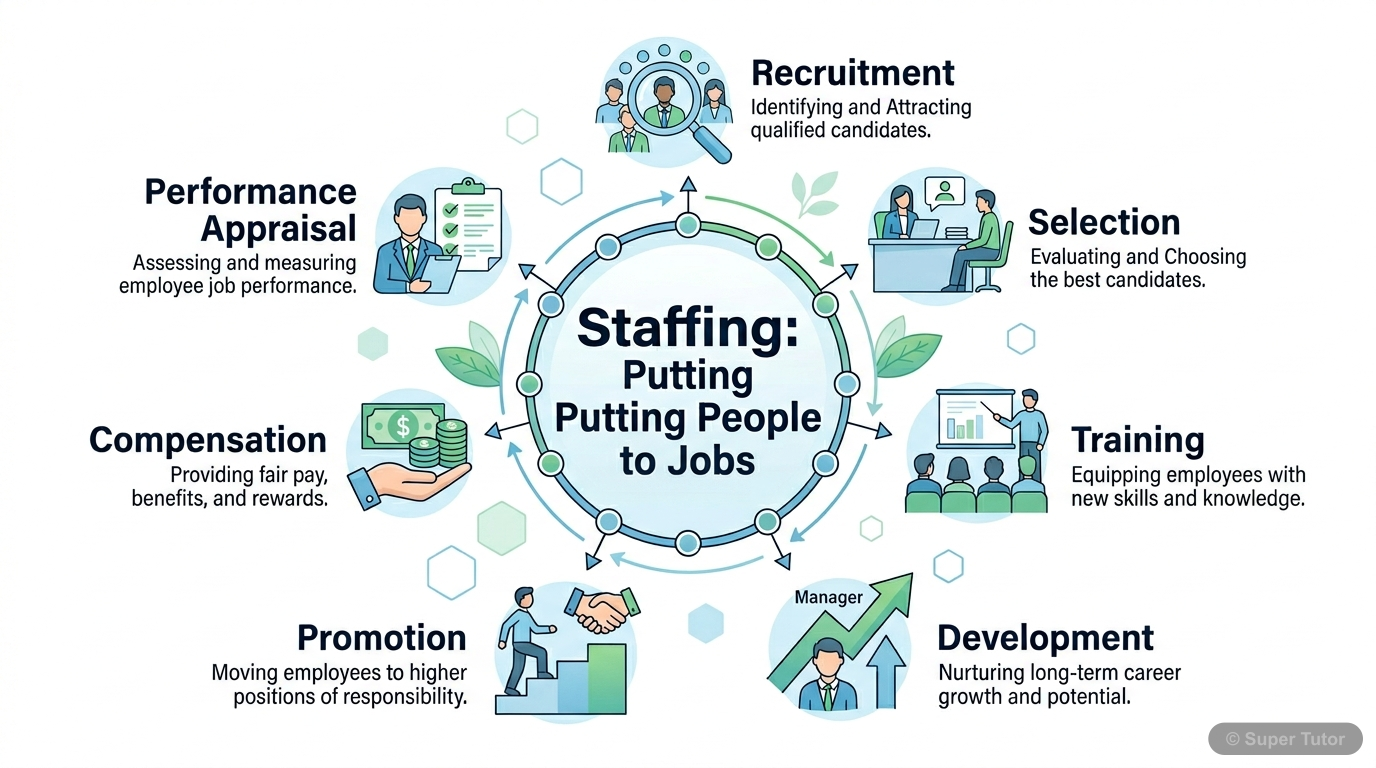
This is just one of 14+ visuals inside Super Tutor's Staffing chapter
Explore the full setVery Short Answer Type
1What is meant by staffing?Show solution
Staffing is the managerial function of filling and keeping filled the positions in an organisation structure. It involves identifying the requirement of the workforce, followed by recruitment, selection, placement, promotion, appraisal and development of personnel to fill the roles designed into the organisation structure.
In simple words, staffing means putting the right person at the right job at the right time. It ensures that the organisation has the required number of employees with the required qualifications and skills to achieve its objectives.
2State the two important sources of recruitment.Show solution
1. Internal Sources: Recruitment from within the organisation. It includes:
- Transfer: Moving an employee from one job, department or location to another.
- Promotion: Upgrading an employee to a higher position with greater responsibilities, better pay and status.
2. External Sources: Recruitment from outside the organisation. It includes direct recruitment, advertisements, employment exchanges, campus recruitment, placement agencies, web publishing, etc.
Internal sources are generally preferred as they are more economical and motivating for existing employees.
3The workers of a factory are unable to work on new machines and always demand for help of supervisor. The Supervisor is overburdened with their frequent calls. Suggest the remedy. (Hint: training)Show solution
Remedy: Training
The management should provide proper training to the workers, specifically:
- On-the-Job Training such as Coaching or Job Rotation can be used, where the supervisor or an expert guides workers on how to operate the new machines.
- Vestibule Training can also be used, where workers are trained on similar machines in a separate training area before working on the actual shop floor.
Benefits of this remedy:
- Workers will become self-sufficient in operating new machines.
- The supervisor will be relieved of frequent interruptions.
- Productivity and efficiency of the factory will improve.
- It will reduce errors and wastage in production.
4The quality of production is not as per standards. On investigation it was observed that most of the workers were not fully aware of the proper operation of the machinery. What could be the way to improve the quality of production to meet the standards? (training)Show solution
Solution: Training
The management should arrange proper training programmes for the workers to improve their knowledge and skills regarding the operation of machinery.
The following training methods can be adopted:
1. Apprenticeship Training: Workers can be trained under experienced operators to learn the correct method of operating machinery.
2. Vestibule Training: Workers can be trained on similar machines in a separate training room before working on the actual production floor.
3. Coaching: A supervisor or expert can personally guide each worker on the correct operation of machinery.
Impact:
- Workers will learn the correct method of operating machinery.
- Quality of production will improve and meet the required standards.
- Wastage and defects will be reduced.
- Overall efficiency and productivity of the organisation will increase.
5The workers of a factory remain idle because of lack of knowledge of hi-tech machines. Frequent visit of engineer is made which causes high overhead charges. How can this problem be removed. (vestibule training)Show solution
Solution: Vestibule Training
Vestibule Training is the most appropriate method to resolve this problem.
Meaning: In vestibule training, employees learn their jobs on the equipment they will be using, but the training is conducted away from the actual work floor. Actual work environments are created in a classroom and employees use the same materials, files and equipment.
How it helps:
- Workers will be trained on hi-tech machines in a simulated environment before they actually start working on the shop floor.
- Once trained, workers will be able to operate the machines independently without requiring the engineer's assistance.
- This will eliminate idle time of workers.
- Frequent visits of engineers will no longer be required, thereby reducing overhead charges significantly.
- Productivity and efficiency of the factory will improve.
Short Answer Type
1What is meant by recruitment? How is it different from selection?Show solution
Recruitment may be defined as the process of searching for prospective employees and stimulating them to apply for jobs in the organisation. It is a positive process as it aims at increasing the number of applicants so that the best candidate can be selected.
Meaning of Selection:
Selection is the process of choosing from among the pool of prospective job candidates developed at the stage of recruitment. It is a negative process as it involves rejection of unsuitable candidates.
Differences between Recruitment and Selection:
| Basis | Recruitment | Selection |
|---|---|---|
| Meaning | Process of searching for prospective employees and stimulating them to apply | Process of choosing the most suitable candidate from the applicants |
| Nature | Positive process (encourages more applications) | Negative process (involves rejection of candidates) |
| Objective | To create a large pool of applicants | To choose the best candidate from the pool |
| Sequence | Precedes selection | Follows recruitment |
| Cost | Less expensive | More expensive |
| Process | Simple process | Complex and lengthy process |
| Contract | No contractual relationship is created | Creates a contractual relationship between employer and employee |
2An organisation provides security services. It requires such candidates who are reliable and don't leak out the secrets of their clients. What steps should be incorporated in selection process?Show solution
The following steps should be incorporated in the selection process:
1. Preliminary Screening: Initial screening of applications to eliminate obviously unsuitable candidates and shortlist those who meet the basic requirements of reliability and integrity.
2. Selection Tests:
- Personality Tests: To assess the character, integrity, emotional stability and reliability of candidates. This is crucial for a security services organisation.
- Intelligence Tests: To assess the mental ability and judgement of candidates.
- Interest Tests: To determine whether the candidate has genuine interest in security-related work.
3. Employment Interview: A thorough interview should be conducted to assess the candidate's attitude, values, commitment to confidentiality and reliability.
4. Reference and Background Checks: This is the most critical step for a security services organisation. Thorough background verification should be done including:
- Verification of past employment records
- Criminal background check
- Character verification from previous employers
- Verification of personal references
5. Medical Examination: To ensure the candidate is physically and mentally fit for security duties.
6. Selection Decision and Job Offer: Based on all the above steps, the most reliable and trustworthy candidate should be selected.
Conclusion: Special emphasis should be placed on personality tests, background checks and reference checks to ensure that only reliable and trustworthy candidates are selected.
3A company is manufacturing paper plates and bowls. It produces 1,00,000 plates and bowls each day. Due to local festival, it got an urgent order of extra 50,000 plates and bowls. Explain the method of recruitment that the company should adopt in the given circumstances to meet the order.Show solution
Recommended Method of Recruitment: Labour Contractors / Direct Recruitment at Factory Gate
The company should adopt the method of Labour Contractors or Direct Recruitment (Gate Hiring) for the following reasons:
Labour Contractors:
- Labour contractors maintain a database of unskilled and semi-skilled workers who can be deployed at short notice.
- Since the requirement is temporary (only for the festival period), labour contractors can provide workers quickly without lengthy recruitment procedures.
- The contractor takes responsibility for the workers, reducing the administrative burden on the company.
- Workers can be hired for a short period and released once the order is fulfilled.
Direct Recruitment (Gate Hiring):
- A notice can be put up at the factory gate inviting unskilled workers to apply directly.
- This is a quick and inexpensive method suitable for urgent and temporary requirements.
- Since manufacturing paper plates and bowls does not require highly skilled workers, unskilled or semi-skilled workers can be easily trained and deployed.
Why these methods are suitable:
- The requirement is temporary (only for the festival period).
- The requirement is urgent (immediate deployment needed).
- The job requires unskilled/semi-skilled workers.
- These methods are quick and economical.
Conclusion: Labour contractors or direct recruitment at the factory gate are the most appropriate methods as they provide quick access to temporary workers at low cost.
4Distinguish between training and development.Show solution
| Basis | Training | Development |
|---|---|---|
| Meaning | Training is the process by which the aptitudes, skills and abilities of employees to perform specific jobs are increased. | Development refers to the learning opportunities designed to help employees grow overall. |
| Objective | To improve the performance of employees in their current job. | To prepare employees for future roles and responsibilities. |
| Focus | Job-oriented; focuses on specific skills needed for a particular job. | Career-oriented; focuses on overall growth and personality development. |
| Scope | Narrow in scope; limited to specific skills. | Wider in scope; covers overall knowledge, attitude and personality. |
| Duration | Short-term process. | Long-term process. |
| Target Group | Mainly for operative/lower-level employees. | Mainly for managerial/executive-level employees. |
| Nature | Reactive in nature (addresses current skill gaps). | Proactive in nature (prepares for future challenges). |
| Outcome | Improvement in job performance. | Overall growth and readiness for higher responsibilities. |
5Why are internal sources of recruitment considered to be more economical?Show solution
1. No Advertising Cost: When vacancies are filled from within the organisation through transfers or promotions, there is no need to advertise the job in newspapers, websites or other media. This saves significant advertising expenditure.
2. No Placement Agency Fees: The organisation does not need to pay fees to placement agencies, management consultants or employment exchanges when recruiting internally.
3. Reduced Selection Costs: The selection process is simpler and less expensive as the organisation already has detailed information about the existing employees — their performance records, skills, qualifications and behaviour.
4. No Induction/Orientation Costs: Existing employees are already familiar with the organisation's culture, policies, rules and working environment. Therefore, there is no need to spend on elaborate induction or orientation programmes.
5. Reduced Training Costs: Employees recruited internally are already trained and experienced in the organisation's systems and processes. They require little or no additional training for the new role.
6. Less Time and Effort: The process of identifying and selecting candidates from within the organisation takes less time and administrative effort compared to external recruitment.
Conclusion: Since internal recruitment eliminates costs related to advertising, placement agencies, induction and training, it is considered a more economical source of recruitment compared to external sources.
6'No organisation can be successful unless it fills and keeps the various positions filled with the right kind of people for the right job.' Elucidate.Show solution
This statement highlights the critical importance of the staffing function in an organisation. The following points elucidate this statement:
1. Achievement of Organisational Goals: An organisation can achieve its goals only when the right people are placed at the right positions. Qualified and competent employees contribute effectively towards the achievement of organisational objectives.
2. Optimum Utilisation of Resources: When the right person is placed at the right job, they can utilise physical and financial resources most efficiently, thereby reducing wastage and improving productivity.
3. Improved Performance and Productivity: Employees who are well-suited for their jobs perform better, leading to higher productivity and quality of output. This directly contributes to the success of the organisation.
4. Employee Satisfaction and Motivation: When employees are placed in jobs that match their skills, qualifications and interests, they feel satisfied and motivated. This reduces absenteeism and employee turnover.
5. Competitive Advantage: In today's competitive environment, the quality of human resources is a key differentiator. Organisations with the right people at the right positions gain a competitive edge over rivals.
6. Adaptability to Change: Properly staffed organisations can adapt more easily to technological changes, market changes and other environmental challenges because their employees are competent and well-trained.
7. Continuity of Operations: Keeping positions filled at all times ensures that there are no gaps in operations. Vacancies lead to disruption of work and loss of productivity.
Conclusion: Staffing is the backbone of an organisation. Without the right people at the right positions, even the best plans, strategies and resources cannot lead to success. Therefore, the statement is absolutely correct — effective staffing is essential for organisational success.
Long Answer Type
1'Human resource management includes many specialized activities and duties.' Explain.Show solution
Human Resource Management (HRM) is the process of managing people in organisations in a structured and thorough manner. It has replaced the traditional concept of labour welfare and personnel management. HRM includes many specialised activities and duties, which are explained below:
1. Manpower Planning (Workforce Planning):
HRM involves estimating the present and future manpower requirements of the organisation. It includes workload analysis (how many people are needed for each job) and workforce analysis (how many people are currently available). This ensures that the organisation has the right number of people at the right time.
2. Recruitment:
HRM is responsible for searching for prospective employees and stimulating them to apply for jobs in the organisation. It identifies and uses various sources of recruitment — both internal (transfers, promotions) and external (advertisements, campus recruitment, placement agencies, etc.).
3. Selection:
HRM conducts the selection process to choose the most suitable candidates from the pool of applicants. This involves preliminary screening, selection tests, interviews, background checks, medical examination and issuing job offers.
4. Placement and Orientation:
After selection, HRM is responsible for placing the employee in the appropriate position and conducting orientation programmes to familiarise the new employee with the organisation's culture, policies, rules and colleagues.
5. Training and Development:
HRM identifies training needs and organises training programmes to improve the skills, knowledge and abilities of employees. It also plans development programmes to prepare employees for future roles and responsibilities.
6. Performance Appraisal:
HRM evaluates the performance of employees against set standards. It provides feedback to employees and helps in identifying areas of improvement. Performance appraisal is used for decisions related to promotions, increments and transfers.
7. Compensation and Remuneration:
HRM is responsible for designing and administering the pay structure, including wages, salaries, bonuses, incentives and other monetary benefits. It ensures that the compensation is fair, competitive and motivating.
8. Employee Welfare and Benefits:
HRM manages employee welfare activities such as health and safety measures, medical facilities, housing, canteen, recreational facilities, etc. It also administers employee benefits like provident fund, gratuity, insurance, etc.
9. Promotion, Transfer and Separation:
HRM manages the movement of employees within the organisation through promotions and transfers. It also handles employee separation through retirement, resignation, retrenchment or dismissal.
10. Maintaining Industrial Relations:
HRM acts as a link between management and workers. It handles grievances, resolves conflicts and maintains harmonious industrial relations. It also deals with trade unions and collective bargaining.
11. Maintaining Records:
HRM maintains detailed records of all employees including their qualifications, experience, performance, attendance, salary, etc. These records are essential for decision-making.
Conclusion: HRM is a comprehensive and specialised function that goes far beyond simple hiring and firing. It encompasses all activities related to managing people in an organisation — from recruitment to retirement — and plays a crucial role in achieving organisational goals.
2Explain the procedure for selection of employees.Show solution
Selection is the process of choosing the most suitable candidate from the pool of applicants developed during recruitment. It is a negative process as it involves rejection of unsuitable candidates. The selection procedure involves the following steps:
Step 1: Preliminary Screening
- The first step is to screen the applications received to eliminate obviously unsuitable candidates.
- The HR manager reviews the application forms/CVs to check whether the candidates meet the basic eligibility criteria (qualifications, experience, age, etc.).
- Candidates who do not meet the minimum requirements are rejected at this stage.
- This saves time and effort in the subsequent steps.
Step 2: Selection Tests
Candidates who pass the preliminary screening are called for selection tests. These include:
- (a) Intelligence Tests: Measure the mental ability, reasoning power and problem-solving ability of candidates.
- (b) Aptitude Tests: Measure the potential of a candidate to learn new skills required for the job.
- (c) Personality Tests: Assess the character, temperament, emotional stability, leadership qualities and interpersonal skills of candidates.
- (d) Trade Tests: Test the existing knowledge and skills of candidates in a specific trade or field.
- (e) Interest Tests: Identify the areas of interest of candidates to determine whether they are genuinely interested in the job.
Step 3: Employment Interview
- The interview is a formal, in-depth conversation between the interviewer and the candidate.
- It helps in assessing the candidate's communication skills, personality, attitude, knowledge and suitability for the job.
- It also gives the candidate an opportunity to know more about the job and the organisation.
- Types of interviews include structured, unstructured, panel and stress interviews.
Step 4: Reference and Background Checks
- The organisation verifies the information provided by the candidate in the application form.
- References provided by the candidate (previous employers, teachers, etc.) are contacted to verify the candidate's character, conduct and past performance.
- Background checks may include verification of educational qualifications, previous employment and criminal records.
Step 5: Selection Decision
- Based on the results of tests, interviews and background checks, the HR manager and the concerned departmental head make the final selection decision.
- The most suitable candidate is chosen for the job.
Step 6: Medical Examination
- The selected candidate is required to undergo a medical examination to ensure that they are physically and mentally fit for the job.
- This step helps in preventing the appointment of a person who is medically unfit and may be a liability to the organisation.
Step 7: Job Offer
- After successful completion of the medical examination, a formal job offer (appointment letter) is made to the selected candidate.
- The appointment letter specifies the designation, salary, terms and conditions of employment and the date of joining.
Step 8: Contract of Employment
- Once the candidate accepts the job offer, a formal contract of employment is signed between the employer and the employee.
- The contract contains details of the job, salary, working hours, leave entitlement, notice period and other terms and conditions.
Conclusion: The selection procedure is a systematic and comprehensive process designed to identify and appoint the most suitable candidate for a job. Each step is important and helps in ensuring that the right person is selected for the right job.
3What are the advantages of training to the individual and to the organisation?Show solution
Training is any process by which the aptitudes, skills and abilities of employees to perform specific jobs are increased. It benefits both the individual employee and the organisation.
## A. Advantages of Training to the Individual Employee:
1. Improved Skills and Knowledge:
Training helps employees acquire new skills and update their existing knowledge. This makes them more competent and efficient in performing their jobs.
2. Higher Earnings:
Trained employees are more productive and efficient. This leads to better performance appraisals, which in turn results in higher salaries, bonuses and incentives.
3. Career Advancement:
Training prepares employees for higher responsibilities and positions. It enhances their career prospects and opens up opportunities for promotion.
4. Increased Job Satisfaction and Morale:
When employees are trained and feel competent in their jobs, they experience greater job satisfaction. This boosts their morale and motivation.
5. Greater Safety:
Training teaches employees the correct methods of operating machinery and equipment, thereby reducing the risk of accidents and injuries at the workplace.
6. Reduced Supervision:
Trained employees are self-sufficient and require less supervision. This gives them greater independence and confidence in their work.
7. Adaptability:
Training helps employees adapt to new technologies, methods and changes in the work environment. This makes them more versatile and valuable to the organisation.
## B. Advantages of Training to the Organisation:
1. Increased Productivity:
Trained employees work more efficiently and produce better quality output. This leads to increased productivity and profitability for the organisation.
2. Reduced Wastage:
Training helps employees learn the correct methods of doing their jobs, which reduces errors, defects and wastage of materials and resources.
3. Reduced Supervision Costs:
Trained employees require less supervision, which reduces the supervisory burden and associated costs.
4. Reduced Accidents:
Proper training on safety procedures and correct operation of machinery reduces the frequency of workplace accidents, thereby reducing costs related to accidents and compensation.
5. Reduced Employee Turnover:
When employees are trained and feel valued by the organisation, they are more satisfied and less likely to leave. This reduces employee turnover and the associated costs of recruitment and selection.
6. Better Adaptability to Change:
A trained workforce can adapt more easily to technological changes, new products and changing market conditions. This gives the organisation a competitive advantage.
7. Improved Organisational Image:
Organisations that invest in training are seen as good employers. This enhances the organisation's reputation and helps in attracting talented candidates.
8. Fulfils Future Manpower Needs:
Training and development programmes prepare employees for future roles and responsibilities, ensuring that the organisation has a ready pool of talent for higher positions.
Conclusion: Training is a win-win investment — it benefits both the individual employee (in terms of skills, earnings and career growth) and the organisation (in terms of productivity, efficiency and competitive advantage).
4Kaul Consultants have launched www.naukaripao.com exclusively for senior management professionals. The portal lists out senior level jobs and ensures that the job is genuine through rigorous screening process.
a. State the source of recruitment highlighted in the case above.
b. State four benefits of the above identified source of recruitment.Show solution
Part (a): Source of Recruitment Highlighted:
The source of recruitment highlighted in the above case is External Source of Recruitment, specifically:
1. Web Publishing / E-Recruitment (the portal www.naukaripao.com is an online job portal)
2. Placement Agencies and Management Consultants (Kaul Consultants is acting as a management consultancy/placement agency for senior management professionals)
Thus, the source is Placement Agencies / Management Consultants using Web Publishing.
---
Part (b): Four Benefits of Placement Agencies / Management Consultants as a Source of Recruitment:
1. Access to Specialised Talent:
Placement agencies and management consultants maintain a database of highly qualified and experienced professionals. They can quickly identify and provide candidates with specialised skills required for senior management positions, which may be difficult to find through other sources.
2. Saves Time and Effort:
The agency handles the entire process of searching, screening and shortlisting candidates. This saves the organisation considerable time and effort that would otherwise be spent on advertising, receiving applications and conducting preliminary screening.
3. Quality Candidates:
As mentioned in the case, the portal ensures that the jobs listed are genuine through a rigorous screening process. Similarly, the candidates referred by management consultants are pre-screened and verified, ensuring that only quality candidates are presented to the organisation.
4. Confidentiality:
When an organisation wants to fill a senior position without making it public (to avoid internal politics or to replace an existing employee), management consultants can conduct the search confidentially. This protects the organisation's interests.
5. Wide Reach:
Web-based portals like www.naukaripao.com have a wide reach and can attract candidates from across the country and even internationally. This gives the organisation access to a larger pool of qualified candidates.
*(Note: Any four of the above benefits are sufficient for the answer.)*
5A company, Xylo limited, is setting up a new plant in India for manufacturing auto components. India is a highly competitive and cost effective production base in this sector. Many reputed car manufacturers source their auto components from here. Xylo limited is planning to capture about 40% of the market share in India and also export to the tune of at least ₹ 50 crores in about 2 years of its planned operations. To achieve these targets it requires a highly trained and motivated work force.
a. Outline the process of staffing the company should follow.
b. Which sources of recruitment the company should rely upon. Give reasons for your recommendation.
c. Outline the process of selection the company should follow with reasons.Show solution
---
Part (a): Process of Staffing Xylo Limited Should Follow:
Since Xylo Limited is a new company setting up a new plant, it should follow the complete staffing process as outlined below:
Step 1: Estimating Manpower Requirements:
- Conduct a workload analysis to determine the number and type of employees needed for each department (production, quality control, marketing, finance, HR, etc.).
- Conduct a workforce analysis to assess what skills are available and what gaps need to be filled.
- Since the company is new, all positions will need to be filled from external sources.
Step 2: Recruitment:
- Identify and use appropriate sources of recruitment (both internal and external) to attract qualified candidates for various positions — from shop floor workers to senior managers.
Step 3: Selection:
- Conduct a systematic selection process including screening, tests, interviews, background checks and medical examination to choose the most suitable candidates.
Step 4: Placement and Orientation:
- Place selected employees in appropriate positions.
- Conduct orientation programmes to familiarise new employees with the company's vision, mission, policies, culture and their specific roles.
Step 5: Training and Development:
- Since the company requires a highly trained workforce for manufacturing sophisticated auto components, extensive training programmes must be conducted.
- On-the-job training (apprenticeship, coaching) and off-the-job training (vestibule training, classroom lectures) should be used.
Step 6: Performance Appraisal:
- Establish a performance appraisal system to regularly evaluate employee performance against set standards.
- Use appraisal results for decisions on promotions, increments and further training needs.
Step 7: Compensation and Motivation:
- Design a competitive compensation package to attract and retain talented employees.
- Implement motivational programmes to keep the workforce motivated and committed to achieving the company's targets.
---
Part (b): Sources of Recruitment Xylo Limited Should Rely Upon:
Since Xylo Limited is a new company with no existing employees, it must rely entirely on External Sources of Recruitment. The recommended sources are:
1. Campus Recruitment:
- For technical positions (engineers, quality control specialists), the company should recruit fresh graduates from engineering colleges and technical institutes.
- *Reason:* Fresh graduates are enthusiastic, can be trained as per company requirements and are cost-effective.
2. Placement Agencies and Management Consultants:
- For senior management positions (plant manager, finance manager, marketing manager), the company should use management consultants.
- *Reason:* Management consultants have access to experienced professionals and can quickly identify suitable candidates for senior roles.
3. Advertisements (Print and Web):
- For middle-level positions, the company should advertise in newspapers, industry journals and job portals.
- *Reason:* Advertisements reach a large number of potential candidates and help in building the company's brand as an employer.
4. Web Publishing / E-Recruitment:
- The company should post job openings on popular job portals like Naukri.com, LinkedIn, etc.
- *Reason:* Online recruitment is cost-effective, has wide reach and allows quick processing of applications.
5. Labour Contractors:
- For unskilled and semi-skilled workers on the shop floor, labour contractors can be used.
- *Reason:* Labour contractors can quickly provide a large number of workers, which is essential for setting up a new plant.
---
Part (c): Process of Selection Xylo Limited Should Follow:
Given that Xylo Limited requires a highly trained and motivated workforce for a competitive sector, the following rigorous selection process should be followed:
Step 1: Preliminary Screening:
- Screen all applications to shortlist candidates who meet the minimum qualifications and experience requirements for each position.
- *Reason:* Eliminates obviously unsuitable candidates and saves time.
Step 2: Selection Tests:
- Intelligence Tests: To assess problem-solving and analytical ability — important for engineers and managers.
- Aptitude Tests: To assess the potential to learn technical skills related to auto component manufacturing.
- Trade Tests: To assess existing technical knowledge and skills of candidates applying for technical positions.
- Personality Tests: To assess leadership, teamwork and interpersonal skills — important for managerial positions.
- *Reason:* Tests provide objective assessment of candidates' abilities and suitability.
Step 3: Employment Interview:
- Conduct structured panel interviews for all positions.
- For senior positions, multiple rounds of interviews should be conducted.
- *Reason:* Interviews help assess communication skills, attitude, technical knowledge and cultural fit.
Step 4: Reference and Background Checks:
- Verify educational qualifications, previous employment records and references provided by candidates.
- *Reason:* Ensures authenticity of information provided and assesses past performance and conduct.
Step 5: Selection Decision:
- Based on test results, interview performance and background checks, select the most suitable candidates.
- *Reason:* Ensures that only the best candidates are chosen.
Step 6: Medical Examination:
- All selected candidates must undergo a thorough medical examination.
- *Reason:* Auto component manufacturing involves working with heavy machinery. Physical fitness is essential for safety and productivity.
Step 7: Job Offer and Contract of Employment:
- Issue formal appointment letters specifying designation, salary, terms and conditions.
- Sign a formal contract of employment.
- *Reason:* Creates a legal and formal relationship between the employer and employee.
Conclusion: By following this comprehensive staffing, recruitment and selection process, Xylo Limited can build a highly competent, trained and motivated workforce capable of achieving its ambitious targets of 40% market share and ₹50 crores in exports within 2 years.
6A major insurance company handled all recruiting, screening and training processes for data entry/customer service representatives. Their competitor was attracting most of the qualified, potential employees in their market. Recruiting was made even more difficult by the strong economy and the 'jobseeker's market.' This resulted in the client having to choose from candidates who had the 'soft' skills needed for the job, but lacked the proper 'hard' skills and training.
a. As an HR manager what problems do you see in the company?
b. How do you think it can be resolved and what would be its impact on the company?Show solution
---
Part (a): Problems Identified in the Company:
1. Ineffective Recruitment Strategy:
- The company is unable to attract qualified candidates because its competitor is offering better opportunities. The company's recruitment strategy is not competitive enough to attract top talent.
2. Skill Gap in Selected Candidates:
- The company is being forced to select candidates who have soft skills (communication, attitude, interpersonal skills) but lack hard skills (technical knowledge, data entry skills, customer service expertise). This creates a significant skill gap.
3. Inadequate Training Programme:
- The company does not have an effective training programme to bridge the skill gap of newly hired employees who lack hard skills. This affects the quality of service provided.
4. Uncompetitive Employer Brand:
- The company is losing the talent war to its competitor. This suggests that the company's employer brand — its reputation as a place to work — is weaker than its competitor's.
5. Impact of External Environment (Jobseeker's Market):
- In a strong economy with a jobseeker's market, candidates have multiple options. The company is not offering sufficiently attractive compensation, benefits or growth opportunities to compete for talent.
6. Poor Workforce Planning:
- The company does not seem to have a proactive manpower planning strategy. It is reacting to vacancies rather than anticipating future needs and building a talent pipeline.
---
Part (b): How the Problems Can Be Resolved and Their Impact:
Resolution 1: Strengthen Recruitment Strategy
- The company should diversify its recruitment sources — use online job portals, social media (LinkedIn), campus recruitment and employee referral programmes.
- It should build a strong employer brand by highlighting career growth opportunities, work culture and employee benefits.
- *Impact:* The company will be able to attract a larger and better pool of candidates, reducing dependence on underqualified applicants.
Resolution 2: Implement Comprehensive Training Programmes
- Since the company is hiring candidates with soft skills but lacking hard skills, it should invest in robust training programmes to develop the required technical/hard skills.
- Methods like vestibule training, programmed instruction and on-the-job coaching can be used to train new employees in data entry and customer service skills.
- *Impact:* Employees will become fully competent in their roles, improving the quality of service and customer satisfaction.
Resolution 3: Offer Competitive Compensation and Benefits
- The company should review and improve its compensation packages, incentives and employee benefits to make them more competitive.
- *Impact:* This will help attract and retain qualified employees, reducing the advantage the competitor currently has.
Resolution 4: Proactive Workforce Planning
- The company should adopt a proactive approach to manpower planning — anticipating future needs and building a talent pipeline through internship programmes, campus recruitment and apprenticeships.
- *Impact:* The company will always have a ready pool of trained candidates, reducing the impact of a jobseeker's market.
Resolution 5: Employee Retention Strategies
- The company should focus on retaining existing employees through career development programmes, performance-based incentives and a positive work environment.
- *Impact:* Reduced employee turnover will lower recruitment costs and maintain organisational knowledge and expertise.
Overall Impact on the Company:
- Improved quality of workforce leading to better customer service.
- Reduced recruitment and training costs in the long run.
- Enhanced competitive position in the market.
- Higher employee satisfaction, motivation and productivity.
- Stronger employer brand attracting better talent.
7Ms. Jayshree recently completed her Post Graduate Diploma in Human Resource Management. A few months from now a large steel manufacturing company appointed her as its human resource manager. As of now, the company employs 800 persons and has an expansion plan in hand which may require another 200 persons for various types of additional requirements. Ms. Jayshree has been given complete charge of the company's Human Resource Department.
a. Point out, what functions is she supposed to perform?
b. What problems do you foresee in her job?
c. What steps is she going to take to perform her job efficiently?
d. How significant is her role in the organisation?Show solution
---
Part (a): Functions Ms. Jayshree is Supposed to Perform:
1. Manpower Planning:
- Assess current workforce (800 employees) and plan for the additional 200 employees required for expansion.
- Conduct workload analysis and workforce analysis to determine the number and type of employees needed.
2. Recruitment:
- Identify appropriate sources of recruitment (internal and external) to attract candidates for the 200 new positions.
- Use sources like campus recruitment, advertisements, placement agencies and web publishing.
3. Selection:
- Conduct the selection process including screening, tests, interviews, background checks and medical examination to choose the most suitable candidates.
4. Placement and Orientation:
- Place selected employees in appropriate positions.
- Conduct orientation programmes to familiarise new employees with the company's policies, culture and their roles.
5. Training and Development:
- Identify training needs of existing 800 employees and new recruits.
- Organise training programmes (on-the-job and off-the-job) to improve skills and performance.
- Plan development programmes for managerial staff.
6. Performance Appraisal:
- Design and implement a performance appraisal system to evaluate employee performance.
- Use appraisal results for decisions on promotions, increments, transfers and training needs.
7. Compensation and Benefits Management:
- Design and administer the pay structure, including wages, salaries, bonuses and benefits.
- Ensure compliance with labour laws regarding minimum wages, provident fund, gratuity, etc.
8. Employee Welfare:
- Manage employee welfare activities such as health and safety, medical facilities, canteen, housing, etc.
- Ensure a safe and healthy working environment (especially important in a steel manufacturing company).
9. Industrial Relations:
- Maintain harmonious relations between management and workers.
- Handle grievances, resolve conflicts and deal with trade unions.
10. Maintaining Records:
- Maintain detailed records of all 800 (and future 200) employees including qualifications, performance, attendance, salary, etc.
---
Part (b): Problems Ms. Jayshree May Face in Her Job:
1. Being a New and Young HR Manager:
- As a fresh post-graduate with limited practical experience, she may face a credibility challenge. Experienced employees may not readily accept her authority and decisions.
2. Managing a Large Workforce:
- Managing 800 existing employees (and planning for 200 more) is a complex task. Handling diverse personalities, skills and expectations is challenging.
3. Recruitment Challenges for Expansion:
- Finding 200 suitable candidates for a steel manufacturing company (which requires specific technical skills) may be difficult, especially in a competitive labour market.
4. Training and Skill Development:
- Steel manufacturing involves sophisticated machinery and processes. Ensuring that all employees (existing and new) are adequately trained is a major challenge.
5. Industrial Relations:
- Steel manufacturing companies often have strong trade unions. Managing industrial relations, handling grievances and preventing strikes/lockouts is a significant challenge.
6. Safety and Welfare:
- Steel manufacturing is a hazardous industry. Ensuring the safety and welfare of 800+ employees requires constant vigilance and robust safety programmes.
7. Resistance to Change:
- Existing employees may resist new HR policies, appraisal systems or training programmes introduced by Ms. Jayshree.
8. Compliance with Labour Laws:
- Ensuring compliance with various labour laws (Factories Act, Minimum Wages Act, Provident Fund Act, etc.) is complex and requires thorough knowledge.
---
Part (c): Steps Ms. Jayshree Should Take to Perform Her Job Efficiently:
1. Understand the Organisation:
- Thoroughly study the company's vision, mission, goals, structure, existing HR policies and the nature of the steel manufacturing business.
2. Conduct a Manpower Audit:
- Assess the current workforce of 800 employees — their skills, qualifications, performance levels and gaps. This will help in planning for the expansion.
3. Develop a Comprehensive HR Plan:
- Prepare a detailed HR plan covering recruitment, training, compensation, welfare and industrial relations for both existing employees and the 200 new recruits.
4. Build Relationships:
- Build positive relationships with existing employees, supervisors, managers and trade union representatives. This will help in gaining their trust and cooperation.
5. Implement Effective Recruitment and Selection:
- Use appropriate sources and methods to recruit and select the right candidates for the 200 new positions.
6. Design Training Programmes:
- Identify training needs and design effective training programmes (both on-the-job and off-the-job) to improve the skills of existing and new employees.
7. Establish a Fair Performance Appraisal System:
- Design and implement a transparent and fair performance appraisal system that motivates employees and helps in identifying high performers.
8. Ensure Legal Compliance:
- Stay updated with all relevant labour laws and ensure that the company complies with all legal requirements.
9. Focus on Employee Welfare and Safety:
- Given the hazardous nature of steel manufacturing, implement robust safety programmes and welfare measures to protect employees.
10. Continuous Learning:
- Stay updated with the latest developments in HRM through professional development, reading and networking with other HR professionals.
---
Part (d): Significance of Ms. Jayshree's Role in the Organisation:
1. Achieving Organisational Goals:
- By ensuring that the right people are recruited, trained and placed at the right positions, Ms. Jayshree directly contributes to the achievement of the company's production and expansion goals.
2. Managing the Most Valuable Resource:
- In a steel manufacturing company, human resources are the most valuable asset. Ms. Jayshree's role in managing, developing and retaining this asset is critical to the company's success.
3. Supporting Expansion:
- The company's expansion plan requires 200 additional employees. Ms. Jayshree's efficient handling of recruitment, selection and training will determine the success of this expansion.
4. Maintaining Industrial Harmony:
- By maintaining good industrial relations and handling grievances effectively, she ensures smooth and uninterrupted production operations.
5. Ensuring Safety and Welfare:
- In a hazardous industry like steel manufacturing, her role in ensuring employee safety and welfare is of paramount importance. This protects both employees and the company from accidents and legal liabilities.
6. Building Organisational Capability:
- Through training and development programmes, she builds the long-term capability of the organisation to adapt to technological changes and market challenges.
7. Enhancing Employee Motivation and Productivity:
- By designing fair compensation systems, appraisal systems and welfare programmes, she enhances employee motivation, satisfaction and productivity.
Conclusion: Ms. Jayshree's role as HR Manager is extremely significant. She is responsible for managing the organisation's most important resource — its people. Her effectiveness in performing HR functions will directly determine the company's ability to achieve its goals, expand successfully and maintain a competitive advantage in the steel manufacturing sector.
Stuck on a step?
Ask Super Tutor AI to explain any solution on this page in a simpler way — free, 24x7.
Ask a Doubt FreeFrequently Asked Questions
What are the important topics in Staffing for Karnataka Board Class 12 Business Studies?
How to score full marks in Staffing — Karnataka Board Class 12 Business Studies?
Where can I get free NCERT Solutions for Staffing Class 12 Business Studies?
Sources & Official References
- Karnataka SSLC — kseeb.kar.nic.in
- Dept of Pre-University Education, Karnataka
- National Education Policy 2020 — education.gov.in
Content is aligned to the official syllabus. Refer to the board website for the latest curriculum.
More resources for Staffing
Important Questions
Practice with board exam-style questions
Syllabus
What topics to cover
Revision Notes
Key points for last-minute revision
Study Plan
Step-by-step plan to ace this chapter
Flashcards
Quick-fire cards for active recall
Formula Sheet
All formulas in one place
Chapter Summary
Understand the chapter at a glance
Practice Quiz
Test yourself with a quick quiz
Concept Maps
See how topics connect visually
For serious students
Get the full Staffing chapter — for free.
Quizzes, flashcards, AI doubt-solver and a step-by-step study plan for Karnataka Board Class 12 Business Studies.