Chapter 4 of 10
NCERT Solutions

Alcohols, Phenols and Ethers

Karnataka Board · Class 12 · Chemistry

NCERT Solutions for Alcohols, Phenols and Ethers — Karnataka Board Class 12 Chemistry.

89 questions20 flashcards5 concepts

Interactive on Super Tutor

Studying Alcohols, Phenols and Ethers? Get the full interactive chapter.

Quizzes, flashcards, AI doubt-solver and a step-by-step study plan — built for ncert solutions and more.

1,000+ Class 12 students started this chapter today

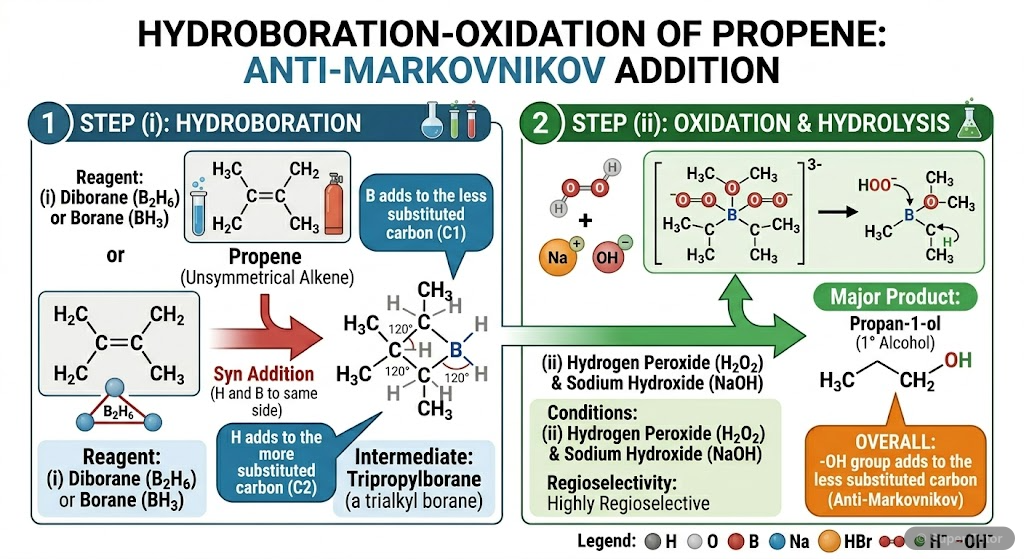
A reaction scheme showing the hydroboration-oxidation of an alkene (e.g., propene) to form an alcohol, highlighting the anti-Markownikov addition.
Super Tutor

Super Tutor has 32+ illustrations like this for Alcohols, Phenols and Ethers alone — flashcards, concept maps, and step-by-step visuals.

See them all
45 Questions Solved · 2 Sections

Intext Questions

7.1Classify the following as primary, secondary and tertiary alcohols: (i) CH₃C(CH₃)₂CH₂OH (ii) H₂C=CH–CH₂OH (iii) CH₃–CH₂–CH₂–OH (iv) CH–CH₃ (secondary cyclohexanol type) (v) CH₂–CH–CH₃ (vi) CH=CH–C–OH (tertiary allylic)Show solution
Given: Various alcohol structures to classify.

Concept: An alcohol is classified based on the number of carbon atoms directly attached to the carbon bearing the –OH group.
- Primary (1°): –OH on a carbon attached to only one other carbon (or no carbon).
- Secondary (2°): –OH on a carbon attached to two other carbons.
- Tertiary (3°): –OH on a carbon attached to three other carbons.

(i) CH3CCH3CH3CH2OH\mathrm{CH_3-\underset{CH_3}{\overset{CH_3}{C}}-CH_2OH}

The –OH group is on CH2-CH_2-, which is attached to only one carbon (the quaternary carbon). Hence it is a Primary alcohol.

(ii) H2C=CHCH2OH\mathrm{H_2C=CH-CH_2OH}

The –OH group is on CH2-CH_2-, which is attached to only one carbon (the vinylic CHCH). Hence it is a Primary alcohol (also an allylic alcohol).

(iii) CH3CH2CH2OH\mathrm{CH_3-CH_2-CH_2-OH}

The –OH group is on the terminal CH2-CH_2-, attached to only one carbon. Hence it is a Primary alcohol.

(iv) The structure represents a secondary alcohol where –OH is on a carbon bearing two other carbon groups (e.g., CH3CHOHCH3\mathrm{CH_3-\underset{OH}{CH}-CH_3}). Hence it is a Secondary alcohol.

(v) The structure CH2CHCH3\mathrm{CH_2-CH-CH_3} with –OH on the middle carbon represents a Secondary alcohol.

(vi) CH=CHCOH\mathrm{CH=CH-\underset{OH}{C}-} where the carbon bearing –OH is attached to three carbons. Hence it is a Tertiary alcohol (also an allylic alcohol).

Summary:
| Compound | Classification |
|---|---|
| (i) | Primary |
| (ii) | Primary |
| (iii) | Primary |
| (iv) | Secondary |
| (v) | Secondary |
| (vi) | Tertiary |
7.2Identify allylic alcohols in the above examples (Question 7.1).Show solution
Concept: An allylic alcohol is one in which the –OH group is present on a carbon adjacent to a carbon–carbon double bond (C=C), i.e., the –OH bearing carbon is allylic.

From the examples in Question 7.1:

- (ii) H2C=CHCH2OH\mathrm{H_2C=CH-CH_2OH}: The –OH is on the carbon next to the double bond. This is an allylic alcohol.

- (vi) CH=CHC(OH)\mathrm{CH=CH-C(OH)-}: The –OH bearing carbon is directly adjacent to the double bond. This is also an allylic alcohol.

Answer: Compounds (ii) and (vi) are allylic alcohols.
7.3Name the following compounds according to IUPAC system: (i) CH₃–CH₂–CH–CH–CH–CH₃ (with substituents) (ii) CH₃–CH–CH₂–CH–CH–CH₃ (with substituents) (iv) H₂C=CH–CH–CH₂–CH₂–CH₃ (v) CH₃–C≡C–CH₂OHShow solution
Concept: IUPAC nomenclature rules — select the longest carbon chain containing the principal functional group (–OH), number from the end nearest to –OH, and name substituents with appropriate prefixes.

(i) Structure: CH3CH2CHClCHCH3CHOHCH3\mathrm{CH_3-CH_2-\underset{Cl}{CH}-\underset{CH_3}{CH}-\underset{OH}{CH}-CH_3} (based on context from Example 7.1)

Longest chain = 6 carbons; –OH at C-2, –CH₃ at C-3, –Cl at C-4.

IUPAC Name: 4-Chloro-3-methylhexan-2-ol\textbf{IUPAC Name: 4-Chloro-3-methylhexan-2-ol}

(ii) Structure: CH3CHOHCH2CHOHCHC2H5CH3\mathrm{CH_3-\underset{OH}{CH}-CH_2-\underset{OH}{CH}-\underset{C_2H_5}{CH}-CH_3}

Longest chain = 6 carbons; –OH groups at C-2 and C-4, –C₂H₅ at C-4 (or as appropriate).

IUPAC Name: 4-Ethylhexane-2,4-diol\textbf{IUPAC Name: 4-Ethylhexane-2,4-diol}

(iii) (Image-based — assumed to be a cyclic compound with –OH)

Based on standard NCERT content, this is likely 2-methylcyclohexan-1-ol or similar. *(Structure depends on figure; solve as per visible data.)*

(iv) H2C=CHCHOHCH2CH2CH3\mathrm{H_2C=CH-\underset{OH}{CH}-CH_2-CH_2-CH_3}

Longest chain containing both –OH and C=C = 6 carbons; number from the –OH end: –OH at C-1, C=C between C-5 and C-6 (or number to give lowest locants).

Numbering from the double-bond end: C=C at C-1,2; –OH at C-3.

IUPAC Name: hex-1-en-3-ol\textbf{IUPAC Name: hex-1-en-3-ol}

(v) CH3CCCH2OH\mathrm{CH_3-C\equiv C-CH_2OH}

Longest chain = 4 carbons; –OH at C-1, triple bond at C-2,3.

IUPAC Name: but-2-yn-1-ol\textbf{IUPAC Name: but-2-yn-1-ol}
7.4Show how are the following alcohols prepared by the reaction of a suitable Grignard reagent on methanal? (i) CH₃–CH(CH₃)–CH₂OH (ii) C₆H₅CH₂OH (benzyl alcohol)Show solution
Concept: Grignard reagent (R–MgX) reacts with methanal (HCHO) to give, after hydrolysis, a primary alcohol with one more carbon than the Grignard reagent.

RMgX+HCHOdryetherRCH2OMgXH3O+RCH2OH\mathrm{R-MgX + HCHO \xrightarrow{dry\,ether} R-CH_2-OMgX \xrightarrow{H_3O^+} R-CH_2OH}

(i) Target alcohol: (CH3)2CHCH2OH\mathrm{(CH_3)_2CH-CH_2OH} (2-methylpropan-1-ol)

Required Grignard reagent: (CH3)2CHMgBr\mathrm{(CH_3)_2CH-MgBr} (isopropylmagnesium bromide)

(CH3)2CHMgBr+HCHO1.dryether2.H3O+(CH3)2CHCH2OH\mathrm{(CH_3)_2CH-MgBr + HCHO \xrightarrow{1.\,dry\,ether}{2.\,H_3O^+} (CH_3)_2CH-CH_2OH}

Product: 2-methylpropan-1-ol\textbf{Product: 2-methylpropan-1-ol}

(ii) Target alcohol: C6H5CH2OH\mathrm{C_6H_5-CH_2OH} (benzyl alcohol / phenylmethanol)

Required Grignard reagent: C6H5MgBr\mathrm{C_6H_5-MgBr} (phenylmagnesium bromide)

C6H5MgBr+HCHO1.dryether2.H3O+C6H5CH2OH\mathrm{C_6H_5MgBr + HCHO \xrightarrow{1.\,dry\,ether}{2.\,H_3O^+} C_6H_5-CH_2OH}

Product: Phenylmethanol (Benzyl alcohol)\textbf{Product: Phenylmethanol (Benzyl alcohol)}
7.5Write structures of the products of the following reactions: (i) CH₃–CH=CH₂ with H₂O/H⁺ (ii) CH₃–CH₂–CH(Et)–CHO with NaBH₄ (iii) CH₃–CH₂–CH(Et)–CHO with NaBH₄Show solution
Concept:
- Acid-catalysed hydration of alkenes follows Markovnikov's rule — –OH adds to the more substituted carbon.
- NaBH4\mathrm{NaBH_4} is a mild reducing agent that reduces aldehydes and ketones to alcohols.

(i) CH3CH=CH2H2O/H+\mathrm{CH_3-CH=CH_2 \xrightarrow{H_2O/H^+}}

By Markovnikov's rule, –OH adds to C-2 (more substituted):

CH3CH=CH2H2O/H+CH3CHOHCH3\mathrm{CH_3-CH=CH_2 \xrightarrow{H_2O/H^+} CH_3-\underset{OH}{CH}-CH_3}

Product: Propan-2-ol\textbf{Product: Propan-2-ol}

(ii) & (iii) CH3CH2CH(C2H5)CHONaBH4\mathrm{CH_3-CH_2-CH(C_2H_5)-CHO \xrightarrow{NaBH_4}}

NaBH4\mathrm{NaBH_4} reduces the aldehyde (–CHO) to a primary alcohol (–CH₂OH):

CH3CH2CHC2H5CHONaBH4CH3CH2CHC2H5CH2OH\mathrm{CH_3-CH_2-\underset{C_2H_5}{CH}-CHO \xrightarrow{NaBH_4} CH_3-CH_2-\underset{C_2H_5}{CH}-CH_2OH}

Product: 2-ethylbutan-1-ol\textbf{Product: 2-ethylbutan-1-ol}
7.6Give structures of the products you would expect when each of the following alcohol reacts with (a) HCl–ZnCl₂ (b) HBr and (c) SOCl₂. (i) Butan-1-ol (ii) 2-Methylbutan-2-olShow solution
Concept: Alcohols react with hydrogen halides (HX) and SOCl2\mathrm{SOCl_2} to give alkyl halides via nucleophilic substitution.
- Primary alcohols react with HCl only in the presence of ZnCl2\mathrm{ZnCl_2} (Lucas reagent).
- Tertiary alcohols react readily with HCl even without ZnCl2\mathrm{ZnCl_2}.
- SOCl2\mathrm{SOCl_2} converts –OH to –Cl with retention of configuration (in pyridine).

(i) Butan-1-ol (CH3CH2CH2CH2OH\mathrm{CH_3CH_2CH_2CH_2OH}) — Primary alcohol

(a) HCl–ZnCl₂:
CH3CH2CH2CH2OHHCl/ZnCl2CH3CH2CH2CH2Cl\mathrm{CH_3CH_2CH_2CH_2OH \xrightarrow{HCl/ZnCl_2} CH_3CH_2CH_2CH_2Cl}
Product: 1-Chlorobutane

(b) HBr:
CH3CH2CH2CH2OHHBrCH3CH2CH2CH2Br\mathrm{CH_3CH_2CH_2CH_2OH \xrightarrow{HBr} CH_3CH_2CH_2CH_2Br}
Product: 1-Bromobutane

(c) SOCl₂:
CH3CH2CH2CH2OHSOCl2CH3CH2CH2CH2Cl+SO2+HCl\mathrm{CH_3CH_2CH_2CH_2OH \xrightarrow{SOCl_2} CH_3CH_2CH_2CH_2Cl + SO_2 + HCl}
Product: 1-Chlorobutane

(ii) 2-Methylbutan-2-ol ((CH3)2C(OH)CH2CH3\mathrm{(CH_3)_2C(OH)CH_2CH_3}) — Tertiary alcohol

(a) HCl–ZnCl₂:
(CH3)2C(OH)CH2CH3HCl/ZnCl2(CH3)2C(Cl)CH2CH3\mathrm{(CH_3)_2C(OH)CH_2CH_3 \xrightarrow{HCl/ZnCl_2} (CH_3)_2C(Cl)CH_2CH_3}
Product: 2-Chloro-2-methylbutane

(b) HBr:
(CH3)2C(OH)CH2CH3HBr(CH3)2C(Br)CH2CH3\mathrm{(CH_3)_2C(OH)CH_2CH_3 \xrightarrow{HBr} (CH_3)_2C(Br)CH_2CH_3}
Product: 2-Bromo-2-methylbutane

(c) SOCl₂:
(CH3)2C(OH)CH2CH3SOCl2(CH3)2C(Cl)CH2CH3+SO2+HCl\mathrm{(CH_3)_2C(OH)CH_2CH_3 \xrightarrow{SOCl_2} (CH_3)_2C(Cl)CH_2CH_3 + SO_2 + HCl}
Product: 2-Chloro-2-methylbutane
7.7Predict the major product of acid catalysed dehydration of (i) 1-methylcyclohexanol and (ii) butan-1-ol.Show solution
Concept: Acid-catalysed dehydration of alcohols follows Zaitsev's rule — the more substituted (more stable) alkene is the major product. The mechanism involves formation of a carbocation intermediate.

(i) 1-Methylcyclohexanol:

1-Methylcyclohexanol is a tertiary alcohol. On dehydration, the proton is lost from the adjacent ring carbon to give the more substituted alkene:

1-methylcyclohexanolH+/Δmethylenecyclohexane  (minor)+1-methylcyclohex-1-ene  (major)\mathrm{1\text{-}methylcyclohexanol \xrightarrow{H^+/\Delta} methylenecyclohexane \;(minor) + 1\text{-}methylcyclohex\text{-}1\text{-}ene\;(major)}

Major product: 1-Methylcyclohex-1-ene (endocyclic double bond, more substituted)

(ii) Butan-1-ol:

Butan-1-ol is a primary alcohol. Dehydration proceeds via an E2\mathrm{E2} mechanism (or through rearrangement to secondary carbocation):

CH3CH2CH2CH2OHH+/ΔCH3CH2CH=CH2  (but-1-ene,minor)+CH3CH=CHCH3  (but-2-ene,major)\mathrm{CH_3CH_2CH_2CH_2OH \xrightarrow{H^+/\Delta} CH_3CH_2CH=CH_2 \;(but\text{-}1\text{-}ene, minor) + CH_3CH=CHCH_3\;(but\text{-}2\text{-}ene, major)}

Major product: But-2-ene (more substituted alkene, by Zaitsev's rule)
7.8Ortho and para nitrophenols are more acidic than phenol. Draw the resonance structures of the corresponding phenoxide ions.Show solution
Concept: The –NO₂ group is an electron-withdrawing group. When present at ortho or para positions, it stabilises the phenoxide ion by delocalising the negative charge through resonance, thereby increasing acidity.

Resonance structures of ortho-nitrophenoxide ion:

The negative charge on oxygen of phenoxide is delocalised into the ring and further onto the –NO₂ group:

o-O2NC6H4O(resonance structures with negative charge on NO2 oxygen)\mathrm{o\text{-}O_2N-C_6H_4-O^- \longleftrightarrow \text{(resonance structures with negative charge on NO}_2\text{ oxygen)}}

Key resonance contributors:
1. OC6H4NO2\mathrm{^-O-C_6H_4-NO_2} (charge on ring oxygen)
2. Charge delocalized into ring at ortho position
3. O=C6H4=N+(O)(O)\mathrm{O=C_6H_4=N^+(O^-)(O^-)} — negative charge on the oxygen of –NO₂ group

Resonance structures of para-nitrophenoxide ion:

Similarly for para:
1. OC6H4NO2\mathrm{^-O-C_6H_4-NO_2} (charge on ring oxygen)
2. Charge delocalized through ring
3. O=C6H4=N+(O)(O)\mathrm{O=C_6H_4=N^+(O^-)(O^-)} — negative charge on the oxygen of –NO₂ group

Conclusion: In both ortho and para isomers, the negative charge is effectively delocalized onto the electronegative oxygen atoms of the nitro group, stabilizing the phenoxide ion and making these phenols more acidic than phenol itself. The meta-nitrophenol does not show this direct resonance delocalization, so it is less acidic than ortho and para isomers.
7.9Write the equations involved in the following reactions: (i) Reimer–Tiemann reaction (ii) Kolbe's reactionShow solution
Concept:

(i) Reimer–Tiemann Reaction:
Phenol reacts with chloroform (CHCl3\mathrm{CHCl_3}) in the presence of aqueous NaOH to introduce a –CHO group at the ortho position of the benzene ring. The intermediate dichlorocarbene (:CCl₂) is the electrophile.

C6H5OH+CHCl3NaOH(aq)o-HOC6H4CHO+HCl\mathrm{C_6H_5OH + CHCl_3 \xrightarrow{NaOH(aq)} o\text{-}HO-C_6H_4-CHO + HCl}

(Salicylaldehyde / 2-hydroxybenzaldehyde is the major product)

Step-wise:
CHCl3+NaOH:CCl2  (dichlorocarbene)+NaCl+H2O\mathrm{CHCl_3 + NaOH \rightarrow :CCl_2 \;(dichlorocarbene) + NaCl + H_2O}
C6H5OH+:CCl2intermediateNaOH/H2Oo-HOC6H4CHO\mathrm{C_6H_5OH + :CCl_2 \rightarrow \text{intermediate} \xrightarrow{NaOH/H_2O} o\text{-}HOC_6H_4CHO}

Product: Salicylaldehyde (2-hydroxybenzaldehyde)

(ii) Kolbe's Reaction:
Sodium phenoxide reacts with CO2\mathrm{CO_2} under pressure at 400 K to give sodium salicylate, which on acidification gives salicylic acid (2-hydroxybenzoic acid).

C6H5ONa+CO2400K,pressureo-HOC6H4COONaH+o-HOC6H4COOH\mathrm{C_6H_5ONa + CO_2 \xrightarrow{400\,K,\,pressure} o\text{-}HOC_6H_4COONa \xrightarrow{H^+} o\text{-}HOC_6H_4COOH}

Product: Salicylic acid (2-hydroxybenzoic acid)
7.10Write the reactions of Williamson synthesis of 2-ethoxy-3-methylpentane starting from ethanol and 3-methylpentan-2-ol.Show solution
Concept: Williamson synthesis involves reaction of an alkoxide ion with a primary alkyl halide via SN2\mathrm{S_N2} mechanism:
RO+RXROR+X\mathrm{R-O^- + R'-X \rightarrow R-O-R' + X^-}

Target ether: 2-Ethoxy-3-methylpentane = C2H5OCH(CH3)CH(CH3)CH2CH3\mathrm{C_2H_5-O-CH(CH_3)-CH(CH_3)-CH_2CH_3}

This ether has an ethoxy group (–OC₂H₅) and a 3-methylpent-2-yl group.

Strategy: Use ethoxide ion (from ethanol) + secondary alkyl halide derived from 3-methylpentan-2-ol. However, SN2\mathrm{S_N2} on secondary halides is slow and gives elimination. The better approach:

Step 1: Convert ethanol to sodium ethoxide:
C2H5OH+NaC2H5ONa+12H2\mathrm{C_2H_5OH + Na \rightarrow C_2H_5ONa + \frac{1}{2}H_2}

Step 2: Convert 3-methylpentan-2-ol to 3-methylpentan-2-yl halide (but this is secondary — prone to elimination).

Alternatively, convert 3-methylpentan-2-ol to its alkoxide and react with ethyl halide (primary):

Step 1: Convert 3-methylpentan-2-ol to sodium 3-methylpentan-2-oxide:
CH3CH(OH)CH(CH3)CH2CH3+NaCH3CH(ONa+)CH(CH3)CH2CH3+12H2\mathrm{CH_3CH(OH)CH(CH_3)CH_2CH_3 + Na \rightarrow CH_3CH(O^-Na^+)CH(CH_3)CH_2CH_3 + \frac{1}{2}H_2}

Step 2: React with ethyl bromide (primary alkyl halide, SN2\mathrm{S_N2} favoured):
CH3CH(ONa)CH(CH3)CH2CH3+C2H5BrCH3CH(OC2H5)CH(CH3)CH2CH3+NaBr\mathrm{CH_3CH(ONa)CH(CH_3)CH_2CH_3 + C_2H_5Br \rightarrow CH_3CH(OC_2H_5)CH(CH_3)CH_2CH_3 + NaBr}

Product: 2-Ethoxy-3-methylpentane

*Note:* The ethyl halide (primary) is used in the SN2\mathrm{S_N2} step to avoid elimination side reactions.
7.11Which of the following is an appropriate set of reactants for the preparation of 1-methoxy-4-nitrobenzene and why? (Set A: sodium methoxide + 4-nitrochlorobenzene; Set B: sodium 4-nitrophenoxide + methyl chloride)Show solution
Given: Target compound = 1-methoxy-4-nitrobenzene (para-nitroanisole)

CH3OC6H4NO2  (para)\mathrm{CH_3-O-C_6H_4-NO_2\;(para)}

Set A: Sodium methoxide (CH3ONa\mathrm{CH_3ONa}) + 4-nitrochlorobenzene (O2NC6H4Cl\mathrm{O_2N-C_6H_4-Cl})

Set B: Sodium 4-nitrophenoxide (O2NC6H4ONa\mathrm{O_2N-C_6H_4-ONa}) + methyl chloride (CH3Cl\mathrm{CH_3Cl})

Analysis:

Set A is the appropriate choice.

Reason: In Set A, the –NO₂ group at the para position of chlorobenzene is an electron-withdrawing group. It activates the C–Cl bond towards nucleophilic aromatic substitution (SNAr\mathrm{S_NAr}) by stabilizing the Meisenheimer complex intermediate. The methoxide ion (CH3O\mathrm{CH_3O^-}) acts as the nucleophile and displaces Cl\mathrm{Cl^-}:

CH3ONa+ClC6H4NO2(p)CH3OC6H4NO2(p)+NaCl\mathrm{CH_3ONa + Cl-C_6H_4-NO_2(p) \rightarrow CH_3O-C_6H_4-NO_2(p) + NaCl}

In Set B, sodium 4-nitrophenoxide is a poor nucleophile (the negative charge is delocalized into the ring and the –NO₂ group), and reaction with methyl chloride would be inefficient. Moreover, the phenoxide oxygen is less nucleophilic due to resonance stabilization by the nitro group.

Conclusion: Set A (sodium methoxide + 4-nitrochlorobenzene) is the appropriate set of reactants.
7.12Predict the products of the following reactions: (i) CH₃–CH₂–CH₂–O–CH₃ + HBr → (ii) Cyclohexyl–OC₂H₅ + HBr → (iii) Cyclohexyl–OC₂H₅ + Conc. H₂SO₄/Conc. HNO₃ → (iv) (CH₃)₃C–OC₂H₅ + HI →Show solution
Concept: Ethers undergo cleavage with HX (HI > HBr > HCl). The bond between oxygen and the less hindered (smaller) alkyl group is broken preferentially. With tertiary alkyl ethers, the tertiary C–O bond breaks to give tertiary carbocation.

(i) CH3CH2CH2OCH3+HBr\mathrm{CH_3-CH_2-CH_2-O-CH_3 + HBr \rightarrow}

The ether has a propyl group and a methyl group. HBr cleaves the C–O bond at the less hindered (methyl) side:

CH3CH2CH2OCH3+HBrCH3CH2CH2OH+CH3Br\mathrm{CH_3CH_2CH_2-O-CH_3 + HBr \rightarrow CH_3CH_2CH_2OH + CH_3Br}

Products: Propan-1-ol + Bromomethane

(ii) Cyclohexyl ethyl ether + HBr:

The less hindered ethyl C–O bond is cleaved:

C6H11OC2H5+HBrC6H11OH+C2H5Br\mathrm{C_6H_{11}-O-C_2H_5 + HBr \rightarrow C_6H_{11}OH + C_2H_5Br}

Products: Cyclohexanol + Bromoethane

(iii) Cyclohexyl ethyl ether + Conc. H₂SO₄/Conc. HNO₃ (nitration):

This is electrophilic aromatic substitution. The –OC₂H₅ group is an electron-donating group (activating, ortho/para director). Nitration occurs at ortho and para positions:

C6H11OC2H5Conc.H2SO4/HNO3o-NO2C6H10OC2H5+p-NO2C6H10OC2H5\mathrm{C_6H_{11}-OC_2H_5 \xrightarrow{Conc.\,H_2SO_4/HNO_3} o\text{-}NO_2-C_6H_{10}-OC_2H_5 + p\text{-}NO_2-C_6H_{10}-OC_2H_5}

Products: ortho- and para-nitro derivatives of cyclohexyl ethyl ether (para predominates)

(iv) (CH3)3COC2H5+HI\mathrm{(CH_3)_3C-OC_2H_5 + HI \rightarrow}

The tertiary C–O bond is weaker and breaks preferentially. The tertiary carbocation ((CH3)3C+)(\mathrm{(CH_3)_3C^+}) is formed and reacts with I\mathrm{I^-}:

(CH3)3COC2H5+HI(CH3)3CI+C2H5OH\mathrm{(CH_3)_3C-OC_2H_5 + HI \rightarrow (CH_3)_3CI + C_2H_5OH}

Products: 2-Iodo-2-methylpropane (tert-butyl iodide) + Ethanol

Exercises

7.1Write IUPAC names of the following compounds: (i) CH₃–CH(OH)–CH(CH₃)–CH₃ (ii) H₃C–CH(OH)–CH₂–CH(OH)–CH(C₂H₅)–CH₂–CH₃ (iii) CH₃–CH(OH)–CH(OH)–CH₃ (iv) HO–CH₂–CH(OH)–CH₂–OH (v) cyclic compound with OH (vi) aromatic compound with OH (vii) another cyclic/aromatic compound (ix) CH₃–O–CH₂–CH(CH₃)–CH₃ (x) C₆H₅–O–C₂H₅ (xi) C₆H₅–O–C₇H₁₅(n-) (xii) CH₃–CH₂–O–CH(CH₃)–CH₂–CH₃Show solution
Concept: IUPAC nomenclature — select the longest chain containing the principal functional group, number to give lowest locants, name substituents alphabetically.

(i) CH3CHOHCHCH3CH3\mathrm{CH_3-\underset{OH}{CH}-\underset{CH_3}{CH}-CH_3}

Longest chain = 4C (butane); –OH at C-3, –CH₃ at C-3 (numbering from right gives –OH at C-2, –CH₃ at C-3).

Numbering from the –OH end: C1=CH₃, C2=CH(OH), C3=CH(CH₃), C4=CH₃

3-Methylbutan-2-ol\boxed{\textbf{3-Methylbutan-2-ol}}

(ii) H3CCHOHCH2CHOHCHC2H5CH2CH3\mathrm{H_3C-\underset{OH}{CH}-CH_2-\underset{OH}{CH}-\underset{C_2H_5}{CH}-CH_2-CH_3}

Longest chain = 7C (heptane); –OH at C-2 and C-4, –C₂H₅ at C-4 (or number from other end).

Number to give lowest locants to –OH groups: –OH at C-2, C-4; –C₂H₅ at C-4.

4-Ethylheptane-2,4-diol\boxed{\textbf{4-Ethylheptane-2,4-diol}}

(iii) CH3CHOHCHOHCH3\mathrm{CH_3-\underset{OH}{CH}-\underset{OH}{CH}-CH_3}

Longest chain = 4C; –OH at C-2 and C-3.

Butane-2,3-diol\boxed{\textbf{Butane-2,3-diol}}

(iv) HOCH2CHOHCH2OH\mathrm{HO-CH_2-\underset{OH}{CH}-CH_2-OH}

Longest chain = 3C (propane); –OH at C-1, C-2, C-3.

Propane-1,2,3-triol (Glycerol)\boxed{\textbf{Propane-1,2,3-triol (Glycerol)}}

(v) (Cyclic compound with –OH — based on standard NCERT, likely 2,2-dimethylcyclohexan-1-ol or similar)

As per figure  e.g., 2,2-dimethylcyclohexan-1-ol\boxed{\textbf{As per figure — e.g., 2,2-dimethylcyclohexan-1-ol}}

(vi) (Aromatic compound with –OH — likely a substituted phenol)

As per figure  e.g., 4-methylphenol (p-cresol)\boxed{\textbf{As per figure — e.g., 4-methylphenol (p-cresol)}}

(vii) (Another compound — as per figure)

As per figure\boxed{\textbf{As per figure}}

(ix) CH3OCH2CHCH3CH3\mathrm{CH_3-O-CH_2-\underset{CH_3}{CH}-CH_3}

Parent chain (larger group): 3C propane with –OCH₃ substituent; –OCH₃ at C-2.

IUPAC: The larger group is isobutyl; methoxy is substituent.

Parent = butane (4C including the CH₂ and CH); –OCH₃ at C-2.

1-Methoxypropane or 2-methylpropyl methyl ether  1-methoxy-2-methylpropane\boxed{\textbf{1-Methoxypropane or 2-methylpropyl methyl ether → 1-methoxy-2-methylpropane}}

(x) C6H5OC2H5\mathrm{C_6H_5-O-C_2H_5}

Larger group = benzene (phenyl); ethoxy substituent on benzene.

Ethoxybenzene\boxed{\textbf{Ethoxybenzene}}

(xi) C6H5OC7H15(n)\mathrm{C_6H_5-O-C_7H_{15}(n-)}

Larger group = n-heptyl; phenoxy substituent.

(Heptyloxy)benzene or 1-(heptyloxy)benzene\boxed{\textbf{(Heptyloxy)benzene or 1-(heptyloxy)benzene}}

(xii) CH3CH2OCHCH3CH2CH3\mathrm{CH_3-CH_2-O-\underset{CH_3}{CH}-CH_2-CH_3}

Larger group = 1-methylpropyl (sec-butyl, 4C); ethoxy substituent at C-1.

Parent = butane; –OC₂H₅ at C-2.

2-Ethoxybutane\boxed{\textbf{2-Ethoxybutane}}
7.2Write structures of the compounds whose IUPAC names are as follows: (i) 2-Methylbutan-2-ol (ii) 1-Phenylpropan-2-ol (iii) 3,5-Dimethylhexane-1,3,5-triol (iv) 2,3-Diethylphenol (v) 1-Ethoxypropane (vi) 2-Ethoxy-3-methylpentane (vii) Cyclohexylmethanol (viii) 3-Cyclohexylpentan-3-ol (ix) Cyclopent-3-en-1-ol (x) 4-Chloro-3-ethylbutan-1-olShow solution
(i) 2-Methylbutan-2-ol:
CH3COH(CH3)CH2CH3\mathrm{CH_3-\underset{OH}{\underset{|}{C}}(CH_3)-CH_2-CH_3}

(ii) 1-Phenylpropan-2-ol:
C6H5CH2CHOHCH3\mathrm{C_6H_5-CH_2-\underset{OH}{CH}-CH_3}

(iii) 3,5-Dimethylhexane-1,3,5-triol:
HOCH2CH2COH(CH3)CH2COH(CH3)CH3\mathrm{HOCH_2-CH_2-\underset{OH}{\underset{|}{C}}(CH_3)-CH_2-\underset{OH}{\underset{|}{C}}(CH_3)-CH_3}

(iv) 2,3-Diethylphenol:
Benzene ring with –OH at C-1, –C2H5 at C-2 and C-3\text{Benzene ring with –OH at C-1, –C}_2\text{H}_5\text{ at C-2 and C-3}

(v) 1-Ethoxypropane:
C2H5OCH2CH2CH3\mathrm{C_2H_5-O-CH_2-CH_2-CH_3}

(vi) 2-Ethoxy-3-methylpentane:
CH3CHOC2H5CHCH3CH2CH3\mathrm{CH_3-\underset{OC_2H_5}{CH}-\underset{CH_3}{CH}-CH_2-CH_3}

(vii) Cyclohexylmethanol:
C6H11CH2OH\mathrm{C_6H_{11}-CH_2OH}
(Cyclohexane ring with –CH₂OH substituent)

(viii) 3-Cyclohexylpentan-3-ol:
CH3CH2COH(C6H11)CH2CH3\mathrm{CH_3-CH_2-\underset{OH}{\underset{|}{C}}(C_6H_{11})-CH_2-CH_3}

(ix) Cyclopent-3-en-1-ol:
Cyclopentane ring with –OH at C-1 and double bond between C-3 and C-4\text{Cyclopentane ring with –OH at C-1 and double bond between C-3 and C-4}

(x) 4-Chloro-3-ethylbutan-1-ol:
HOCH2CH2CHC2H5CH2Cl\mathrm{HOCH_2-CH_2-\underset{C_2H_5}{CH}-CH_2Cl}
7.3(i) Draw the structures of all isomeric alcohols of molecular formula C₅H₁₂O and give their IUPAC names. (ii) Classify the isomers of alcohols in 7.3(i) as primary, secondary and tertiary alcohols.Show solution
Given: Molecular formula C5H12O\mathrm{C_5H_{12}O} (alcohols only, i.e., –OH group present)

Degree of unsaturation = 0 (saturated)

All isomeric alcohols of C₅H₁₂O:

(i) Structures and IUPAC names:

1. CH3CH2CH2CH2CH2OH\mathrm{CH_3CH_2CH_2CH_2CH_2OH}Pentan-1-ol

2. CH3CH2CH2CHOHCH3\mathrm{CH_3CH_2CH_2\underset{OH}{CH}CH_3}Pentan-2-ol

3. CH3CH2CHOHCH2CH3\mathrm{CH_3CH_2\underset{OH}{CH}CH_2CH_3}Pentan-3-ol

4. (CH3)2CHCH2CH2OH\mathrm{(CH_3)_2CHCH_2CH_2OH}3-Methylbutan-1-ol

5. (CH3)2CHCHOHCH3\mathrm{(CH_3)_2CH\underset{OH}{CH}CH_3}3-Methylbutan-2-ol

6. (CH3)2C(OH)CH2CH3\mathrm{(CH_3)_2C(OH)CH_2CH_3}2-Methylbutan-2-ol

7. CH3CH2C(CH3)2OH\mathrm{CH_3CH_2C(CH_3)_2OH}2-Methylbutan-2-ol (same as 6)

7. (CH3)3CCH2OH\mathrm{(CH_3)_3CCH_2OH}2,2-Dimethylpropan-1-ol (neopentyl alcohol)

8. CH3C(CH3)(OH)CH2CH3\mathrm{CH_3C(CH_3)(OH)CH_2CH_3}2-Methylbutan-2-ol (already listed)

Correct 8 isomers:
1. Pentan-1-ol: CH3(CH2)4OH\mathrm{CH_3(CH_2)_4OH}
2. Pentan-2-ol: CH3CH(OH)(CH2)2CH3\mathrm{CH_3CH(OH)(CH_2)_2CH_3}
3. Pentan-3-ol: CH3CH2CH(OH)CH2CH3\mathrm{CH_3CH_2CH(OH)CH_2CH_3}
4. 2-Methylbutan-1-ol: (CH3)2CHCH2CH2OH\mathrm{(CH_3)_2CHCH_2CH_2OH} — wait, this is 3-methylbutan-1-ol
5. 3-Methylbutan-1-ol: (CH3)2CHCH2CH2OH\mathrm{(CH_3)_2CHCH_2CH_2OH}
6. 2-Methylbutan-1-ol: CH3CH2CH(CH3)CH2OH\mathrm{CH_3CH_2CH(CH_3)CH_2OH}
7. 3-Methylbutan-2-ol: (CH3)2CHCH(OH)CH3\mathrm{(CH_3)_2CHCH(OH)CH_3}
8. 2-Methylbutan-2-ol: CH3C(CH3)(OH)CH2CH3\mathrm{CH_3C(CH_3)(OH)CH_2CH_3}
9. 2,2-Dimethylpropan-1-ol: (CH3)3CCH2OH\mathrm{(CH_3)_3CCH_2OH}

(ii) Classification:

| Compound | Classification |
|---|---|
| Pentan-1-ol | Primary (1°) |
| Pentan-2-ol | Secondary (2°) |
| Pentan-3-ol | Secondary (2°) |
| 2-Methylbutan-1-ol | Primary (1°) |
| 3-Methylbutan-1-ol | Primary (1°) |
| 3-Methylbutan-2-ol | Secondary (2°) |
| 2-Methylbutan-2-ol | Tertiary (3°) |
| 2,2-Dimethylpropan-1-ol | Primary (1°) |
7.4Explain why propanol has higher boiling point than that of the hydrocarbon, butane?Show solution
Given: Propanol (b.p. = 97°C) vs Butane (b.p. = –0.5°C); both have comparable molecular masses (~60 g/mol).

Reason:

Propanol (CH3CH2CH2OH\mathrm{CH_3CH_2CH_2OH}) contains a hydroxyl (–OH) group. The oxygen atom is highly electronegative, making the O–H bond highly polar. This enables propanol molecules to form intermolecular hydrogen bonds with each other:

CH3CH2CH2OHOHOH\mathrm{CH_3CH_2CH_2-O-H\cdots O-H\cdots O-H}

These hydrogen bonds are strong intermolecular forces that require considerable energy to break. Therefore, propanol has a much higher boiling point.

Butane (CH3CH2CH2CH3\mathrm{CH_3CH_2CH_2CH_3}), being a non-polar hydrocarbon, has only weak van der Waals (London dispersion) forces between its molecules. These are much weaker than hydrogen bonds and require less energy to overcome.

Conclusion: Due to the presence of strong intermolecular hydrogen bonding in propanol (absent in butane), propanol has a significantly higher boiling point than butane despite having comparable molecular masses.
7.5Alcohols are comparatively more soluble in water than hydrocarbons of comparable molecular masses. Explain this fact.Show solution
Concept: Like dissolves like — solubility depends on the ability of solute molecules to interact with solvent (water) molecules.

Explanation:

Alcohols contain the –OH group, which can form hydrogen bonds with water molecules:

ROHOH2    and    ROHOH\mathrm{R-O-H\cdots O-H_2 \;\;and\;\; R-O\cdots H-O-H}

This hydrogen bonding between alcohol and water molecules makes alcohols miscible with or soluble in water. The energy released in forming alcohol–water hydrogen bonds compensates for the energy required to break alcohol–alcohol and water–water hydrogen bonds.

Hydrocarbons, on the other hand, are non-polar and cannot form hydrogen bonds with water. When a hydrocarbon is added to water, it disrupts the hydrogen bond network of water without forming any compensating interactions. This makes hydrocarbons practically insoluble in water.

Conclusion: The ability of alcohols to form hydrogen bonds with water molecules makes them considerably more soluble in water than hydrocarbons of comparable molecular masses.
7.6What is meant by hydroboration-oxidation reaction? Illustrate it with an example.Show solution
Definition: Hydroboration-oxidation is a two-step reaction for the preparation of alcohols from alkenes. It involves:
1. Hydroboration: Addition of diborane (B2H6\mathrm{B_2H_6}) to an alkene — boron adds to the less substituted carbon (anti-Markovnikov addition).
2. Oxidation: Treatment with alkaline hydrogen peroxide (H2O2/NaOH\mathrm{H_2O_2/NaOH}) converts the C–B bond to C–OH.

Overall result: Anti-Markovnikov addition of water across the double bond, with syn addition (both H and OH add to the same face).

Example: Hydroboration-oxidation of propene:

Step 1 — Hydroboration:
CH3CH=CH2+B2H6(CH3CH2CH2)3B\mathrm{CH_3-CH=CH_2 + B_2H_6 \rightarrow (CH_3CH_2CH_2)_3B}
(Boron adds to the terminal, less substituted carbon)

Step 2 — Oxidation:
(CH3CH2CH2)3B+H2O2/NaOH3CH3CH2CH2OH+B(OH)3\mathrm{(CH_3CH_2CH_2)_3B + H_2O_2/NaOH \rightarrow 3\,CH_3CH_2CH_2OH + B(OH)_3}

CH3CH=CH21.B2H6    2.H2O2/NaOHCH3CH2CH2OH\mathrm{CH_3-CH=CH_2 \xrightarrow{1.\,B_2H_6\;\;2.\,H_2O_2/NaOH} CH_3-CH_2-CH_2OH}

Product: Propan-1-ol (anti-Markovnikov product)

Significance: This reaction gives the alcohol that is NOT obtained by acid-catalysed hydration (which follows Markovnikov's rule).
7.7Give the structures and IUPAC names of monohydric phenols of molecular formula C₇H₈O.Show solution
Given: Molecular formula C7H8O\mathrm{C_7H_8O} — monohydric phenols (one –OH on benzene ring)

The benzene ring accounts for C6H5\mathrm{C_6H_5}; remaining = CH3\mathrm{CH_3} (one methyl group) + –OH.

So these are cresols (methylphenols) — the methyl group can be at ortho, meta, or para position:

1. 2-Methylphenol (ortho-cresol):
Benzene ring with –OH at C-1 and –CH3 at C-2\text{Benzene ring with –OH at C-1 and –CH}_3\text{ at C-2}
Structure: o-CH3C6H4OHo\text{-}\mathrm{CH_3C_6H_4OH}

2. 3-Methylphenol (meta-cresol):
Benzene ring with –OH at C-1 and –CH3 at C-3\text{Benzene ring with –OH at C-1 and –CH}_3\text{ at C-3}
Structure: m-CH3C6H4OHm\text{-}\mathrm{CH_3C_6H_4OH}

3. 4-Methylphenol (para-cresol):
Benzene ring with –OH at C-1 and –CH3 at C-4\text{Benzene ring with –OH at C-1 and –CH}_3\text{ at C-4}
Structure: p-CH3C6H4OHp\text{-}\mathrm{CH_3C_6H_4OH}

Summary:
| IUPAC Name | Common Name |
|---|---|
| 2-Methylphenol | o-Cresol |
| 3-Methylphenol | m-Cresol |
| 4-Methylphenol | p-Cresol |
7.8While separating a mixture of ortho and para nitrophenols by steam distillation, name the isomer which will be steam volatile. Give reason.Show solution
Answer: ortho-Nitrophenol is steam volatile.

Reason:

In ortho-nitrophenol, the –OH group and the –NO₂ group are adjacent (ortho positions). The –OH group forms an intramolecular hydrogen bond with the –NO₂ group of the same molecule:

O2NHOC6H4NO2 (intramolecular H-bond)\mathrm{O_2N\cdots H-O-C_6H_4-NO_2}\text{ (intramolecular H-bond)}

Because of this intramolecular hydrogen bonding, ortho-nitrophenol molecules do not associate with each other or with water molecules through intermolecular hydrogen bonds. Therefore, it has a lower boiling point and is volatile with steam (steam distillable).

In para-nitrophenol, the –OH and –NO₂ groups are far apart and cannot form intramolecular hydrogen bonds. Instead, para-nitrophenol forms intermolecular hydrogen bonds with other para-nitrophenol molecules and with water. This leads to a higher boiling point and makes it non-volatile (not steam distillable).

Conclusion: ortho-Nitrophenol is steam volatile due to intramolecular hydrogen bonding, while para-nitrophenol is not steam volatile due to intermolecular hydrogen bonding.
7.9Give the equations of reactions for the preparation of phenol from cumene.Show solution
Concept: Industrial preparation of phenol from cumene (isopropylbenzene) involves two steps:

Step 1 — Oxidation of cumene:
Cumene is oxidised by atmospheric oxygen (air) in the presence of a catalyst to form cumene hydroperoxide:

C6H5CH(CH3)2+O2catalystC6H5C(CH3)2OOH\mathrm{C_6H_5-CH(CH_3)_2 + O_2 \xrightarrow{catalyst} C_6H_5-C(CH_3)_2-O-OH}
(Cumene hydroperoxide)

Step 2 — Acid-catalysed cleavage:
Cumene hydroperoxide is treated with dilute acid (H2SO4\mathrm{H_2SO_4}) to give phenol and acetone:

C6H5C(CH3)2OOHdil.H2SO4C6H5OH+CH3COCH3\mathrm{C_6H_5-C(CH_3)_2-O-OH \xrightarrow{dil.\,H_2SO_4} C_6H_5OH + CH_3COCH_3}

Overall:
C6H5CH(CH3)21.O2    2.H+C6H5OH+(CH3)2CO\mathrm{C_6H_5CH(CH_3)_2 \xrightarrow{1.\,O_2\;\;2.\,H^+} C_6H_5OH + (CH_3)_2CO}

Products: Phenol + Acetone (both are commercially important)
7.10Write chemical reaction for the preparation of phenol from chlorobenzene.Show solution
Concept: Chlorobenzene undergoes nucleophilic aromatic substitution with NaOH at high temperature and pressure to give sodium phenoxide, which on acidification gives phenol. (Dow's process)

Step 1 — Reaction with NaOH:
C6H5Cl+NaOH623K,300atmC6H5ONa+NaCl\mathrm{C_6H_5Cl + NaOH \xrightarrow{623\,K,\,300\,atm} C_6H_5ONa + NaCl}
(Sodium phenoxide)

Step 2 — Acidification:
C6H5ONa+HClC6H5OH+NaCl\mathrm{C_6H_5ONa + HCl \rightarrow C_6H_5OH + NaCl}

Overall reaction:
C6H5Cl1.NaOH,623K,300atm    2.H+C6H5OH\mathrm{C_6H_5Cl \xrightarrow{1.\,NaOH,\,623\,K,\,300\,atm\;\;2.\,H^+} C_6H_5OH}

Product: Phenol
7.11Write the mechanism of hydration of ethene to yield ethanol.Show solution
Concept: Acid-catalysed hydration of ethene is an electrophilic addition reaction proceeding through a carbocation intermediate.

Overall reaction:
CH2=CH2+H2OH+CH3CH2OH\mathrm{CH_2=CH_2 + H_2O \xrightarrow{H^+} CH_3CH_2OH}

Mechanism:

Step 1 — Protonation of ethene (formation of carbocation):

The π\pi electrons of ethene act as a nucleophile and attack a proton (H+\mathrm{H^+}) from the acid catalyst:
CH2=CH2+H+CH3C+H2\mathrm{CH_2=CH_2 + H^+ \rightarrow CH_3-\overset{+}{C}H_2}
(Ethyl carbocation / primary carbocation)

Step 2 — Nucleophilic attack of water:

Water (nucleophile) attacks the carbocation:
CH3C+H2+H2OCH3CH2O+H2\mathrm{CH_3-\overset{+}{C}H_2 + H_2O \rightarrow CH_3-CH_2-\overset{+}{O}H_2}
(Oxonium ion)

Step 3 — Deprotonation:

The oxonium ion loses a proton to regenerate the acid catalyst:
CH3CH2O+H2CH3CH2OH+H+\mathrm{CH_3-CH_2-\overset{+}{O}H_2 \rightarrow CH_3CH_2OH + H^+}

Product: Ethanol

The H+\mathrm{H^+} is regenerated and acts as a catalyst.
7.12You are given benzene, conc. H₂SO₄ and NaOH. Write the equations for the preparation of phenol using these reagents.Show solution
Concept: Phenol can be prepared from benzene via benzene sulphonic acid (sulphonation followed by alkali fusion).

Step 1 — Sulphonation of benzene:
C6H6+H2SO4ΔC6H5SO3H+H2O\mathrm{C_6H_6 + H_2SO_4 \xrightarrow{\Delta} C_6H_5SO_3H + H_2O}
(Benzenesulphonic acid)

Step 2 — Alkali fusion (fusion with NaOH):
C6H5SO3H+2NaOHΔ,fusionC6H5ONa+Na2SO3+H2O\mathrm{C_6H_5SO_3H + 2NaOH \xrightarrow{\Delta,\,fusion} C_6H_5ONa + Na_2SO_3 + H_2O}
(Sodium phenoxide)

Step 3 — Acidification:
C6H5ONa+HClC6H5OH+NaCl\mathrm{C_6H_5ONa + HCl \rightarrow C_6H_5OH + NaCl}

*(Note: HCl is not given, but acidification can also be done with CO₂/H₂O or dilute H₂SO₄)*

Overall:
C6H61.H2SO4    2.NaOH(fusion)    3.H+C6H5OH\mathrm{C_6H_6 \xrightarrow{1.\,H_2SO_4\;\;2.\,NaOH\,(fusion)\;\;3.\,H^+} C_6H_5OH}

Product: Phenol
7.13Show how will you synthesise: (i) 1-phenylethanol from a suitable alkene. (ii) cyclohexylmethanol using an alkyl halide by an SN2 reaction. (iii) pentan-1-ol using a suitable alkyl halide?Show solution
Concept:
- Acid-catalysed hydration of alkenes (Markovnikov) or hydroboration-oxidation (anti-Markovnikov)
- SN2\mathrm{S_N2}: alkyl halide + hydroxide ion → alcohol

(i) 1-Phenylethanol (C6H5CH(OH)CH3\mathrm{C_6H_5-CH(OH)-CH_3}) from an alkene:

The alkene is styrene (C6H5CH=CH2\mathrm{C_6H_5-CH=CH_2}).

Acid-catalysed hydration follows Markovnikov's rule — –OH adds to the more substituted carbon (benzylic position):

C6H5CH=CH2H2O/H+C6H5CHOHCH3\mathrm{C_6H_5-CH=CH_2 \xrightarrow{H_2O/H^+} C_6H_5-\underset{OH}{CH}-CH_3}

Product: 1-Phenylethanol

(ii) Cyclohexylmethanol (C6H11CH2OH\mathrm{C_6H_{11}-CH_2OH}) by SN2\mathrm{S_N2}:

Use chloromethylcyclohexane (C6H11CH2Cl\mathrm{C_6H_{11}-CH_2Cl}) + aqueous NaOH:

C6H11CH2Cl+NaOH(aq)SN2C6H11CH2OH+NaCl\mathrm{C_6H_{11}-CH_2Cl + NaOH(aq) \xrightarrow{S_N2} C_6H_{11}-CH_2OH + NaCl}

(Primary alkyl halide — SN2\mathrm{S_N2} proceeds readily)

Product: Cyclohexylmethanol

(iii) Pentan-1-ol (CH3(CH2)4OH\mathrm{CH_3(CH_2)_4OH}) from an alkyl halide:

Use 1-bromopentane (CH3(CH2)3CH2Br\mathrm{CH_3(CH_2)_3CH_2Br}) + aqueous NaOH:

CH3CH2CH2CH2CH2Br+NaOH(aq)SN2CH3CH2CH2CH2CH2OH+NaBr\mathrm{CH_3CH_2CH_2CH_2CH_2Br + NaOH(aq) \xrightarrow{S_N2} CH_3CH_2CH_2CH_2CH_2OH + NaBr}

Product: Pentan-1-ol
7.14Give two reactions that show the acidic nature of phenol. Compare acidity of phenol with that of ethanol.Show solution
Concept: Phenol is acidic due to the ability to donate a proton from the –OH group. The phenoxide ion formed is stabilized by resonance with the benzene ring.

Two reactions showing acidic nature of phenol:

Reaction 1 — Reaction with sodium metal:
2C6H5OH+2Na2C6H5ONa+H2\mathrm{2C_6H_5OH + 2Na \rightarrow 2C_6H_5ONa + H_2\uparrow}
(Sodium phenoxide + hydrogen gas)

Reaction 2 — Reaction with sodium hydroxide:
C6H5OH+NaOHC6H5ONa+H2O\mathrm{C_6H_5OH + NaOH \rightarrow C_6H_5ONa + H_2O}
(Phenol reacts with NaOH — a strong base — showing it is acidic)

Comparison of acidity — Phenol vs Ethanol:

| Property | Phenol | Ethanol |
|---|---|---|
| pKa\mathrm{pK_a} | ~10 | ~16 |
| Acidity | More acidic | Less acidic |
| Reaction with NaOH | Yes | No |

Phenol is more acidic than ethanol because:
1. The phenoxide ion (C6H5O\mathrm{C_6H_5O^-}) is stabilized by resonance — the negative charge is delocalized over the benzene ring and the oxygen atom.
2. The ethoxide ion (C2H5O\mathrm{C_2H_5O^-}) has no such resonance stabilization; the negative charge remains on oxygen.
3. The sp2sp^2 hybridized carbon of benzene ring is more electronegative than the sp3sp^3 carbon of ethyl group, making the O–H bond in phenol more polar.

Therefore, phenol readily donates a proton while ethanol does not react with NaOH.
7.15Explain why is ortho nitrophenol more acidic than ortho methoxyphenol?Show solution
Concept: Acidity of phenols depends on the stability of the phenoxide ion formed after loss of a proton.

ortho-Nitrophenol vs ortho-Methoxyphenol:

ortho-Nitrophenol is more acidic because:

1. The –NO₂ group is a strong electron-withdrawing group (EWG) by both inductive effect and resonance. When –NO₂ is at the ortho position, it withdraws electron density from the ring and from the oxygen of the phenoxide ion. This stabilizes the phenoxide ion by dispersing the negative charge, making it easier to lose a proton.

2. Additionally, the –NO₂ group at ortho position can directly delocalize the negative charge of the phenoxide ion through resonance:
o-O2NC6H4Oresonance structures with charge on NO2\mathrm{o\text{-}O_2N-C_6H_4-O^- \longleftrightarrow \text{resonance structures with charge on NO}_2}

3. The –OCH₃ group is an electron-donating group (EDG) by resonance (+M effect). When –OCH₃ is at the ortho position, it donates electron density into the ring and towards the oxygen of the phenoxide ion. This destabilizes the phenoxide ion (increases electron density on already negative oxygen), making it harder to lose a proton.

Conclusion: –NO₂ stabilizes the phenoxide ion (increases acidity) while –OCH₃ destabilizes it (decreases acidity). Hence, ortho-nitrophenol is more acidic than ortho-methoxyphenol.
7.16Explain how does the –OH group attached to a carbon of benzene ring activate it towards electrophilic substitution?Show solution
Concept: The –OH group is an electron-donating group by resonance (+M effect) and activates the benzene ring towards electrophilic aromatic substitution (EAS).

Explanation:

In phenol, the oxygen atom of the –OH group has lone pairs of electrons. These lone pairs are in conjugation with the π\pi electron system of the benzene ring. The oxygen donates electron density into the ring through resonance:

C6H5OHresonance structures with negative charge at ortho and para positions\mathrm{C_6H_5-OH \longleftrightarrow \text{resonance structures with negative charge at ortho and para positions}}

The resonance structures show that the ortho and para positions of the benzene ring have increased electron density (partial negative charge). This makes these positions more nucleophilic and more susceptible to attack by electrophiles (E+\mathrm{E^+}).

Effect on EAS:
- The ring is activated (more reactive than benzene) because the overall electron density of the ring is increased.
- The –OH group is an ortho/para director — electrophiles preferentially attack ortho and para positions.
- The transition state for attack at ortho/para positions is more stable (the positive charge in the arenium ion intermediate is delocalized onto the oxygen atom, providing extra stabilization).

Conclusion: The –OH group activates the benzene ring by donating electron density through resonance, increasing electron density at ortho and para positions, thereby facilitating electrophilic substitution at these positions.
7.17Give equations of the following reactions: (i) Oxidation of propan-1-ol with alkaline KMnO₄ solution. (ii) Bromine in CS₂ with phenol. (iii) Dilute HNO₃ with phenol. (iv) Treating phenol with chloroform in presence of aqueous NaOH.Show solution
(i) Oxidation of propan-1-ol with alkaline KMnO₄:

Alkaline KMnO4\mathrm{KMnO_4} is a strong oxidising agent. Primary alcohols are oxidised first to aldehydes and then to carboxylic acids:

CH3CH2CH2OHKMnO4/KOHCH3CH2COOH\mathrm{CH_3CH_2CH_2OH \xrightarrow{KMnO_4/KOH} CH_3CH_2COOH}

Product: Propanoic acid

(ii) Bromine in CS₂ with phenol:

In the absence of water (non-polar solvent CS2\mathrm{CS_2}), bromine is not ionized. Phenol undergoes electrophilic substitution but the reaction is less vigorous. Monobromination occurs at ortho and para positions:

C6H5OH+Br2CS2o-BrC6H4OH+p-BrC6H4OH+HBr\mathrm{C_6H_5OH + Br_2 \xrightarrow{CS_2} o\text{-}BrC_6H_4OH + p\text{-}BrC_6H_4OH + HBr}

Products: ortho-bromophenol and para-bromophenol

(iii) Dilute HNO₃ with phenol:

With dilute HNO3\mathrm{HNO_3} (no H2SO4\mathrm{H_2SO_4}), phenol undergoes nitration at ortho and para positions:

C6H5OH+HNO3(dil.)o-O2NC6H4OH+p-O2NC6H4OH+H2O\mathrm{C_6H_5OH + HNO_3(dil.) \rightarrow o\text{-}O_2NC_6H_4OH + p\text{-}O_2NC_6H_4OH + H_2O}

Products: ortho-nitrophenol and para-nitrophenol

(iv) Phenol + CHCl₃ + aqueous NaOH (Reimer–Tiemann reaction):

C6H5OH+CHCl3NaOH(aq)o-HOC6H4CHO+HCl\mathrm{C_6H_5OH + CHCl_3 \xrightarrow{NaOH(aq)} o\text{-}HOC_6H_4CHO + HCl}

The intermediate is dichlorocarbene (:CCl₂), which acts as the electrophile.

Product: Salicylaldehyde (2-hydroxybenzaldehyde)
7.18Explain the following with an example: (i) Kolbe's reaction. (ii) Reimer–Tiemann reaction. (iii) Williamson ether synthesis. (iv) Unsymmetrical ether.Show solution
(i) Kolbe's Reaction:

Sodium phenoxide reacts with CO2\mathrm{CO_2} under pressure at 400 K to give sodium salicylate. On acidification, salicylic acid is obtained.

C6H5ONa+CO2400K,pressureo-HOC6H4COONasodium salicylateH+o-HOC6H4COOHsalicylic acid\mathrm{C_6H_5ONa + CO_2 \xrightarrow{400\,K,\,pressure} \underset{\text{sodium salicylate}}{o\text{-}HOC_6H_4COONa} \xrightarrow{H^+} \underset{\text{salicylic acid}}{o\text{-}HOC_6H_4COOH}}

This reaction is used in the manufacture of aspirin (acetylsalicylic acid).

(ii) Reimer–Tiemann Reaction:

Phenol reacts with chloroform (CHCl3\mathrm{CHCl_3}) in the presence of aqueous NaOH to introduce a –CHO group at the ortho position. The electrophile is dichlorocarbene (:CCl₂).

C6H5OH+CHCl3NaOH(aq),Δo-HOC6H4CHOsalicylaldehyde+3HCl\mathrm{C_6H_5OH + CHCl_3 \xrightarrow{NaOH(aq),\,\Delta} \underset{\text{salicylaldehyde}}{o\text{-}HOC_6H_4CHO} + 3HCl}

(iii) Williamson Ether Synthesis:

An alkoxide ion (formed from alcohol + sodium) reacts with a primary alkyl halide via SN2\mathrm{S_N2} mechanism to give an ether.

ROH+NaRONa+12H2\mathrm{R-OH + Na \rightarrow R-ONa + \frac{1}{2}H_2}
RONa+RXROR+NaX\mathrm{R-ONa + R'-X \rightarrow R-O-R' + NaX}

Example:
C2H5ONa+CH3BrC2H5OCH3+NaBr\mathrm{C_2H_5ONa + CH_3Br \rightarrow C_2H_5-O-CH_3 + NaBr}
(Methoxyethane)

(iv) Unsymmetrical Ether:

An ether in which the two alkyl/aryl groups attached to the oxygen atom are different is called an unsymmetrical (or mixed) ether.

Example: C2H5OCH3\mathrm{C_2H_5-O-CH_3} (ethyl methyl ether / methoxyethane)

Here, one group is ethyl (C2H5\mathrm{C_2H_5}) and the other is methyl (CH3\mathrm{CH_3}) — they are different, so it is an unsymmetrical ether.

Contrast: C2H5OC2H5\mathrm{C_2H_5-O-C_2H_5} (diethyl ether) is a symmetrical ether.
7.19Write the mechanism of acid dehydration of ethanol to yield ethene.Show solution
Concept: Acid-catalysed dehydration of ethanol is an elimination reaction (E1 or E2) proceeding through a carbocation intermediate at higher temperatures.

Overall reaction:
CH3CH2OHconc.H2SO4,443KCH2=CH2+H2O\mathrm{CH_3CH_2OH \xrightarrow{conc.\,H_2SO_4,\,443\,K} CH_2=CH_2 + H_2O}

Mechanism (E1 — three steps):

Step 1 — Protonation of ethanol:

The lone pair on oxygen of ethanol attacks a proton from the acid:
CH3CH2OH+H+CH3CH2O+H2\mathrm{CH_3CH_2OH + H^+ \rightarrow CH_3CH_2\overset{+}{O}H_2}
(Ethyloxonium ion)

Step 2 — Formation of carbocation:

The C–O bond breaks heterolytically; water leaves as a leaving group:
CH3CH2O+H2CH3C+H2+H2O\mathrm{CH_3CH_2\overset{+}{O}H_2 \rightarrow CH_3\overset{+}{C}H_2 + H_2O}
(Ethyl carbocation — primary)

Step 3 — Elimination of proton:

A base (water or HSO4\mathrm{HSO_4^-}) abstracts a proton from the β\beta-carbon, forming the double bond:
CH3C+H2H+CH2=CH2\mathrm{CH_3\overset{+}{C}H_2 \xrightarrow{-H^+} CH_2=CH_2}

The H+\mathrm{H^+} is regenerated (catalyst).

Product: Ethene
7.20How are the following conversions carried out? (i) Propene → Propan-2-ol. (ii) Benzyl chloride → Benzyl alcohol. (iii) Ethyl magnesium chloride → Propan-1-ol. (iv) Methyl magnesium bromide → 2-Methylpropan-2-ol.Show solution
(i) Propene → Propan-2-ol:

Acid-catalysed hydration (Markovnikov addition):
CH3CH=CH2H2O/H+CH3CHOHCH3\mathrm{CH_3-CH=CH_2 \xrightarrow{H_2O/H^+} CH_3-\underset{OH}{CH}-CH_3}

Reagent: H2O/H+\mathrm{H_2O/H^+} (dilute H2SO4\mathrm{H_2SO_4} or H3PO4\mathrm{H_3PO_4})

(ii) Benzyl chloride → Benzyl alcohol:

Nucleophilic substitution (SN2\mathrm{S_N2}) with aqueous NaOH:
C6H5CH2Cl+NaOH(aq)C6H5CH2OH+NaCl\mathrm{C_6H_5CH_2Cl + NaOH(aq) \rightarrow C_6H_5CH_2OH + NaCl}

Reagent: Aqueous NaOH

(iii) Ethyl magnesium chloride → Propan-1-ol:

Grignard reagent reacts with methanal (HCHO) followed by hydrolysis:
C2H5MgCl+HCHOdryetherC2H5CH2OMgClH3O+C2H5CH2OH\mathrm{C_2H_5MgCl + HCHO \xrightarrow{dry\,ether} C_2H_5CH_2OMgCl \xrightarrow{H_3O^+} C_2H_5CH_2OH}

Reagents: (1) Methanal (HCHO), dry ether; (2) H3O+\mathrm{H_3O^+}

Product: Propan-1-ol

(iv) Methyl magnesium bromide → 2-Methylpropan-2-ol:

2-Methylpropan-2-ol is a tertiary alcohol: (CH3)3COH\mathrm{(CH_3)_3COH}

Grignard reagent (CH3MgBr\mathrm{CH_3MgBr}) reacts with acetone ((CH3)2CO\mathrm{(CH_3)_2CO}):
CH3MgBr+(CH3)2COdryether(CH3)3COMgBrH3O+(CH3)3COH\mathrm{CH_3MgBr + (CH_3)_2CO \xrightarrow{dry\,ether} (CH_3)_3COMgBr \xrightarrow{H_3O^+} (CH_3)_3COH}

Reagents: (1) Acetone (propanone), dry ether; (2) H3O+\mathrm{H_3O^+}

Product: 2-Methylpropan-2-ol
7.21Name the reagents used in the following reactions: (i) Oxidation of a primary alcohol to carboxylic acid. (ii) Oxidation of a primary alcohol to aldehyde. (iii) Bromination of phenol to 2,4,6-tribromophenol. (iv) Benzyl alcohol to benzoic acid. (v) Dehydration of propan-2-ol to propene. (vi) Butan-2-one to butan-2-ol.Show solution
(i) Oxidation of a primary alcohol to carboxylic acid:

Reagent: Acidified potassium permanganate (KMnO4/H+\mathrm{KMnO_4/H^+}) or acidified potassium dichromate (K2Cr2O7/H2SO4\mathrm{K_2Cr_2O_7/H_2SO_4})

RCH2OHKMnO4/H+RCOOH\mathrm{RCH_2OH \xrightarrow{KMnO_4/H^+} RCOOH}

(ii) Oxidation of a primary alcohol to aldehyde:

Reagent: Pyridinium chlorochromate (PCC) — CrO3HClC5H5N\mathrm{CrO_3 \cdot HCl \cdot C_5H_5N} — or CrO3/H2SO4\mathrm{CrO_3/H_2SO_4} (Jones reagent, carefully controlled) or MnO2\mathrm{MnO_2}

RCH2OHPCCRCHO\mathrm{RCH_2OH \xrightarrow{PCC} RCHO}

(iii) Bromination of phenol to 2,4,6-tribromophenol:

Reagent: Bromine water (Br2/H2O\mathrm{Br_2/H_2O})

C6H5OH+3Br2(aq)2,4,6-Br3C6H2OH+3HBr\mathrm{C_6H_5OH + 3Br_2(aq) \rightarrow 2,4,6\text{-}Br_3C_6H_2OH + 3HBr}

(iv) Benzyl alcohol to benzoic acid:

Reagent: Acidified KMnO4\mathrm{KMnO_4} or alkaline KMnO4\mathrm{KMnO_4}

C6H5CH2OHKMnO4/H+C6H5COOH\mathrm{C_6H_5CH_2OH \xrightarrow{KMnO_4/H^+} C_6H_5COOH}

(v) Dehydration of propan-2-ol to propene:

Reagent: Concentrated H2SO4\mathrm{H_2SO_4} (or H3PO4\mathrm{H_3PO_4}) at 443 K

CH3CHOHCH3conc.H2SO4,443KCH3CH=CH2+H2O\mathrm{CH_3CHOHCH_3 \xrightarrow{conc.\,H_2SO_4,\,443\,K} CH_3CH=CH_2 + H_2O}

(vi) Butan-2-one to butan-2-ol:

Reagent: Sodium borohydride (NaBH4\mathrm{NaBH_4}) or lithium aluminium hydride (LiAlH4\mathrm{LiAlH_4}) followed by hydrolysis

CH3COCH2CH3NaBH4/H3O+CH3CH(OH)CH2CH3\mathrm{CH_3COCH_2CH_3 \xrightarrow{NaBH_4\,/\,H_3O^+} CH_3CH(OH)CH_2CH_3}
7.22Give reason for the higher boiling point of ethanol in comparison to methoxymethane.Show solution
Given: Ethanol (C2H5OH\mathrm{C_2H_5OH}, b.p. = 78.4°C) vs Methoxymethane (CH3OCH3\mathrm{CH_3OCH_3}, b.p. = –24°C)

Both have the same molecular formula C2H6O\mathrm{C_2H_6O} (same molecular mass = 46 g/mol).

Reason:

Ethanol contains an –OH group in which the hydrogen is bonded to the highly electronegative oxygen atom. This makes the O–H bond highly polar, enabling ethanol molecules to form strong intermolecular hydrogen bonds with each other:

C2H5OHOHOH\mathrm{C_2H_5-O-H\cdots O-H\cdots O-H}

These hydrogen bonds are strong intermolecular forces that require considerable energy to break. Therefore, ethanol has a high boiling point.

Methoxymethane (CH3OCH3\mathrm{CH_3-O-CH_3}) has no O–H bond. Although the C–O bonds are polar, there is no hydrogen bonded to oxygen, so methoxymethane cannot form hydrogen bonds with other methoxymethane molecules. It has only weak van der Waals (dipole-dipole and London dispersion) forces between molecules.

Conclusion: Due to the presence of strong intermolecular hydrogen bonding in ethanol (absent in methoxymethane), ethanol has a much higher boiling point than methoxymethane despite having the same molecular formula.
7.23Give IUPAC names of the following ethers: (i) C₂H₅OCH₂–CH(CH₃)–CH₃ (ii) CH₃OCH₂CH₂Cl (iii) O₂N–C₆H₄–OCH₃ (p) (iv) CH₃CH₂CH₂OCH₃ (v) image-based compound (vi) OC₂H₅ (cyclohexyl ethyl ether)Show solution
Concept: In IUPAC nomenclature, ethers are named as alkoxyalkanes. The larger alkyl group is the parent chain; the smaller alkyl group with oxygen is the alkoxy substituent.

(i) C2H5OCH2CH(CH3)CH3\mathrm{C_2H_5-O-CH_2-CH(CH_3)-CH_3}

Groups: ethyl (2C) and 2-methylpropyl (3C chain with methyl branch). Parent = 2-methylpropane (isobutane, 4C including branch) or butane.

Larger group: CH2CH(CH3)CH3\mathrm{CH_2CH(CH_3)CH_3} = 2-methylpropyl (isobutyl, 4C); smaller = ethoxy.

Parent chain = 2-methylpropane; –OC₂H₅ at C-1.

1-Ethoxy-2-methylpropane\boxed{\textbf{1-Ethoxy-2-methylpropane}}

(ii) CH3OCH2CH2Cl\mathrm{CH_3-O-CH_2CH_2Cl}

Parent chain = 2-chloroethane (2C); –OCH₃ at C-1.

1-Chloro-2-methoxyethane\boxed{\textbf{1-Chloro-2-methoxyethane}}

(iii) O2NC6H4OCH3\mathrm{O_2N-C_6H_4-OCH_3} (para)

Parent = benzene (methoxybenzene = anisole); –NO₂ at para position.

1-Methoxy-4-nitrobenzene\boxed{\textbf{1-Methoxy-4-nitrobenzene}}

(iv) CH3CH2CH2OCH3\mathrm{CH_3CH_2CH_2-O-CH_3}

Groups: propyl (3C) and methyl (1C). Parent = propane; –OCH₃ at C-1.

1-Methoxypropane\boxed{\textbf{1-Methoxypropane}}

(v) (Image-based — likely a cyclic ether or substituted compound; solve as per figure)

As per figure\boxed{\textbf{As per figure}}

(vi) Cyclohexyl ethyl ether (C6H11OC2H5\mathrm{C_6H_{11}-O-C_2H_5})

Parent = cyclohexane; –OC₂H₅ substituent.

Ethoxycyclohexane\boxed{\textbf{Ethoxycyclohexane}}
7.24Write the names of reagents and equations for the preparation of the following ethers by Williamson's synthesis: (i) 1-Propoxypropane (ii) Ethoxybenzene (iii) 2-Methoxy-2-methylpropane (iv) 1-MethoxyethaneShow solution
Concept: Williamson synthesis: RONa+RXROR+NaX\mathrm{R-ONa + R'-X \rightarrow R-O-R' + NaX} (R'-X must be primary for best results)

(i) 1-Propoxypropane (CH3CH2CH2OCH2CH2CH3\mathrm{CH_3CH_2CH_2-O-CH_2CH_2CH_3}, di-n-propyl ether):

Reagents: Sodium propoxide + 1-bromopropane

CH3CH2CH2ONa+CH3CH2CH2BrCH3CH2CH2OCH2CH2CH3+NaBr\mathrm{CH_3CH_2CH_2ONa + CH_3CH_2CH_2Br \rightarrow CH_3CH_2CH_2-O-CH_2CH_2CH_3 + NaBr}

(ii) Ethoxybenzene (C6H5OC2H5\mathrm{C_6H_5-O-C_2H_5}, phenyl ethyl ether):

Reagents: Sodium phenoxide + bromoethane

C6H5ONa+C2H5BrC6H5OC2H5+NaBr\mathrm{C_6H_5ONa + C_2H_5Br \rightarrow C_6H_5-O-C_2H_5 + NaBr}

(iii) 2-Methoxy-2-methylpropane ((CH3)3COCH3\mathrm{(CH_3)_3C-O-CH_3}, tert-butyl methyl ether):

Reagents: Sodium methoxide + 2-chloro-2-methylpropane (tert-butyl chloride)

*Note:* Since tert-butyl halide is tertiary, SN2\mathrm{S_N2} is not feasible. Use sodium tert-butoxide + methyl halide instead:

(CH3)3CONa+CH3Br(CH3)3COCH3+NaBr\mathrm{(CH_3)_3CONa + CH_3Br \rightarrow (CH_3)_3C-O-CH_3 + NaBr}

Reagents: Sodium 2-methylpropan-2-oxide + bromomethane

(iv) 1-Methoxyethane (CH3OCH2CH3\mathrm{CH_3-O-CH_2CH_3}, methyl ethyl ether):

Reagents: Sodium methoxide + bromoethane (or sodium ethoxide + bromomethane)

CH3ONa+C2H5BrCH3OC2H5+NaBr\mathrm{CH_3ONa + C_2H_5Br \rightarrow CH_3-O-C_2H_5 + NaBr}
7.25Illustrate with examples the limitations of Williamson synthesis for the preparation of certain types of ethers.Show solution
Concept: Williamson synthesis involves SN2\mathrm{S_N2} attack of an alkoxide ion on an alkyl halide. The limitations arise when the alkyl halide is secondary or tertiary.

Limitation 1 — Secondary alkyl halides:

With secondary alkyl halides, the SN2\mathrm{S_N2} reaction is slow and elimination (E2) competes, giving alkenes as major products.

Example: Preparation of diisopropyl ether:
(CH3)2CHONa+(CH3)2CHBrSN2slow(CH3)2CHOCH(CH3)2\mathrm{(CH_3)_2CHONa + (CH_3)_2CHBr \xrightarrow{S_N2\,slow} (CH_3)_2CH-O-CH(CH_3)_2}

Instead, elimination occurs predominantly:
(CH3)2CHONa+(CH3)2CHBrE2majorCH3CH=CH2+(CH3)2CHOH\mathrm{(CH_3)_2CHONa + (CH_3)_2CHBr \xrightarrow{E2\,major} CH_3CH=CH_2 + (CH_3)_2CHOH}

Limitation 2 — Tertiary alkyl halides:

Tertiary alkyl halides cannot undergo SN2\mathrm{S_N2} due to steric hindrance. They undergo E2 elimination exclusively to give alkenes.

Example: Preparation of tert-butyl ethyl ether:
C2H5ONa+(CH3)3CBrno SN2(CH3)2C=CH2+C2H5OH+NaBr\mathrm{C_2H_5ONa + (CH_3)_3CBr \xrightarrow{\text{no }S_N2} (CH_3)_2C=CH_2 + C_2H_5OH + NaBr}

Solution: For ethers with a tertiary alkyl group, use the tertiary alkoxide with a primary alkyl halide:
(CH3)3CONa+C2H5Br(CH3)3COC2H5+NaBr\mathrm{(CH_3)_3CONa + C_2H_5Br \rightarrow (CH_3)_3C-O-C_2H_5 + NaBr}

Limitation 3 — Aryl halides:

Aryl halides (e.g., chlorobenzene) do not undergo SN2\mathrm{S_N2} under normal conditions due to the strong Csp2X\mathrm{C_{sp^2}-X} bond and the rigidity of the ring. Special conditions (high temperature, pressure, EWG on ring) are required.
7.26How is 1-propoxypropane synthesised from propan-1-ol? Write mechanism of this reaction.Show solution
Concept: 1-Propoxypropane (di-n-propyl ether) is synthesised by intermolecular dehydration of propan-1-ol at 413 K with excess alcohol and conc. H2SO4\mathrm{H_2SO_4}.

Overall reaction:
2CH3CH2CH2OHconc.H2SO4,413KCH3CH2CH2OCH2CH2CH3+H2O\mathrm{2\,CH_3CH_2CH_2OH \xrightarrow{conc.\,H_2SO_4,\,413\,K} CH_3CH_2CH_2-O-CH_2CH_2CH_3 + H_2O}

Mechanism (SN2\mathrm{S_N2} type):

Step 1 — Protonation of propan-1-ol:
CH3CH2CH2OH+H+CH3CH2CH2O+H2\mathrm{CH_3CH_2CH_2OH + H^+ \rightarrow CH_3CH_2CH_2\overset{+}{O}H_2}
(Propyloxonium ion)

Step 2 — Nucleophilic attack by second alcohol molecule (SN2\mathrm{S_N2}):

Another molecule of propan-1-ol acts as a nucleophile and attacks the protonated alcohol, displacing water:
CH3CH2CH2OH+CH3CH2CH2O+H2CH3CH2CH2O+(H)CH2CH2CH3+H2O\mathrm{CH_3CH_2CH_2OH + CH_3CH_2CH_2\overset{+}{O}H_2 \rightarrow CH_3CH_2CH_2-\overset{+}{O}(H)-CH_2CH_2CH_3 + H_2O}

Step 3 — Deprotonation:
CH3CH2CH2O+(H)CH2CH2CH3CH3CH2CH2OCH2CH2CH3+H+\mathrm{CH_3CH_2CH_2-\overset{+}{O}(H)-CH_2CH_2CH_3 \rightarrow CH_3CH_2CH_2-O-CH_2CH_2CH_3 + H^+}

Product: 1-Propoxypropane (di-n-propyl ether)

The H+\mathrm{H^+} is regenerated as a catalyst.
7.27Preparation of ethers by acid dehydration of secondary or tertiary alcohols is not a suitable method. Give reason.Show solution
Reason:

Acid dehydration of alcohols can proceed by two pathways:
1. Intermolecular dehydration (at lower temperatures, ~413 K) → ether
2. Intramolecular dehydration (at higher temperatures, ~443 K) → alkene

For secondary and tertiary alcohols, the carbocation intermediates formed are secondary and tertiary carbocations, respectively. These are more stable than primary carbocations and have a strong tendency to undergo elimination (loss of proton from adjacent carbon) to form alkenes rather than undergoing nucleophilic substitution to form ethers.

Example — Tertiary alcohol (2-methylpropan-2-ol):
(CH3)3COHH+(CH3)3C+H+(CH3)2C=CH2\mathrm{(CH_3)_3COH \xrightarrow{H^+} (CH_3)_3C^+ \xrightarrow{-H^+} (CH_3)_2C=CH_2}
(2-Methylpropene — major product, not ether)

The tertiary carbocation strongly prefers elimination over substitution due to:
1. Steric hindrance — bulky groups around the carbocation prevent nucleophilic attack.
2. Stability of alkene — the more substituted alkene formed is thermodynamically stable.

Conclusion: Secondary and tertiary alcohols predominantly undergo dehydration to alkenes rather than forming ethers under acidic conditions, making this method unsuitable for ether preparation from such alcohols.
7.28Write the equation of the reaction of hydrogen iodide with: (i) 1-propoxypropane (ii) methoxybenzene and (iii) benzyl ethyl ether.Show solution
Concept: HI cleaves the C–O bond in ethers. The bond between oxygen and the less hindered carbon is broken preferentially. HI is the most reactive (HI > HBr > HCl).

(i) 1-Propoxypropane (CH3CH2CH2OCH2CH2CH3\mathrm{CH_3CH_2CH_2-O-CH_2CH_2CH_3}) + HI:

Both groups are primary propyl; either C–O bond can be cleaved:
CH3CH2CH2OCH2CH2CH3+HI2CH3CH2CH2I\mathrm{CH_3CH_2CH_2-O-CH_2CH_2CH_3 + HI \rightarrow 2\,CH_3CH_2CH_2I}

With excess HI:
CH3CH2CH2OCH2CH2CH3+HICH3CH2CH2OH+CH3CH2CH2I\mathrm{CH_3CH_2CH_2-O-CH_2CH_2CH_3 + HI \rightarrow CH_3CH_2CH_2OH + CH_3CH_2CH_2I}

Products: Propan-1-ol + 1-Iodopropane (with one equivalent HI)

(ii) Methoxybenzene (C6H5OCH3\mathrm{C_6H_5-O-CH_3}, anisole) + HI:

The aryl C–O bond is very strong (due to resonance). Cleavage occurs at the alkyl (methyl) C–O bond:
C6H5OCH3+HIC6H5OH+CH3I\mathrm{C_6H_5-O-CH_3 + HI \rightarrow C_6H_5OH + CH_3I}

Products: Phenol + Iodomethane

(iii) Benzyl ethyl ether (C6H5CH2OC2H5\mathrm{C_6H_5CH_2-O-C_2H_5}) + HI:

The benzyl C–O bond is weaker (benzylic position is more reactive). Cleavage occurs at the benzyl C–O bond:
C6H5CH2OC2H5+HIC6H5CH2I+C2H5OH\mathrm{C_6H_5CH_2-O-C_2H_5 + HI \rightarrow C_6H_5CH_2I + C_2H_5OH}

Products: Benzyl iodide (iodomethylbenzene) + Ethanol
7.29Explain the fact that in aryl alkyl ethers (i) the alkoxy group activates the benzene ring towards electrophilic substitution and (ii) it directs the incoming substituents to ortho and para positions in benzene ring.Show solution
Concept: The –OR (alkoxy) group is an electron-donating group by resonance (+M effect).

(i) Activation of benzene ring:

In aryl alkyl ethers (e.g., anisole, C6H5OCH3\mathrm{C_6H_5OCH_3}), the oxygen atom of the –OCH₃ group has lone pairs of electrons in p-orbitals. These lone pairs are in conjugation with the π\pi electron system of the benzene ring.

The oxygen donates electron density into the ring through resonance:
C6H5OCH3resonance structures with increased electron density at ortho/para\mathrm{C_6H_5-OCH_3 \longleftrightarrow \text{resonance structures with increased electron density at ortho/para}}

This increases the overall electron density of the benzene ring, making it more nucleophilic and more reactive towards electrophilic attack. Hence, the ring is activated (reacts faster than benzene).

(ii) Ortho/para direction:

The resonance structures of anisole show that the negative charge (increased electron density) is concentrated at the ortho and para positions relative to the –OCH₃ group:

- Resonance contributor 1: negative charge at ortho position
- Resonance contributor 2: negative charge at para position
- Resonance contributor 3: negative charge at ortho position (other side)

Electrophiles (E+\mathrm{E^+}) preferentially attack positions of highest electron density, i.e., ortho and para positions.

Additionally, when the electrophile attacks ortho or para positions, the resulting arenium ion (Wheland intermediate) has an extra resonance structure where the positive charge is on the carbon bearing the –OCH₃ group, and the oxygen lone pair can stabilize this by donating electrons. This provides extra stabilization for ortho/para attack.

Conclusion: The –OCH₃ group activates the ring by donating electrons through resonance and directs electrophiles to ortho and para positions due to higher electron density at these positions.
7.30Write the mechanism of the reaction of HI with methoxymethane.Show solution
Concept: Cleavage of ethers by HI proceeds via SN2\mathrm{S_N2} mechanism (for primary/methyl ethers).

Overall reaction:
CH3OCH3+HICH3OH+CH3I\mathrm{CH_3-O-CH_3 + HI \rightarrow CH_3OH + CH_3I}

With excess HI:
CH3OH+HICH3I+H2O\mathrm{CH_3OH + HI \rightarrow CH_3I + H_2O}

Mechanism:

Step 1 — Protonation of ether oxygen:

The iodide acid protonates the oxygen of methoxymethane:
CH3OCH3+H+CH3O+(H)CH3\mathrm{CH_3-O-CH_3 + H^+ \rightarrow CH_3-\overset{+}{O}(H)-CH_3}
(Dimethyloxonium ion)

Step 2 — SN2\mathrm{S_N2} attack by iodide ion:

The iodide ion (I\mathrm{I^-}), being a good nucleophile, attacks one of the methyl carbons from the back side, displacing methanol as the leaving group:
I+CH3O+(H)CH3SN2CH3I+CH3OH\mathrm{I^- + CH_3-\overset{+}{O}(H)-CH_3 \xrightarrow{S_N2} CH_3I + CH_3OH}

Products: Iodomethane + Methanol

With excess HI, methanol is further converted:
CH3OH+HICH3I+H2O\mathrm{CH_3OH + HI \rightarrow CH_3I + H_2O}

Final products (excess HI): 2 molecules of Iodomethane + Water
7.31Write equations of the following reactions: (i) Friedel-Crafts reaction – alkylation of anisole. (ii) Nitration of anisole. (iii) Bromination of anisole in ethanoic acid medium. (iv) Friedel-Crafts acetylation of anisole.Show solution
(i) Friedel-Crafts alkylation of anisole:

Anisole reacts with an alkyl halide (e.g., CH3Cl\mathrm{CH_3Cl}) in the presence of anhydrous AlCl3\mathrm{AlCl_3} to give ortho and para methylanisole:

C6H5OCH3+CH3Clanhy.AlCl3o-CH3C6H4OCH3+p-CH3C6H4OCH3+HCl\mathrm{C_6H_5OCH_3 + CH_3Cl \xrightarrow{anhy.\,AlCl_3} o\text{-}CH_3C_6H_4OCH_3 + p\text{-}CH_3C_6H_4OCH_3 + HCl}

Products: 2-Methyl-1-methoxybenzene (o-methylanisole) + 4-Methyl-1-methoxybenzene (p-methylanisole)

(ii) Nitration of anisole:

Anisole reacts with a mixture of conc. HNO3\mathrm{HNO_3} and conc. H2SO4\mathrm{H_2SO_4} to give ortho and para nitroanisole:

C6H5OCH3+HNO3conc.H2SO4o-O2NC6H4OCH3+p-O2NC6H4OCH3+H2O\mathrm{C_6H_5OCH_3 + HNO_3 \xrightarrow{conc.\,H_2SO_4} o\text{-}O_2NC_6H_4OCH_3 + p\text{-}O_2NC_6H_4OCH_3 + H_2O}

Products: 2-Nitroanisole (o-nitroanisole) + 4-Nitroanisole (p-nitroanisole)

(iii) Bromination of anisole in ethanoic acid medium:

In ethanoic acid (acetic acid) medium, bromine reacts with anisole to give predominantly para-bromoanisole:

C6H5OCH3+Br2CH3COOHp-BrC6H4OCH3+HBr\mathrm{C_6H_5OCH_3 + Br_2 \xrightarrow{CH_3COOH} p\text{-}BrC_6H_4OCH_3 + HBr}

Major product: 4-Bromoanisole (p-bromoanisole)

(iv) Friedel-Crafts acetylation of anisole:

Anisole reacts with acetyl chloride (CH3COCl\mathrm{CH_3COCl}) in the presence of anhydrous AlCl3\mathrm{AlCl_3} to give ortho and para methoxyacetophenone:

C6H5OCH3+CH3COClanhy.AlCl3p-CH3COC6H4OCH3+o-CH3COC6H4OCH3+HCl\mathrm{C_6H_5OCH_3 + CH_3COCl \xrightarrow{anhy.\,AlCl_3} p\text{-}CH_3COC_6H_4OCH_3 + o\text{-}CH_3COC_6H_4OCH_3 + HCl}

Major product: 4-Methoxyacetophenone (p-methoxyacetophenone)
7.32Show how would you synthesise the following alcohols from appropriate alkenes? (i) 1-methylcyclohexanol (ii) cyclohexanol (iii) 2-methylpropan-2-ol (iv) propan-2-ol (based on images showing these structures)Show solution
Concept:
- Acid-catalysed hydration (Markovnikov): gives more substituted alcohol
- Hydroboration-oxidation (anti-Markovnikov): gives less substituted alcohol

(i) 1-Methylcyclohexanol (tertiary alcohol):

Alkene: Methylenecyclohexane or 1-methylcyclohexene

Using 1-methylcyclohexene + acid-catalysed hydration:
1-methylcyclohex-1-eneH2O/H+1-methylcyclohexan-1-ol\mathrm{1\text{-}methylcyclohex\text{-}1\text{-}ene \xrightarrow{H_2O/H^+} 1\text{-}methylcyclohexan\text{-}1\text{-}ol}

(ii) Cyclohexanol (secondary alcohol):

Alkene: Cyclohexene

cyclohexeneH2O/H+cyclohexanol\mathrm{cyclohexene \xrightarrow{H_2O/H^+} cyclohexanol}

(iii) 2-Methylpropan-2-ol (tertiary alcohol, (CH3)3COH(\mathrm{CH_3)_3COH}):

Alkene: 2-Methylpropene ((CH3)2C=CH2\mathrm{(CH_3)_2C=CH_2})

(CH3)2C=CH2H2O/H+(CH3)3COH\mathrm{(CH_3)_2C=CH_2 \xrightarrow{H_2O/H^+} (CH_3)_3COH}

(Markovnikov addition — –OH adds to more substituted carbon)

(iv) Propan-2-ol (secondary alcohol):

Alkene: Propene (CH3CH=CH2\mathrm{CH_3CH=CH_2})

CH3CH=CH2H2O/H+CH3CH(OH)CH3\mathrm{CH_3CH=CH_2 \xrightarrow{H_2O/H^+} CH_3CH(OH)CH_3}

(Markovnikov addition)
7.33When 3-methylbutan-2-ol is treated with HBr, the following reaction takes place: CH₃–CH(OH)–CH(CH₃)–CH₃ + HBr → CH₃–CBr(CH₃)–CH₂–CH₃. Give a mechanism for this reaction.Show solution
Given: 3-Methylbutan-2-ol + HBr → 2-Bromo-2-methylbutane

This involves a carbocation rearrangement (hydride shift).

Mechanism:

Step 1 — Protonation of the –OH group:

The hydroxyl group of 3-methylbutan-2-ol is protonated by HBr:
CH3CHOHCHCH3CH3+H+CH3CHO+H2CHCH3CH3\mathrm{CH_3-\underset{OH}{CH}-\underset{CH_3}{CH}-CH_3 + H^+ \rightarrow CH_3-\underset{\overset{+}{O}H_2}{CH}-\underset{CH_3}{CH}-CH_3}

Step 2 — Formation of secondary carbocation:

Water leaves as a leaving group, forming a secondary carbocation at C-2:
CH3CHO+H2CHCH3CH3CH3C+HCHCH3CH3+H2O\mathrm{CH_3-\underset{\overset{+}{O}H_2}{CH}-\underset{CH_3}{CH}-CH_3 \rightarrow CH_3-\overset{+}{C}H-\underset{CH_3}{CH}-CH_3 + H_2O}
(Secondary carbocation at C-2)

Step 3 — Hydride shift (rearrangement):

A hydride ion (H⁻) migrates from C-3 to C-2 (1,2-hydride shift), converting the secondary carbocation to a more stable tertiary carbocation at C-3:
CH3C+HCHCH3CH3HshiftCH3CH2C+(CH3)CH3\mathrm{CH_3-\overset{+}{C}H-\underset{CH_3}{CH}-CH_3 \xrightarrow{H^-\,shift} CH_3-CH_2-\overset{+}{C}(CH_3)-CH_3}
(Tertiary carbocation at C-3 — more stable)

Step 4 — Attack of bromide ion:

The bromide ion (Br\mathrm{Br^-}) attacks the tertiary carbocation:
CH3CH2C+(CH3)CH3+BrCH3CH2CBr(CH3)CH3\mathrm{CH_3-CH_2-\overset{+}{C}(CH_3)-CH_3 + Br^- \rightarrow CH_3-CH_2-\underset{Br}{C}(CH_3)-CH_3}

Product: 2-Bromo-2-methylbutane (tertiary alkyl bromide)

Explanation: The reaction proceeds through rearrangement because the tertiary carbocation (formed after hydride shift) is more stable than the initial secondary carbocation. This is why the product has the bromine on a different carbon than the original –OH group.

Stuck on a step?

Ask Super Tutor AI to explain any solution on this page in a simpler way — free, 24x7.

Ask a Doubt Free

Frequently Asked Questions

What are the important topics in Alcohols, Phenols and Ethers for Karnataka Board Class 12 Chemistry?
Key topics in Alcohols, Phenols and Ethers include Classification of Alcohols, Phenols and Ethers, Alcohols, Phenols and Ethers — Complete Chapter Overview, Correct vs Wrong: Predicting Products of Alcohol Reactions. These are the concepts Karnataka Board Class 12 examiners draw on most — study them first, then practise related questions.
How to score full marks in Alcohols, Phenols and Ethers — Karnataka Board Class 12 Chemistry?
Understand the core concepts first, then work through the 89 practice questions available for this chapter. Revise formulas and definitions regularly, and use flashcards for quick recall before the exam.
Where can I get free NCERT Solutions for Alcohols, Phenols and Ethers Class 12 Chemistry?
This page has free step-by-step NCERT Solutions for every exercise question in Alcohols, Phenols and Ethers (Karnataka Board Class 12 Chemistry) — written the way examiners award marks: given, formula, working, answer.

Sources & Official References

Content is aligned to the official syllabus. Refer to the board website for the latest curriculum.

For serious students

Get the full Alcohols, Phenols and Ethers chapter — for free.

Quizzes, flashcards, AI doubt-solver and a step-by-step study plan for Karnataka Board Class 12 Chemistry.