Solutions — Practice Quiz
Karnataka Board · Class 12 · Chemistry
Try a 4-question quiz on Solutions for Karnataka Board Class 12 Chemistry: tap an answer to check it and see why. 147 questions in the full chapter test.
Interactive on Super Tutor
Studying Solutions? Get the full interactive chapter.
Quizzes, flashcards, AI doubt-solver and a step-by-step study plan — built for practice quiz and more.
Free trial, no card needed.
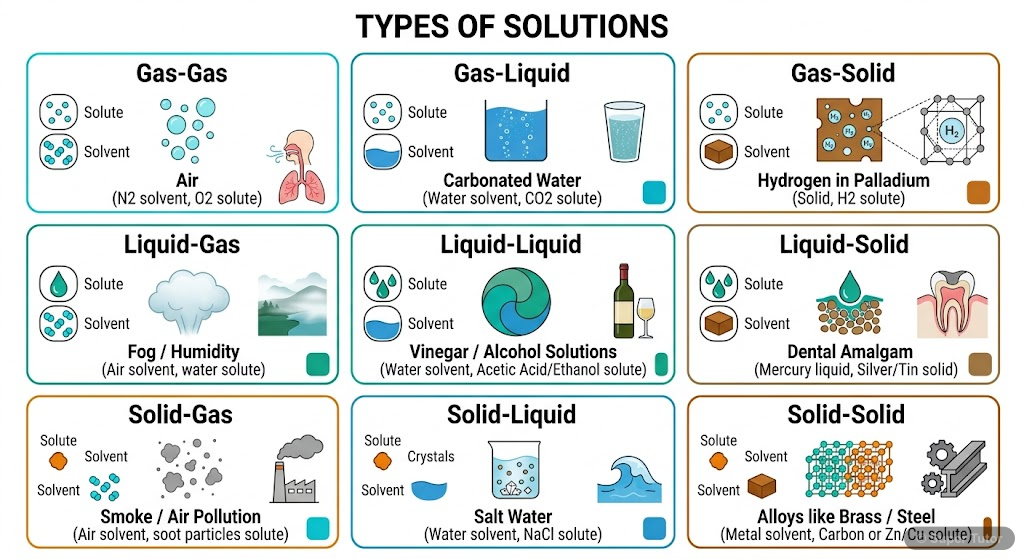
Learn better with visuals Super Tutor pairs illustrations like this with notes and quizzes for Solutions.
Quick Quiz: Solutions
0/4Tap an answer to check it instantly. No sign-up needed for these 4.
Which of the following is an example of a solid-liquid solution?
What is the mass percentage of solute in a solution containing 20g of salt dissolved in 80g of water?
According to Henry's law, the solubility of a gas in a liquid is directly proportional to:
What happens to the freezing point of water when salt is added to it?
Sample Questions
Which of the following are colligative properties?
Show answer
Lowering of vapor pressure, Elevation of boiling point, Depression of freezing point, Osmotic pressure
Colligative properties depend only on the number of solute particles, not their identity. The four main colligative properties are: lowering of vapor pressure, elevation of boiling point, depression of freezing point, and osmotic pressure. Color and density depend on the nature of solute.
Which of the following solutions will have the highest boiling point?
Show answer
1M NaCl solution
NaCl dissociates into Na+ and Cl- ions, giving 2 particles per formula unit. 1M NaCl effectively gives 2M particles. Glucose doesn't dissociate. More particles cause greater elevation in boiling point. Pure water has the lowest boiling point.
An ideal solution obeys Raoult's law over:
Show answer
The entire range of concentration
An ideal solution is defined as one that obeys Raoult's law over the entire range of concentration (from 0 to 1 mole fraction). Real solutions may show deviations from Raoult's law at certain concentrations.
Which of the following statements about osmosis are correct?
Show answer
Solvent moves from lower concentration to higher concentration, It occurs through a semipermeable membrane, It can be reversed by applying pressure
Osmosis is the movement of solvent from lower to higher concentration through a semipermeable membrane. It can be reversed by applying pressure greater than osmotic pressure. It's a colligative property, so depends only on number of particles, not their nature. It occurs in both living and non-living systems.
+143 more questions on Solutions (Karnataka Board Class 12 Chemistry)
Practise AllFrequently Asked Questions
What are the important topics in Solutions for Karnataka Board Class 12 Chemistry?
How many practice questions are there for Solutions?
Sources & Official References
- Karnataka SSLC — kseeb.kar.nic.in
- Dept of Pre-University Education, Karnataka
- National Education Policy 2020 — education.gov.in
Content is aligned to the official syllabus. Refer to the board website for the latest curriculum.
More resources for Solutions
Important Questions
Exam-style questions with answers
Revision Notes
Key points for last-minute revision
Formula Sheet
The chapter's formulas in one place
Chapter Summary
Understand the chapter at a glance
Concept Maps
See how topics connect
Study Plan
Step-by-step plan for this chapter
Flashcards
Quick-fire cards for active recall
Syllabus
What topics to cover
NCERT Solutions
Every textbook question solved step by step
For serious students
Get the full Solutions chapter — start free.
Quizzes, flashcards, an AI doubt solver and a study plan for Karnataka Board Class 12 Chemistry. Free to start, no card needed.