Chapter 5 of 14
NCERT Solutions

Current Electricity

Karnataka Board · Class 12 · Physics

NCERT Solutions for Current Electricity — Karnataka Board Class 12 Physics.

30 questions22 flashcards5 concepts

Interactive on Super Tutor

Studying Current Electricity? Get the full interactive chapter.

Quizzes, flashcards, AI doubt-solver and a step-by-step study plan — built for ncert solutions and more.

1,000+ Class 12 students started this chapter today

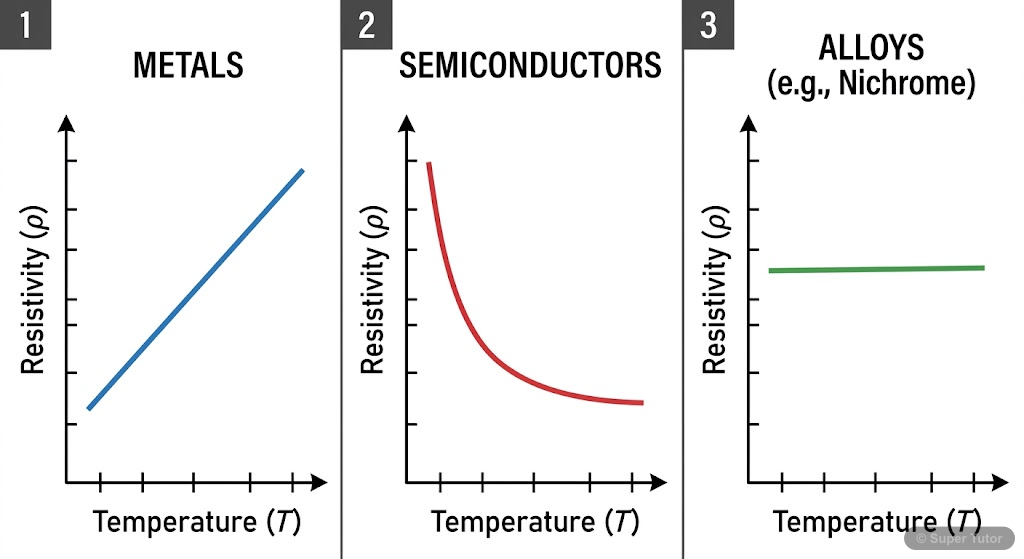
Graphs showing the variation of resistivity with temperature for different types of materials: metals, semiconductors, and alloys.
Super Tutor

Super Tutor has 13+ illustrations like this for Current Electricity alone — flashcards, concept maps, and step-by-step visuals.

See them all
9 Questions Solved · 1 Section

EXERCISES

3.1The storage battery of a car has an emf of 12V12\mathrm{V}. If the internal resistance of the battery is 0.4Ω0.4\Omega, what is the maximum current that can be drawn from the battery?Show solution
Given:
- EMF of battery, ε=12V\varepsilon = 12\,\mathrm{V}
- Internal resistance, r=0.4Ωr = 0.4\,\Omega

Concept: The current drawn from a battery is maximum when the external resistance R=0R = 0 (short circuit condition).

Formula:
Imax=εrI_{\max} = \frac{\varepsilon}{r}

Calculation:
Imax=120.4=30AI_{\max} = \frac{12}{0.4} = 30\,\mathrm{A}

Answer: The maximum current that can be drawn from the battery is 30A\boxed{30\,\mathrm{A}}.
3.2A battery of emf 10V10\mathrm{V} and internal resistance 3Ω3\Omega is connected to a resistor. If the current in the circuit is 0.5A0.5\mathrm{A}, what is the resistance of the resistor? What is the terminal voltage of the battery when the circuit is closed?Show solution
Given:
- EMF, ε=10V\varepsilon = 10\,\mathrm{V}
- Internal resistance, r=3Ωr = 3\,\Omega
- Current, I=0.5AI = 0.5\,\mathrm{A}

Part (i): Finding the external resistance RR

Using the formula:
I=εR+rI = \frac{\varepsilon}{R + r}
R+r=εI=100.5=20ΩR + r = \frac{\varepsilon}{I} = \frac{10}{0.5} = 20\,\Omega
R=20r=203=17ΩR = 20 - r = 20 - 3 = 17\,\Omega

Part (ii): Terminal voltage of the battery

The terminal voltage is the voltage across the external resistor:
V=εIr=10(0.5×3)=101.5=8.5VV = \varepsilon - Ir = 10 - (0.5 \times 3) = 10 - 1.5 = 8.5\,\mathrm{V}

Alternatively: V=IR=0.5×17=8.5VV = IR = 0.5 \times 17 = 8.5\,\mathrm{V}

Answer: Resistance of the resistor R=17ΩR = 17\,\Omega; Terminal voltage V=8.5VV = 8.5\,\mathrm{V}.
3.3At room temperature (27.0C)(27.0^{\circ}\mathrm{C}) the resistance of a heating element is 100Ω100\Omega. What is the temperature of the element if the resistance is found to be 117Ω117\Omega, given that the temperature coefficient of the material of the resistor is 1.70×10⁴C11.70\times 10^{-4}\,^{\circ}\mathrm{C}^{-1}?Show solution
Given:
- Temperature T1=27.0CT_1 = 27.0^{\circ}\mathrm{C}
- Resistance at T1T_1: R1=100ΩR_1 = 100\,\Omega
- Resistance at T2T_2: R2=117ΩR_2 = 117\,\Omega
- Temperature coefficient, α=1.70×10⁴C1\alpha = 1.70 \times 10^{-4}\,^{\circ}\mathrm{C}^{-1}

Formula:
R2=R1[1+α(T2T1)]R_2 = R_1\,[1 + \alpha(T_2 - T_1)]

Calculation:
117=100[1+1.70×10⁴(T227)]117 = 100\,[1 + 1.70 \times 10^{-4}(T_2 - 27)]
117100=1+1.70×10⁴(T227)\frac{117}{100} = 1 + 1.70 \times 10^{-4}(T_2 - 27)
1.171=1.70×10⁴(T227)1.17 - 1 = 1.70 \times 10^{-4}(T_2 - 27)
0.17=1.70×10⁴(T227)0.17 = 1.70 \times 10^{-4}(T_2 - 27)
T227=0.171.70×104=1000CT_2 - 27 = \frac{0.17}{1.70 \times 10^{-4}} = 1000^{\circ}\mathrm{C}
T2=1000+27=1027CT_2 = 1000 + 27 = 1027^{\circ}\mathrm{C}

Answer: The temperature of the heating element is 1027C\boxed{1027^{\circ}\mathrm{C}}.
3.4A negligibly small current is passed through a wire of length 15m15\,\mathrm{m} and uniform cross-section 6.0×10⁷m26.0 \times 10^{-7}\,\mathrm{m}^2, and its resistance is measured to be 5.0Ω5.0\,\Omega. What is the resistivity of the material at the temperature of the experiment?Show solution
Given:
- Length of wire, l=15ml = 15\,\mathrm{m}
- Cross-sectional area, A=6.0×10⁷m2A = 6.0 \times 10^{-7}\,\mathrm{m}^2
- Resistance, R=5.0ΩR = 5.0\,\Omega

Formula:
R=ρlA    ρ=RAlR = \frac{\rho l}{A} \implies \rho = \frac{RA}{l}

Calculation:
ρ=5.0×6.0×10715\rho = \frac{5.0 \times 6.0 \times 10^{-7}}{15}
ρ=30×10715=2.0×10⁷Ωm\rho = \frac{30 \times 10^{-7}}{15} = 2.0 \times 10^{-7}\,\Omega\,\mathrm{m}

Answer: The resistivity of the material is 2.0×10⁷Ωm\boxed{2.0 \times 10^{-7}\,\Omega\,\mathrm{m}}.
3.5A silver wire has a resistance of 2.1Ω2.1\,\Omega at 27.5C27.5\,^{\circ}\mathrm{C}, and a resistance of 2.7Ω2.7\,\Omega at 100C100\,^{\circ}\mathrm{C}. Determine the temperature coefficient of resistivity of silver.Show solution
Given:
- R1=2.1ΩR_1 = 2.1\,\Omega at T1=27.5CT_1 = 27.5^{\circ}\mathrm{C}
- R2=2.7ΩR_2 = 2.7\,\Omega at T2=100CT_2 = 100^{\circ}\mathrm{C}

Formula:
R2=R1[1+α(T2T1)]R_2 = R_1[1 + \alpha(T_2 - T_1)]

Solving for α\alpha:
α=R2R1R1(T2T1)\alpha = \frac{R_2 - R_1}{R_1(T_2 - T_1)}
α=2.72.12.1×(10027.5)\alpha = \frac{2.7 - 2.1}{2.1 \times (100 - 27.5)}
α=0.62.1×72.5\alpha = \frac{0.6}{2.1 \times 72.5}
α=0.6152.25\alpha = \frac{0.6}{152.25}
α3.94×10³C1\alpha \approx 3.94 \times 10^{-3}\,^{\circ}\mathrm{C}^{-1}

Answer: The temperature coefficient of resistivity of silver is α3.94×10³C1\alpha \approx 3.94 \times 10^{-3}\,^{\circ}\mathrm{C}^{-1}.
3.6A heating element using nichrome connected to a 230V230\,\mathrm{V} supply draws an initial current of 3.2A3.2\,\mathrm{A} which settles after a few seconds to a steady value of 2.8A2.8\,\mathrm{A}. What is the steady temperature of the heating element if the room temperature is 27.0C27.0\,^{\circ}\mathrm{C}? Temperature coefficient of resistance of nichrome averaged over the temperature range involved is 1.70×10⁴C11.70 \times 10^{-4}\,^{\circ}\mathrm{C}^{-1}.Show solution
Given:
- Supply voltage, V=230VV = 230\,\mathrm{V}
- Initial current (at room temperature), I1=3.2AI_1 = 3.2\,\mathrm{A}
- Steady current, I2=2.8AI_2 = 2.8\,\mathrm{A}
- Room temperature, T1=27.0CT_1 = 27.0^{\circ}\mathrm{C}
- α=1.70×10⁴C1\alpha = 1.70 \times 10^{-4}\,^{\circ}\mathrm{C}^{-1}

Step 1: Find initial and steady resistances.

Since voltage is constant:
R1=VI1=2303.2=71.875ΩR_1 = \frac{V}{I_1} = \frac{230}{3.2} = 71.875\,\Omega
R2=VI2=2302.8=82.14ΩR_2 = \frac{V}{I_2} = \frac{230}{2.8} = 82.14\,\Omega

Step 2: Use the temperature-resistance relation.
R2=R1[1+α(T2T1)]R_2 = R_1[1 + \alpha(T_2 - T_1)]
T2T1=R2R1αR1T_2 - T_1 = \frac{R_2 - R_1}{\alpha R_1}
T2T1=82.1471.8751.70×104×71.875T_2 - T_1 = \frac{82.14 - 71.875}{1.70 \times 10^{-4} \times 71.875}
T2T1=10.2650.012219840CT_2 - T_1 = \frac{10.265}{0.012219} \approx 840^{\circ}\mathrm{C}

Step 3: Find steady temperature.
T2=27+840=867CT_2 = 27 + 840 = 867^{\circ}\mathrm{C}

Answer: The steady temperature of the heating element is approximately 867C\boxed{867^{\circ}\mathrm{C}}.
3.7Determine the current in each branch of the network shown in Fig. 3.20.Show solution
Note: The figure shows a Wheatstone-bridge-type network. Based on the standard NCERT figure 3.20, the network has the following configuration: A battery of 10 V is connected between points A and B. The resistances are: RABR_{AB} (top-left) =10Ω= 10\,\Omega, RADR_{AD} (bottom-left) =5Ω= 5\,\Omega, RBCR_{BC} (top-right) =5Ω= 5\,\Omega, RDCR_{DC} (bottom-right) =10Ω= 10\,\Omega, and RBDR_{BD} (middle/galvanometer branch) =10Ω= 10\,\Omega. The emf source (10 V) is between A and C.

Applying Kirchhoff's Laws:

Let:
- I1I_1 = current through ABAB (10 Ω)
- I2I_2 = current through ADAD (5 Ω)
- IgI_g = current through BDBD (10 Ω)
- Current through BCBC = I1IgI_1 - I_g
- Current through DCDC = I2+IgI_2 + I_g

At junction B: current in = I1I_1, current out = (I1Ig)+Ig(I_1 - I_g) + I_g

Loop ABDA (clockwise):
10I1+10Ig5I2=010I_1 + 10I_g - 5I_2 = 0
2I1+2IgI2=0(1)2I_1 + 2I_g - I_2 = 0 \quad \cdots (1)

Loop BCDB (clockwise):
5(I1Ig)10(I2+Ig)10Ig=05(I_1 - I_g) - 10(I_2 + I_g) - 10I_g = 0
5I15Ig10I210Ig10Ig=05I_1 - 5I_g - 10I_2 - 10I_g - 10I_g = 0
5I125Ig10I2=05I_1 - 25I_g - 10I_2 = 0
I15Ig2I2=0(2)I_1 - 5I_g - 2I_2 = 0 \quad \cdots (2)

Loop ADCEA (main outer loop):
5I2+10(I2+Ig)=105I_2 + 10(I_2 + I_g) = 10
15I2+10Ig=1015I_2 + 10I_g = 10
3I2+2Ig=2(3)3I_2 + 2I_g = 2 \quad \cdots (3)

Solving equations (1) and (2):

From (1): I2=2I1+2IgI_2 = 2I_1 + 2I_g

Substitute into (2):
I15Ig2(2I1+2Ig)=0I_1 - 5I_g - 2(2I_1 + 2I_g) = 0
I15Ig4I14Ig=0I_1 - 5I_g - 4I_1 - 4I_g = 0
3I19Ig=0-3I_1 - 9I_g = 0
I1=3Ig(4)I_1 = -3I_g \quad \cdots (4)

Substitute (4) into (1):
I2=2(3Ig)+2Ig=6Ig+2Ig=4Ig(5)I_2 = 2(-3I_g) + 2I_g = -6I_g + 2I_g = -4I_g \quad \cdots (5)

Substitute (5) into (3):
3(4Ig)+2Ig=23(-4I_g) + 2I_g = 2
12Ig+2Ig=2-12I_g + 2I_g = 2
10Ig=2-10I_g = 2
Ig=0.2AI_g = -0.2\,\mathrm{A}

From (4): I1=3(0.2)=0.6AI_1 = -3(-0.2) = 0.6\,\mathrm{A}

From (5): I2=4(0.2)=0.8AI_2 = -4(-0.2) = 0.8\,\mathrm{A}

Currents in each branch:
- Current through ABAB (10 Ω): I1=0.6AI_1 = 0.6\,\mathrm{A}
- Current through ADAD (5 Ω): I2=0.8AI_2 = 0.8\,\mathrm{A}
- Current through BDBD (10 Ω): Ig=0.2AI_g = -0.2\,\mathrm{A} (i.e., 0.2A0.2\,\mathrm{A} in the direction opposite to assumed)
- Current through BCBC (5 Ω): I1Ig=0.6(0.2)=0.8AI_1 - I_g = 0.6 - (-0.2) = 0.8\,\mathrm{A}
- Current through DCDC (10 Ω): I2+Ig=0.8+(0.2)=0.6AI_2 + I_g = 0.8 + (-0.2) = 0.6\,\mathrm{A}
- Total current from battery: I1+I2=0.6+0.8=1.4AI_1 + I_2 = 0.6 + 0.8 = 1.4\,\mathrm{A}

Answer: IAB=0.6AI_{AB} = 0.6\,\mathrm{A}, IAD=0.8AI_{AD} = 0.8\,\mathrm{A}, IBD=0.2AI_{BD} = 0.2\,\mathrm{A}, IBC=0.8AI_{BC} = 0.8\,\mathrm{A}, IDC=0.6AI_{DC} = 0.6\,\mathrm{A}, Total current =1.4A= 1.4\,\mathrm{A}.
3.8A storage battery of emf 8.0V8.0\,\mathrm{V} and internal resistance 0.5Ω0.5\,\Omega is being charged by a 120V120\,\mathrm{V} dc supply using a series resistor of 15.5Ω15.5\,\Omega. What is the terminal voltage of the battery during charging? What is the purpose of having a series resistor in the charging circuit?Show solution
Given:
- EMF of battery being charged, ε=8.0V\varepsilon = 8.0\,\mathrm{V}
- Internal resistance of battery, r=0.5Ωr = 0.5\,\Omega
- DC supply voltage, V=120VV = 120\,\mathrm{V}
- Series resistance, R=15.5ΩR = 15.5\,\Omega

Step 1: Find the charging current.

During charging, the battery's emf opposes the supply voltage:
I=VεR+r=1208.015.5+0.5=11216=7.0AI = \frac{V - \varepsilon}{R + r} = \frac{120 - 8.0}{15.5 + 0.5} = \frac{112}{16} = 7.0\,\mathrm{A}

Step 2: Find the terminal voltage of the battery during charging.

During charging, current flows into the positive terminal of the battery, so:
Vterminal=ε+Ir=8.0+7.0×0.5=8.0+3.5=11.5VV_{\text{terminal}} = \varepsilon + Ir = 8.0 + 7.0 \times 0.5 = 8.0 + 3.5 = 11.5\,\mathrm{V}

Purpose of series resistor:
The series resistor limits the charging current to a safe value. Without it, the current would be excessively large (since the net voltage 1208=112V120 - 8 = 112\,\mathrm{V} would drive current through only the small internal resistance 0.5Ω0.5\,\Omega, giving I=224AI = 224\,\mathrm{A}), which could damage the battery and the supply.

Answer: Terminal voltage during charging =11.5V= 11.5\,\mathrm{V}. The series resistor limits the charging current to a safe value.
3.9The number density of free electrons in a copper conductor estimated in Example 3.1 is 8.5×1028m38.5 \times 10^{28}\,\mathrm{m}^{-3}. How long does an electron take to drift from one end of a wire 3.0m3.0\,\mathrm{m} long to its other end? The area of cross-section of the wire is 2.0×10⁶m22.0 \times 10^{-6}\,\mathrm{m}^2 and it is carrying a current of 3.0A3.0\,\mathrm{A}.Show solution
Given:
- Number density of free electrons, n=8.5×1028m3n = 8.5 \times 10^{28}\,\mathrm{m}^{-3}
- Length of wire, l=3.0ml = 3.0\,\mathrm{m}
- Area of cross-section, A=2.0×10⁶m2A = 2.0 \times 10^{-6}\,\mathrm{m}^2
- Current, I=3.0AI = 3.0\,\mathrm{A}
- Charge of electron, e=1.6×10¹⁹Ce = 1.6 \times 10^{-19}\,\mathrm{C}

Step 1: Find the drift velocity.

Using I=neAvdI = neAv_d:
vd=IneAv_d = \frac{I}{neA}
vd=3.08.5×1028×1.6×1019×2.0×106v_d = \frac{3.0}{8.5 \times 10^{28} \times 1.6 \times 10^{-19} \times 2.0 \times 10^{-6}}
vd=3.08.5×1.6×2.0×1028196v_d = \frac{3.0}{8.5 \times 1.6 \times 2.0 \times 10^{28-19-6}}
vd=3.027.2×103v_d = \frac{3.0}{27.2 \times 10^{3}}
vd=3.02.72×1041.103×104ms1v_d = \frac{3.0}{2.72 \times 10^{4}} \approx 1.103 \times 10^{-4}\,\mathrm{m\,s^{-1}}

Step 2: Find the time to drift the full length.

t=lvd=3.01.103×104t = \frac{l}{v_d} = \frac{3.0}{1.103 \times 10^{-4}}
t2.7×104st \approx 2.7 \times 10^{4}\,\mathrm{s}

Answer: An electron takes approximately 2.7×10⁴s\boxed{2.7 \times 10^{4}\,\mathrm{s}} (about 7.5 hours) to drift from one end of the wire to the other.

Stuck on a step?

Ask Super Tutor AI to explain any solution on this page in a simpler way — free, 24x7.

Ask a Doubt Free

Frequently Asked Questions

What are the important topics in Current Electricity for Karnataka Board Class 12 Physics?
Current Electricity covers several key topics that are frequently asked in Karnataka Board Class 12 board exams. Focus on the core concepts listed on this page and practise related questions to build confidence.
How to score full marks in Current Electricity — Karnataka Board Class 12 Physics?
Understand the core concepts first, then work through the 30 practice questions available for this chapter. Revise formulas and definitions regularly, and use flashcards for quick recall before the exam.
Where can I get free NCERT Solutions for Current Electricity Class 12 Physics?
This page has free step-by-step NCERT Solutions for every exercise question in Current Electricity (Karnataka Board Class 12 Physics) — written the way examiners award marks: given, formula, working, answer.

Sources & Official References

Content is aligned to the official syllabus. Refer to the board website for the latest curriculum.

For serious students

Get the full Current Electricity chapter — for free.

Quizzes, flashcards, AI doubt-solver and a step-by-step study plan for Karnataka Board Class 12 Physics.