File Handling in Python — Chapter Summary
Kerala Board · Class 12 · Computer Science
Summary of File Handling in Python for Kerala Board Class 12 Computer Science. Part of the Kerala Board Class 12 Computer Science syllabus.
Interactive on Super Tutor
Studying File Handling in Python? Get the full interactive chapter.
Quizzes, flashcards, AI doubt-solver and a step-by-step study plan — built for chapter summary and more.
Free trial, no card needed.
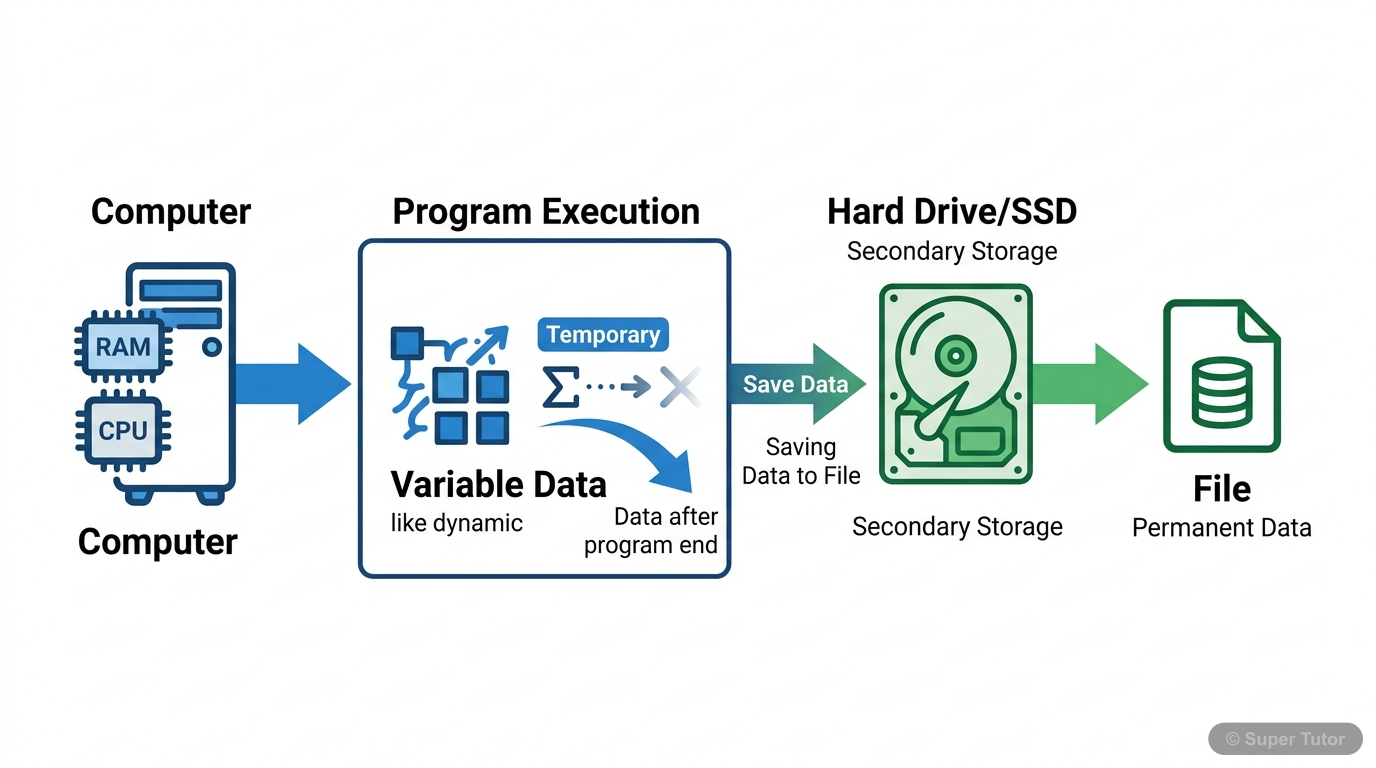
One of 9 illustrations for File Handling in Python in Super Tutor — alongside flashcards, concept maps and practice questions.
Overview
File handling makes it possible to store data permanently on secondary storage so that it can be used later. A file is a named location on secondary storage where data are permanently stored for later access. Python uses the io module for file operations. Files are mainly of two types: text files an
Key Concepts
A file is a named location
A file is a named location on secondary storage where data are permanently stored for later access.
A text file contains only textual
A text file contains only textual information. It stores the ASCII equivalent of contents and is usually human readable. Examples include files with e
A binary file stores actual content
A binary file stores actual content as bytes, not ASCII character values. It is used for image, audio, video, compressed, and executable files.
open() creates a file object
open() creates a file object, also called a file handle. The syntax is file_object= open(file_name, access_mode). If the file does not exist, a new em
close() closes the file using file_object
close() closes the file using file_object.close(). It frees memory and other resources allocated to the file and flushes unwritten data.
Learning Objectives
- Understand the meaning and purpose of files in Python
- Differentiate between text files and binary files
- Use open() and close() to handle files safely
- Write data to text files using write() and writelines()
- Read data from text files using read(), readline(), and readlines()
Frequently Asked Questions
What are the important topics in File Handling in Python for Kerala Board Class 12 Computer Science?
How should I revise File Handling in Python for the Kerala Board Class 12 board exam?
Sources & Official References
- Kerala Board of Public Examinations — keralapareekshabhavan.in
- National Education Policy 2020 — education.gov.in
Content is aligned to the official syllabus. Refer to the board website for the latest curriculum.
More resources for File Handling in Python
Practice Quiz
Test yourself with a quick quiz
Important Questions
Exam-style questions with answers
Revision Notes
Key points for last-minute revision
Formula Sheet
The chapter's formulas in one place
Concept Maps
See how topics connect
Study Plan
Step-by-step plan for this chapter
Flashcards
Quick-fire cards for active recall
Syllabus
What topics to cover
NCERT Solutions
Every textbook question solved step by step
For serious students
Get the full File Handling in Python chapter — start free.
Quizzes, flashcards, an AI doubt solver and a study plan for Kerala Board Class 12 Computer Science. Free to start, no card needed.