Application of Derivatives — NCERT Solutions
Kerala Board · Class 12 · Mathematics
NCERT Solutions for Application of Derivatives, Kerala Board Class 12 Mathematics: 82 textbook questions solved step by step.
Interactive on Super Tutor
Studying Application of Derivatives? Get the full interactive chapter.
Quizzes, flashcards, AI doubt-solver and a step-by-step study plan — built for NCERT solutions and more.
Free trial, no card needed.
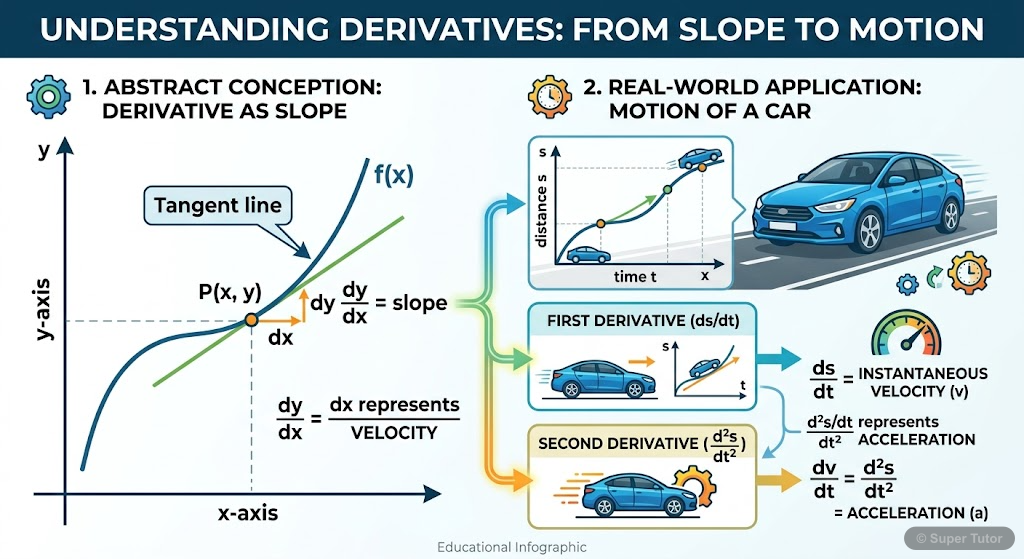
Learn better with visuals Super Tutor pairs illustrations like this with notes and quizzes for Application of Derivatives.
The first 41 solutions are open to read. The other 41 are free with a Super Tutor account.
Exercise 6.1
1Find the rate of change of the area of a circle with respect to its radius when (a) (b) Show solution
Given: Area of a circle .
Formula used: Rate of change of area with respect to radius .
(a) When cm:
(b) When cm:
2The volume of a cube is increasing at the rate of . How fast is the surface area increasing when the length of an edge is ?Show solution
Given: , edge .
Volume of cube:
Surface area of cube:
Hence, the surface area is increasing at the rate of .
3The radius of a circle is increasing uniformly at the rate of . Find the rate at which the area of the circle is increasing when the radius is .Show solution
Given: , .
Area:
Hence, the area is increasing at the rate of .
4An edge of a variable cube is increasing at the rate of . How fast is the volume of the cube increasing when the edge is long?Show solution
Given: , .
Volume:
Hence, the volume is increasing at the rate of .
5A stone is dropped into a quiet lake and waves move in circles at the speed of . At the instant when the radius of the circular wave is , how fast is the enclosed area increasing?Show solution
Given: , .
Area:
Hence, the enclosed area is increasing at the rate of .
6The radius of a circle is increasing at the rate of . What is the rate of increase of its circumference?Show solution
Given: .
Circumference:
Hence, the circumference is increasing at the rate of .
7The length of a rectangle is decreasing at the rate of and the width is increasing at the rate of . When and , find the rates of change of (a) the perimeter, and (b) the area of the rectangle.Show solution
Given: (decreasing), (increasing), , .
(a) Perimeter:
The perimeter is decreasing at the rate of .
(b) Area:
The area is increasing at the rate of .
8A balloon, which always remains spherical on inflation, is being inflated by pumping in 900 cubic centimetres of gas per second. Find the rate at which the radius of the balloon increases when the radius is .Show solution
Given: , .
Volume of sphere:
Hence, the radius is increasing at the rate of .
9A balloon, which always remains spherical has a variable radius. Find the rate at which its volume is increasing with the radius when the latter is .Show solution
Given: Radius .
Volume of sphere:
At :
Hence, the volume is increasing at the rate of per cm increase in radius.
10A ladder long is leaning against a wall. The bottom of the ladder is pulled along the ground, away from the wall, at the rate of . How fast is its height on the wall decreasing when the foot of the ladder is away from the wall?Show solution
Given: Length of ladder , , .
Let = distance of foot from wall, = height on wall.
By Pythagoras theorem:
Differentiating with respect to :
When :
Converting:
Hence, the height on the wall is decreasing at the rate of .
11A particle moves along the curve . Find the points on the curve at which the -coordinate is changing 8 times as fast as the -coordinate.Show solution
Given: and .
Differentiating with respect to :
Substituting :
When : . Point: .
When : . Point: .
Hence, the required points are and .
12The radius of an air bubble is increasing at the rate of . At what rate is the volume of the bubble increasing when the radius is ?Show solution
Given: , .
Volume of sphere:
Hence, the volume of the bubble is increasing at the rate of .
13A balloon, which always remains spherical, has a variable diameter . Find the rate of change of its volume with respect to .Show solution
Given: Diameter , so radius .
Volume:
Hence, .
14Sand is pouring from a pipe at the rate of . The falling sand forms a cone on the ground in such a way that the height of the cone is always one-sixth of the radius of the base. How fast is the height of the sand cone increasing when the height is ?Show solution
Given: , , i.e., .
Volume of cone:
Hence, the height of the sand cone is increasing at the rate of .
15The total cost in Rupees associated with the production of units of an item is given by . Find the marginal cost when 17 units are produced.Show solution
Given: .
Marginal Cost (MC)
At :
Hence, the marginal cost when 17 units are produced is ₹ 20.967 (approximately ₹ 20.97).
16The total revenue in Rupees received from the sale of units of a product is given by . Find the marginal revenue when .Show solution
Given: .
Marginal Revenue (MR)
At :
Hence, the marginal revenue when is ₹ 208.
17The rate of change of the area of a circle with respect to its radius at is\n(A) (B) (C) (D) Show solution
Correct Answer: (B)
Justification: Area .
At : .
18The total revenue in Rupees received from the sale of units of a product is given by . The marginal revenue, when is\n(A) 116 (B) 96 (C) 90 (D) 126Show solution
Correct Answer: (D) 126
Justification: .
At : .
Exercise 6.2
1Show that the function given by is increasing on .Show solution
Given: .
Differentiating: for all .
Since for all , the function is strictly increasing on .
2Show that the function given by is increasing on .Show solution
Given: .
Differentiating: .
Since for all , we have for all .
Hence, is strictly increasing on .
3Show that the function given by is (a) increasing in (b) decreasing in (c) neither increasing nor decreasing in Show solution
Given: , so .
(a) In : , so . Hence is increasing in .
(b) In : , so . Hence is decreasing in .
(c) In : is increasing on and decreasing on . Hence is neither increasing nor decreasing on the entire interval .
4Find the intervals in which the function given by is (a) increasing (b) decreasingShow solution
Given: .
Setting : .
(a) Increasing: .
So is increasing on .
(b) Decreasing: .
So is decreasing on .
5Find the intervals in which the function given by is (a) increasing (b) decreasingShow solution
Given: .
Critical points: and .
| Interval | Sign of | Sign of | Sign of |
|---|---|---|---|
(a) Increasing: when .
(b) Decreasing: when .
6Find the intervals in which the following functions are strictly increasing or decreasing: (a) (b) (c) (d) (e) Show solution
(a)
- Strictly increasing: , i.e., .
- Strictly decreasing: , i.e., .
(b)
- Strictly increasing: , i.e., .
- Strictly decreasing: .
(c)
| Interval | Sign of |
|---|---|
- Strictly increasing: .
- Strictly decreasing: .
(d)
- Strictly increasing: , i.e., .
- Strictly decreasing: .
(e)
Note: and always.
- Strictly increasing: (and ), i.e., .
- Strictly decreasing: (and ), i.e., .
7Show that , , is an increasing function of throughout its domain.Show solution
Given: , .
For : , , and .
So for all , and only at .
Hence, is an increasing function throughout its domain.
8Find the values of for which is an increasing function.Show solution
Given: .
Critical points: .
| Interval | Sign of |
|---|---|
is increasing when , i.e., for .
9Prove that is an increasing function of in .Show solution
Given: .
For :
Hence for all .
Therefore, is an increasing function of in .
10Prove that the logarithmic function is increasing on .Show solution
Let , defined for .
For all : .
Hence, the logarithmic function is strictly increasing on .
11Prove that the function given by is neither strictly increasing nor decreasing on .Show solution
Given: .
.
- For : (decreasing).
- For : (increasing).
Since is decreasing on part of and increasing on another part, is neither strictly increasing nor strictly decreasing on .
12Which of the following functions are decreasing on ? (A) (B) (C) (D) Show solution
Correct Answer: (A)
(A) : for . ✓ Decreasing.
(B) : . For , so ; for , so . Not entirely decreasing.
(C) : . At , and changes sign. Not entirely decreasing.
(D) : . Increasing.
Hence, only (A) is decreasing on .
13On which of the following intervals is the function given by decreasing? (A) (B) (C) (D) None of theseShow solution
Correct Answer: (D) None of these
(A) : and , so . Increasing.
(B) : (since ). Although here, dominates (e.g., at , is very large). So . Increasing.
(C) : Both and , so . Increasing.
Hence, is not decreasing on any of the given intervals. Answer: (D).
14For what values of the function given by is increasing on ?Show solution
Given: .
For to be increasing on , we need for all .
The minimum value of on occurs at :
Hence, is increasing on for all .
15Let I be any interval disjoint from . Prove that the function given by is increasing on I.Show solution
Given: .
For any interval disjoint from , we have , i.e., .
So and , giving .
Hence, is strictly increasing on .
16Prove that the function given by is increasing on and decreasing on .Show solution
Given: .
- For : , so . Hence is increasing.
- For : , so . Hence is decreasing.
17Prove that the function given by is decreasing on and increasing on .Show solution
Given: .
For : , so .
Since in , . Hence is decreasing on .
For : , so .
Since in , . Hence is increasing on .
18Prove that the function given by is increasing in .Show solution
Given: .
Since for all , we have for all .
only at (a single point), so is strictly increasing on .
19The interval in which is increasing is (A) (B) (C) (D) Show solution
Correct Answer: (D)
Since always, when , i.e., .
Hence is increasing on .
Exercise 6.3
1Find the maximum and minimum values, if any, of the following functions given by (i) (ii) (iii) (iv) Show solution
(i)
Since for all , we have .
when .
Minimum value = 3 at . No maximum value (as ).
(ii)
Since , .
when .
Minimum value = at . No maximum value.
(iii)
Since , .
when .
Maximum value = 10 at . No minimum value.
(iv)
for all , and only at .
Since does not change sign, is neither a maximum nor a minimum.
Neither maximum nor minimum value exists.
2Find the maximum and minimum values, if any, of the following functions given by (i) (ii) (iii) (iv) (v) Show solution
(i)
Since , .
when .
Minimum value = at . No maximum value.
(ii)
Since , .
when .
Maximum value = 3 at . No minimum value.
(iii)
Since :
Maximum value = (when ).
Minimum value = (when ).
(iv)
Since , we have .
So always, hence .
Maximum value = 4, Minimum value = 2.
(v) ,
is strictly increasing on the open interval .
As , ; as , . The endpoints are not attained.
Neither maximum nor minimum value exists (open interval).
3Find the local maxima and local minima, if any, of the following functions. Find also the local maximum and the local minimum values, as the case may be: (i) (ii) (iii) (iv) (v) (vi) (vii) (viii) Show solution
(i)
.
, so is a point of local minimum.
Local minimum value = .
(ii)
.
.
- At : → local minimum. .
- At : → local maximum. .
Local maximum value = 2 at ; Local minimum value = at .
(iii) ,
.
.
At : → local maximum.
.
Local maximum value = at .
(iv) ,
or .
.
- At : → local maximum. .
- At : → local minimum. .
Local maximum value = at ; Local minimum value = at .
(v)
.
.
- At : → local maximum. .
- At : → local minimum. .
Local maximum value = 19 at ; Local minimum value = 15 at .
(vi) ,
(since ).
. At : → local minimum.
.
Local minimum value = 2 at .
(vii)
.
: At , use first derivative test: for and for → local maximum.
.
Local maximum value = at .
(viii) ,
.
For : ; for : → local maximum at .
.
Local maximum value = at .
4Prove that the following functions do not have maxima or minima: (i) (ii) (iii) Show solution
(i)
for all .
Since never equals zero, there are no critical points. Hence has no maxima or minima.
(ii) ,
for all .
No critical points exist. Hence has no maxima or minima.
(iii)
.
Discriminant , and leading coefficient , so for all .
No critical points. Hence has no maxima or minima.
Free with a Super Tutor account
Free with a Super Tutor account
Free with a Super Tutor account
Free with a Super Tutor account
Free with a Super Tutor account
Free with a Super Tutor account
Free with a Super Tutor account
Free with a Super Tutor account
Free with a Super Tutor account
Free with a Super Tutor account
Free with a Super Tutor account
Free with a Super Tutor account
Free with a Super Tutor account
Free with a Super Tutor account
Free with a Super Tutor account
Free with a Super Tutor account
Free with a Super Tutor account
Free with a Super Tutor account
Free with a Super Tutor account
Free with a Super Tutor account
Free with a Super Tutor account
Free with a Super Tutor account
Free with a Super Tutor account
Free with a Super Tutor account
Free with a Super Tutor account
Miscellaneous Exercise on Chapter 6
Free with a Super Tutor account
Free with a Super Tutor account
Free with a Super Tutor account
Free with a Super Tutor account
Free with a Super Tutor account
Free with a Super Tutor account
Free with a Super Tutor account
Free with a Super Tutor account
Free with a Super Tutor account
Free with a Super Tutor account
Free with a Super Tutor account
Free with a Super Tutor account
Free with a Super Tutor account
Free with a Super Tutor account
Free with a Super Tutor account
Free with a Super Tutor account
41 more solved questions in Application of Derivatives
They are free with a Super Tutor account, along with practice quizzes and flashcards for this chapter. Free to start, no card needed.
Frequently Asked Questions
What are the important topics in Application of Derivatives for Kerala Board Class 12 Mathematics?
Are these NCERT Solutions for Application of Derivatives free?
How should I revise Application of Derivatives for the Kerala Board Class 12 board exam?
Sources & Official References
- Kerala Board of Public Examinations — keralapareekshabhavan.in
- National Education Policy 2020 — education.gov.in
Content is aligned to the official syllabus. Refer to the board website for the latest curriculum.
More resources for Application of Derivatives
Practice Quiz
Test yourself with a quick quiz
Important Questions
Exam-style questions with answers
Revision Notes
Key points for last-minute revision
Formula Sheet
The chapter's formulas in one place
Chapter Summary
Understand the chapter at a glance
Concept Maps
See how topics connect
Study Plan
Step-by-step plan for this chapter
Flashcards
Quick-fire cards for active recall
Syllabus
What topics to cover
For serious students
Get the full Application of Derivatives chapter — start free.
Quizzes, flashcards, an AI doubt solver and a study plan for Kerala Board Class 12 Mathematics. Free to start, no card needed.