Semiconductor Electronics: Materials, Devices and Simple Circuits — Practice Quiz
Kerala Board · Class 12 · Physics
Try a 4-question quiz on Semiconductor Electronics: Materials, Devices and Simple Circuits for Kerala Board Class 12 Physics: tap an answer to check it.
Interactive on Super Tutor
Studying Semiconductor Electronics: Materials, Devices and Simple Circuits? Get the full interactive chapter.
Quizzes, flashcards, AI doubt-solver and a step-by-step study plan — built for practice quiz and more.
Free trial, no card needed.
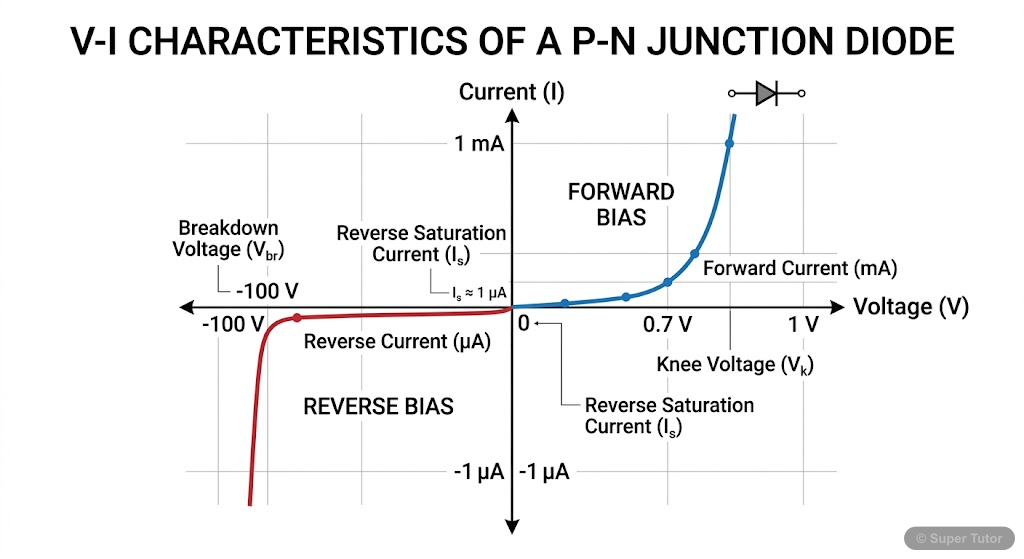
Learn better with visuals Super Tutor pairs illustrations like this with notes and quizzes for Semiconductor Electronics: Materials, Devices and Simple Circuits.
Quick Quiz: Semiconductor Electronics: Materials, Devices and Simple Circuits
0/4Tap an answer to check it instantly. No sign-up needed for these 4.
Which of the following materials has resistivity in the range of 10^-5 to 10^6 Ω m?
How many valence electrons do Silicon (Si) and Germanium (Ge) have?
In an intrinsic semiconductor at thermal equilibrium, which relationship is correct?
What is the energy gap (Eg) for Silicon approximately?
Sample Questions
Which impurities are used to create n-type semiconductors?
Show answer
Phosphorus (P), Arsenic (As), Antimony (Sb)
N-type semiconductors are created by doping with pentavalent (5 valence electrons) impurities like P, As, and Sb. These donate extra electrons. Trivalent elements like B, Al, In create p-type semiconductors.
In p-type semiconductors, which are the majority and minority carriers?
Show answer
Majority: holes, Minority: electrons
In p-type semiconductors, doping with trivalent impurities creates more holes than electrons. Holes become majority carriers while electrons are minority carriers (nh >> ne).
What happens when a p-n junction is formed?
Show answer
Electrons diffuse from n to p region, Holes diffuse from p to n region, A depletion region is formed, An electric field develops across the junction
At p-n junction formation, diffusion creates a depletion region with fixed charges, establishing an electric field. At equilibrium, diffusion and drift currents balance, so no net current flows.
The threshold voltage for a Silicon diode is approximately:
Show answer
0.7 V
Silicon diodes have a threshold voltage of approximately 0.7 V in forward bias. Germanium diodes have a lower threshold of about 0.2 V. This is the minimum voltage needed for significant current flow.
+101 more questions on Semiconductor Electronics: Materials, Devices and Simple Circuits (Kerala Board Class 12 Physics)
Practise AllFrequently Asked Questions
What are the important topics in Semiconductor Electronics: Materials, Devices and Simple Circuits for Kerala Board Class 12 Physics?
How many practice questions are there for Semiconductor Electronics: Materials, Devices and Simple Circuits?
Sources & Official References
- Kerala Board of Public Examinations — keralapareekshabhavan.in
- National Education Policy 2020 — education.gov.in
Content is aligned to the official syllabus. Refer to the board website for the latest curriculum.
More resources for Semiconductor Electronics: Materials, Devices and Simple Circuits
Important Questions
Exam-style questions with answers
Revision Notes
Key points for last-minute revision
Formula Sheet
The chapter's formulas in one place
Chapter Summary
Understand the chapter at a glance
Concept Maps
See how topics connect
Study Plan
Step-by-step plan for this chapter
Flashcards
Quick-fire cards for active recall
Syllabus
What topics to cover
NCERT Solutions
Every textbook question solved step by step
For serious students
Get the full Semiconductor Electronics: Materials, Devices and Simple Circuits chapter — start free.
Quizzes, flashcards, an AI doubt solver and a study plan for Kerala Board Class 12 Physics. Free to start, no card needed.