Sexual Reproduction in Flowering Plants
Manipur Board · Class 12 · Biology
NCERT Solutions for Sexual Reproduction in Flowering Plants — Manipur Board Class 12 Biology.
Interactive on Super Tutor
Studying Sexual Reproduction in Flowering Plants? Get the full interactive chapter.
Quizzes, flashcards, AI doubt-solver and a step-by-step study plan — built for ncert solutions and more.
1,000+ Class 12 students started this chapter today

Super Tutor has 16+ illustrations like this for Sexual Reproduction in Flowering Plants alone — flashcards, concept maps, and step-by-step visuals.
See them allEXERCISES — Sexual Reproduction in Flowering Plants
1Name the parts of an angiosperm flower in which development of male and female gametophyte take place.Show solution
Male Gametophyte Development:
The male gametophyte (pollen grain) develops inside the microsporangia (pollen sacs) present in the anther of the stamen.
- The sporogenous tissue within the microsporangium undergoes meiosis (microsporogenesis) to form microspore tetrads.
- Each microspore matures into a pollen grain (male gametophyte).
Female Gametophyte Development:
The female gametophyte (embryo sac) develops inside the ovule, which is present within the ovary of the pistil (gynoecium).
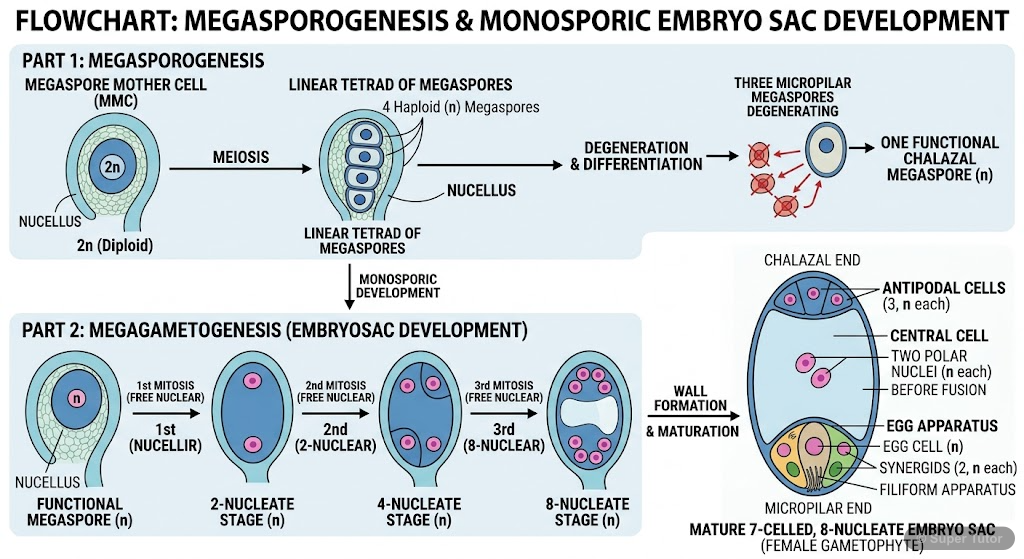
- The megaspore mother cell in the nucellus undergoes meiosis (megasporogenesis) to form megaspores.
- One functional megaspore develops into the embryo sac (female gametophyte).
Answer:
- Male gametophyte → Anther (microsporangia/pollen sacs)
- Female gametophyte → Ovule (inside the ovary)
2Differentiate between microsporogenesis and megasporogenesis. Which type of cell division occurs during these events? Name the structures formed at the end of these two events.Show solution
| Feature | Microsporogenesis | Megasporogenesis |
|---|---|---|
| Definition | Process of formation of microspores (pollen grains) from the pollen mother cell (PMC) | Process of formation of megaspores from the megaspore mother cell (MMC) |
| Site | Microsporangia (anther) | Nucellus of the ovule |
| Mother cell | Pollen Mother Cell (PMC) / Microspore Mother Cell | Megaspore Mother Cell (MMC) |
| Number of functional spores | All four microspores of the tetrad are functional | Usually only one megaspore is functional (3 degenerate) |
| Product | Microspore tetrad → Pollen grains | Megaspore tetrad → One functional megaspore |
| Further development | Each microspore → male gametophyte (pollen grain) | Functional megaspore → female gametophyte (embryo sac) |
Type of Cell Division:
Both microsporogenesis and megasporogenesis involve meiosis (meiotic division / reductive division).
Structures formed at the end:
- Microsporogenesis → Microspore tetrad (which further matures into pollen grains — the male gametophyte)
- Megasporogenesis → Megaspore tetrad (one functional megaspore, which develops into the embryo sac — the female gametophyte)
3Arrange the following terms in the correct developmental sequence: Pollen grain, sporogenous tissue, microspore tetrad, pollen mother cell, male gametes.Show solution
Concept: During microsporogenesis, the sporogenous tissue gives rise to pollen mother cells, which undergo meiosis to form microspore tetrads, which mature into pollen grains, which finally produce male gametes.
Correct Developmental Sequence:
Explanation:
1. Sporogenous tissue — mass of compactly arranged homogeneous cells in the centre of microsporangium.
2. Pollen mother cell (PMC) — cells of sporogenous tissue differentiate into PMCs.
3. Microspore tetrad — each PMC undergoes meiosis to form a tetrad of four microspores.
4. Pollen grain — individual microspores dissociate and mature into pollen grains (male gametophyte).
5. Male gametes — the generative cell inside the pollen grain divides to form two male gametes.
4With a neat, labelled diagram, describe the parts of a typical angiosperm ovule.Show solution
[Note: Draw a neat diagram of a longitudinal section of an ovule with the following parts labelled.]
A typical angiosperm ovule has the following parts:
1. Funicle (Funiculus): A stalk that attaches the ovule to the placenta of the ovary wall. It provides the vascular supply to the ovule.
2. Hilum: The point of attachment of the funicle to the body of the ovule.
3. Integuments: Protective covering(s) surrounding the ovule. Most angiosperms have two integuments — outer integument and inner integument. They protect the nucellus and the embryo sac.
4. Micropyle: A small pore or opening at one end of the ovule formed by the integuments. It is the entry point for the pollen tube during fertilisation.
5. Chalaza: The basal part of the ovule opposite to the micropyle, where the integuments and nucellus merge.
6. Nucellus: The central mass of parenchymatous cells enclosed by the integuments. It provides nutrition to the developing embryo sac. The embryo sac is embedded within the nucellus.
7. Embryo Sac (Female Gametophyte): Located inside the nucellus. It is the 7-celled, 8-nucleate female gametophyte containing the egg apparatus (egg cell + 2 synergids), 3 antipodal cells, and a central cell with 2 polar nuclei.
8. Raphe: The ridge formed by the fusion of the funicle with the body of the ovule (present in anatropous ovules).
Diagram description:
- Draw an oval-shaped ovule.
- Show funicle at the bottom connecting to hilum.
- Draw two integuments (outer and inner) surrounding the nucellus.
- Show micropyle at the top (narrow opening).
- Show chalaza at the base.
- Inside the nucellus, draw the embryo sac with egg apparatus at micropylar end, antipodals at chalazal end, and central cell in the middle.
5What is meant by monosporic development of female gametophyte?Show solution
Definition: When the female gametophyte (embryo sac) develops from only one (mono = single) of the four megaspores formed after meiosis of the megaspore mother cell, it is called monosporic development.
Process:
1. The megaspore mother cell (MMC) present in the nucellus undergoes meiosis to produce a linear tetrad of four megaspores.
2. Out of the four megaspores, three megaspores degenerate.
3. Only one functional megaspore (usually the one towards the chalazal end) remains and develops into the female gametophyte (embryo sac).
4. This single functional megaspore undergoes three successive mitotic divisions to form the mature 7-celled, 8-nucleate embryo sac.
This type of development is called monosporic because only a single megaspore participates in the formation of the embryo sac.
Example: This is the most common type of embryo sac development found in the majority of angiosperms (e.g., *Polygonum* type — the most common type).
6With a neat diagram explain the 7-celled, 8-nucleate nature of the female gametophyte.Show solution
[Note: Draw a neat labelled diagram of the mature embryo sac showing all 7 cells and 8 nuclei.]
Development:
The functional megaspore undergoes three successive mitotic divisions:
- 1st mitotic division → 2 nuclei
- 2nd mitotic division → 4 nuclei
- 3rd mitotic division → 8 nuclei
These 8 nuclei are organised into 7 cells as follows:
At the Micropylar End — Egg Apparatus (3 cells):
1. Egg cell (1): The female gamete; large cell with a prominent nucleus; located at the centre of the egg apparatus.
2. Synergids (2): Two cells flanking the egg cell. They have special cellular thickenings called filiform apparatus at the micropylar tip, which help in guiding the pollen tube and absorbing nutrients.
At the Chalazal End — Antipodal Cells (3 cells):
3. Antipodal cells (3): Three cells present at the chalazal end. Their exact function is not clearly known; they may help in nutrition. They degenerate after fertilisation.
At the Centre — Central Cell (1 cell with 2 nuclei):
4. Central cell (1): The largest cell of the embryo sac. It contains two polar nuclei (one from each pole). During fertilisation, the two polar nuclei fuse with one male gamete to form the triploid primary endosperm nucleus (PEN).
Summary:
Hence the mature embryo sac is 7-celled and 8-nucleate.
7What are chasmogamous flowers? Can cross-pollination occur in cleistogamous flowers? Give reasons for your answer.Show solution
Flowers that are open (exposed) at the time of pollination, with exposed anthers and stigma, are called chasmogamous flowers. In these flowers, both self-pollination and cross-pollination are possible.
Examples: Most common flowers like those of *Hibiscus*, *Petunia*, etc.
---
Can cross-pollination occur in cleistogamous flowers?
No, cross-pollination cannot occur in cleistogamous flowers.
Reasons:
1. Cleistogamous flowers are flowers that never open at all (remain permanently closed).
2. Since the flowers remain closed, pollen from another flower (of the same or different plant) cannot reach the stigma of a cleistogamous flower.
3. In cleistogamous flowers, the anthers and stigma lie close together within the closed flower, so only self-pollination (autogamy) is possible.
4. These flowers are therefore obligate self-pollinators and always produce seeds by self-pollination.
Examples of cleistogamous flowers: *Viola* (common violet), *Oxalis*, *Commelina* — these plants produce both chasmogamous and cleistogamous flowers.
Significance: Cleistogamy ensures seed production even in the absence of pollinators, guaranteeing reproductive success.
8Mention two strategies evolved to prevent self-pollination in flowers.Show solution
Strategy 1: Dichogamy
In some flowers, the anther and stigma mature at different times, so that pollen is not available when the stigma is receptive (or vice versa).
- Protandry: Anthers mature and release pollen before the stigma of the same flower becomes receptive. Example: *Salvia*, sunflower.
- Protogyny: Stigma becomes receptive before the anthers of the same flower mature. Example: *Mirabilis*, *Magnolia*.
This ensures that self-pollen cannot fertilise the egg of the same flower.
Strategy 2: Self-Incompatibility (Herkogamy / Genetic Incompatibility)
- Self-incompatibility is a genetic mechanism that prevents the germination of self-pollen on the stigma or prevents the growth of the pollen tube in the style.
- The pollen and pistil recognise each other through biochemical (molecular) interactions. If pollen carries the same S-allele as the pistil, the pollen is rejected and does not germinate.
- This prevents self-fertilisation even if self-pollen lands on the stigma.
Other strategies (bonus):
- Herkogamy: Physical separation of anthers and stigma in the same flower (e.g., different heights).
- Unisexuality (Dioecy): Male and female flowers on separate plants (e.g., papaya, date palm).
9What is self-incompatibility? Why does self-pollination not lead to seed formation in self-incompatible species?Show solution
Definition: Self-incompatibility is a genetic mechanism in flowering plants that prevents self-fertilisation by inhibiting the germination of self-pollen on the stigma or by preventing the growth of the pollen tube through the style, even when viable self-pollen lands on a receptive stigma of the same flower or plant.
Mechanism:
- It is controlled by a multi-allelic gene called the S-gene (S-locus).
- Both the pollen grain and the pistil (stigma/style) carry specific S-alleles.
- When the S-allele of the pollen matches the S-allele of the pistil (i.e., self-pollen), a recognition reaction occurs.
- This triggers a rejection response: the pistil produces proteins (S-proteins/ribonucleases) that inhibit pollen germination or degrade the RNA in the pollen tube, preventing its growth.
Why self-pollination does not lead to seed formation:
1. When self-pollen lands on the stigma of a self-incompatible species, the pollen is recognised as "self" due to matching S-alleles.
2. The stigma/style produces inhibitory proteins that either:
- Prevent the pollen grain from germinating on the stigma, OR
- Inhibit the growth of the pollen tube through the style.
3. As a result, the pollen tube never reaches the ovule, and the male gametes are not delivered to the embryo sac.
4. Without fertilisation, no zygote is formed, and consequently no seed is produced.
Thus, self-incompatibility acts as a barrier to self-fertilisation and promotes cross-pollination and outbreeding.
10What is bagging technique? How is it useful in a plant breeding programme?Show solution
Definition: Bagging is a technique used in plant breeding in which the emasculated (or un-emasculated female) flowers are covered with a bag (usually made of butter paper or polythene) to prevent contamination of the stigma with unwanted pollen.
Procedure:
1. In cross-pollination experiments, the flower selected as the female parent is first emasculated (anthers are removed before they dehisce) if it is a bisexual flower.
2. The emasculated flower (or a female flower in case of unisexual plants) is immediately covered with a bag to prevent any foreign/unwanted pollen from reaching the stigma.
3. When the stigma becomes receptive, the bag is carefully removed.
4. Desired pollen (from the selected male parent) is dusted on the receptive stigma.
5. The flower is re-bagged to prevent further contamination until the fruit/seed develops.
Usefulness in Plant Breeding Programme:
1. Prevents unwanted pollination: The bag prevents contamination of the stigma by undesired pollen carried by wind, insects, or other agents, ensuring that only the desired cross is made.
2. Ensures controlled pollination: The breeder can precisely control which pollen fertilises the egg, enabling the production of desired hybrids with specific traits.
3. Maintains purity of cross: It ensures that the seeds produced are truly from the intended cross and not from accidental self-pollination or cross-pollination.
4. Used in hybrid seed production: It is an essential technique in producing F₁ hybrid seeds used in agriculture and horticulture.
5. Useful in studying inheritance: It allows breeders and geneticists to study the inheritance of specific traits in a controlled manner.
11What is triple fusion? Where and how does it take place? Name the nuclei involved in triple fusion.Show solution
Definition: Triple fusion is the fusion of one male gamete with the two polar nuclei (or the secondary nucleus/diploid nucleus formed by their fusion) present in the central cell of the embryo sac, resulting in the formation of a triploid primary endosperm nucleus (PEN).
Where does it take place?
Triple fusion takes place inside the embryo sac (female gametophyte), specifically in the central cell of the embryo sac, which is located within the ovule in the ovary of the flower.
How does it take place?
1. After compatible pollination, the pollen grain germinates on the stigma and the pollen tube grows through the style.
2. The pollen tube enters the embryo sac through the micropyle and discharges two male gametes into one of the synergids.
3. One male gamete moves towards the egg cell and fuses with it — this is called syngamy, forming the diploid zygote (2n).
4. The second male gamete moves towards the central cell and fuses with the two polar nuclei (2 × n = 2n).
5. This fusion of one male gamete (n) + two polar nuclei (n + n) results in a triploid (3n) primary endosperm nucleus (PEN).
Nuclei involved in triple fusion:
- One male gamete nucleus (haploid, n)
- Two polar nuclei (each haploid, n) — present in the central cell
Significance: The PEN (3n) develops into the endosperm, which provides nutrition to the developing embryo.
Note: Since two fusion events occur in the embryo sac (syngamy + triple fusion), the process is collectively called double fertilisation, a unique feature of angiosperms.
12Why do you think the zygote is dormant for sometime in a fertilised ovule?Show solution
The zygote remains dormant for some time after fertilisation in a fertilised ovule due to the following reasons:
1. Endosperm development must precede embryo development: The primary endosperm nucleus (PEN) divides rapidly to form the endosperm tissue before the zygote starts dividing. The endosperm provides essential nutrients, hormones, and growth factors required for the proper development of the embryo. The zygote waits until sufficient endosperm is available to support embryo growth.
2. Preparation of nutritive environment: The zygote remains dormant until the surrounding tissues (endosperm, nucellus) are adequately developed to create a suitable nutritive and hormonal environment for embryo development.
3. Physiological readiness: The zygote needs to undergo certain metabolic and physiological changes before it can begin active cell division and differentiation.
4. Coordination of development: Dormancy ensures that embryo development is coordinated with the development of the seed coat (from integuments) and other seed structures, so that all parts of the seed develop in a synchronised manner.
In summary: The dormancy of the zygote ensures that the endosperm is formed first to provide the necessary nutrition and conditions for the subsequent development of the embryo, thereby ensuring successful seed formation.
13Differentiate between:
(a) hypocotyl and epicotyl;
(b) coleoptile and coleorrhiza;
(c) integument and testa;
(d) perisperm and pericarp.Show solution
| Feature | Hypocotyl | Epicotyl |
|---|---|---|
| Definition | The portion of the embryonal axis below the point of attachment of cotyledons | The portion of the embryonal axis above the point of attachment of cotyledons |
| Position | Between the radicle and the cotyledonary node | Between the cotyledonary node and the plumule |
| Develops into | The lower part of the stem and the root-shoot junction | The upper part of the stem (shoot above cotyledons) |
| Terminates in | Radicle (which forms the primary root) | Plumule (which forms the shoot/leaves) |
---
(b) Coleoptile and Coleorrhiza:
| Feature | Coleoptile | Coleorrhiza |
|---|---|---|
| Definition | A hollow, conical sheath that encloses and protects the plumule (shoot apex and young leaves) in monocot embryos | A sheath that encloses and protects the radicle in monocot embryos |
| Location | Covers the epicotyl/plumule | Covers the radicle |
| Function | Protects the emerging shoot during germination as it pushes through the soil | Protects the radicle before it emerges from the seed |
| Found in | Monocots (e.g., maize/grass) | Monocots (e.g., maize/grass) |
---
(c) Integument and Testa:
| Feature | Integument | Testa |
|---|---|---|
| Definition | Protective covering(s) of the ovule | The outer seed coat of the mature seed |
| Stage | Present in the ovule (before fertilisation) | Present in the seed (after fertilisation and maturation) |
| Origin | Part of the ovule structure | Develops from the outer integument of the ovule after fertilisation |
| Number | Usually two (outer and inner integuments) in most angiosperms | One layer (outer seed coat); the inner integument forms the tegmen |
---
(d) Perisperm and Pericarp:
| Feature | Perisperm | Pericarp |
|---|---|---|
| Definition | Remnant of the nucellus that persists in the mature seed as a nutritive tissue | The wall of the fruit, developed from the ovary wall after fertilisation |
| Origin | Derived from the nucellus of the ovule | Derived from the ovary wall |
| Location | Found inside the seed, surrounding the embryo | Forms the outer covering of the fruit |
| Function | Provides nutrition to the developing embryo (like endosperm) | Protects the seeds inside the fruit |
| Example | Seeds of black pepper (*Piper nigrum*), beet | Wall of mango, tomato, coconut |
| Ploidy | Diploid (2n) | Diploid (2n) |
14Why is apple called a false fruit? Which part(s) of the flower forms the fruit?Show solution
True fruit is defined as a fruit that develops only from the ovary of the flower after fertilisation.
False fruit (Pseudocarp): A fruit in which parts other than the ovary also contribute to the formation of the fruit is called a false fruit or pseudocarp.
In apple:
- The fleshy, edible part of the apple that we eat is not derived from the ovary.
- It develops from the thalamus (receptacle) of the flower, which enlarges, becomes fleshy and forms the major edible portion.
- The true fruit (developed from the ovary) forms only the core of the apple — the hard, papery inner part containing the seeds.
Therefore, apple is called a false fruit because the major edible portion is formed by the thalamus (a non-ovary floral part) and not by the ovary alone.
Parts of the flower that form the fruit in apple:
1. Thalamus (receptacle) — forms the major fleshy, edible part of the apple.
2. Ovary — forms the core (true fruit) containing the seeds.
Other examples of false fruits: Strawberry (thalamus), cashew (peduncle), pear.
15What is meant by emasculation? When and why does a plant breeder employ this technique?Show solution
Definition: Emasculation is the process of removal of anthers (male reproductive organs) from the flower bud of the plant selected as the female parent before the anthers dehisce (before pollen is shed), to prevent self-pollination.
When is emasculation employed?
Emasculation is carried out before the anthers mature and dehisce (i.e., at the bud stage), so that the anthers are removed before they can shed pollen on the stigma of the same flower. This is done when the flower is still in the bud stage.
Why does a plant breeder employ emasculation?
1. To prevent self-pollination: In bisexual flowers, if the anthers are not removed, self-pollen may land on the stigma and cause self-fertilisation, which would defeat the purpose of making a controlled cross.
2. To ensure cross-pollination: By removing the anthers, the breeder ensures that only the desired pollen (from the selected male parent) will fertilise the egg of the female parent.
3. To produce desired hybrids: Plant breeders use emasculation to make specific crosses between two plants with desired traits to produce F₁ hybrids with improved characteristics such as higher yield, disease resistance, better quality, etc.
Procedure after emasculation:
- After emasculation, the flower is bagged to prevent contamination by unwanted pollen.
- When the stigma becomes receptive, the bag is removed and desired pollen from the selected male parent is dusted on the stigma.
- The flower is then re-bagged until seeds develop.
16If one can induce parthenocarpy through the application of growth substances, which fruits would you select to induce parthenocarpy and why?Show solution
Parthenocarpy is the development of fruit without fertilisation, resulting in seedless fruits. It can be induced by the application of growth hormones such as auxins (IAA), gibberellins (GA), or cytokinins.
Fruits selected for inducing parthenocarpy:
I would select fruits that are:
1. Consumed for their fleshy part (not for seeds)
2. Commercially important and widely consumed
3. Fruits where seeds are undesirable from the consumer's perspective
Examples and Reasons:
1. **Banana (*Musa*): Already naturally parthenocarpic. Seedless bananas are preferred worldwide as seeds make them unpalatable. Inducing parthenocarpy ensures seedless, edible fruits.
2. Grapes (*Vitis vinifera*): Seedless grapes are highly preferred by consumers for eating and for making raisins. Gibberellin treatment is already used commercially to produce seedless grapes.
3. Watermelon (*Citrullus lanatus*): Seedless watermelons are preferred as seeds are inconvenient while eating.
4. Tomato (*Solanum lycopersicum*): Seedless tomatoes would be preferred in food processing and cooking.
5. Orange/Lemon (Citrus): Seedless citrus fruits are highly preferred by consumers.
Reason for selection: These fruits are consumed directly and the presence of seeds is undesirable from the consumer's point of view. Seedless fruits are:
- More convenient to eat
- Have better texture and taste
- Have longer shelf life in some cases
- Are commercially more valuable
Note: Parthenocarpy would not** be desirable in fruits grown for their seeds (e.g., sunflower, groundnut, cereals).
17Explain the role of tapetum in the formation of pollen-grain wall.Show solution
Tapetum is the innermost layer of the microsporangium wall that directly surrounds the sporogenous tissue. It is a nutritive layer that plays a crucial role in the development of pollen grains, especially in the formation of the pollen wall.
Structure of Pollen Wall:
The pollen grain wall has two layers:
1. Exine — the outer, hard, resistant layer made of sporopollenin.
2. Intine — the inner, thin, delicate layer made of cellulose and pectin.
Role of Tapetum:
1. Provides sporopollenin for exine formation:
- The tapetal cells synthesise and secrete sporopollenin — one of the most resistant biological substances known.
- Sporopollenin is deposited on the outer surface of the microspore to form the exine of the pollen wall.
- Sporopollenin makes the exine extremely resistant to physical, chemical, and biological degradation.
2. Provides precursors for sporopollenin:
- The tapetum provides the precursor molecules (lipids, carotenoids) that are used by the developing microspores to synthesise sporopollenin.
3. Pollen kitt formation:
- Tapetal cells produce pollen kitt (a sticky, oily coating) that covers the exine surface.
- Pollen kitt helps in adhesion of pollen to pollinators (especially in insect-pollinated flowers) and protects pollen from UV radiation.
4. Provides tryphine:
- Tapetum contributes tryphine (a mixture of proteins, lipids, and pigments) to the pollen surface, which plays a role in pollen-pistil recognition (compatibility reactions).
5. Nutrition:
- Tapetum provides nutrients and enzymes to the developing microspores/pollen grains during their maturation.
Summary: The tapetum is essential for the formation of the exine (through sporopollenin synthesis), the pollen kitt, and provides nutrition for pollen development. Without a functional tapetum, viable pollen grains cannot be formed.
18What is apomixis and what is its importance?Show solution
Definition: Apomixis is a form of asexual reproduction in plants that mimics sexual reproduction — it is the production of seeds without fertilisation (i.e., without the fusion of male and female gametes). The seeds produced by apomixis are genetically identical to the mother plant.
Mechanism of Apomixis:
Apomixis can occur by different mechanisms:
1. Diploid egg cell development: The diploid cells of the nucellus or integuments (instead of the haploid egg cell) develop directly into the embryo without fertilisation.
2. Parthenogenesis: The egg cell develops into an embryo without fertilisation.
3. Adventive embryony: Nucellar cells surrounding the embryo sac start dividing and develop into embryos (e.g., in Citrus, mango).
Importance of Apomixis:
1. Maintenance of hybrid vigour:
- In hybrid varieties, if apomixis is introduced, the hybrid characters are maintained in the progeny without segregation.
- Farmers can use seeds from hybrid plants year after year without loss of hybrid vigour.
2. Economic benefit to farmers:
- Hybrid seeds are very expensive to produce every year.
- If hybrids are made apomictic, farmers do not need to buy hybrid seeds every year — they can save seeds from their own crop and replant them, reducing the cost of cultivation.
3. Preservation of superior genotypes:
- Apomixis allows the perpetuation of superior genotypes without the risk of genetic segregation that occurs in sexual reproduction.
4. Polyembryony:
- Apomixis leads to polyembryony (more than one embryo per seed), which can be exploited in horticulture for producing multiple plants from a single seed.
5. Clonal propagation through seeds:
- Apomictic seeds produce plants that are clones of the mother plant, combining the advantages of seed propagation (ease of storage, transport) with clonal uniformity.
6. Research importance:
- Understanding the genetics of apomixis and transferring apomictic genes into hybrid varieties is an active area of research that could revolutionise hybrid seed industry worldwide.
Conclusion: Apomixis is of great significance in agriculture and horticulture as it can help in reducing the cost of hybrid seed production and ensuring that hybrid vigour is maintained across generations.
Stuck on a step?
Ask Super Tutor AI to explain any solution on this page in a simpler way — free, 24x7.
Ask a Doubt FreeFrequently Asked Questions
What are the important topics in Sexual Reproduction in Flowering Plants for Manipur Board Class 12 Biology?
How to score full marks in Sexual Reproduction in Flowering Plants — Manipur Board Class 12 Biology?
Where can I get free NCERT Solutions for Sexual Reproduction in Flowering Plants Class 12 Biology?
Sources & Official References
Content is aligned to the official syllabus. Refer to the board website for the latest curriculum.
More resources for Sexual Reproduction in Flowering Plants
Important Questions
Practice with board exam-style questions
Syllabus
What topics to cover
Revision Notes
Key points for last-minute revision
Study Plan
Step-by-step plan to ace this chapter
Flashcards
Quick-fire cards for active recall
Formula Sheet
All formulas in one place
Chapter Summary
Understand the chapter at a glance
Practice Quiz
Test yourself with a quick quiz
Concept Maps
See how topics connect visually
For serious students
Get the full Sexual Reproduction in Flowering Plants chapter — for free.
Quizzes, flashcards, AI doubt-solver and a step-by-step study plan for Manipur Board Class 12 Biology.