Haloalkanes and Haloarenes — NCERT Solutions
Manipur Board · Class 12 · Chemistry
NCERT Solutions for Haloalkanes and Haloarenes, Manipur Board Class 12 Chemistry: 29 textbook questions solved step by step.
Interactive on Super Tutor
Studying Haloalkanes and Haloarenes? Get the full interactive chapter.
Quizzes, flashcards, AI doubt-solver and a step-by-step study plan — built for NCERT solutions and more.
Free trial, no card needed.
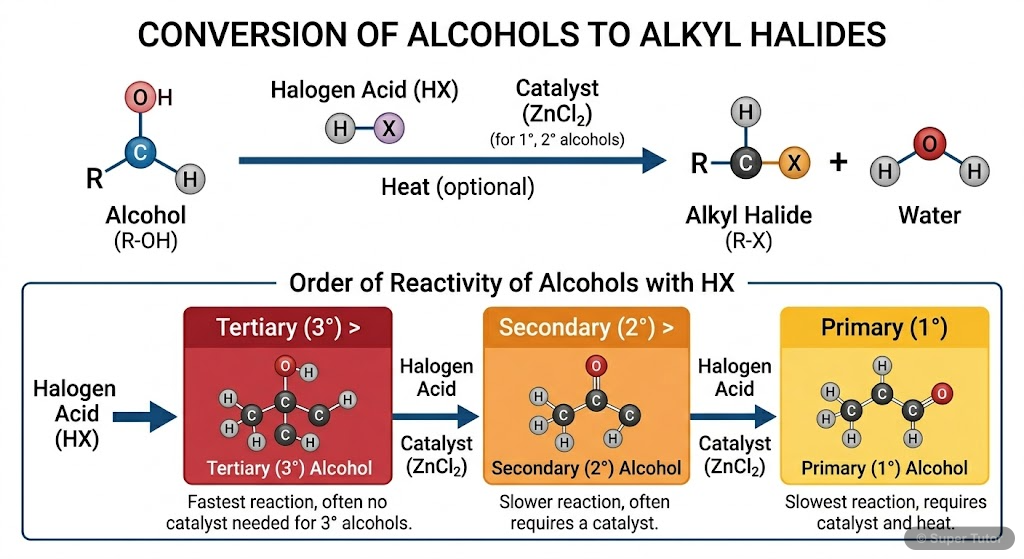
One of 33 illustrations for Haloalkanes and Haloarenes in Super Tutor — alongside flashcards, concept maps and practice questions.
The first 15 solutions are open to read. The other 14 are free with a Super Tutor account.
Intext Questions
6.2Why is sulphuric acid not used during the reaction of alcohols with KI?Show solution
Given: Reaction of alcohols with KI to prepare alkyl iodides.
Concept: KI is used with phosphoric acid (H₃PO₄) and not H₂SO₄ for the conversion of alcohols to alkyl iodides.
Explanation:
H₂SO₄ is an oxidising acid. If H₂SO₄ is used along with KI, the following side reactions occur:
The HI formed is then oxidised by H₂SO₄:
Thus H₂SO₄ oxidises HI (and KI) to I₂, which cannot act as a nucleophile for the substitution reaction. Hence H₂SO₄ is not used; instead, non-oxidising acids like H₃PO₄ are used.
6.3Write structures of different dihalogen derivatives of propane.Show solution
Given: Propane, ; dihalogen derivatives (using Cl as representative halogen).
Concept: Replace two hydrogen atoms of propane with halogen atoms in all possible ways.
The different dihalogen derivatives of propane are:
(i) 1,1-Dichloropropane:
(ii) 1,2-Dichloropropane:
(iii) 1,3-Dichloropropane:
(iv) 2,2-Dichloropropane:
(v) 1,1-Dichloropropane (gem on C1) is listed above; additionally:
All four structural isomers:
- — 1,3-dichloropropane
- — 1,2-dichloropropane
- — 2,2-dichloropropane
- — 1,1-dichloropropane
6.4Among the isomeric alkanes of molecular formula , identify the one that on photochemical chlorination yields (i) A single monochloride. (ii) Three isomeric monochlorides. (iii) Four isomeric monochlorides.Show solution
Note: The molecular formula given in the text appears as but in context of isomeric alkanes yielding mono-chloro products, the correct formula should be (pentane isomers). Solutions are given accordingly.
Given: Isomers of : n-pentane, isopentane (2-methylbutane), neopentane (2,2-dimethylpropane).
Concept: Photochemical chlorination replaces H atoms. The number of monochloride products equals the number of sets of equivalent (chemically distinct) hydrogen atoms.
(i) Single monochloride:
2,2-Dimethylpropane (Neopentane):
All 12 hydrogen atoms are equivalent (all are on methyl groups attached to the central carbon). Hence only one monochloride is formed:
(ii) Three isomeric monochlorides:
2-Methylbutane (Isopentane):
Distinct types of H atoms:
- groups at C-1 and C-4 (equivalent, 6H)
- at C-2 (3H)
- at C-2 (1H)
- at C-3 (2H)
Wait — this gives 4 types. Let us recount:
- C1: — the two methyl groups on C2 are equivalent (6H)
- C2: tertiary H (1H)
- C3: (2H)
- C4: terminal (3H)
This gives 4 types. So isopentane gives 4 monochlorides.
n-Pentane:
Distinct H types:
- C1 (and C5): (6H equivalent)
- C2 (and C4): (4H equivalent)
- C3: (2H)
This gives 3 types → 3 isomeric monochlorides.
(iii) Four isomeric monochlorides:
2-Methylbutane (Isopentane):
Four distinct H environments → 4 isomeric monochlorides.
6.5Draw the structures of major monohalo products in each of the following reactions:
(i) Isobutane + Cl₂ (hν)
(ii) 2-Methylbutane + Cl₂ (hν)
(iii) Cyclopentane + Br₂ (hν)
(iv) Methylcyclohexane + Cl₂ (hν)
(v) CH₃CH₂Br + NaI →
(vi) CH₄ + Br₂ (heat/UV light)Show solution
Note: Structures (i)–(iv) are given as images in the source. The reactions are interpreted from context.
(i) Isobutane + Cl₂ (hν):
Isobutane:
Tertiary C–H bond is weaker and more reactive toward free radical halogenation. The major product is the tertiary chloride:
(ii) 2-Methylbutane + Cl₂ (hν):
2-Methylbutane:
The tertiary H at C-2 is most reactive. Major product:
(iii) Cyclopentane + Br₂ (hν):
All H atoms in cyclopentane are equivalent. Only one monobromo product is possible:
(iv) Methylcyclohexane + Cl₂ (hν):
The tertiary C–H (at C-1, bearing the methyl group) is most reactive. Major product:
(v)
This is a Finkelstein reaction (halogen exchange, ):
Major product: Iodoethane (ethyl iodide)
(vi)
Free radical bromination of methane:
Major product: Bromomethane (methyl bromide)
6.7Which alkyl halide from the following pairs would you expect to react more rapidly by an mechanism? Explain your answer.
(i) or (with Br)
(ii) (with Br) or (tertiary)
(iii) or (with CH₃ branch)Show solution
Concept: reaction rate depends on steric hindrance at the carbon bearing the leaving group. Less hindered (less substituted) carbon reacts faster in .
(i) (1° — n-butyl bromide) vs. (2° — sec-butyl bromide)
n-Butyl bromide (1°) reacts faster by because the carbon bearing Br has less steric hindrance (only one alkyl group) compared to the secondary carbon (two alkyl groups) in sec-butyl bromide.
(ii) (2° — sec-butyl bromide) vs. (3° — tert-butyl bromide)
sec-Butyl bromide (2°) reacts faster by because tertiary carbon is highly hindered (three alkyl groups), making backside attack by nucleophile very difficult.
(iii) (1°, but with branching at C-3) vs. (1°, branching at C-2)
Both are primary halides, but branching closer to the reaction centre causes more steric hindrance. In , the branch is at the -carbon (C-2), causing more hindrance to backside attack than in where the branch is at the -carbon (C-3).
6.8In the following pairs of halogen compounds, which compound undergoes faster reaction?
(i) Two compounds (structures given as images)
(ii) Two compounds (structures given as images)Show solution
Concept: reaction rate depends on the stability of the carbocation intermediate formed. More stable carbocation → faster reaction. Stability order: 3° > 2° > 1° > methyl. Benzylic and allylic carbocations are also stabilised by resonance.
(i) Since the structures are given as images (not visible), the general principle is:
The compound that forms the more stable carbocation upon ionisation will undergo faster. A tertiary or benzylic/allylic halide will react faster than a primary or secondary halide.
(ii) Similarly, the compound forming the more stable (higher substituted or resonance-stabilised) carbocation reacts faster by .
General Answer: In each pair, the compound with the more substituted carbon bearing the halogen (tertiary > secondary > primary) or with resonance stabilisation of the carbocation (benzylic, allylic) undergoes faster reaction.
6.9Identify A, B, C, D, E, R and in the following:
Show solution
Concept: Grignard reagent formation: (Grignard reagent). Hydrolysis with H₂O gives R-H; with D₂O gives R-D.
Reaction 1:
- A = R-MgX (Grignard reagent)
- B = R-H (hydrocarbon)
Reaction 2:
Product with D₂O is which is — actually the product is propane with one D: (2-deuteropropane) or (1-deuteropropane).
From the formula : this suggests the Grignard reagent C is — isopropyl magnesium halide, formed from isopropyl halide.
So: (isopropyl halide)
- C = (isopropyl magnesium halide)
- Product with D₂O: (2-deuteropropane)
Reaction 3:
Wurtz reaction of with Na gives — but this is the Wurtz product. However, the sequence shows R'-X is formed first, then Grignard D, then hydrolysis gives E.
Actually, re-reading: with Na in ether undergoes Wurtz reaction with another molecule R'-X. If R' = , then:
- R'-X = (tert-butyl halide)
- D = (tert-butyl magnesium halide, Grignard reagent)
- E = (2-methylpropane / isobutane)
Summary:
- R = isopropyl group, = isopropyl halide (e.g., )
- A =
- B = (propane)
- C =
- R' = tert-butyl, =
- D =
- E = (isobutane)
Exercise 6.1
6.1Name the following halides according to IUPAC system and classify them as alkyl, allyl, benzyl (primary, secondary, tertiary), vinyl or aryl halides:
(i)
(ii)
(iii)
(iv)
(v)
(vi)
(vii) (Note: likely )
(viii)
(ix)
(x)
(xi)
(xii) Show solution
(i)
Longest chain containing C–Cl: 4 carbons (butane). Cl is on C-2, methyl branch on C-3.
IUPAC Name: 2-Chloro-3-methylbutane
Classification: Secondary (2°) alkyl halide (Cl on secondary carbon)
(ii)
Expand:
Longest chain: 6 carbons (hexane). Cl on C-3, methyl on C-4.
IUPAC Name: 3-Chloro-4-methylhexane
Classification: Secondary (2°) alkyl halide
(iii)
Longest chain: 4 carbons. I on C-1, two methyl groups on C-2, ethyl on C-2.
Actually:
Longest chain including I-bearing carbon: C1(CH₂I)–C2(C(CH₃)₂)–C3(CH₂)–C4(CH₃) = 4C with two methyls at C2.
IUPAC Name: 1-Iodo-2,2-dimethylbutane
Classification: Primary (1°) alkyl halide
(iv)
The carbon bearing Br is also attached to (phenyl group) and two other carbons → benzylic position.
Longest chain: C1(CH(Br))–C2(CH₂)–C3(C(CH₃)₃) = 3 carbons with tert-butyl at C2 and phenyl at C1.
Name as: 1-Bromo-1-phenyl-3,3-dimethylbutane
Classification: Benzyl halide, secondary (2°)
(v)
This is:
Longest chain: 4 carbons. Br on C-2, methyl on C-3.
IUPAC Name: 2-Bromo-3-methylbutane
Classification: Secondary (2°) alkyl halide
(vi)
Expand:
Longest chain: C1(CH₂Br)–C2(C)–C3(CH₂)–C4(CH₃) = 4C, with methyl and ethyl at C2.
Actually longest chain through C2: C4H chain with two ethyl groups? Let's count:
Longest chain: 5 carbons (including one ethyl): C1(CH₂Br)–C2(C)–C3(CH₂)–C4(CH₂)–C5(CH₃), with methyl and ethyl substituents at C2.
IUPAC Name: 1-Bromo-2-ethyl-2-methylbutane
Classification: Primary (1°) alkyl halide
(vii)
This is: central C bearing Cl, CH₃, C₂H₅, and CH₂CH₃.
Longest chain: C1(CH₃)–C2(CCl)–C3(CH₂)–C4(CH₃) = 4C with ethyl at C2.
IUPAC Name: 2-Chloro-2-methylbutane
Classification: Tertiary (3°) alkyl halide
(viii)
Longest chain containing double bond and Cl: C1(CH₃)–C2(CH=)–C3(=CCl)–C4(CH₂)–C5(CH)–C6(CH₃) with methyl at C5.
IUPAC Name: 3-Chloro-5-methylhex-2-ene
Classification: Vinyl halide (Cl on sp² carbon of double bond)
(ix)
Longest chain: C1(CH₃)–C2(CH=)–C3(=CH)–C4(CBr(CH₃)₂) = 4C with two methyls at C4 and Br at C4.
Numbering from Br end: C1(C(Br)(CH₃)₂)–C2(CH=)–C3(=CH)–C4(CH₃)
Give lower locant to double bond: but-2-ene with Br at C1 and two methyls at C1.
IUPAC Name: 1-Bromo-1-methylbut-2-ene (or 3-Bromo-3-methylbut-1-ene)
Using lowest locant rule for double bond: 3-Bromo-3-methylbut-1-ene
Classification: Allylic halide (Br on carbon adjacent to C=C), tertiary (3°)
(x)
Cl is directly on benzene ring (aryl Cl). The side chain is isobutyl.
IUPAC Name: 1-Chloro-4-(2-methylpropyl)benzene
Classification: Aryl halide
(xi)
Here is a chloromethyl group attached to benzene ring at meta position. The Cl is on the benzylic carbon (CH₂ attached to ring).
IUPAC Name: 1-(Chloromethyl)-3-(2,2-dimethylpropyl)benzene
Classification: Benzyl halide, primary (1°)
(xii)
Br is directly on benzene ring. The substituent at ortho position is sec-butyl: .
IUPAC Name: 1-Bromo-2-(1-methylpropyl)benzene or 1-Bromo-2-sec-butylbenzene
Classification: Aryl halide
Exercise 6.2
6.2Give the IUPAC names of the following compounds:
(i)
(ii)
(iii)
(iv)
(v)
(vi) -Show solution
(i)
Chain: 4 carbons (butane). Cl on C-2, Br on C-3.
Number to give lower locants: Cl at C-2, Br at C-3.
IUPAC Name: 2-Bromo-3-chlorobutane
(Alphabetical order: bromo before chloro; numbering gives 2,3 from either end — choose end giving lower locant to first-cited substituent alphabetically: Br gets 3, Cl gets 2 → set {2,3}; from other end Br gets 2, Cl gets 3 → set {2,3}. Same. Use alphabetical: bromo cited first, so give Br lower number → 2-Bromo-3-chlorobutane.)
(ii)
Two-carbon chain (ethane). C1: CHF₂; C2: CBrClF.
Substituents: Br, Cl, F, F, F → on C1: 2F, 1H; on C2: Br, Cl, F.
Number to give lower locants: C1 has F,F; C2 has Br,Cl,F.
IUPAC Name: 2-Bromo-2-chloro-1,1,2-trifluoroethane
(Halothane is a common name for this compound.)
(iii)
Four-carbon chain with triple bond between C2 and C3 (but-2-yne). Cl on C1, Br on C4.
IUPAC Name: 1-Bromo-4-chlorobut-2-yne
(Number from Br end to give lower locant to triple bond: Br at C1, Cl at C4, triple bond at C2–C3.)
(iv)
Central carbon bears Cl and three CCl₃ groups. Total carbons = 4 (neopentane skeleton). Central C: C with Cl; three terminal C: each with 3 Cl.
This is 2-carbon? No: = C(CCl₃)₃Cl.
Longest chain: 2 carbons. But with three CCl₃ branches on one carbon:
Actually this is a 4-carbon compound: central C + 3 × CCl₃. Longest chain = 2C (one CCl₃ + central C). Substituents: 2 × CCl₃ (as trichloromethyl) on C2, Cl on C2.
IUPAC Name: 1,1,1-Trichloro-2,2,2-tris(trichloromethyl)ethane
Alternatively treating as methane derivative: 2-(trichloromethyl)-1,1,1,3,3,3-hexachloropropane...
Simplest: The compound is 2-carbon: is hexachloroethane; here we have .
Longest chain = 2C: (C1) — (C2).
IUPAC Name: 1,1,1,2-Tetrachloro-2,2-bis(trichloromethyl)ethane
(Note: This is a complex polychlorinated compound; the systematic name reflects all substituents.)
(v)
Chain: C1(CH₃)–C2(C(Ar)₂)–C3(CHBr)–C4(CH₃) = 4 carbons (butane). Br on C3, two (4-chlorophenyl) groups on C2.
IUPAC Name: 3-Bromo-2,2-bis(4-chlorophenyl)butane
(vi)
Chain: C1(C(CH₃)₃)–C2(CH=)–C3(=CCl)–C6H4I(p) attached to C3.
Longest chain including double bond: C1(tBu carbon)... actually the tert-butyl is a substituent.
Longest chain: C1–C2=C3 with (4-iodophenyl) on C3 and Cl on C3, tert-butyl on C1.
As a 3-carbon chain (prop-1-ene): C1(=CH–C(CH₃)₃)–C2...
Renumber: C1(CCl(Ar)=)–C2(=CH)–C3(C(CH₃)₃)
IUPAC Name: 1-Chloro-1-(4-iodophenyl)-3,3-dimethylbut-1-ene
Exercise 6.3
6.3Write the structures of the following organic halogen compounds:
(i) 2-Chloro-3-methylpentane
(ii) -Bromochlorobenzene
(iii) 1-Chloro-4-ethylcyclohexane
(iv) 2-(2-Chlorophenyl)-1-iodooctane
(v) 2-Bromobutane
(vi) 4-tert-Butyl-3-iodoheptane
(vii) 1-Bromo-4-sec-butyl-2-methylbenzene
(viii) 1,4-Dibromobut-2-eneShow solution
(i) 2-Chloro-3-methylpentane:
(ii) -Bromochlorobenzene:
Benzene ring with Br and Cl at para positions (1,4):
(Cl at C-1, Br at C-4 of benzene ring)
(iii) 1-Chloro-4-ethylcyclohexane:
Cyclohexane ring with Cl at C-1 and ethyl group () at C-4.
(iv) 2-(2-Chlorophenyl)-1-iodooctane:
(8-carbon chain, I at C-1, 2-chlorophenyl group at C-2)
(v) 2-Bromobutane:
(vi) 4-tert-Butyl-3-iodoheptane:
(7-carbon chain, I at C-3, tert-butyl at C-4)
(vii) 1-Bromo-4-sec-butyl-2-methylbenzene:
Benzene ring with:
- Br at C-1
- Methyl () at C-2
- sec-Butyl () at C-4
(viii) 1,4-Dibromobut-2-ene:
Exercise 6.4
6.4Which one of the following has the highest dipole moment?
(i)
(ii)
(iii) Show solution
Given: Three chloromethane derivatives.
Concept: Dipole moment depends on the vector sum of individual bond dipoles. In a symmetric molecule, bond dipoles cancel.
- : Tetrahedral, perfectly symmetric. All four C–Cl bond dipoles cancel completely. Dipole moment = 0.
- (Chloroform): Three C–Cl bonds point in similar directions; the C–H bond dipole is small and in the opposite direction. The net dipole moment is significant but partial cancellation occurs. D.
- (Dichloromethane): Two C–Cl bonds and two C–H bonds. The two C–Cl dipoles add up (they are on the same side), and the two C–H dipoles also add up (opposite side). The resultant is the largest among the three. D.
Wait — comparing values: : 1.60 D; : 1.87 D.
has the highest dipole moment among the three because in there is more cancellation between the two Cl–C–Cl vectors, while in the three C–Cl dipoles reinforce each other more effectively.
Answer: (ii) has the highest dipole moment.
Justification: In , all dipoles cancel (μ = 0). In , partial cancellation gives μ ≈ 1.60 D. In , three C–Cl dipoles point in nearly the same direction with only one C–H dipole opposing, giving μ ≈ 1.87 D (highest).
Exercise 6.5
6.5A hydrocarbon does not react with chlorine in dark but gives a single monochloro compound in bright sunlight. Identify the hydrocarbon.Show solution
Given: Molecular formula ; no reaction with in dark; single monochloro product in sunlight.
Analysis:
- with degree of unsaturation = . So it has one degree of unsaturation — either a ring or a double bond.
- No reaction with in dark rules out alkenes (which undergo addition with in dark). So it must be a cycloalkane.
- Single monochloro product in sunlight (free radical substitution) means all hydrogen atoms in the molecule are equivalent.
- Among cycloalkanes: Cyclopentane has all 10 H atoms equivalent (all are groups in a symmetric ring). Substitution of any H gives the same product: chlorocyclopentane.
The hydrocarbon is Cyclopentane.
All 10 hydrogen atoms in cyclopentane are equivalent, so only one monochloro product (chlorocyclopentane) is formed.
Exercise 6.6
6.6Write the isomers of the compound having formula .Show solution
Given: Molecular formula (monobromo derivatives of butane).
Concept: Write all possible structural isomers by placing Br at different positions on the butane skeleton.
The four isomers are:
(i) 1-Bromobutane (n-butyl bromide):
(ii) 2-Bromobutane (sec-butyl bromide):
(iii) 1-Bromo-2-methylpropane (isobutyl bromide):
(iv) 2-Bromo-2-methylpropane (tert-butyl bromide):
These are all four structural isomers of .
Exercise 6.7
6.7Write the equations for the preparation of 1-iodobutane from
(i) 1-butanol
(ii) 1-chlorobutane
(iii) but-1-ene.Show solution
(i) From 1-butanol:
Reaction of 1-butanol with HI (or KI + H₃PO₄):
Alternatively using red phosphorus and iodine:
(ii) From 1-chlorobutane (Finkelstein reaction):
Halogen exchange using NaI in dry acetone:
NaCl precipitates out of acetone, driving the equilibrium forward.
(iii) From but-1-ene:
Addition of HI to but-1-ene. By Markovnikov's rule, H adds to C-1 and I adds to C-2, giving 2-iodobutane. To get 1-iodobutane, anti-Markovnikov addition is needed using HI in the presence of peroxides:
(Note: Peroxide effect/anti-Markovnikov addition works well for HBr but not for HI. An alternative route: add HBr with peroxide to get 1-bromobutane, then Finkelstein reaction with NaI to get 1-iodobutane.)
Exercise 6.8
6.8What are ambident nucleophiles? Explain with an example.Show solution
Definition: Ambident nucleophiles are nucleophiles that have two different nucleophilic sites (two atoms through which they can attack an electrophile), and can form two different products depending on which site attacks.
Example: Cyanide ion ()
The cyanide ion has two nucleophilic sites:
- Through carbon (C) → forms nitrile (alkyl cyanide, R–C≡N)
- Through nitrogen (N) → forms isonitrile (isocyanide, R–N≡C)
Another example: Nitrite ion ()
- Attack through oxygen → forms nitrite ester (R–O–N=O)
- Attack through nitrogen → forms nitroalkane (R–NO₂)
Such nucleophiles are called ambident nucleophiles because they can donate electrons from either of two sites.
Exercise 6.9
(i) or
(ii) or
Free with a Super Tutor account
Exercise 6.10
(i) 1-Bromo-1-methylcyclohexane
(ii) 2-Chloro-2-methylbutane
(iii) 2,2,3-Trimethyl-3-bromopentane
Free with a Super Tutor account
Exercise 6.11
(i) Ethanol to but-1-yne
(ii) Ethane to bromoethene
(iii) Propene to 1-nitropropane
(iv) Toluene to benzyl alcohol
(v) Propene to propyne
(vi) Ethanol to ethyl fluoride
(vii) Bromomethane to propanone
(viii) But-1-ene to but-2-ene
(ix) 1-Chlorobutane to n-octane
(x) Benzene to biphenyl
Free with a Super Tutor account
Exercise 6.12
(i) the dipole moment of chlorobenzene is lower than that of cyclohexyl chloride?
(ii) alkyl halides, though polar, are immiscible with water?
(iii) Grignard reagents should be prepared under anhydrous conditions?
Free with a Super Tutor account
Exercise 6.13
Free with a Super Tutor account
Exercise 6.14
(i)
(ii)
(iii)
(iv)
(v)
(vi)
(vii)
(viii)
Free with a Super Tutor account
Exercise 6.15
Free with a Super Tutor account
Exercise 6.16
(i) 2-Bromo-2-methylbutane, 1-Bromopentane, 2-Bromopentane
(ii) 1-Bromo-3-methylbutane, 2-Bromo-2-methylbutane, 2-Bromo-3-methylbutane
(iii) 1-Bromobutane, 1-Bromo-2,2-dimethylpropane, 1-Bromo-2-methylbutane, 1-Bromo-3-methylbutane
Free with a Super Tutor account
Exercise 6.17
Free with a Super Tutor account
Exercise 6.18
Free with a Super Tutor account
Exercise 6.19
(i) Propene to propan-1-ol
(ii) Ethanol to but-1-yne
(iii) 1-Bromopropane to 2-bromopropane
(iv) Toluene to benzyl alcohol
(v) Benzene to 4-bromonitrobenzene
(vi) Benzyl alcohol to 2-phenylethanoic acid
(vii) Ethanol to propanenitrile
(viii) Aniline to chlorobenzene
(ix) 2-Chlorobutane to 3,4-dimethylhexane
(x) 2-Methyl-1-propene to 2-chloro-2-methylpropane
(xi) Ethyl chloride to propanoic acid
(xii) But-1-ene to n-butyliodide
(xiii) 2-Chloropropane to 1-propanol
(xiv) Isopropyl alcohol to iodoform
(xv) Chlorobenzene to -nitrophenol
(xvi) 2-Bromopropane to 1-bromopropane
(xvii) Chloroethane to butane
(xviii) Benzene to diphenyl
(xix) tert-Butyl bromide to isobutyl bromide
(xx) Aniline to phenylisocyanide
Free with a Super Tutor account
Exercise 6.20
Free with a Super Tutor account
Exercise 6.21
Free with a Super Tutor account
Exercise 6.22
(i) n-butyl chloride is treated with alcoholic KOH,
(ii) bromobenzene is treated with Mg in the presence of dry ether,
(iii) chlorobenzene is subjected to hydrolysis,
(iv) ethyl chloride is treated with aqueous KOH,
(v) methyl bromide is treated with sodium in the presence of dry ether,
(vi) methyl chloride is treated with KCN?
Free with a Super Tutor account
14 more solved questions in Haloalkanes and Haloarenes
They are free with a Super Tutor account, along with practice quizzes and flashcards for this chapter. Free to start, no card needed.
Frequently Asked Questions
What are the important topics in Haloalkanes and Haloarenes for Manipur Board Class 12 Chemistry?
Are these NCERT Solutions for Haloalkanes and Haloarenes free?
How should I revise Haloalkanes and Haloarenes for the Manipur Board Class 12 board exam?
Sources & Official References
Content is aligned to the official syllabus. Refer to the board website for the latest curriculum.
More resources for Haloalkanes and Haloarenes
Practice Quiz
Test yourself with a quick quiz
Important Questions
Exam-style questions with answers
Revision Notes
Key points for last-minute revision
Formula Sheet
The chapter's formulas in one place
Chapter Summary
Understand the chapter at a glance
Concept Maps
See how topics connect
Study Plan
Step-by-step plan for this chapter
Flashcards
Quick-fire cards for active recall
Syllabus
What topics to cover
For serious students
Get the full Haloalkanes and Haloarenes chapter — start free.
Quizzes, flashcards, an AI doubt solver and a study plan for Manipur Board Class 12 Chemistry. Free to start, no card needed.