International Trade
Manipur Board · Class 12 · Geography
NCERT Solutions for International Trade — Manipur Board Class 12 Geography.
Interactive on Super Tutor
Studying International Trade? Get the full interactive chapter.
Quizzes, flashcards, AI doubt-solver and a step-by-step study plan — built for ncert solutions and more.
1,000+ Class 12 students started this chapter today

Super Tutor has 7+ illustrations like this for International Trade alone — flashcards, concept maps, and step-by-step visuals.
See them allEXERCISES
1(i)Trade between two countries is termed as
(a) Internal trade
(b) External trade
(c) International trade
(d) Local tradeShow solution
Trade that takes place between two or more countries is called International trade. It involves the exchange of goods and services across national boundaries, unlike internal or local trade which occurs within a country.
1(ii)Which one of the following is a land locked harbour?
(a) Vishakhapatnam
(b) Mumbai
(c) Kamarajar (Ennore)
(d) HaldiaShow solution
Vishakhapatnam (Visakhapatnam) is a land-locked harbour located on the east coast of India. It is protected from the sea by a narrow strip of land (sand spit), making it a natural land-locked harbour. It had to be connected to the sea by cutting through the sand bar.
1(iii)Most of India's foreign trade is carried through
(a) Land and sea
(b) Land and air
(c) Sea and air
(d) SeaShow solution
Most of India's foreign trade is carried through sea and air routes. Sea routes handle the bulk of trade (about 95% by volume) due to their large carrying capacity and lower cost, while air transport is used for high-value, low-volume and perishable goods.
2(i)Mention the characteristics of India's foreign trade.Show solution
1. Volume: India's foreign trade has grown significantly in volume and value since Independence.
2. Composition: India exports engineering goods, petroleum products, gems and jewellery, chemicals, textiles, etc. It imports crude oil, machinery, fertilisers, chemicals, and gold.
3. Direction: India trades with a large number of countries. Major trading partners include the USA, China, UAE, Saudi Arabia, and European nations.
4. Balance of Trade: India generally has a trade deficit, meaning the value of imports exceeds the value of exports.
5. Ports: Most foreign trade is conducted through major seaports and airports located along the coastline.
2(ii)Distinguish between port and harbour.Show solution
| Port | Harbour |
|---|---|
| A port is a place where ships dock to load and unload cargo and passengers. | A harbour is a sheltered body of water where ships can anchor safely. |
| A port has all the necessary infrastructure like warehouses, docks, cranes, and customs facilities. | A harbour may or may not have such commercial infrastructure. |
| Every port has a harbour. | Every harbour need not be a port. |
| Example: Mumbai Port, Chennai Port. | Example: A natural creek or bay used for shelter. |
In short, a harbour provides shelter to ships, while a port is a harbour with commercial and loading/unloading facilities.
2(iii)Explain the meaning of hinterland.Show solution
The term hinterland refers to the area lying behind a port or harbour that is served by that port. It is the region from which goods are collected for export and to which imported goods are distributed.
- The hinterland of a port is connected to it through a network of roads, railways, and waterways.
- A port with a large and productive hinterland handles more trade.
- For example, the hinterland of Mumbai port includes Maharashtra, Madhya Pradesh, and parts of Gujarat and Rajasthan.
2(iv)Name important items which India imports from different countries.Show solution
India imports a wide variety of goods from different countries. The major import items include:
1. Petroleum and petroleum products – from Gulf countries (Saudi Arabia, Iraq, UAE)
2. Machinery and equipment – from USA, Germany, Japan
3. Electronic goods – from China, South Korea
4. Gold and silver – from Switzerland, UAE
5. Fertilisers – from Russia, China
6. Chemicals – from various countries
7. Edible oils – from Malaysia, Indonesia
8. Pulses – from Australia, Canada
Petroleum products constitute the largest share of India's import bill.
2(v)Name the ports of India located on the east coast.Show solution
The following major ports are located on the eastern coast (Coromandel Coast and Northern Circars) of India:
1. Kolkata (including Haldia) – West Bengal
2. Paradip – Odisha
3. Vishakhapatnam – Andhra Pradesh
4. Kamarajar (Ennore) – Tamil Nadu
5. Chennai – Tamil Nadu
6. Tuticorin (V.O. Chidambaranar Port) – Tamil Nadu
These ports handle a significant share of India's foreign trade, especially coal, iron ore, and other bulk commodities.
3(i)Describe the composition of export and import trade of India.Show solution
Exports:
India's export basket has diversified and changed significantly over the decades. Major items of export include:
1. Engineering Goods: This is the largest export category, including machinery, transport equipment, and metal manufactures.
2. Petroleum Products: Refined petroleum products are a major export item.
3. Gems and Jewellery: India is a major exporter of cut and polished diamonds and gold jewellery.
4. Chemicals and Allied Products: Includes drugs, pharmaceuticals, and cosmetics.
5. Textiles: Cotton yarn, fabrics, readymade garments, and handicrafts.
6. Agriculture and Allied Products: Rice (especially Basmati), spices, tea, coffee, cashew, and marine products.
7. Ores and Minerals: Iron ore and other minerals.
Imports:
India's import composition reflects its developmental needs and resource deficiencies:
1. Petroleum, Crude and Products: This is the single largest import item, accounting for a major share of the total import bill.
2. Capital Goods: Machinery, machine tools, electrical equipment needed for industrial development.
3. Electronic Goods: Computers, telecom equipment.
4. Gold and Silver: India is one of the largest importers of gold in the world.
5. Chemicals and Fertilisers: Required for agriculture and industry.
6. Edible Oils: Palm oil and other vegetable oils.
7. Pulses: To meet domestic food requirements.
Conclusion: India's trade composition shows a shift from primary goods to manufactured and value-added goods in exports, while imports are dominated by energy needs and capital goods required for economic growth.
3(ii)Write a note on the changing nature of the international trade of India.Show solution
India's international trade has undergone significant changes since Independence in terms of volume, composition, and direction.
1. Changes in Volume:
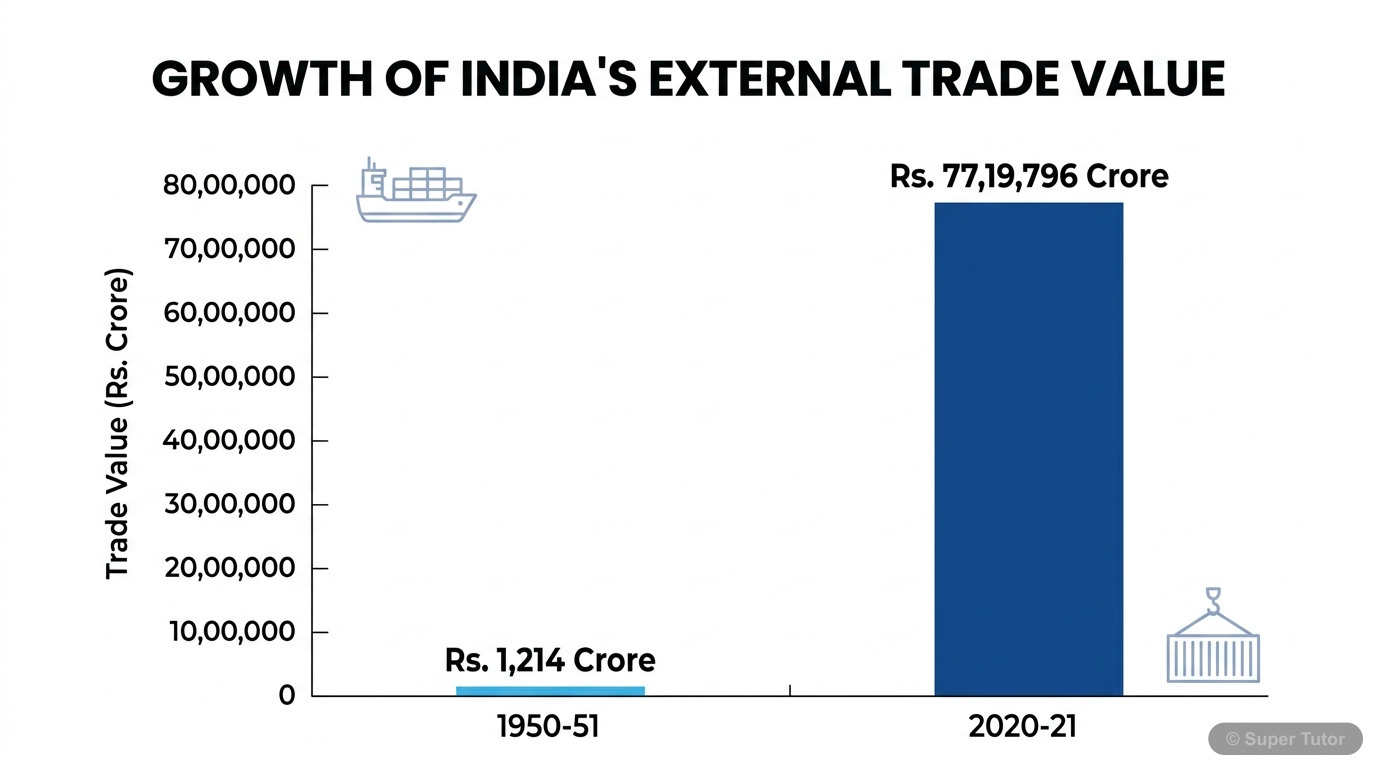
The volume and value of India's foreign trade have increased manifold since 1947. Liberalisation, privatisation, and globalisation (LPG reforms of 1991) gave a major boost to India's trade. India is now one of the leading trading nations of the world.
2. Changes in Composition of Exports:
- Before Independence, India mainly exported raw materials like cotton, jute, and tea.
- After Independence, the share of manufactured goods increased.
- Today, engineering goods, petroleum products, gems and jewellery, chemicals, and software services dominate exports.
- The share of traditional items like tea and jute has declined.
3. Changes in Composition of Imports:
- Earlier, India imported mostly consumer goods and manufactured products.
- Now, the import basket is dominated by petroleum and crude oil, capital goods, electronic goods, and gold.
- With industrial development, the import of machinery and technology has increased.
4. Changes in Direction of Trade:
- Before Independence, India's trade was largely confined to the UK and Commonwealth countries.
- After Independence, trade relations diversified.
- Today, India's major trading partners include the USA, China, UAE, Saudi Arabia, Germany, Hong Kong, and other Asian and European nations.
- Trade with ASEAN countries and the Middle East has grown considerably.
5. Trade Balance:
- India has generally faced a trade deficit (imports exceeding exports).
- However, earnings from software exports, remittances, and services have helped improve the overall balance of payments.
Conclusion: The international trade of India has become more diversified, dynamic, and globally integrated. The shift from a primary-goods-based trade to a manufactured and service-oriented trade reflects India's growing economic strength.
Stuck on a step?
Ask Super Tutor AI to explain any solution on this page in a simpler way — free, 24x7.
Ask a Doubt FreeFrequently Asked Questions
What are the important topics in International Trade for Manipur Board Class 12 Geography?
How to score full marks in International Trade — Manipur Board Class 12 Geography?
Where can I get free NCERT Solutions for International Trade Class 12 Geography?
Sources & Official References
Content is aligned to the official syllabus. Refer to the board website for the latest curriculum.
More resources for International Trade
Important Questions
Practice with board exam-style questions
Syllabus
What topics to cover
Revision Notes
Key points for last-minute revision
Study Plan
Step-by-step plan to ace this chapter
Flashcards
Quick-fire cards for active recall
Formula Sheet
All formulas in one place
Chapter Summary
Understand the chapter at a glance
Practice Quiz
Test yourself with a quick quiz
Concept Maps
See how topics connect visually
For serious students
Get the full International Trade chapter — for free.
Quizzes, flashcards, AI doubt-solver and a step-by-step study plan for Manipur Board Class 12 Geography.