Alternating Current — NCERT Solutions
Manipur Board · Class 12 · Physics
NCERT Solutions for Alternating Current, Manipur Board Class 12 Physics: 8 textbook questions solved step by step. Covers Exercises.
Interactive on Super Tutor
Studying Alternating Current? Get the full interactive chapter.
Quizzes, flashcards, AI doubt-solver and a step-by-step study plan — built for NCERT solutions and more.
Free trial, no card needed.
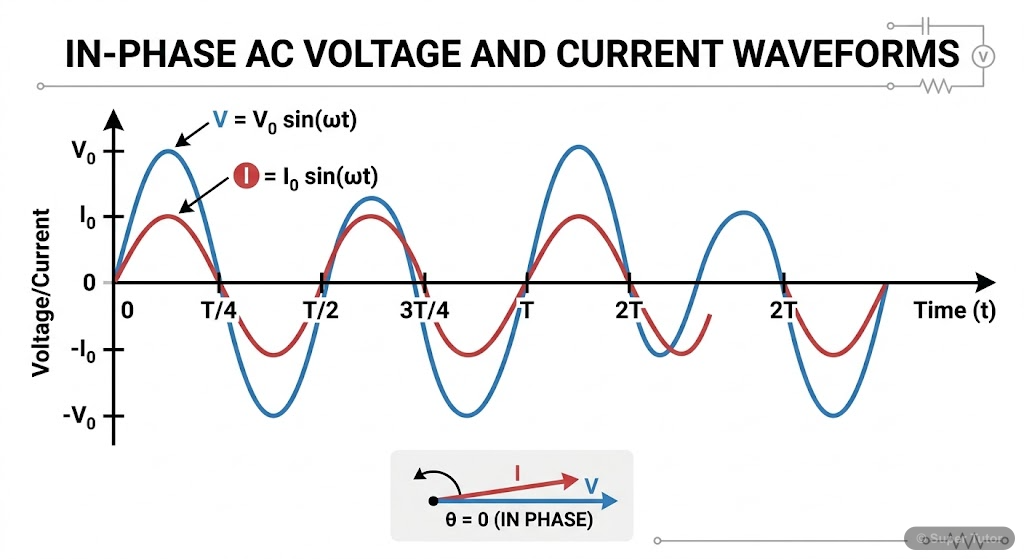
Learn better with visuals Super Tutor pairs illustrations like this with notes and quizzes for Alternating Current.
The first 4 solutions are open to read. The other 4 are free with a Super Tutor account.
Exercises
7.1A 100 Ω resistor is connected to a 220 V, 50 Hz ac supply.
(a) What is the rms value of current in the circuit?
(b) What is the net power consumed over a full cycle?Show solution
For a pure resistor, Ohm's law applies to rms values:
For a resistor, the power consumed over a full cycle is
So the rms current is and the net power consumed is .
7.2(a) The peak voltage of an ac supply is 300 V. What is the rms voltage?
(b) The rms value of current in an ac circuit is 10 A. What is the peak current?Show solution
(a) For ac quantities,
(b) Similarly,
So,
7.3A 44 mH inductor is connected to 220 V, 50 Hz ac supply. Determine the rms value of the current in the circuit.Show solution
For a pure inductor,
Given and :
The rms current is
So the rms current is .
7.4A 60 μF capacitor is connected to a 110 V, 60 Hz ac supply. Determine the rms value of the current in the circuit.Show solution
For a pure capacitor,
Given and :
Then
Free with a Super Tutor account
Free with a Super Tutor account
Free with a Super Tutor account
(a) Determine the source frequency which drives the circuit in resonance.
(b) Obtain the impedance of the circuit and the amplitude of current at the resonating frequency.
(c) Determine the rms potential drops across the three elements of the circuit. Show that the potential drop across the LC combination is zero at the resonating frequency.
Free with a Super Tutor account
4 more solved questions in Alternating Current
They are free with a Super Tutor account, along with practice quizzes and flashcards for this chapter. Free to start, no card needed.
Frequently Asked Questions
What are the important topics in Alternating Current for Manipur Board Class 12 Physics?
Are these NCERT Solutions for Alternating Current free?
How should I revise Alternating Current for the Manipur Board Class 12 board exam?
Sources & Official References
Content is aligned to the official syllabus. Refer to the board website for the latest curriculum.
More resources for Alternating Current
Practice Quiz
Test yourself with a quick quiz
Important Questions
Exam-style questions with answers
Revision Notes
Key points for last-minute revision
Formula Sheet
The chapter's formulas in one place
Chapter Summary
Understand the chapter at a glance
Concept Maps
See how topics connect
Study Plan
Step-by-step plan for this chapter
Flashcards
Quick-fire cards for active recall
Syllabus
What topics to cover
For serious students
Get the full Alternating Current chapter — start free.
Quizzes, flashcards, an AI doubt solver and a study plan for Manipur Board Class 12 Physics. Free to start, no card needed.