Era of one-party dominance — Study Plan
Manipur Board · Class 12 · Political Science
A step-by-step study plan for Era of one-party dominance, Manipur Board Class 12 Political Science: what to learn first, what to practise and when.
Interactive on Super Tutor
Studying Era of one-party dominance? Get the full interactive chapter.
Quizzes, flashcards, AI doubt-solver and a step-by-step study plan — built for study plan and more.
Free trial, no card needed.
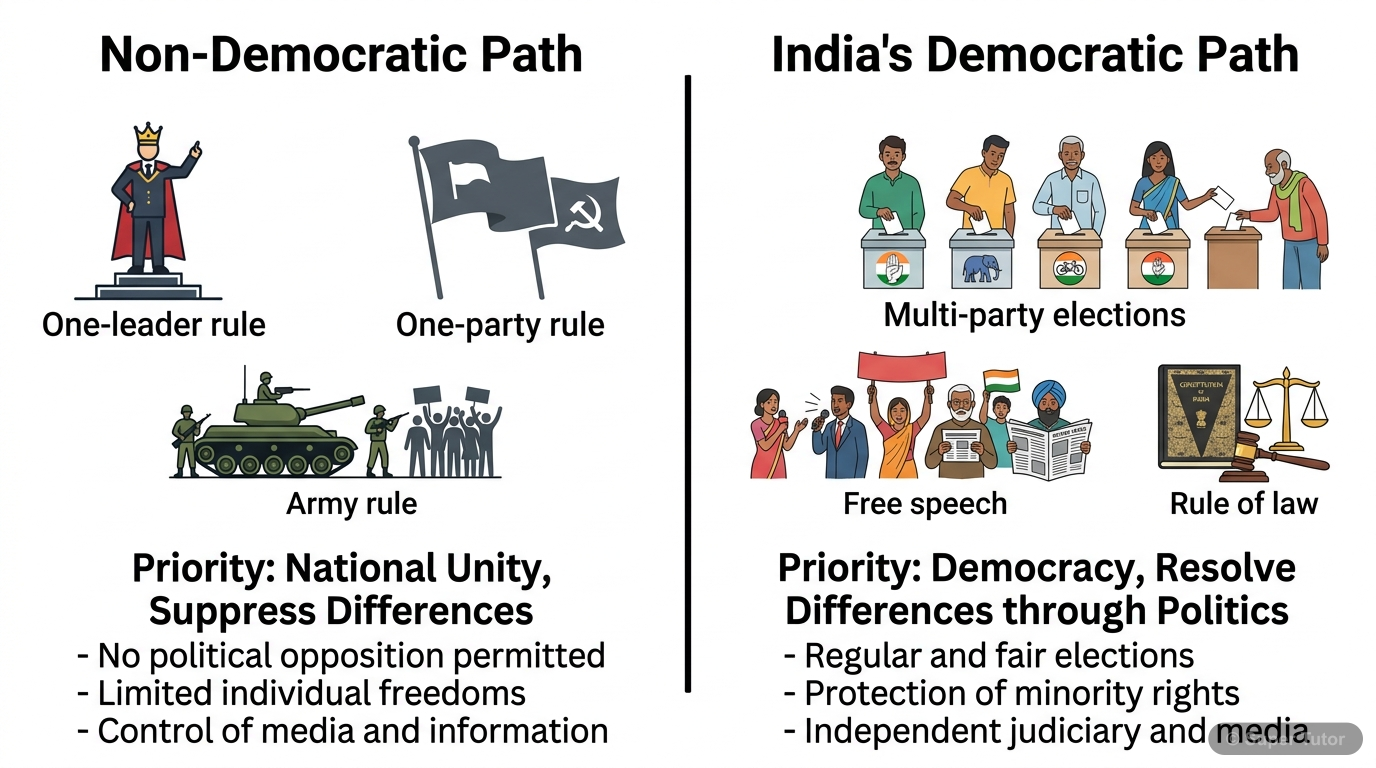
One of 15 illustrations for Era of one-party dominance in Super Tutor — alongside flashcards, concept maps and practice questions.
Study Plan
Learn the Theory
Read the textbook chapter carefully. Note down definitions, formulas and key ideas. Focus on: Building democracy after Independence, The first general election, Congress dominance in the first three elections.
Practise
Solve the textbook exercises and extra practice questions. There are 37 questions available for this chapter.
Revise & Test
Revise key points without looking at your notes. Take a practice quiz and mark weak areas for another pass.
Spaced Revision
Come back to Era of one-party dominance after a week. Use flashcards for quick recall and try past exam questions on this chapter.
What to Focus On
- Democracy in India began under difficult conditions.
- Some post-colonial countries chose non-democratic rule in the name of unity.
- Indian leaders treated politics as a solution, not a threat.
- The Election Commission was created in January 1950.
- Sukumar Sen was the first Chief Election Commissioner.
- Electoral rolls had to be carefully prepared and revised.
- The first election used box-voting with separate boxes for each candidate.
- About 20 lakh steel boxes were used.
- Later, stamped ballot papers replaced box-voting.
Common Mistakes to Avoid
Congress dominance meant India was a one-party state like China or Cuba.
The first general election took place entirely in 1952.
The Congress won because it was more popular than all the other parties combined in vote share.
Memory Tips
Constitution dates and democratic setup
Election Commission and first Chief Election Commissioner
Missing women from first draft electoral rolls
Scale of the first general election
Want a personalised study plan?
Super Tutor builds a day-by-day plan for Manipur Board Class 12 Political Science that fits your exam date and pace.
Create My Study PlanFrequently Asked Questions
What are the important topics in Era of one-party dominance for Manipur Board Class 12 Political Science?
How should I revise Era of one-party dominance for the Manipur Board Class 12 board exam?
Sources & Official References
Content is aligned to the official syllabus. Refer to the board website for the latest curriculum.
More resources for Era of one-party dominance
Practice Quiz
Test yourself with a quick quiz
Important Questions
Exam-style questions with answers
Revision Notes
Key points for last-minute revision
Chapter Summary
Understand the chapter at a glance
Concept Maps
See how topics connect
Flashcards
Quick-fire cards for active recall
Syllabus
What topics to cover
NCERT Solutions
Every textbook question solved step by step
For serious students
Get the full Era of one-party dominance chapter — start free.
Quizzes, flashcards, an AI doubt solver and a study plan for Manipur Board Class 12 Political Science. Free to start, no card needed.