Control and Coordination — Revision Notes
Meghalaya Board · Class 10 · Science
Control and Coordination revision notes for Meghalaya Board Class 10 Science: 4 topics in quick points. Includes Nervous System and Neuron, Reflex Action.
Interactive on Super Tutor
Studying Control and Coordination? Get the full interactive chapter.
Quizzes, flashcards, AI doubt-solver and a step-by-step study plan — built for revision notes and more.
Free trial, no card needed.
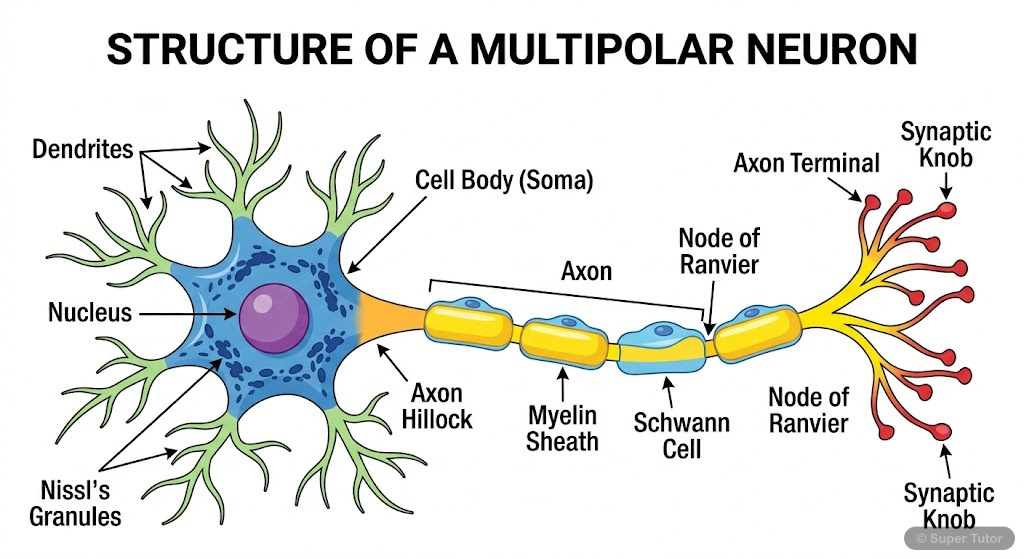
Learn better with visuals Super Tutor pairs illustrations like this with notes and quizzes for Control and Coordination.
Key Topics to Revise
Nervous System and Neuron
- A neuron, or nerve cell, is the basic unit of nervous tissue.
- Nervous tissue is an organised network of neurons specialised for carrying information by electrical impulses.
- Information is acquired at the dendritic tip of a neuron.
Reflex Action and Reflex Arc
- A reflex action is a quick, automatic response without conscious thinking.
- Examples include change in pupil size and pulling back from a hot object.
- A reflex arc is the connection between input nerve and output nerve formed in the spinal cord.
Human Brain and Its Parts
- The brain is the main coordinating centre of the body.
- It sits inside a bony box and is further protected by a fluid-filled balloon that absorbs shock.
- The brain has three major parts: fore-brain, mid-brain and hind-brain.
Actions in Animals
- The nervous system responses can be classified as reflex action, voluntary action or involuntary action.
- Voluntary actions are done by choice, such as moving a chair.
- Involuntary actions happen without conscious control.
Get complete notes with diagrams and examples
Full NotesKey Concepts
Frequently Asked Questions
What are the important topics in Control and Coordination for Meghalaya Board Class 10 Science?
How should I revise Control and Coordination for the Meghalaya Board Class 10 board exam?
Sources & Official References
Content is aligned to the official syllabus. Refer to the board website for the latest curriculum.
More resources for Control and Coordination
Practice Quiz
Test yourself with a quick quiz
Important Questions
Exam-style questions with answers
Chapter Summary
Understand the chapter at a glance
Concept Maps
See how topics connect
Study Plan
Step-by-step plan for this chapter
Flashcards
Quick-fire cards for active recall
Syllabus
What topics to cover
NCERT Solutions
Every textbook question solved step by step
For serious students
Get the full Control and Coordination chapter — start free.
Quizzes, flashcards, an AI doubt solver and a study plan for Meghalaya Board Class 10 Science. Free to start, no card needed.