Lifelines of National Economy
Meghalaya Board · Class 10 · Social Science
NCERT Solutions for Lifelines of National Economy — Meghalaya Board Class 10 Social Science.
Interactive on Super Tutor
Studying Lifelines of National Economy? Get the full interactive chapter.
Quizzes, flashcards, AI doubt-solver and a step-by-step study plan — built for ncert solutions and more.
1,000+ Class 10 students started this chapter today
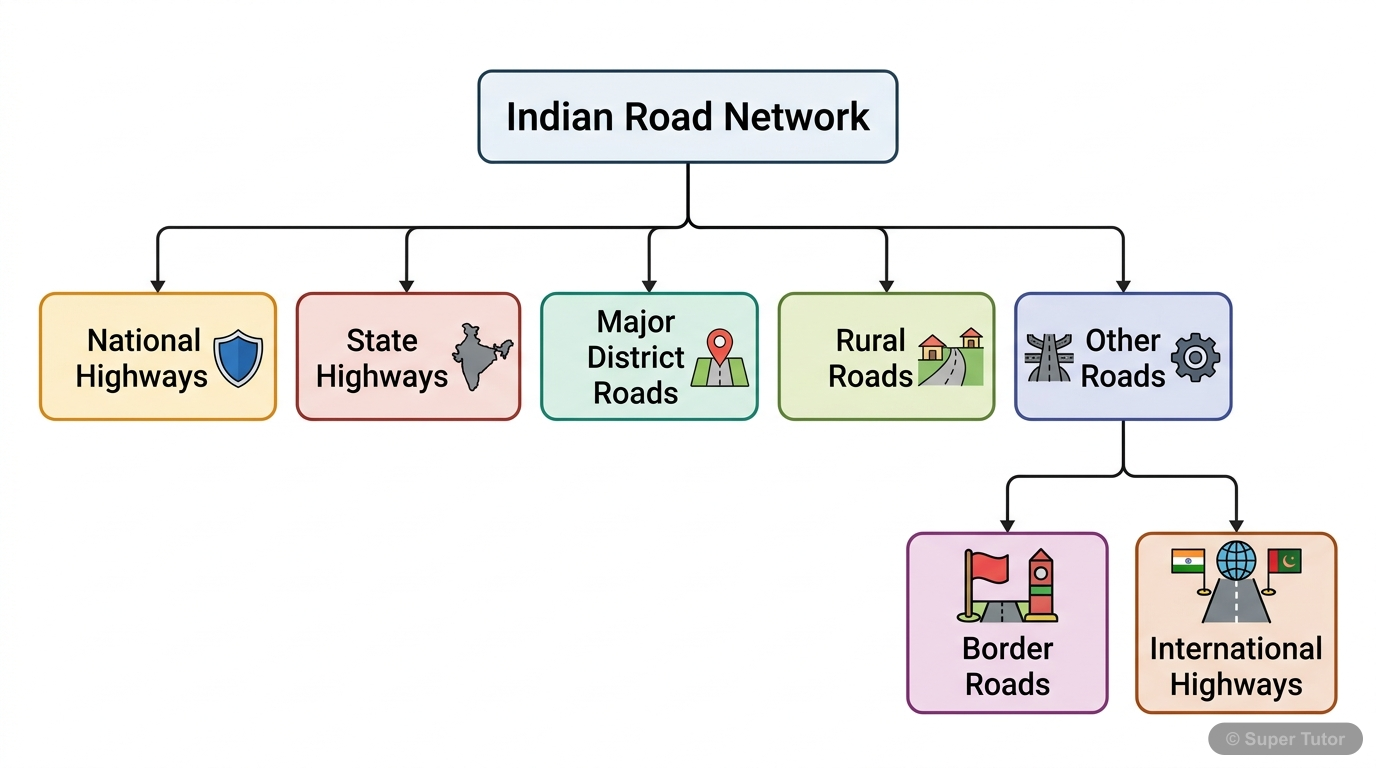
This is just one of 12+ visuals inside Super Tutor's Lifelines of National Economy chapter
Explore the full setExercise 1: Multiple Choice Questions
1(i)Which two of the following extreme locations are connected by the east-west corridor?
(a) Mumbai and Nagpur
(b) Silchar and Porbandar
(c) Mumbai and Kolkata
(d) Nagpur and SiligudiShow solution
Justification: The East-West Corridor is part of the Golden Quadrilateral Super Highway project. It connects Silchar (in Assam, extreme east) to Porbandar (in Gujarat, extreme west), covering a distance of about 3,640 km.
1(ii)Which mode of transportation reduces trans-shipment losses and delays?
(a) Railways
(b) Roadways
(c) Pipeline
(d) WaterwaysShow solution
Justification: Pipelines are used to transport liquids, gases, and even slurry (solids mixed with water) directly from source to destination without any intermediate loading/unloading (trans-shipment). This eliminates losses and delays caused by handling at multiple points.
1(iii)Which one of the following states is not connected with the H.V.J. pipeline?
(a) Madhya Pradesh
(b) Maharashtra
(c) Gujarat
(d) Uttar PradeshShow solution
Justification: The Hazira–Vijaipur–Jagdishpur (HVJ) pipeline passes through Gujarat, Madhya Pradesh, and Uttar Pradesh. Maharashtra is not connected with this pipeline network.
1(iv)Which one of the following ports is the deepest land-locked and well-protected port along the east coast?
(a) Chennai
(b) Paradwip
(c) V.O. Chidambaranar (Tuticorin)
(d) VishakhapatnamShow solution
Justification: Vishakhapatnam (Visakhapatnam) is the deepest land-locked and well-protected port on the east coast of India. It is located in Andhra Pradesh and handles a large volume of cargo including iron ore exports.
1(v)Which one of the following is the most important mode of transportation in India?
(a) Pipeline
(b) Railways
(c) Roadways
(d) AirwaysShow solution
Justification: Roadways constitute the most important mode of transportation in India. India has one of the largest road networks in the world (~63 lakh km). Roads carry about 85% of passenger traffic and 70% of freight traffic, making them the dominant mode of transport.
1(vi)Which one of the following terms is used to describe trade between two or more countries?
(a) Internal trade
(b) International trade
(c) External trade
(d) Local tradeShow solution
Justification: Trade that takes place between two or more countries is called International trade. It involves the exchange of goods and services across national boundaries and is also referred to as foreign trade.
Exercise 2: Short Answer Questions (about 30 words)
2(i)State any three merits of roadways.Show solution
1. Door-to-door service: Roads provide the advantage of door-to-door delivery of goods and passengers, which is not possible with railways or airways.
2. Construction in difficult terrain: Roads can be constructed in hilly, mountainous, and remote areas where laying railway lines is difficult and expensive.
3. Economical for short distances: Transporting goods and passengers over short distances is cheaper and more convenient by road than by any other mode of transport.
2(ii)Where and why is rail transport the most convenient means of transportation?Show solution
- The vast level land makes construction of railway lines easy and economical.
- The high density of population and large volume of agricultural produce and goods require bulk transport over long distances.
- The extensive plain area allows a dense network of railway lines to be laid easily.
2(iii)What is the significance of the border roads?Show solution
- They have improved accessibility in remote and strategically important areas near international borders (e.g., in the Himalayas and North-East India).
- They are vital for the movement of defence personnel and military equipment to border areas.
- They have promoted economic development and integration of border regions with the rest of the country by connecting previously isolated areas.
2(iv)What is meant by trade? What is the difference between international and local trade?Show solution
Difference between International and Local Trade:
| Basis | International Trade | Local Trade |
|---|---|---|
| Scope | Takes place between two or more countries | Takes place within a city, town, or village |
| Currency | Involves foreign exchange | Conducted in domestic currency |
| Example | India exporting software to the USA | Buying vegetables in a local market |
Local trade is conducted within a limited area, while international trade crosses national boundaries.
Exercise 3: Long Answer Questions (about 120 words)
3(i)Why are the means of transportation and communication called the lifelines of a nation and its economy?Show solution
Answer:
Means of transportation and communication are called the lifelines of a nation and its economy because of the following reasons:
1. Movement of goods and people: Transportation networks (roads, railways, airways, waterways) carry raw materials from production centres to factories and finished goods from factories to markets. Without this, economic activity would come to a standstill.
2. Integration of markets: They link different regions of the country, integrating local, regional, and national markets. This ensures that goods produced in one part of the country are available in other parts.
3. Agricultural and industrial development: Farmers can sell their produce in distant markets, and industries can obtain raw materials from far-off places, boosting both agricultural and industrial growth.
4. Employment generation: The transport and communication sector itself provides employment to millions of people.
5. National unity and security: Roads and railways connect remote border areas with the mainland, strengthening national integration and enabling quick movement of defence forces.
6. Communication networks (telephone, internet, postal services) facilitate the exchange of information, enabling trade, governance, and social interaction.
Thus, just as blood vessels are lifelines of the human body, transportation and communication networks are the lifelines of a nation and its economy.
3(ii)Write a note on the changing nature of the international trade in the last fifteen years.Show solution
Answer:
International trade refers to the exchange of goods and services between countries. The nature of India's international trade has changed significantly in recent years:
1. Shift from raw materials to manufactured goods: Earlier, India mainly exported raw materials and agricultural products. Now, India exports a large variety of manufactured goods, engineering products, software, and services.
2. Growth of service sector exports: India has emerged as a major exporter of IT services, business process outsourcing (BPO), and software. This has transformed the composition of exports.
3. Diversification of trading partners: India's trade is no longer limited to a few countries. It now trades with a large number of countries across Asia, Europe, America, and Africa.
4. Increase in volume: The total volume of India's international trade has grown enormously due to liberalisation and globalisation policies adopted since 1991.
5. Rise of sea ports and airports: Modern ports like Jawaharlal Nehru Port (Mumbai) and airports have been developed to handle the increased volume of international trade.
6. Trade balance: India imports more than it exports in goods (trade deficit), but earns significantly through service exports and remittances.
Thus, international trade has become more diversified, technology-driven, and larger in volume, playing a crucial role in India's economic growth.
Quiz Drive
1Northern terminal of the North-South corridor.Show solution
2The headquarter of the southern railway zone.Show solution
3The rail gauge with a track width of 1.676 m.Show solution
4A Riverine Port.Show solution
5Busiest railway junction in Northern India.Show solution
Stuck on a step?
Ask Super Tutor AI to explain any solution on this page in a simpler way — free, 24x7.
Ask a Doubt FreeFrequently Asked Questions
What are the important topics in Lifelines of National Economy for Meghalaya Board Class 10 Social Science?
How to score full marks in Lifelines of National Economy — Meghalaya Board Class 10 Social Science?
Where can I get free NCERT Solutions for Lifelines of National Economy Class 10 Social Science?
Sources & Official References
Content is aligned to the official syllabus. Refer to the board website for the latest curriculum.
More resources for Lifelines of National Economy
Important Questions
Practice with board exam-style questions
Syllabus
What topics to cover
Revision Notes
Key points for last-minute revision
Study Plan
Step-by-step plan to ace this chapter
Flashcards
Quick-fire cards for active recall
Formula Sheet
All formulas in one place
Chapter Summary
Understand the chapter at a glance
Practice Quiz
Test yourself with a quick quiz
Concept Maps
See how topics connect visually
For serious students
Get the full Lifelines of National Economy chapter — for free.
Quizzes, flashcards, AI doubt-solver and a step-by-step study plan for Meghalaya Board Class 10 Social Science.