Theory of Consumer Behavior — Study Plan
Meghalaya Board · Class 12 · Economics
A step-by-step study plan for Theory of Consumer Behavior, Meghalaya Board Class 12 Economics: what to learn first, what to practise and when to revise.
Interactive on Super Tutor
Studying Theory of Consumer Behavior? Get the full interactive chapter.
Quizzes, flashcards, AI doubt-solver and a step-by-step study plan — built for study plan and more.
Free trial, no card needed.
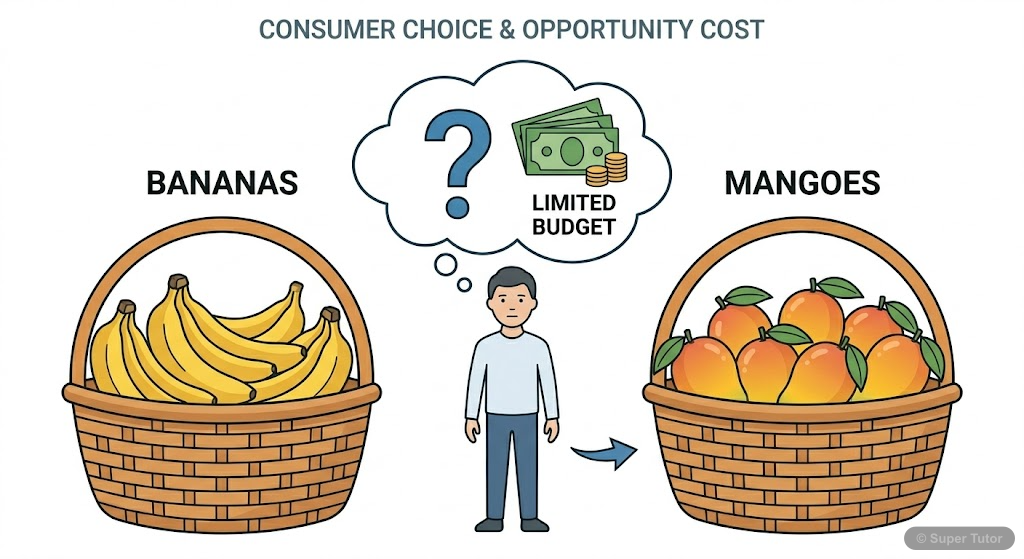
Learn better with visuals Super Tutor pairs illustrations like this with notes and quizzes for Theory of Consumer Behavior.
Study Plan
Learn the Theory
Read the textbook chapter carefully. Note down definitions, formulas and key ideas. Focus on: 1. Utility, Cardinal Utility Analysis, and Marginal Utility, 2. Ordinal Utility Analysis, Indifference Curve, and MRS, 3. Budget Set, Budget Line, and Consumer’s Optimum.
Practise
Solve the textbook exercises and extra practice questions. There are 46 questions available for this chapter.
Revise & Test
Revise key points without looking at your notes. Take a practice quiz and mark weak areas for another pass.
Spaced Revision
Come back to Theory of Consumer Behavior after a week. Use flashcards for quick recall and try past exam questions on this chapter.
What to Focus On
- Utility means want-satisfying capacity.
- Cardinal utility uses numbers to measure utility.
- TU is total satisfaction from a quantity consumed.
- Ordinal utility ranks bundles instead of measuring utility numerically.
- An indifference curve shows bundles giving equal satisfaction.
- Indifference curves slope downward because more of one good requires less of the other to keep satisfaction constant.
- Budget constraint: p1x1 + p2x2 ≤ M.
- Budget set includes all affordable bundles.
- Budget line: p1x1 + p2x2 = M.
Common Mistakes to Avoid
Utility is the same for everyone and can be measured exactly in numbers in real life.
Marginal utility is the total utility from one unit, so MU and TU mean the same thing.
Marginal utility always falls, so total utility must also fall from the very beginning.
Memory Tips
Utility as want-satisfying capacity
Cardinal utility analysis
Ordinal utility analysis
Total utility and marginal utility relationship
Want a personalised study plan?
Super Tutor builds a day-by-day plan for Meghalaya Board Class 12 Economics that fits your exam date and pace.
Create My Study PlanFrequently Asked Questions
What are the important topics in Theory of Consumer Behavior for Meghalaya Board Class 12 Economics?
How should I revise Theory of Consumer Behavior for the Meghalaya Board Class 12 board exam?
Sources & Official References
Content is aligned to the official syllabus. Refer to the board website for the latest curriculum.
More resources for Theory of Consumer Behavior
Practice Quiz
Test yourself with a quick quiz
Important Questions
Exam-style questions with answers
Revision Notes
Key points for last-minute revision
Formula Sheet
The chapter's formulas in one place
Chapter Summary
Understand the chapter at a glance
Concept Maps
See how topics connect
Flashcards
Quick-fire cards for active recall
Syllabus
What topics to cover
NCERT Solutions
Every textbook question solved step by step
For serious students
Get the full Theory of Consumer Behavior chapter — start free.
Quizzes, flashcards, an AI doubt solver and a study plan for Meghalaya Board Class 12 Economics. Free to start, no card needed.