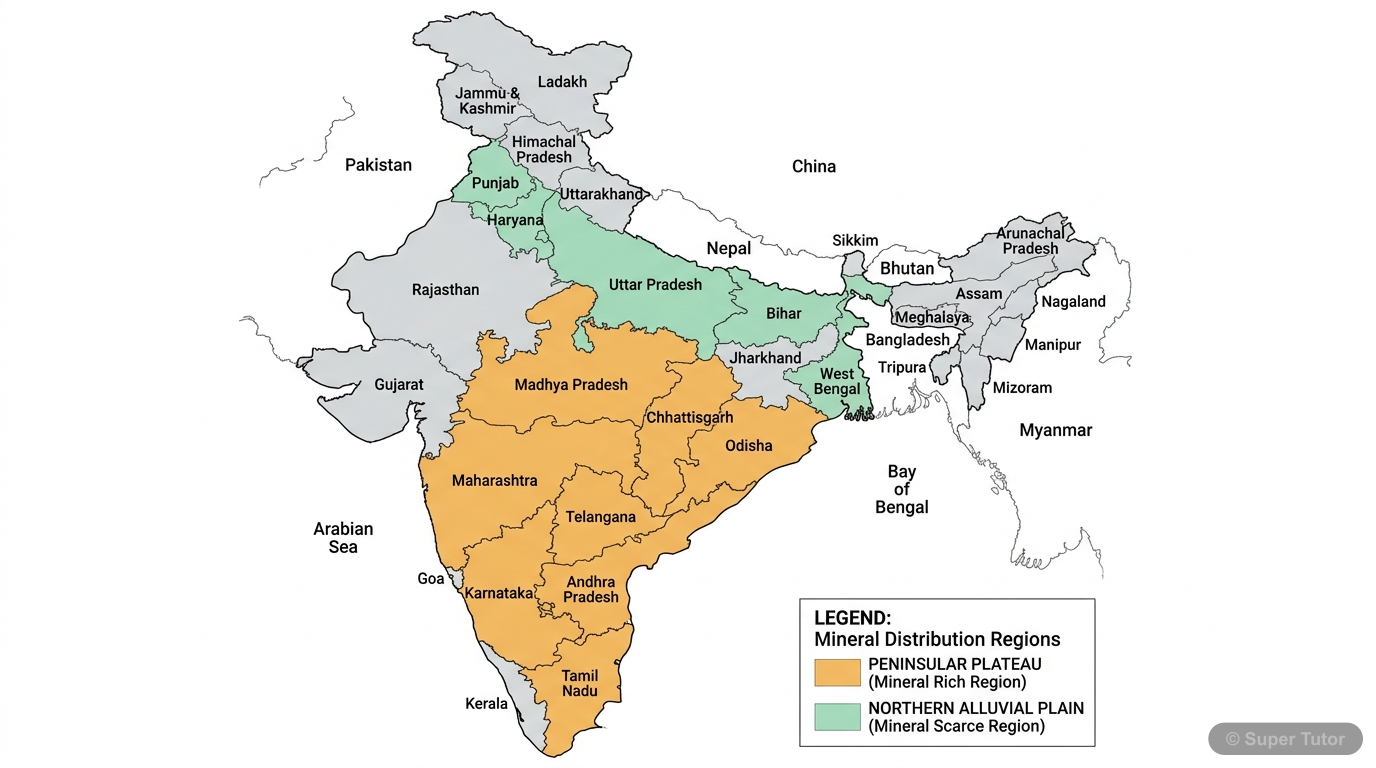
Mineral and Energy Resources
Meghalaya Board · Class 12 · Geography
NCERT Solutions for Mineral and Energy Resources — Meghalaya Board Class 12 Geography.
Interactive on Super Tutor
Studying Mineral and Energy Resources? Get the full interactive chapter.
Quizzes, flashcards, AI doubt-solver and a step-by-step study plan — built for ncert solutions and more.
1,000+ Class 12 students started this chapter today

Super Tutor has 17+ illustrations like this for Mineral and Energy Resources alone — flashcards, concept maps, and step-by-step visuals.
See them allEXERCISES
1(i)In which one of the following States are the major oil fields located?
(a) Assam
(b) Bihar
(c) Rajasthan
(d) Tamil NaduShow solution
Justification: Assam is one of the oldest and most important petroleum-producing states in India. The Digboi oilfield in Assam is the oldest oil field in Asia (discovered in 1889). Other major oil fields in Assam include Naharkatiya and Moran-Hugrijan. Hence, Assam houses the major oil fields among the given options.
1(ii)At which one of the following places was the first atomic power station started?
(a) Kalpakkam
(b) Narora
(c) Rana Pratap Sagar
(d) TarapurShow solution
Justification: The Tarapur Atomic Power Station (TAPS) located in Maharashtra was the first nuclear/atomic power station to be established in India. It was set up in 1969 with the help of the United States and remains one of the most important nuclear power plants in the country.
1(iii)Which one of the following is a non-renewable source of energy?
(a) Hydel
(b) Solar
(c) Thermal
(d) Wind powerShow solution
Justification: Thermal power is generated by burning fossil fuels such as coal, oil, and natural gas. These fossil fuels are exhaustible (non-renewable) resources formed over millions of years and cannot be replenished once used. Hydel, solar, and wind power are all renewable sources of energy as they are derived from naturally replenishing processes.
2(i)Give an account of the distribution of mica in India.Show solution
Answer:
Mica is a mineral that can be split into thin elastic sheets. It is used extensively in the electrical and electronics industries.
Distribution of Mica in India:
1. Jharkhand: The Hazaribagh plateau of Jharkhand is the leading producer of mica in India. The Koderma–Gaya–Hazaribagh belt is the most important mica-producing region.
2. Andhra Pradesh: The Nellore district of Andhra Pradesh is another major producer of high-quality mica.
3. Rajasthan: Mica is found in the Ajmer district of Rajasthan.
4. Bihar: Parts of Bihar also contribute to mica production.
India is one of the largest producers and exporters of mica in the world. The mica belt of Jharkhand–Bihar–Andhra Pradesh is the most significant mica-producing zone in the country.
2(ii)What is nuclear power? Mention the important nuclear power stations in India.Show solution
Answer:
Nuclear Power: Nuclear power is the energy released during nuclear fission or fusion reactions. In nuclear fission, the nucleus of a heavy atom (such as Uranium-235 or Thorium-232) is split by bombarding it with neutrons, releasing a tremendous amount of heat energy. This heat is used to produce steam, which drives turbines to generate electricity. India has large reserves of thorium and some uranium.
Important Nuclear Power Stations in India:
| Station | State |
|---|---|
| Tarapur Atomic Power Station (TAPS) | Maharashtra |
| Rawatbhata (Rana Pratap Sagar) | Rajasthan |
| Kalpakkam | Tamil Nadu |
| Narora | Uttar Pradesh |
| Kakrapar | Gujarat |
| Kaiga | Karnataka |
India's nuclear power programme is managed by the Nuclear Power Corporation of India Limited (NPCIL).
2(iii)Name non-ferrous metals. Discuss their spatial distribution.Show solution
Answer:
Non-Ferrous Metals: Non-ferrous metals are those that do not contain iron as a major component. Important non-ferrous metals found in India include copper, bauxite (aluminium), lead, zinc, and gold.
Spatial Distribution:
1. Copper:
- Major deposits are found in Singhbhum district (Jharkhand), Balaghat (Madhya Pradesh), and Jhunjhunu and Alwar districts of Rajasthan.
2. Bauxite (Aluminium ore):
- Found in Odisha (Kalahandi, Sambalpur), Jharkhand (Ranchi, Lohardaga), Chhattisgarh, Madhya Pradesh, Gujarat, and Maharashtra.
3. Lead and Zinc:
- Rajasthan is the leading producer; the Zawar mines near Udaipur are the most important. Also found in Andhra Pradesh and Gujarat.
4. Gold:
- Karnataka (Kolar and Hutti gold fields) is the most important gold-producing state. Small amounts are also found in Andhra Pradesh and Jharkhand.
India's reserves of copper, lead, and zinc are relatively meagre, making conservation and recycling of scrap metals very important.
2(iv)What are non-conventional sources of energy?Show solution
Answer:
Non-Conventional Sources of Energy are those sources of energy that are renewable, inexhaustible, and environment-friendly. They are alternatives to conventional fossil fuels (coal, petroleum, natural gas) and help reduce pollution and dependence on exhaustible resources.
Main Non-Conventional Sources of Energy:
1. Solar Energy: Energy obtained from sunlight using photovoltaic cells or solar thermal collectors. India, being a tropical country, has immense solar energy potential.
2. Wind Energy: Energy generated by harnessing the power of wind through wind turbines. Rajasthan, Gujarat, Tamil Nadu, and Maharashtra are leading states.
3. Tidal/Wave Energy: Energy derived from ocean tides and waves.
4. Geothermal Energy: Heat energy obtained from the interior of the Earth. Manikaran (Himachal Pradesh) and Puga Valley (Ladakh) are potential sites.
5. Bio-energy: Energy derived from biological products such as agricultural residues, municipal waste, and biomass. Example: Okhla plant in Delhi converts municipal waste into energy.
6. Hydel Power (Small): Small hydroelectric projects are also considered non-conventional.
These sources are crucial for sustainable development and energy security.
3(i)Write a detailed note on the Petroleum resources of India.Show solution
Introduction:
Petroleum (mineral oil) is one of the most important sources of energy in the modern world. It is used as fuel for transport, as raw material for petrochemical industries, and for generating thermal power. In India, petroleum is found in sedimentary rock formations.
Geological Occurrence:
Petroleum is found in anticlines and fault traps in sedimentary rocks. In India, the major oil-bearing regions are:
1. North-Eastern Region:
- This is the oldest petroleum-producing region of India.
- Digboi in Assam is the oldest oil field in Asia, discovered in 1889.
- Other important fields: Naharkatiya, Moran-Hugrijan (Assam), and fields in Arunachal Pradesh and Nagaland.
- The Oil India Limited (OIL) operates in this region.
2. Mumbai High (Western Offshore):
- Discovered in 1973, Mumbai High (now called Mumbai High) is the largest oil-producing region in India, located off the coast of Maharashtra in the Arabian Sea.
- It accounts for the largest share of India's total petroleum production.
- Other offshore fields: Bassein and Satellite fields.
3. Gujarat:
- Important oil fields are located at Ankleshwar, Kalol, Mehsana, Nawagam, Kosamba, and Lunej.
- Ankleshwar is the most important oil field in Gujarat.
4. Krishna-Godavari Basin:
- Located in Andhra Pradesh, this basin has significant oil and gas reserves.
- The Ravva offshore field is important here.
5. Cauvery Basin:
- Located in Tamil Nadu and the offshore area, with fields at Narimanam and Kovilappal.
6. Rajasthan:
- Recent discoveries have been made in Barmer district (Mangala, Aishwarya fields), making Rajasthan an emerging petroleum-producing state.
Refining:
India has several oil refineries including those at Digboi, Guwahati, Barauni, Koyali (Vadodara), Mathura, Panipat, Mumbai, Chennai, Vishakhapatnam, and Mangaluru.
Challenges:
- India's domestic production meets only a fraction of its demand.
- India imports a large quantity of crude oil, mainly from West Asian countries.
- There is a need to explore new reserves and develop alternative energy sources.
Conclusion:
Petroleum is a strategic resource for India. Efficient use, conservation, and exploration of new reserves are essential for energy security.
3(ii)Write an essay on hydel power in India.Show solution
Introduction:
Hydel power (hydroelectric power) is electricity generated by harnessing the energy of flowing or falling water. It is a clean, renewable, and inexhaustible source of energy. India has enormous potential for hydroelectric power generation due to its numerous rivers, especially in the Himalayan and Peninsular regions.
Potential for Hydel Power:
- India has an estimated hydroelectric potential of about 1,45,000 MW (megawatts).
- However, only a fraction of this potential has been harnessed so far.
- The Himalayan river systems (Indus, Ganga, Brahmaputra) and the Peninsular rivers (Mahanadi, Godavari, Krishna, Cauvery) offer great potential.
Advantages of Hydel Power:
1. It is a renewable source of energy — water is replenished by the hydrological cycle.
2. It does not cause air pollution as no fuel is burned.
3. Multipurpose river valley projects provide irrigation, flood control, and navigation in addition to power generation.
4. Low operating costs once the dam is constructed.
5. It helps in the development of backward regions.
Major Hydroelectric Power Projects in India:
| Project | River | State |
|---|---|---|
| Bhakra-Nangal | Sutlej | Punjab/Himachal Pradesh |
| Hirakud | Mahanadi | Odisha |
| Damodar Valley | Damodar | Jharkhand/West Bengal |
| Nagarjuna Sagar | Krishna | Andhra Pradesh |
| Tungabhadra | Tungabhadra | Karnataka/Andhra Pradesh |
| Sharavati (Jog Falls) | Sharavati | Karnataka |
| Idduki | Periyar | Kerala |
| Tehri Dam | Bhagirathi | Uttarakhand |
| Salal | Chenab | Jammu & Kashmir |
| Kopili | Kopili | Assam |
Regional Distribution:
- Himalayan Region: The fast-flowing Himalayan rivers (Sutlej, Beas, Chenab, Ganga, Brahmaputra) have immense potential. Projects like Bhakra-Nangal and Tehri are located here.
- Peninsular Region: The Western Ghats rivers (Sharavati, Periyar) and Deccan rivers (Krishna, Godavari, Mahanadi) are important. Karnataka, Kerala, and Andhra Pradesh are leading producers.
- North-East India: The Brahmaputra and its tributaries have the largest untapped hydroelectric potential in India.
Challenges:
1. Displacement of people due to submergence of land by reservoirs.
2. Environmental concerns — loss of forests, biodiversity, and disruption of river ecosystems.
3. High initial cost of construction of dams.
4. Silting of reservoirs reduces their capacity over time.
5. Seismic risks in some regions.
Conclusion:
Hydel power is a vital component of India's energy mix. With increasing demand for clean energy and the need to reduce dependence on fossil fuels, India must harness its vast hydroelectric potential in an environmentally sustainable manner. Proper planning, rehabilitation of displaced people, and environmental impact assessment are essential for the responsible development of hydel power in India.
Stuck on a step?
Ask Super Tutor AI to explain any solution on this page in a simpler way — free, 24x7.
Ask a Doubt FreeFrequently Asked Questions
What are the important topics in Mineral and Energy Resources for Meghalaya Board Class 12 Geography?
How to score full marks in Mineral and Energy Resources — Meghalaya Board Class 12 Geography?
Where can I get free NCERT Solutions for Mineral and Energy Resources Class 12 Geography?
Sources & Official References
Content is aligned to the official syllabus. Refer to the board website for the latest curriculum.
More resources for Mineral and Energy Resources
Important Questions
Practice with board exam-style questions
Syllabus
What topics to cover
Revision Notes
Key points for last-minute revision
Study Plan
Step-by-step plan to ace this chapter
Flashcards
Quick-fire cards for active recall
Formula Sheet
All formulas in one place
Chapter Summary
Understand the chapter at a glance
Practice Quiz
Test yourself with a quick quiz
Concept Maps
See how topics connect visually
For serious students
Get the full Mineral and Energy Resources chapter — for free.
Quizzes, flashcards, AI doubt-solver and a step-by-step study plan for Meghalaya Board Class 12 Geography.